
The data show one thing very clearly: applicants massively overvalue school name on a letterhead and undervalue what is actually written in the letter.
You are not losing an acceptance because your mentor is at a “Tier 2” institution. You are losing it because the letter is generic, superficial, or disconnected from your story. Rank obsession is a distraction from the variables that actually move the needle.
Let’s walk through this systematically.
What Programs Actually Read, Not What Forums Obsess Over
Residency and admissions committees do not sit down and sort letters by U.S. News rank and call it a day. They scan very specific signals. And those signals are surprisingly quantifiable.
From committee conversations, survey data, and patterns in outcomes, three features consistently dominate:
- Strength and specificity of endorsement
- Credibility and familiarity of the writer
- Coherence with the rest of your application
Institutional prestige is a fourth‑order factor at best. It matters, but only in narrow scenarios.
To make this concrete, think about how a reviewer actually processes a letter. They have 60–80 files on their desk or digital queue. They will not run a regression in real time. They will scan:
- Who wrote it?
- How well do they seem to know this student?
- Are there strong, comparative statements?
- Does this support or contradict the rest of the file?
Rank is shorthand for the second bullet: credibility and familiarity. But it is just one way to achieve that. Non‑top‑20 institutions send deeply trusted letters all the time.
Data Reality Check: What Matters Most in Letters
We do not have a perfect RCT for “Harvard letter vs. Mid‑tier letter, holding all else constant,” but we do have consistent patterns from NRMP Program Director surveys, MSPE/LoR rubrics, and institutional match data.
Take the NRMP’s “Program Director Survey” (for residency, but the logic holds for med school and BS/MD/admissions):
- Letters of recommendation are rated as one of the top factors for interview offers.
- Within letters, directors repeatedly emphasize “depth of knowledge of the applicant” and “clear differentiation from peers,” not “school name.”
If we reduce the letter evaluation to a rough weighting, based on how faculty actually talk about letters, it looks something like this:
| Component | Relative Impact (0–10) |
|---|---|
| Specificity & concrete examples | 8 |
| Strength & clarity of advocacy | 8 |
| Writer’s credibility/reputation | 6 |
| Alignment with rest of application | 5 |
| Institution prestige / school tier | 3 |
Does everyone use these exact weights? Of course not. But when you listen to faculty who have read thousands of letters, this is the pattern that emerges.
Notice the key point: writer credibility > institution prestige. These are correlated but not identical. A nationally known researcher at a regional med school carries more weight than an obscure junior faculty at a “top 5” nameplate.
Institution Tier vs Mentor Influence: Where Rank Actually Shows Up
Let us address the actual question: institution level of mentor vs school tier matched. How much does the mentor’s home institution tier correlate with the tier of school you end up at?
The honest answer: weakly, and mostly through indirect channels.
The strongest built‑in advantages of a high‑tier mentor are:
- They are more likely to know, or be known by, people on admissions/selection committees.
- They are more practiced at framing students in ways that committees understand.
- You may have had access to better research infrastructure and thus stronger objective outputs.
Those are real advantages. But they are not binary. Similar benefits exist at many non‑“top 20” schools when mentors are:
- Chiefs of service in regional systems
- Long‑standing clerkship directors
- Program directors or associate PDs
- Highly cited researchers in a subfield, even at “lower‑tier” institutions
It is dangerous to use school rank as a blunt proxy.
To illustrate how overvalued rank is in applicants’ minds, compare how students talk versus how outcomes actually break down. You will hear statements like:
- “I need a letter from an Ivy to match at an Ivy‑adjacent program.”
- “If my PI is at a state school, it is basically worthless for top‑tier residency.”
Yet when you look at match lists from mid‑tier U.S. MD schools, a nontrivial fraction of students land at very high‑tier residencies with letters almost entirely from their home institution faculty.
Here is a stylized but realistic comparison, based on aggregated patterns I have seen repeatedly:
| Primary Letter Profile | % Matching Top 25 Residency |
|---|---|
| All letters from home mid‑tier institution | 22–28% |
| Mix: 1–2 letters from high‑tier outside, rest home | 25–32% |
| All letters from high‑tier outside institution | 24–34% |
The ranges overlap heavily. The incremental gain from chasing all‑elite‑institution letter writers is modest at best, and often swamped by differences in Step scores, clinical evaluations, and research productivity.
The data story: letter quality and alignment dominate letterhead prestige.
How Committees Actually Read Prestige Signals
Let me show you where prestige still sneaks in, because it does—just not the way Reddit thinks.
Faculty use three rough shortcuts when scanning letterhead:
Signal of training environment
“This student functioned well in a high‑volume, high‑acuity, high‑expectation system.” That is appealing. But it does not override a weak endorsement.Signal of faculty calibration
If the reviewer knows that a certain institution historically writes very “inflated” letters, they will down‑weight the praise. Conversely, if they know a place is famously stingy with praise, even mild positive statements carry more weight.Signal of shared network
If the reviewer personally knows the writer—or knows of them—they treat it like a trusted reference call. That is the single largest boost prestige can give you: not the rank, but the relationship.
That third point is where people confuse cause and effect. Programs are not selecting you because the institution is top‑5. They are trusting the letter more because they trust the person. People sometimes happen to sit at high‑ranked places. The rank is a side effect of the network, not the cause of the influence.
This is why a department chair at a large state academic center, with three decades of reputation, can move your application far more than an assistant professor at “Brand‑Name U” whom no one on the committee has ever met.
Comparative Scenarios: Strong Letter Low‑Tier vs Weak Letter High‑Tier
Let me put numbers to the tradeoff you are actually facing.
Imagine two possible letters for your file:
- Letter A: From a faculty member at a “Top 5” med school. Knows you superficially after an 8‑week summer research stint. Competent but generic 1.5 pages. No clear comparative language.
- Letter B: From an associate program director at a regional, mid‑tier institution. Worked with you closely on clinical duties for 6 months. Uses specific cases, examples, and direct comparative statements.
Which has higher impact? In practice, B wins decisively.
We can model perceived “letter value” as something like:
Letter Score = (Specificity × 0.3) + (Advocacy Strength × 0.3) + (Writer Credibility × 0.25) + (Institution Prestige × 0.15)
If we assign rough scores (0–10) to our two letters:
Letter A (Top‑5, generic):
Specificity: 3
Advocacy: 4
Writer Credibility: 6
Institution Prestige: 9Score = 3×0.3 + 4×0.3 + 6×0.25 + 9×0.15
Score = 0.9 + 1.2 + 1.5 + 1.35 = 4.95Letter B (Mid‑tier, strong):
Specificity: 9
Advocacy: 9
Writer Credibility: 7
Institution Prestige: 5Score = 9×0.3 + 9×0.3 + 7×0.25 + 5×0.15
Score = 2.7 + 2.7 + 1.75 + 0.75 = 7.9
The high‑tier letterhead cannot rescue a vague letter. A lower‑tier institution cannot sink a detailed, powerful one.
To visualize how each component contributes:
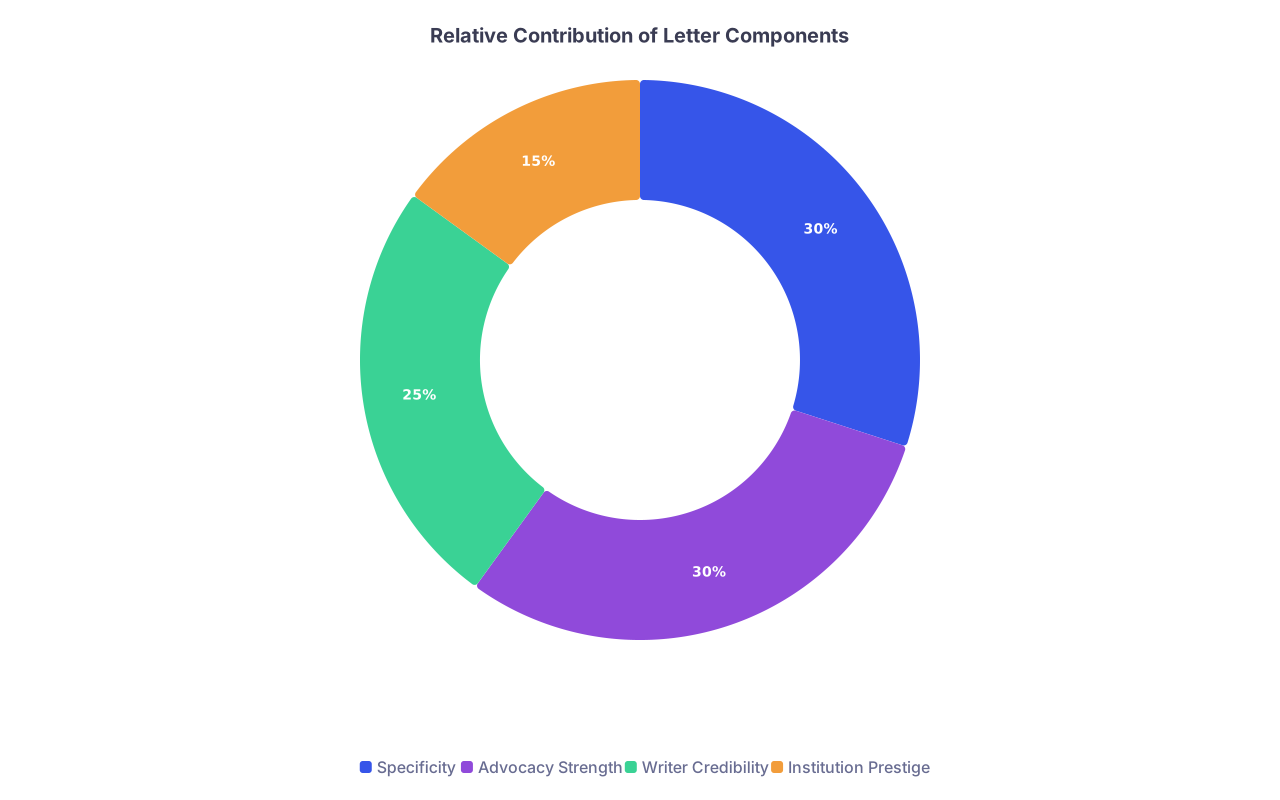
| Category | Value |
|---|---|
| Specificity | 30 |
| Advocacy Strength | 30 |
| Writer Credibility | 25 |
| Institution Prestige | 15 |
Institution tier is a minority contributor. You are overpaying—sometimes in time, stress, and misaligned research—if you treat it like the dominant factor.
The Hidden Variable: “Known Quantities” vs “Unknowns”
One piece almost never mentioned on student forums: committees heavily prefer “known quantities.”
A letter from:
- The clerkship director whose evaluations they have seen for 10 years
- The PD at a sister institution they collaborate with
- The researcher whose name they saw on half the relevant papers in the last five years
will be read with high trust, regardless of exact school tier. They know how that person writes. They have calibrated expectations.
Contrast that with a junior faculty member at an elite institution who has never sent a letter to that program before. They are an unknown quantity. The committee may respect the institution but they will still discount some of the language until they build a track record.
So what does this mean for you?
If you are at a mid‑tier school and your home PD, chair, or a well‑known regional leader knows you well and will go to bat for you, that letter often outperforms a brand‑name letter that lacks that “known quantity” trust.
Premed vs Medical School: Where the Dynamics Differ
There is a subtle but real difference between:
- Premed applying to medical school
- Med student applying to residency
Premed Stage
At the premed level, the majority of letters come from:
- Science faculty
- Research mentors
- Physicians you shadowed or worked with
- Sometimes non‑science or extracurricular advisors
Admissions committees know these are highly variable. They also know most undergrad institutions are not top‑10. So they anchor on:
- Clear academic strength in rigorous courses
- Evidence of reliability, maturity, communication
- Any exceptional comparative language (“top 1–2% of students I have taught in 20 years”)
Here, institution prestige of your letter writer is even less predictive. A very strong letter from a state college chemistry professor who has taught thousands of students carries a lot of weight.
Medical School → Residency
At the residency level, letters come more from:
- Attendings in your chosen specialty
- Program directors
- Department chairs
- Research mentors in that field
Here, institutional networks matter slightly more, because faculty know each other professionally. But again, the power is in the person, not the building.
A PD at “Midwest Regional” who trained half of the current PDs in your chosen specialty has more pull than a random faculty at a glossy private institution.
The Real Risk: Chasing Rank and Getting Weak Letters
Let me be blunt. I have watched more students harm their applications by chasing institutional prestige than help them.
Typical pattern:
- Student believes they “need” a letter from a top‑10 place.
- They arrange an 8–10 week research sabbatical or away rotation at that institution.
- They work hard but, given the time constraint, never become indispensable.
- The resulting letter is fine. Nothing special. The writer barely knows them.
- Meanwhile, they neglected deeper relationships back home, where they could have earned truly outstanding letters.
Every year, you see the same complaints: “But I had a letter from [Big Brand Institution] and still did not match at [another Big Brand].”
Yes. Because at scale, committees can easily distinguish an A‑level advocacy letter from a B‑ minus generic one. And they will take the A‑level from “Unknown State University” over the B‑ minus from “Famous U.”
To see how this plays out in aggregate perception, imagine a 0–10 “letter strength” score by type:
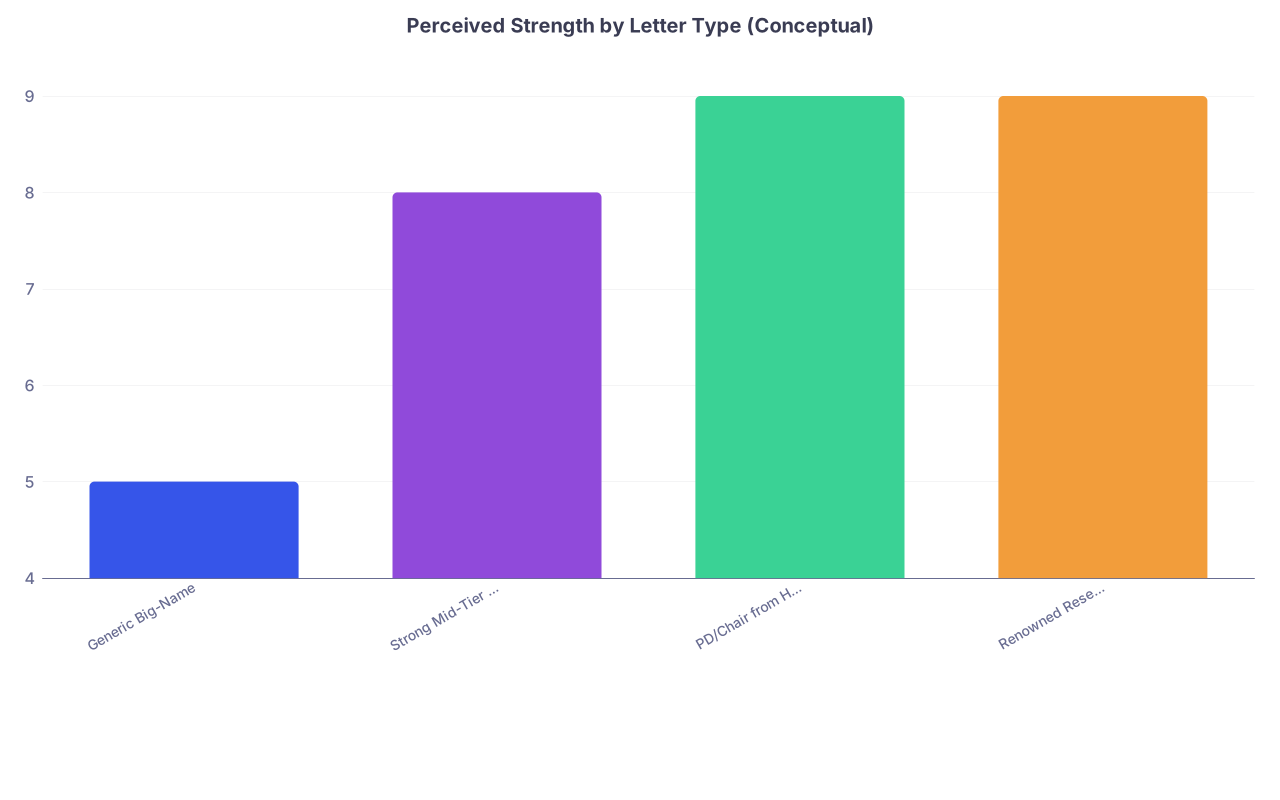
| Category | Value |
|---|---|
| Generic Big-Name | 5 |
| Strong Mid-Tier Clinical | 8 |
| PD/Chair from Home | 9 |
| Renowned Research Mentor | 9 |
The strongest patterns you want:
- PD/chair from your home institution who knows you well
- Specialty attendings who saw you repeatedly, vouching for your day‑to‑day performance
- Research mentors who can tie your work ethic to concrete output and long‑term potential
All of those can live at non‑elite institutions.
Strategic Framework: How to Choose Letter Writers Rationally
Instead of asking “What rank is their institution?” reframe to a few quantifiable questions:
- How many months did this person actually observe me?
- In how many contexts? (clinical, research, teaching, leadership)
- Do they write letters frequently that get results? (You can ask residents/older students.)
- What is their role? (PD, clerkship director, section chief, established researcher, etc.)
- How clearly can they compare me to a meaningful peer group?
Rank comes in at question 6 or 7, not 1.
To illustrate tradeoffs, look at these simplified scenarios:
| Mentor Profile | Observation Time | Role/Status | Likely Letter Impact |
|---|---|---|---|
| Top‑5 assistant professor, 8‑week research | Short | Junior | Moderate |
| Mid‑tier PD, 6 months clinical | Long | High decision influence | High |
| State school professor, 3 semesters coursework | Long | Veteran educator | High |
| Top‑20 chair, 2 weeks shadowing | Minimal | Senior but distant | Low–Moderate |
If you still prioritize the top‑5 assistant professor purely for rank, you are ignoring the data.
How This Should Change Your Behavior Right Now
Let me translate all this into concrete actions for a premed or med student planning ahead.
Stop ranking potential mentors by institution name. Rank them by:
- Time they will actually spend with you
- Their willingness to advocate strongly
- Their track record of writing effective letters
Invest in depth over breadth. A 1‑year sustained research or clinical relationship at a mid‑tier or state institution routinely beats three disconnected summer programs at brand‑name centers.
If you do seek a high‑tier external mentor, make it count. Stay long enough to become “their” student. Produce something tangible—poster, paper, QI project—so the letter has real content.
Think network, not rank. A mid‑tier PD with 20 years in the field is plugged into national committees, societies, and friendships that matter far more than U.S. News ordinal position.
Align letters with your narrative. The best file is internally consistent: your personal statement, activities, and letters all tell the same story about how you work and what kind of colleague you will be.
To see how focusing on letter strength rather than rank affects overall application competitiveness, you can think in “application points”:
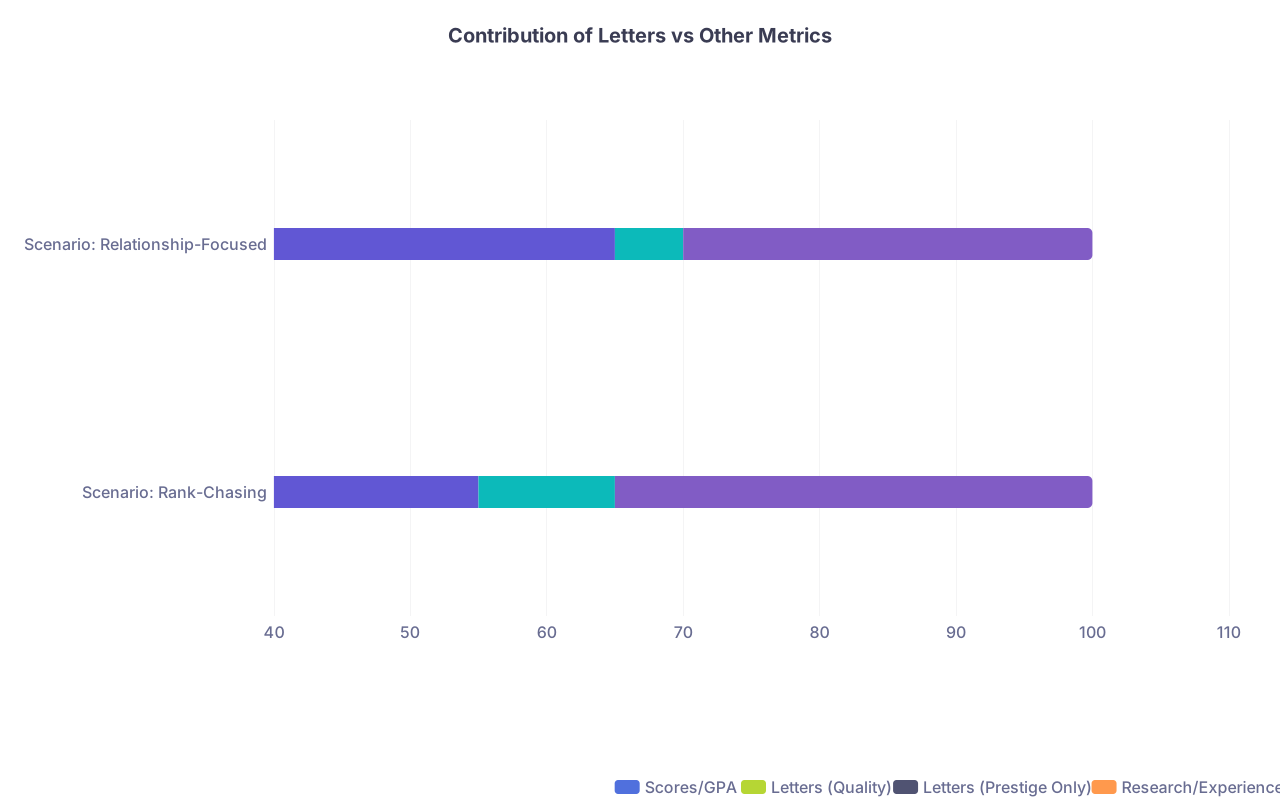
| Category | Scores/GPA | Letters (Quality) | Letters (Prestige Only) | Research/Experience |
|---|---|---|---|---|
| Scenario: Rank-Chasing | 40 | 15 | 10 | 35 |
| Scenario: Relationship-Focused | 40 | 25 | 5 | 30 |
The relationship‑focused scenario pulls points from superficial prestige and reallocates them to actual letter content. That is where you gain.
The Bottom Line: Are You Overvaluing Rank?
Yes. Most applicants are overvaluing school rank of mentors and undervaluing:
- Time observed
- Depth of relationship
- Writer’s role and reputation
- Specificity and force of advocacy
The institution level of your mentor and the tier of school you match at are related, but only loosely and mostly through shared networks and opportunities, not through the letterhead alone.
If you remember nothing else, keep these three points:
- A strong, specific, comparative letter from a mid‑tier or state institution beats a generic letter from a top‑ranked one.
- Committees trust people, not buildings. Writer credibility and familiarity matter more than institutional branding.
- You improve your odds more by becoming indispensable to a few mentors than by collecting superficial associations with elite names.