

It is 9:15 PM on a Tuesday. The general peds team has mostly signed out. The adult hospitalists are two floors up eating cold pizza in the workroom. You are still on the pediatric cardiology floor, finishing your third prior-auth of the evening, responding to two “quick questions” from residents, and editing the Specific Aims page of a K23 grant that is due in three weeks.
You are an academic pediatric subspecialty fellow. The work is complex, the patients are fascinating, your name is on abstracts from PAS and ASPHO and ATS. And your paycheck is—be honest—barely more than a well‑compensated pediatric nurse practitioner. You watch your med school classmates who went into anesthesia, derm, or ortho buying houses while you are half‑joking about whether your R01 can cover daycare.
Let me break this down specifically: academic pediatric subspecialties sit in a weird corner of medicine. High prestige in the ivory tower. Strong grant pipelines in some niches. Real scientific impact. And chronically low salaries compared with both adult subspecialists and non‑academic pediatricians.
This is not random. It is structural.
We are going to walk through:
- Which pediatric subspecialties sit at the bottom of the pay scale
- How “prestige” and NIH funding intersect with those fields
- What the typical academic career track looks like—and why the numbers so often hurt
- How to think about this as a resident trying to choose a path
1. The Big Picture: Why Pediatric Subspecialties Pay So Poorly
Academic pediatrics is structurally underpaid. Three blunt drivers:
- Kids generate less billable RVU per complex encounter than adults.
- Medicaid heavy payer mix. Reimbursement is worse, full stop.
- Academic time (research, teaching, QI) does not produce RVUs and is chronically undervalued.
So, if you mix:
- Low reimbursement (pediatrics)
- Lower relative RVU generation (subspecialty clinic, complex coordination, family meetings)
- Academic protection (20–70% non-clinical time)
You get some of the lowest salaries in U.S. physician practice.
To make this concrete, let’s compare starting academic salaries.
| Role | Typical Range (USD) |
|---|---|
| General Pediatric Hospitalist (academic) | 200k–240k |
| Academic Pediatric Endocrinology | 180k–220k |
| Academic Pediatric Infectious Disease | 180k–220k |
| Academic Pediatric Rheumatology | 185k–230k |
| Academic Pediatric Hem/Onc | 210k–260k |
| Academic Adult Cardiology | 400k–600k+ |
| Academic Adult GI | 400k–600k+ |
Numbers vary by region and institution, and some private children’s hospitals pay better. But the relative picture holds. Academic pediatric subspecialists commonly start under 250k, sometimes under 200k, even at major centers.
And they often trained:
- 3 years pediatrics residency
- 3 years fellowship
- Sometimes an extra research year or MPH/PhD along the way
Six or seven years post‑residency, then an assistant professor job that pays barely more than a mid‑career general pediatrician in community practice.
2. Prestige vs Pay: Which Academic Pediatric Subspecialties Are the Lowest Paid?
Let’s sort out the major pediatric subspecialties that sit in the low‑salary, high‑prestige corner. I am focusing on academic tracks at children’s hospitals tied to medical schools.
The Core “Low Pay – High Prestige” Pediatric Subspecialties
The notorious cluster:
- Pediatric Infectious Disease
- Pediatric Endocrinology
- Pediatric Rheumatology
- Pediatric Nephrology
- Pediatric Pulmonology (especially academic, research‑focused)
- Developmental-Behavioral Pediatrics
- Pediatric Genetics / Metabolism
These are generally among the lowest paid subspecialties in all of medicine. They share some traits:
- Long, complicated patients
- High cognitive load, low procedural billing
- Heavy outpatient and consult time, lots of care coordination
- Strong ties to academic centers, with many faculty taking on research or teaching roles
Let’s draw a rough comparison across a few key dimensions: pay, perceived academic prestige, and grant / basic science culture.
| Subspecialty | Relative Pay (Academic) | Academic Prestige | Strong Grant / Basic Science Culture |
|---|---|---|---|
| Ped Infectious Disease | Very Low | High | High |
| Ped Endocrinology | Very Low | Moderate | Moderate |
| Ped Rheumatology | Very Low | Moderate-High | Moderate |
| Ped Nephrology | Low | High | High |
| Ped Pulmonology | Low | High | High |
| Dev-Behavioral | Very Low | Moderate | Low-Moderate (more clinical/QI) |
| Ped Genetics/Metabolism | Very Low | High | High |
| Ped Hem/Onc | Moderate (for peds) | Very High | Very High |
Translation: The fields with real NIH footprint and strong academic branding are paradoxically some of the worst compensated.
You can be a globally recognized pediatric nephrologist and still earn less than your classmate doing outpatient anesthesia 2 miles away.
3. How Grants Fit In: Funding Streams, Not Paychecks
Residents see “NIH‑funded pediatric pulmonologist” and assume: ah, must be well‑compensated. No. Grants are not salary multipliers in the way non‑physicians sometimes think.
Here is how grant funding usually interacts with your paycheck in academic pediatrics:
Your base salary is set by:
- Your department’s pay scale (often linked to AAMC benchmarks)
- Your academic rank (assistant, associate, full)
- Your expected clinical % effort
Your FTE composition might be something like:
- 0.5 clinical
- 0.4 research (grant‑funded)
- 0.1 teaching/admin
Your NIH K‑ or R‑level grant pays part of your existing salary for the research effort, plus direct research costs. It does not magically double your income.
Occasionally, in very research‑intense departments, your grant‑funded effort can slightly push your salary above a pure-clinical peer. But often, it simply “buys down” your clinical time, not up your pay.
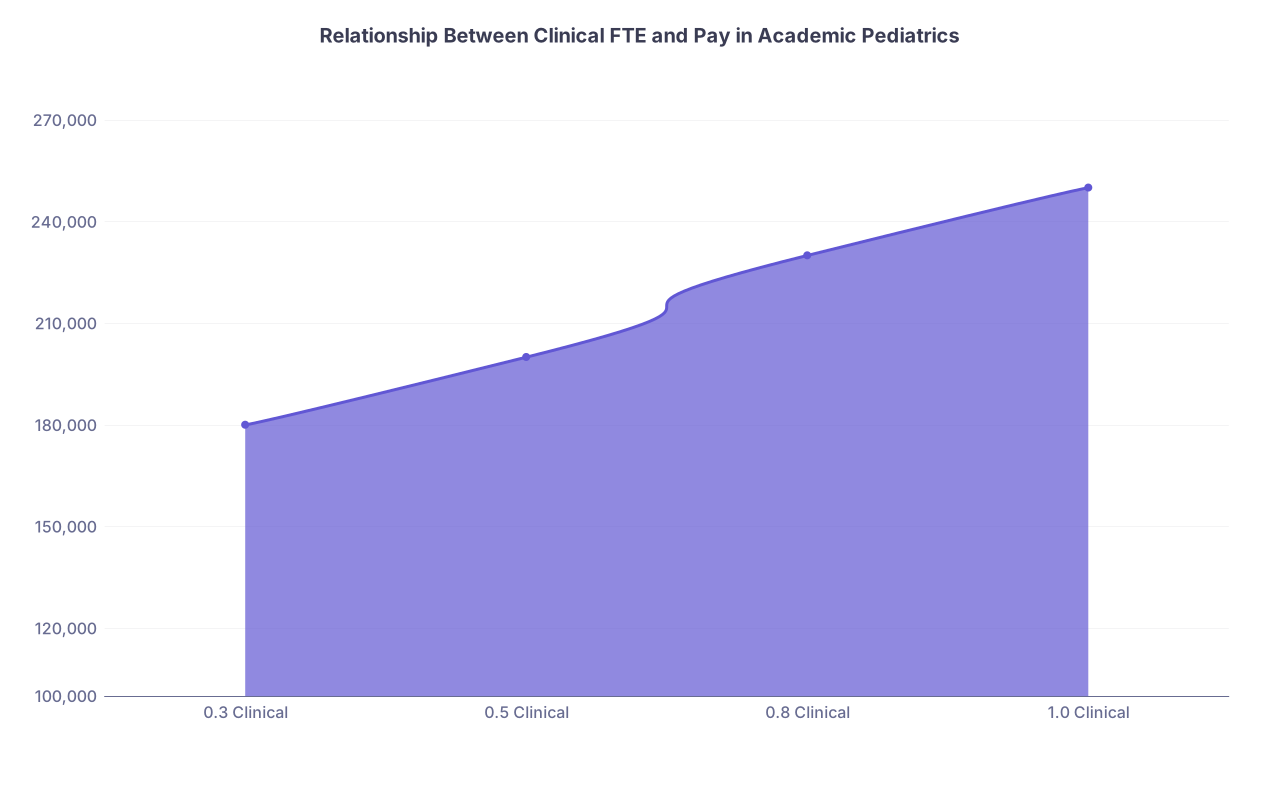
Here is the general relationship:
| Category | Value |
|---|---|
| 0.3 Clinical | 180000 |
| 0.5 Clinical | 200000 |
| 0.8 Clinical | 230000 |
| 1.0 Clinical | 250000 |
Rough idea: more clinical FTE, more pay. The research time itself is subsidized but not premium‑priced. If anything, research time often drags down your total compensation compared with a full‑time clinician.
So why do people chase grants?
Because in academic pediatric subspecialties, grants equal:
- Promotion
- Protected time
- Academic prestige
- The ability to actually move the field forward
You do not write R01s to buy a Tesla. You write R01s so your salary does not get slashed when your K award ends, and so you have enough time to do science without being in clinic 9 half‑days a week.
4. Fellowship and the Academic Track: How the Money Actually Flows
Residents hear fuzzy things on rounds. “They have 70% protected time.” Or, “She is on soft money now.” Let me decode this with a typical academic pediatric subspecialist career path.

| Step | Description |
|---|---|
| Step 1 | Med School Grad Debt |
| Step 2 | Peds Residency 3y |
| Step 3 | Subspecialty Fellowship 3y |
| Step 4 | Instructor or Asst Prof Hire |
| Step 5 | Protected Research 50 to 75 percent |
| Step 6 | Mostly Clinical Work 70 to 90 percent |
| Step 7 | Stable Research Faculty Track |
| Step 8 | Shift to More Clinical FTE |
| Step 9 | Promotion and Leadership Roles |
| Step 10 | Has Career Development Award? |
| Step 11 | Get R level Grant? |
Key pain points:
- Fellowship: salary is usually PGY‑4/5/6 level; you are functionally an attending in terms of responsibility in year 3, but not in pay.
- Early faculty: “Instructor” or “Assistant Professor” at 0.5–0.7 clinical, 0.3–0.5 research/QI/education. Pay often 180k–230k.
- Promotion and grants: success with K‑ and R‑level grants buys you time and status, but usually not large salary jumps unless your department is unusually generous.
And always remember: debt does not care that your research is impactful.
5. Subspecialty‑Specific Realities: Who Actually Lives in the “Prestige + Low Salary” Box?
Let’s go specialty by specialty and talk concrete realities.
Pediatric Infectious Disease
If you want pure “intellectual prestige minus money,” peds ID is the poster child.
What it is like:
- You get complex consults: immunocompromised kids, weird fevers, post‑transplant infections.
- Heavy rounds and interdisciplinary meetings; lots of “sign this vancomycin order” nonsense.
- Global health, epidemiology, and antimicrobial stewardship are common interest areas.
Academic environment:
- Strong NIH and CDC funding opportunities (HIV, TB, vaccine research, epidemiology).
- Many chairs and deans came out of ID or ID‑like fields because the skillset maps well to policy and public health.
Financially:
- Among the absolute lowest paid subspecialties in pediatrics—even for attendings. Lower than many outpatient general pediatricians.
- Heavy reliance on academic centers; private practice ID in pediatrics is almost nonexistent.
I have seen fellows in peds ID with 300k+ debt accept faculty jobs under 200k. Why? Because they love the pathogens and the science more than they hate the numbers. You have to be honest with yourself about whether that tradeoff fits your life.
Pediatric Endocrinology
Endo feels “cognitive and lifestyle‑friendly” on the surface. Diabetes clinics, growth issues, puberty quirks. Many residents like it.
Reality:
- Clinic‑heavy, largely outpatient, with long visits and lots of coordination.
- A huge chunk of patients are diabetes; technology (pumps, CGMs) dominates the conversation.
- RVUs per visit are poor; visits run long because families need education and reassurance.
Academic climate:
- Reasonable research space in metabolism, obesity, diabetes technology, and basic science.
- Good for K awards and endocrine society grants, but not as heavily funded as hem/onc or pulm.
Compensation:
- Low. On par with or just above peds ID in many centers.
- The upside: hours can be more predictable; less overnight call intensity than PICU, hem/onc, NICU.
If you want a research‑leaning academic life with a somewhat more humane schedule, peds endo is defensible. But you will almost certainly never catch up financially to your adult endo peers.
Pediatric Rheumatology
Niche field. Tiny. Hard to get into fellowship only because there are few spots, not because it is hyper‑competitive.
What you actually do:
- Autoimmune disease in kids: JIA, lupus, vasculitis, autoinflammatory syndromes.
- Heavy complexity, long visits, family counseling.
- Procedures are limited mostly to joint injections. Not big RVU drivers.
Academic draw:
- Strong connection to immunology and translational research.
- Many rheum divisions are “small but mighty” in research footprint.
Pay:
- Also low, though sometimes a notch above ID/endo. Still nowhere near adult rheum.
- Market scarcity can occasionally push salaries slightly higher in underserved regions, but the floor is low.
This is a great choice for people obsessed with immune systems and okay with modest income. But you have to like being one of two or three in your whole region.
Pediatric Nephrology
Nephrology has a bit more procedural juice with dialysis and biopsies, but still not a moneymaker.
Reality:
- Mix of inpatient (AKI, transplant, nephrotic) and outpatient (CKD, hypertension).
- Call can be real, especially with transplant programs.
- Kids with chronic dialysis or transplant can be longitudinally intense.
Academic piece:
- Solid basic science potential around renal physiology, transplant immunology.
- NIH loves some nephrology topics, especially cardiorenal and hereditary kidney disease.
Pay:
- Slightly better than peds ID/endo in many settings, but still well below high‑paying subspecialties.
- Adult neph is not a cash machine either, but it usually outpaces peds neph significantly.
Pediatric Pulmonology
This one is interesting because some jobs are “more clinical, more RVU” and others are “barely clinical, big grant portfolios.”
Clinical reality:
- CF, severe asthma, chronic lung disease of prematurity, ventilation‑dependent kids.
- Some bronchoscopy, sleep medicine crossover, and invasive disease management.
- NICU and PICU consults at tertiary centers.
Academic climate:
- High grant density in CF, rare lung disease, and pulmonary physiology.
- CF Foundation and NIH support a lot of investigator‑initiated research.
Financially:
- Still low relative to adult pulm/crit, but can be slightly better compensated than ID/endo/rheum if you lean more clinical.
- Those with heavy research (e.g., 70% protected) commonly stay in the low 200s or below.
If you want serious bench or translational science with enough clinical variety to keep you grounded, this is not a bad package. Just drop any fantasy that “CF doctor at big‑name children’s” equals high salary.
Developmental-Behavioral Pediatrics
Residents often underestimate how underpaid this is.
Day‑to‑day:
- ADHD, autism, learning disorders, developmental delays, behavior issues.
- Very long visits. Huge counseling burden. Heavy coordination with schools, therapists, and community resources.
- Almost entirely outpatient.
Academic role:
- Less NIH wet‑lab research, more outcomes, health services, and education.
- Many DBP faculty are heavily involved in curriculum design, advocacy, and policy.
Pay:
- Among the lowest in pediatrics. Sometimes below 200k for attendings even with several years in.
- RVU capture is terrible; the system pays lip service to “time‑based billing” but rarely compensates it properly.
This field is vital. The system treats it like a hobby. If you go here, you do it because nothing else feels as meaningful.
Pediatric Genetics / Metabolism
You want to be the person diagnosing the syndrome no one else could name? This is your playground.
Clinical work:
- Dysmorphic kids, intellectual disability, metabolic crises, newborn screening follow‑up.
- Heavy use of genomics, WES/WGS, metabolic labs.
- Long consults. Many family meetings and counseling.
Academic angle:
- Strong alignment with basic science, genomics, translational research.
- NIH appreciates rare disease, gene therapy, and mechanistic studies.
Compensation:
- Low. Frequently near the bottom along with ID and DBP.
- On the plus side, some labs and industry connections can supplement income down the line (advisory boards, trials), but that takes time.
If you want to live close to the bench and still see patients, this is one of the tightest integrations. You just pay for it financially.
6. Comparing Academic vs Non‑Academic Paths in These Fields
One blunt question I hear from residents: “Can I just do this subspecialty but not be underpaid?”
Sometimes yes, sometimes not really.
| Subspecialty | Realistic Non-Academic Path? | Typical Pay Difference |
|---|---|---|
| Peds ID | Very limited (mostly academic) | Minimal |
| Peds Endo | Moderate (hospital/large groups) | +10–30% outside academia |
| Peds Rheum | Limited but possible | +10–25% |
| Peds Neph | Some private/hybrid options | +10–30% |
| Peds Pulm | Better private/hybrid options | +15–35% |
| Dev-Behavioral | Rare outside academic centers | Minimal |
| Genetics | Mostly academic or hospital‐based | Minimal to +15% |
Two big points:
- Some of these specialties are functionally welded to academic centers (peds ID, genetics, DBP). You will not dodge the academic pay scales there.
- Even when private or hospital‑employed non‑academic options exist, you rarely jump to derm or GI money. You just move from “academic low” to “medium‑low community subspecialty.”
7. Who Should Actually Choose These Paths?
Let me be direct: if your primary motivation is income, these are bad choices. Not “could be better.” Bad. You will be spending many more years in training for less aggregate lifetime earnings than a shorter path in a higher‑paid field.
So why do these fields still attract good people?
Because certain residents care more about:
- Complex, rare diseases and diagnostic puzzles
- Longitudinal relationships with medically complex kids
- The chance to run a lab or be a national leader in a tiny but important disease niche
- Having real influence on guidelines, policy, or translational science
The ones who thrive in academic low‑paid pediatric subspecialties usually share three traits:
- They are genuinely obsessed with their patient population or disease area. Not just “I liked the rotation.” Full‑on intrinsic interest.
- They are realistic about their finances. They plan loan repayment, partner income, cost of living, and lifestyle before they commit.
- They derive status and meaning from academic identity (grants, papers, guideline authorship, podium talks), not from salary brochures.
If you are wavering, you probably should not do the lowest‑paid, highest‑training‑length option. There is no heroism in resenting your job and your paycheck at 45.
8. Strategic Advice for Residents Considering These Fields
You are looking at one of these subspecialties seriously. What should you actually do?
1. Get real numbers from current faculty and fellows
Do not accept vague “the pay is not great” comments. Ask politely but clearly:
- “What is the starting salary range for new faculty here?”
- “How many years out of fellowship before people hit 250k? 300k?”
- “What percentage of your time is funded by grants vs clinical?”
- “Does this institution top off K‑award salary or do you take a cut?”
You will be surprised how many attendings quietly tell you the truth when asked directly.
2. Look at loan repayment programs aggressively
These fields actually line up fairly well with:
- Public Service Loan Forgiveness (academic hospitals are almost all qualifying employers)
- NIH Loan Repayment Programs (LRP) for research in pediatrics, rare disease, genomics, etc.
| Category | Value |
|---|---|
| No LRP/PSLF | 0 |
| PSLF Only | 15000 |
| LRP Only | 20000 |
| LRP + PSLF | 30000 |
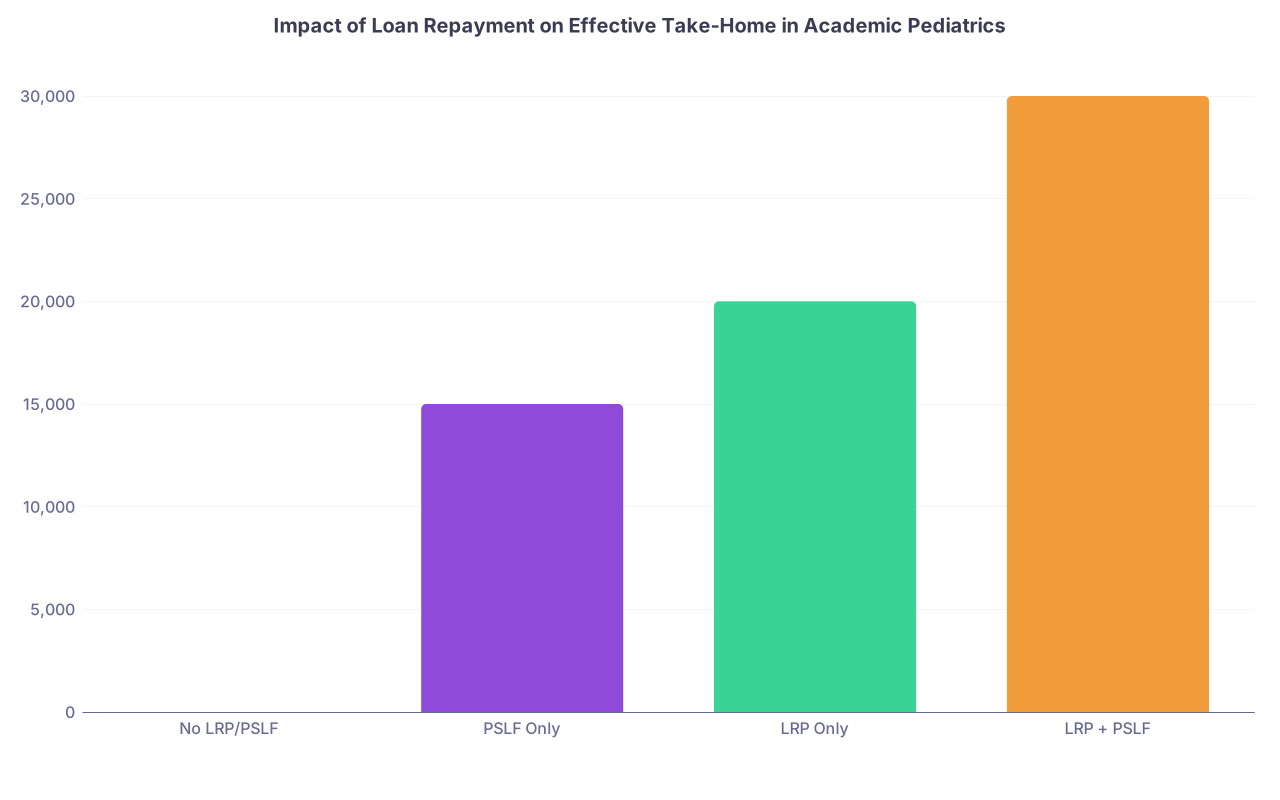
That bar chart is conceptual: combined loan programs can effectively add tens of thousands per year in “debt relief” equivalent. It is not cash in hand, but it matters.
3. Decide how much research you actually want
Do not claim to want 70% research time if what you really want is an interesting clinic life, modest scholarly work, and good teaching. Misalignment leads to misery and underperformance.
Rough buckets:
- >60% research: You need real grant ambitions (K23, K08, R01 path), probably bench or high‑level translational science.
- 30–50% research/education/QI: You are more of a clinician‑scholar or clinical researcher; K awards are still useful but not always mandatory.
- <20% research: You are primarily clinical faculty. You can still write papers, do QI, be involved in trials, but grants will not be your core job.
Income rarely scales well when research FTE is high unless your department explicitly values it monetarily, which is uncommon in pediatrics.
4. Be honest about your life plans
If you are the sole earner, want three kids, and plan to live in high‑COL markets (Bay Area, NYC, Boston), going into academic low‑paid pediatric subspecialty is tough. It is not impossible. But you will feel the squeeze.
If you have a partner with solid income, lower personal spending goals, or you are fine living in mid‑cost markets, the tradeoff softens.
9. The Prestige Trap: What Actually Matters 10 Years Out
Residents overestimate how much “prestige” will matter to their future self.
People chase:
- The name‑brand children’s hospital
- The NIH K award
- The fancy titles: Division X of University Y
And those things do matter in academia. They shape your network, your opportunities, your ability to launch trials or shape guidelines.
But on a random Tuesday night, what often matters more:
- Are you doing work you still find intellectually satisfying?
- Do you resent your pay, or are you at peace with the tradeoff you made?
- Do you have enough time and money to see your own kids, take a vacation, and not panic about every roof leak?
A mid‑career academic pediatric ID physician who truly loves the field, has stable grants, and lives in a sane city can be happier than the burned‑out anesthesiologist in a high‑pay, high‑stress private group. Money is one variable. Not the only one.
The trap is when you pretend money does not matter, and then discover at 40 that it very much does—to you, to your family, to your stress levels.
FAQ (Exactly 4 Questions)
1. Which academic pediatric subspecialty is truly the lowest paid?
In most recent datasets and real‑world offers I have seen, pediatric infectious disease, developmental‑behavioral pediatrics, pediatric endocrinology, and pediatric genetics sit at the very bottom. Locally there is variation, but those four reliably cluster in the lowest tier, often starting well under 220k in academic centers.
2. Can I make “good money” in any pediatric subspecialty while staying academic?
“Good” is relative. If you mean 400k+, that is rare in academic pediatrics. Some higher‑RVU fields—peds cardiology, GI, critical care, anesthesia—can approach that with leadership roles, high clinical FTE, or hybrid arrangements. But the low‑paid cognitive fields we discussed almost never hit that level in pure academic positions.
3. Do research grants ever significantly boost take‑home pay in these fields?
For most pediatric subspecialists, grants stabilize and justify your salary rather than dramatically increase it. They fund your research time and some fringe, but base pay is usually pegged to institutional scales. Certain institutions offer incentive structures or soft‑money bonuses, but that is the exception, not the rule, in pediatrics.
4. If I love a low‑paid pediatric subspecialty, is there any way to mitigate the financial hit?
Yes. Combine several tactics: choose a medium‑COL city, maximize PSLF and NIH LRP, negotiate clinical FTE and salary transparently, avoid lifestyle inflation, and be open to modest side income (consulting, speaking, clinical shifts) once you are established. None of this will turn peds ID into ortho, but it can move you from “perpetually stressed” to “comfortably middle/upper‑middle class.”
Key Points to Remember
- Academic pediatric subspecialties like ID, endo, rheum, neph, pulm, DBP, and genetics offer prestige and grant opportunities but are structurally some of the lowest‑paid jobs in medicine.
- Grants usually buy you protected time and academic survival, not large pay raises; your clinical FTE largely drives your income.
- These paths are rational only if you deeply value the specific patient population, the science, and the academic identity more than you value maximizing income.


