

The first 24 months as an attending in a low‑paid specialty will make or break your career. Not clinically. Financially and psychologically.
You are walking into peak responsibility with near-floor compensation compared to your peers. That gap, if you do not manage it from day one, will quietly chain you to bad jobs, bad call, and bad geography for years.
I am going to walk you through a strict 24‑month survival timeline. Month by month. What you should do, what you should absolutely avoid, and when you make each critical move.
Assumptions: you are entering one of the usual “lowest paid” suspects—pediatrics, child psych, family medicine, geriatrics, general internal medicine (non‑procedural), outpatient psych in some markets. You have loans. You are not sitting on a trust fund.
3–6 Months Before Start Date: Pre‑Attending Reality Check
At this point you should stop thinking like a resident and start thinking like a small business that happens to wear a white coat.
6 Months Before Start
Focus: Contract, cash flow, and exit options.
Lock down the contract (but with eyes open).
- You should already have:
- Base salary
- Expected productivity (RVUs or panel size)
- Call expectations
- Non‑compete radius and duration
- Red flags I would not accept in a low‑paid field:
- Non‑compete > 15–20 miles in a dense area
- Tail coverage on you in a short‑term, unproven job
- RVU expectations that match procedural specialties
- You should already have:
Build a brutally honest first‑year budget.
- Use conservative numbers:
- Take‑home pay = 55–65% of gross unless you have exact withholdings.
- Loan payments at full standard or SAVE/IBR projected amounts.
- Line‑item:
- Housing (rent or mortgage + insurance + utilities)
- Student loans
- Car (payment + insurance + gas)
- Health/disability insurance
- Minimal fun money
- If your budget does not work on paper, it will not work in reality. Adjust before you sign a lease.
- Use conservative numbers:
| Category | Amount ($) |
|---|---|
| Rent/Utilities | 2,000 |
| Student Loans | 1,200 |
| Car + Insurance | 500 |
| Groceries | 600 |
| Insurance (extra) | 300 |
| Phone/Internet | 200 |
| Misc/Lifestyle | 700 |
| Savings/Investing | 1,000 |
- Clarify start‑up support.
- Ask in writing:
- How many patients per day in month 1? Month 3? Month 12?
- Who markets you? How do new patients get assigned?
- Any ramp‑up guarantee separate from base?
- In low‑paid specialties, “we’ll build you up” often means “you will be underwater for a year.” Do not just trust reassurance. Get numbers.
- Ask in writing:
3 Months Before Start
Focus: Logistics and protecting downside.
- At this point you should:
- Lock housing at a reasonable cost. Target 20–25% of gross income on housing, not 40%.
- Buy only what you need for work:
- A decent laptop or desktop if your job does not provide one.
- Minimal new wardrobe. You are not a dermatologist with a fashion budget.
- Secure insurance:
- Own‑occupation disability policy in place before first shift as attending.
- Term life if you have dependents or co‑signers.
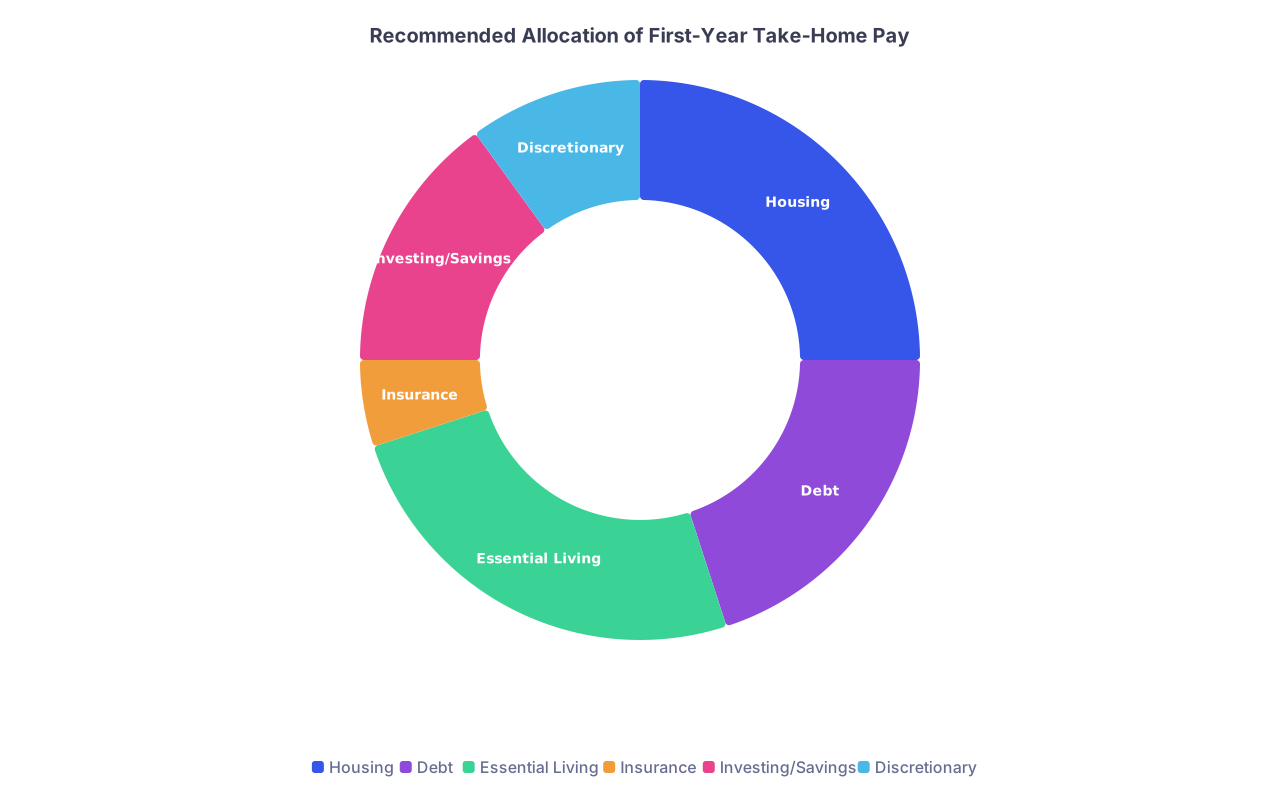
| Category | Value |
|---|---|
| Housing | 25 |
| Debt | 20 |
| Essential Living | 25 |
| Insurance | 5 |
| Investing/Savings | 15 |
| Discretionary | 10 |
Months 0–3: Orientation, Identity Shock, and Spending Guardrails
You start now. This is when new attendings make their biggest mistakes—usually on lifestyle and boundaries.
Week 1–2: Orientation and Systems
At this point you should focus on survival tasks, not optimization.
- Master:
- EMR workflows specific to billing and documentation:
- Level 3 vs 4 vs 5 visits
- How to capture complexity in notes without writing novels
- Order sets and referral processes
- EMR workflows specific to billing and documentation:
- Ask directly:
- “Who can I sit with for 1–2 half‑days to review my documentation and billing?”
- Do not:
- Volunteer for committees.
- Agree to extra clinics “to be a team player.”
Week 3–4: First Paycheck and Lifestyle Trap
You will see a paycheck bigger than any resident check you have had. It is still small relative to your training, but it feels huge.
At this point you must set strict rules:
- Automate:
- 10–15% of take‑home to:
- High‑yield savings for emergency fund until you hit 3–6 months of expenses
- Loan payments as scheduled (no heroic overpayments yet unless your budget is rock solid).
- 10–15% of take‑home to:
- Cap:
- One “celebration” purchase or trip. Then stop.
- Delay:
- House purchase
- New luxury car
- Private school decisions for kids
- Any commitment that jacks up your fixed costs
Months 3–6: Panel Growth, Burnout Risk, and Side Income Decisions
By 3 months, you are no longer “the new attending.” You are just another clinician with a full inbox.
Month 3: Reality Check
At this point you should perform a structured 1‑hour review on a day off:
Clinical:
- Average:
- Patients per day
- RVUs per day (if visible)
- Inbox messages per day
- Pain points:
- Refill chaos?
- Endless portal messages?
- Too many 15‑minute slots for complex patients?
- Average:
Financial:
- Compare:
- Actual spending vs your pre‑year budget
- Fix:
- Any category that consistently blows up (eating out, Amazon, travel)
- Compare:
Schedule boundaries:
- If you are always staying 2 hours late:
- Look at template. Push to:
- Add admin time blocks
- Convert some return visits to telehealth (if paid reasonably)
- Look at template. Push to:
- If you are always staying 2 hours late:
Month 4–6: Decide on Extra Income vs Sanity
This is where low‑paid specialties either sink or keep their head above water.
Common options:
- Extra clinic sessions
- Urgent care shifts
- Inpatient weeks (for FM/IM)
- Telemedicine (psych, FM, peds to some extent)
At this point you should:
- Run the math per hour:
- Example:
- Extra clinic half‑day: $600 for 4 hours = $150/hr before extra unpaid documentation.
- Urgent care: $130/hr, but you walk out clean.
- Example:
- Protect:
- At least:
- 1 full day off per week
- 1–2 evenings with no work at all
- At least:
Months 6–9: Data, Negotiation Positioning, and Loan Strategy Shift
You now have enough data to stop guessing.
Month 6: Hard Numbers and Future Leverage
At this point you should pull:
- 6‑month stats:
- RVUs generated
- No‑show rates
- Panel size growth
- Any QI or patient satisfaction metrics tracked
Ask for a quick meeting with your medical director or supervisor. Agenda:
- “Here is what I see for my volume and RVUs.”
- “Here are my pain points: [documentation overflow, inbox, double‑booking].”
- “To sustain this long term, I need: [protected admin time, adjusted template, better MA support].”
You are not negotiating salary yet. You are building a record that you are thoughtful, data‑driven, and already productive.
Loan Strategy Check
Low‑paid specialties often qualify for PSLF or state loan repayment programs. At 6 months you should:
- Confirm:
- Employer is a qualifying 501(c)(3) or government entity (for PSLF).
- Evaluate:
- Income‑driven repayment vs aggressive payoff if:
- You hate your job and might leave nonprofit world soon.
- Income‑driven repayment vs aggressive payoff if:
- If PSLF makes sense:
- Maximize retirement contributions to reduce AGI and keep payments manageable.
- If PSLF does not make sense:
- Plan a structured payoff schedule:
- Decide specific extra monthly payment starting month 9 or 12.
- Plan a structured payoff schedule:
Months 9–12: First Contract Year Closeout and “Stay or Go” Recon
By now, the shine is off. You know exactly what frustrates you. This is when you start exploring exit ramps quietly, even if you decide to stay.
Month 9: Market Scan (Quietly)
At this point you should:
- Spend 1–2 evenings:
- Browsing actual posted jobs in:
- Your region
- One or two backup regions where you would realistically move
- Browsing actual posted jobs in:
- Track:
- Base salary ranges
- Bonus structures
- Call packages
- Telehealth/hybrid options

This is not “grass is greener” fantasy. This is establishing your market value so that when your current group tells you you are “well compensated for the area,” you can respond internally, “That is false.”
Month 10–11: Process and Efficiency Overhaul
Now you fix the parts of your day that are quietly stealing 1–2 hours.
At this point you should:
- Block a half‑day (take PTO if needed) to:
- Build or refine:
- Smart phrases and templates for common visits
- Order sets for your bread‑and‑butter problems
- Standardize:
- “Refill policy” you give to patients
- When staff can handle messages vs which come to you
- Build or refine:
This sounds trivial. It is not. I have watched pediatricians reclaim 5–8 hours a week just by ruthlessly pruning portal message chaos and rewriting their patient instructions.
Month 12: One‑Year Review and Decision Node
At the one‑year mark, you should sit down with three documents:
- Your contract.
- Your actual pay stubs and W‑2.
- Your productivity and performance data.
Ask yourself bluntly:
- Clinically: Do I like my patient population and colleagues enough?
- Financially: Is this salary + any bonus competitive within ±10–15% of the local market?
- Operationally: Can I see myself doing this schedule for 2–3 more years without burning out?
If the answers are “yes, roughly,” you stay but push for tactical improvements.
If the answer is “no” on more than one dimension, you start planning a move in the next 12–18 months.
Months 12–18: Positioning for Raise, Move, or Side‑Gig Stability
This is the consolidation phase. You either improve your current job or you make your next job significantly better.
Months 12–14: Document Value and Pain
At this point you should:
- Compile:
- RVUs or panel size growth compared to:
- Other new hires if possible
- Department averages if available
- Any leadership roles you have taken (no more than 1–2).
- Examples of:
- QI projects you contributed to
- Patient satisfaction wins
- RVUs or panel size growth compared to:
- Clarify:
- Top 3 specific issues you want changed:
- “I need 4 hours of protected admin per week.”
- “I need call frequency reduced from 1:3 to 1:4.”
- “I need salary adjusted to be within market range.”
- Top 3 specific issues you want changed:
Months 15–16: Negotiation or Search
Two parallel tracks. Which one you run harder depends on your answers at month 12.
At this point you should:
If staying:
- Request a formal sit‑down:
- “I would like to discuss my first year, my performance, and how to make this sustainable long term.”
- Go in with:
- Specific numbers (not vibes).
- A prioritized list of asks.
- Be ready for:
- “We cannot raise base salary right now.”
- Then pivot:
- “Let us talk about schedule, bonus structure, and admin support.”
- Request a formal sit‑down:
If leaving is likely:
- Start active interviewing:
- 2–3 serious applications sent.
- One weekend visit to your top alternate city or system if out of state.
- Start active interviewing:
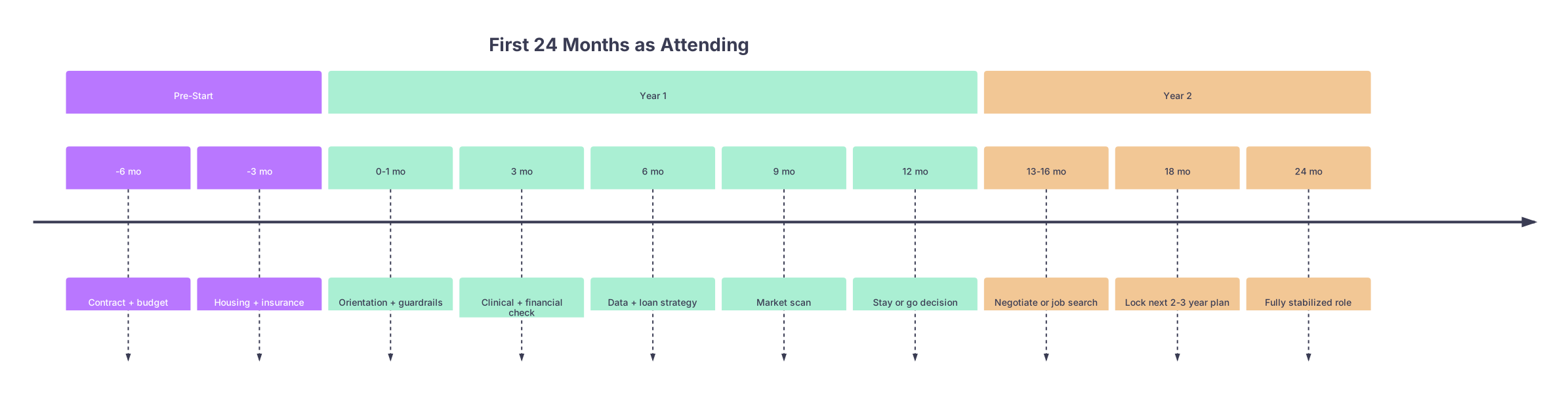
| Period | Event |
|---|---|
| Pre-Start - -6 mo | Contract + budget |
| Pre-Start - -3 mo | Housing + insurance |
| Year 1 - 0-1 mo | Orientation + guardrails |
| Year 1 - 3 mo | Clinical + financial check |
| Year 1 - 6 mo | Data + loan strategy |
| Year 1 - 9 mo | Market scan |
| Year 1 - 12 mo | Stay or go decision |
| Year 2 - 13-16 mo | Negotiate or job search |
| Year 2 - 18 mo | Lock next 2-3 year plan |
| Year 2 - 24 mo | Fully stabilized role |
Side‑Gig Reality Check for Low‑Paid Fields
Everyone talks about “side gigs.” Most of them are fantasy.
At this point—mid second year—you can realistically add:
- Extra clinical shifts:
- Urgent care
- Telemed blocks
- Teaching:
- Precepting residents or students
- Rare but legit:
- Medical writing or consulting if you like that world
You should not be building a startup, flipping real estate across three states, and moonlighting four nights a week while holding a full panel. That is how people in already underpaid fields hit the wall.
Months 18–24: Locking in a Sustainable 3–5 Year Plan
By 18 months, the novelty is gone. You are either in a barely tolerable grind or a job you could make genuinely good with the right tweaks. This last 6‑month stretch is where you lock in your next phase.
Month 18: Choose Your Path Explicitly
At this point you should decide, in writing (to yourself):
- Path A: “I will stay here at least 2–3 more years.”
- Path B: “I will transition to a new role within 12–18 months.”
No more vague “seeing how it goes.” That limbo burns energy.
For Path A: Deepen Roots, Not Chains
If you are staying:
- Clarify:
- Final negotiated schedule and support:
- Admin time locked in writing.
- Call structure clearly documented.
- Growth:
- One or two areas you might subspecialize in (e.g., adolescent medicine, geriatrics, perinatal psych) that do not require a full new fellowship but can raise your value.
- Final negotiated schedule and support:
- Financial:
- By 24 months you should:
- Have 3–6 months of expenses saved.
- Be contributing meaningfully to retirement (ideally 15–20% of gross when including employer match).
- Have a clear student loan trajectory:
- PSLF path with documented qualifying payments.
- Or a 5–10 year payoff plan with actual numbers.
- By 24 months you should:
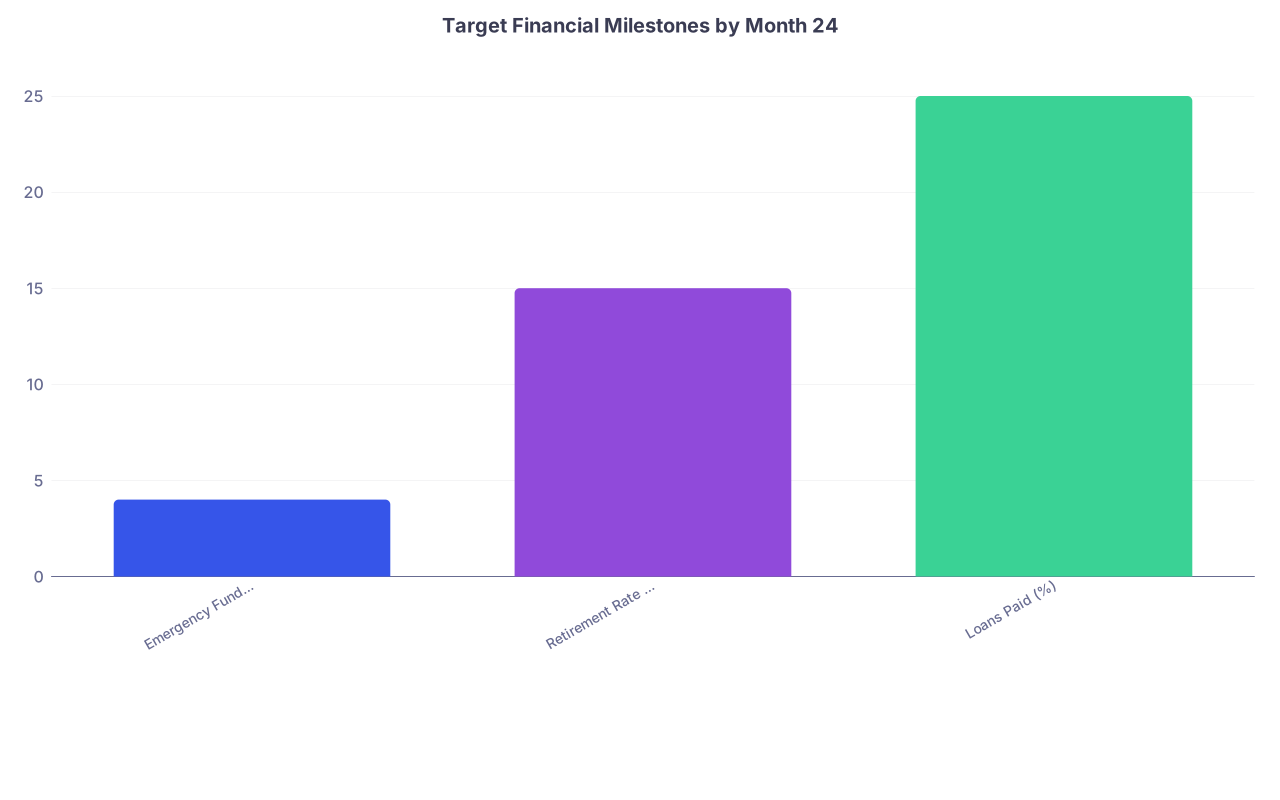
| Category | Value |
|---|---|
| Emergency Fund (months) | 4 |
| Retirement Rate (%) | 15 |
| Loans Paid (%) | 25 |
For Path B: Controlled Exit, Not Panic Jump
If you are leaving:
At this point you should:
- Have:
- An updated CV with clear bullet points on:
- Volume
- Patient mix
- Any leadership or QI work
- 2–3 references lined up (attendings, chiefs, medical directors).
- An updated CV with clear bullet points on:
- Strategy:
- Target roles that fix specific pain points of your current job:
- If your pay is fine but schedule kills you: look for fewer clinic days, more telehealth.
- If your pay is low relative to peers: prioritize comp packages, even if it means a slightly less “prestigious” system.
- Be extremely careful with non‑competes:
- Confirm how far you need to move or what distance from current offices you must maintain.
- Target roles that fix specific pain points of your current job:
Do not drag this out. Once you know you are leaving, aim to have a signed new contract by the 24‑month mark or shortly after.
Daily and Weekly Micro‑Habits That Keep You Afloat
These are not sexy, but they are what separate the attendings who still like their lives at 5 years from the ones counting down to an early exit.
Daily (During First 24 Months)
At this point—every day—you should:
- Close charts same day for at least:
- 80–90% of visits.
- Cap after‑hours work:
- Set a hard stop (e.g., 8:30 pm).
- Anything beyond that moves to next day’s admin block.
- Spend 5 minutes:
- Glancing at your checking + credit card balances.
- Not to obsess—just to keep from drifting into financial fog.
Weekly
You should have:
- One 30–60 minute block:
- Protected for:
- Reviewing schedule templates
- Cleaning up dot phrases
- Adjusting how your staff triages calls/messages
- Protected for:
- One hour for life logistics:
- Paying any non‑auto bills
- Reviewing upcoming big expenses
- Skimming job boards for 5 minutes (yes, even if “happy”)

The Bottom Line for the First 24 Months
Keep it simple:
- Control fixed costs and lifestyle from day one. In a low‑paid specialty, you cannot afford early lifestyle creep. It will trap you in bad jobs and bad call.
- Use the first 12–18 months to gather data and build leverage. Track your volume, efficiency, and market value so negotiations (or exits) are grounded in facts, not feelings.
- Make a clear 3–5 year plan by month 24. Either commit to optimizing your current role or pivot to a better‑matched job. Do not float indefinitely in “maybe next year” mode.
Follow this timeline with discipline, and your “low‑paid” field becomes a manageable constraint, not a life sentence.


