
The biggest financial mistake in low-paying specialties is not the salary. It is missing critical deadlines between pre‑match and your first contract.
You are in a field where every extra month without a paycheck, every botched contract clause, and every late licensure fee hurts more. Family medicine, pediatrics, psychiatry, preventive medicine, geriatrics—there is no plastic surgery money coming to bail out sloppy planning.
So you need a timeline. Down to the month and often the week.
This guide walks you from the pre‑match window of your final year through the day you start your first attending job, with specific “at this point you should…” checkpoints tailored for lower‑paid specialties.
Overview Timeline: MS4 Fall to First Paycheck
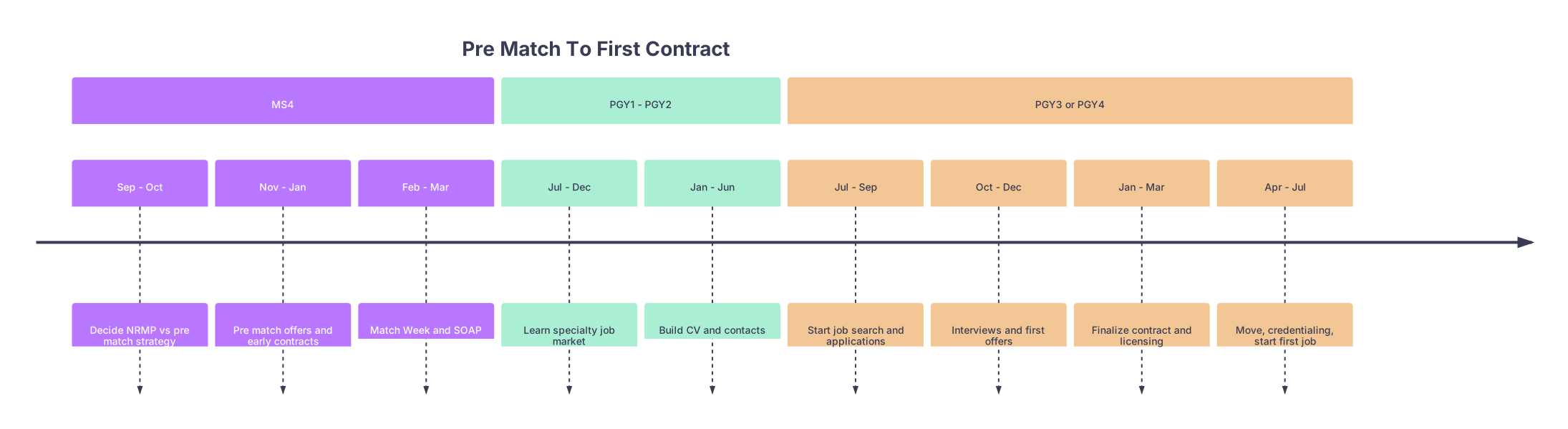
| Period | Event |
|---|---|
| MS4 - Sep - Oct | Decide NRMP vs pre match strategy |
| MS4 - Nov - Jan | Pre match offers and early contracts |
| MS4 - Feb - Mar | Match Week and SOAP |
| PGY1 - PGY2 - Jul - Dec | Learn specialty job market |
| PGY1 - PGY2 - Jan - Jun | Build CV and contacts |
| PGY3 or PGY4 - Jul - Sep | Start job search and applications |
| PGY3 or PGY4 - Oct - Dec | Interviews and first offers |
| PGY3 or PGY4 - Jan - Mar | Finalize contract and licensing |
| PGY3 or PGY4 - Apr - Jul | Move, credentialing, start first job |
Keep this mental model:
- MS4: You are locking in training (pre‑match vs Match), not income.
- Residency years 1–2: You are learning your market and setting up options.
- Final training year: You are on a tight countdown from “job search” to “first direct deposit.”
MS4: Pre‑Match vs Match – Training First, But Money in Mind
Low‑paying specialties have a split personality: some are pre‑match heavy (particularly community family medicine, internal medicine with primary care focus, certain psych programs), others are strictly NRMP.
At this stage, you are not choosing your first contract, but you are choosing how painful your future job search will be. Under‑resourced, unknown programs can make you less competitive later.
September – October (MS4): Decide Your Path
At this point you should:
Make a clear decision:
- Only NRMP Match,
- Open to pre‑match + Match, or
- Aggressively pre‑match, Match as backup.
Ask program directors and coordinators directly (especially in family med, psych, peds, IM primary care):
- “Do you offer pre‑match contracts?”
- “What is your typical pre‑match timeline?”
- “Do your pre‑match residents usually stay for all years?”
Know your risk category:
- Strong applicant (solid scores, strong letters, U.S. grad, decent clinical record): you can be picky and avoid sketchy pre‑match contracts.
- Borderline applicant: pre‑match may be your lifeline. But read the contract like it is a mortgage.
November – January (MS4): Pre‑Match Offer Window
This is where people get pushed into bad deals. Fast.
At this point you should:
Expect early calls or emails from community programs in:
- Family medicine
- Psychiatry
- Internal medicine with heavy outpatient/primary care focus
- Pediatrics in less desirable locations
If you get a pre‑match offer:
- Ask for the written contract before verbally committing.
- Verify these non‑negotiable items:
- ACGME accreditation status and duration
- Funding for all years of training
- Rotation sites (are they stable or constantly “in development”)
- Clear duty hours and call expectations
Understand the binding nature:
- Many pre‑match contracts lock you out of NRMP ranking for that specialty.
- Breaking a pre‑match can put you in the NRMP “problem child” category.
Low‑paid specialties often use pre‑match to fill less desirable spots. Some are excellent, some are toxic. The deadline is not just time, it is your future leverage.
February – March (MS4): Match Week and SOAP
By now either you are locked in via pre‑match, or you are riding the NRMP process.
At this point you should:
If you matched or pre‑matched:
- Clarify salary, benefits, and moonlighting policy with your soon‑to‑be program.
- Ask for a resident contract draft no later than late spring.
If you did not match and you are SOAPing into a low‑paying specialty:
- You are in a weaker negotiating position for future jobs. Not fatal, but real.
- Keep an extra eye on program reputation and board pass rates. Marginal programs + low‑paying specialties = long‑term income drag.
PGY1–PGY2: Setting Up Your Future Income (Quiet Phase, Critical Work)
Residents in low‑paying specialties often make the second big financial error here: they assume attending jobs will be “easy to find later” because “primary care is in demand.” True and misleading.
Yes, there are jobs. No, they are not all equal. The timeline here is about preparation, not signing.
PGY1: Baseline and Reality Check
At this point you should:
By the end of PGY1:
- Understand your specialty’s job market range, not vague rumors.
- Example: outpatient family medicine in rural Midwest: $240–280k base.
- Academic pediatrics in major metro: $160–190k.
- Community psychiatry in underserved area: $260–300k with heavy call.
- Understand your specialty’s job market range, not vague rumors.
Track your interests:
- Inpatient vs outpatient
- Academic vs community
- Underserved / FQHC vs private practice vs hospital employed
Start a running document (Google Doc, OneNote, whatever) with:
- Interesting practice models you see on rotations
- Names of attendings you would actually want to work with
- Geographic preferences that are real, not fantasy
PGY2: Quiet Networking and CV Positioning
PGY2 is where the smartest residents quietly pull ahead. Not by overworking. By planning.
At this point you should, by end of PGY2:
Have a clean, current CV:
- Updated with every presentation, QI project, committee role.
- Designed for job applications, not ERAS.
Have at least 2–3 attendings in your corner who:
- Know your work well.
- Work in settings similar to where you want to land.
- Are willing to take your call and send your CV somewhere.
Know the credentialing/visa/loan realities:
- If you are on a visa: understand J‑1 waiver or H‑1B timelines now, not in PGY3.
- If you have large loans: know exactly how your specialty’s typical salary interacts with PSLF, IDR, or private refinancing.
Final Year (PGY3/PGY4): Job Search Clock Starts
Here is where the deadlines get real. For most low‑paying specialties, you cannot afford to wait until spring of your final year to start looking. Positions at better paying, better‑run clinics are often filled early.
July – September (Final Year): Launch the Search
At this point you should:
By July 31:
- Finalize your CV.
- Draft a generic but solid cover letter template you can tailor in 10 minutes.
By August 31:
- Create a shortlist of:
- 2–3 target regions
- 5–10 health systems / large groups per region
- Any FQHCs / VA / county systems you would genuinely consider
- Create a shortlist of:
By September 30:
- Start sending initial feeler emails to:
- Department chairs at hospitals where you rotated.
- Medical directors at FQHCs or community mental health centers.
- Recruiters for large systems (yes, even for “low‑paid” fields, they still recruit).
- Start sending initial feeler emails to:
Think of this as Phase 1 outreach, not final decisions. You are signaling early interest and getting on their radar before the late crowd shows up.
October – December (Final Year): Interviews and Early Offers
This is the busiest and most important quarter.
At this point you should:
Schedule interviews:
- Aim for 2–4 site visits by the end of December.
- Prioritize practices that:
- Can show you real schedules, not fantasy templates.
- Are transparent about panel size, call burden, and support staff.
Ask for compensation details early, not after falling in love with the clinic:
- Base salary vs RVU model?
- Sign‑on bonus?
- Loan repayment (especially for FQHC/HRSA/VA)?
- Tail coverage if malpractice is claims‑made?
Track offers in a simple table:
| Job | Base Salary | Bonus/Loan Help | Call Burden | Start Date |
|---|---|---|---|---|
| A | $185k | $20k sign-on | 1:4 | Aug 1 |
| B | $210k | $50k loan repay | 1:8 | Sep 1 |
| C | $170k | None | No call | Jul 15 |
Does not have to be fancy. Just visible. You cannot mentally juggle these when you are post‑call.
Compensation Reality Check: Low‑Paid vs Higher‑Paid
Your entire timeline should be shaped by the fact that your “room for error” is smaller. One year of delay, one badly underpaid contract—this hurts far more in pediatrics than in ortho.
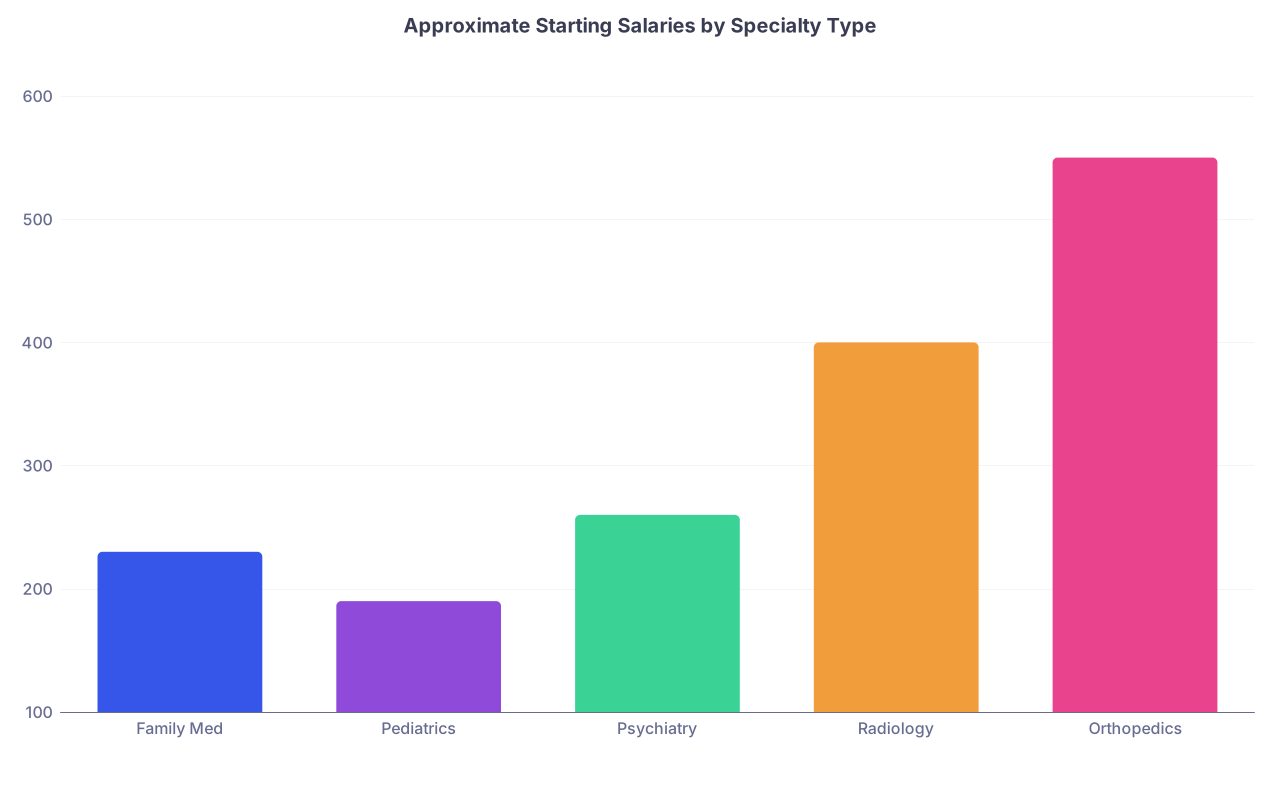
| Category | Value |
|---|---|
| Family Med | 230 |
| Pediatrics | 190 |
| Psychiatry | 260 |
| Radiology | 400 |
| Orthopedics | 550 |
You cannot control the field’s baseline, but you can absolutely control:
- How many months you are unemployed between residency and first job.
- Whether you accept a dramatically under‑market starting salary.
- Whether you ignore loan repayment or PSLF‑qualifying employers that would effectively add tens of thousands to your compensation.
This is why your job search starts early and moves on a schedule.
Contract and Licensure Deadlines: The Hidden Traps
Most residents underestimate how long state licensure, hospital credentialing, and payer enrollment take. In low‑paying specialties, delays can erase a big chunk of your first‑year income.
Typical Backward Planning to Start Work
Assume you want to start your first job on August 1 after residency.
Work backwards:
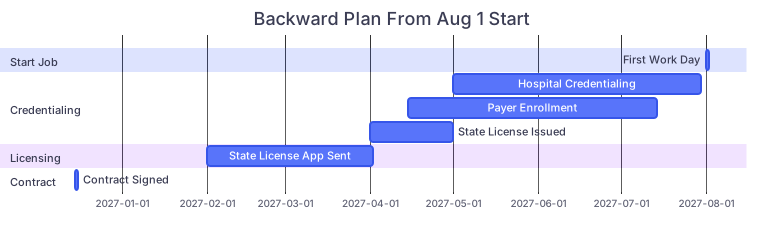
| Task | Details |
|---|---|
| Start Job: First Work Day | a1, 2027-08-01, 1d |
| Credentialing: Hospital Credentialing | a2, 2027-05-01, 90d |
| Credentialing: Payer Enrollment | a3, 2027-04-15, 90d |
| Credentialing: State License Issued | a4, 2027-04-01, 30d |
| Licensing: State License App Sent | a5, 2027-02-01, 60d |
| Contract: Contract Signed | a6, 2026-12-15, 1d |
That is conservative. Many hospitals and state boards are slower.
At this point, if your planned start date is August 1, you should:
- By mid‑December of your final year:
- Have a signed contract or be so close you know the exact clinic and location.
- By February 1:
- Submit the state medical license application (if new state).
- By April 1–15:
- Have your license approved or near approval.
- By May 1:
- Have all hospital credentialing documents submitted.
Miss these and you might be sitting at home in September, with loans due and no paycheck, because “HR is still processing.”
Month‑By‑Month in Final Year: Concrete Checklist
Let us be very literal.
July (Final Year)
At this point you should:
- Finish your CV and template cover letter.
- Narrow to 2–3 realistic regions.
- Ask your PD and two attendings if they are comfortable serving as references.
August
At this point you should:
Start light outreach (email + phone) to:
- Medical directors at FQHCs.
- Leaders in local community mental health centers (for psychiatry).
- Larger primary care groups in your target area.
Update your LinkedIn profile to show:
- Anticipated completion date.
- Specialty.
- Any niche interests (addiction, geriatrics, developmental peds).
September
At this point you should:
- Begin formal applications to posted jobs in your target areas.
- Respond promptly to recruiter emails that match your criteria.
- Keep a running log of:
- Applications sent
- Responses
- Interview dates
October
At this point you should:
Complete your first 1–2 site visits.
Ask specific questions:
- What was the panel size of the last physician who left?
- How many patients per day are expected in year 1 vs year 3?
- Who covers call and how often?
Request draft contracts for any jobs you like enough to seriously consider.
November
At this point you should:
- Have 2–3 site visits completed.
- Have at least one draft contract in hand.
- Start lining up an attorney or experienced mentor to review the contract:
- Particularly pay attention to:
- Non‑compete radius and duration
- Termination clauses
- Call expectations and “other duties as assigned”
- Particularly pay attention to:
December
At this point you should:
Choose your top job and actively negotiate:
- Salary (even if only modestly).
- Signing bonus or relocation stipend.
- CME funds and vacation time.
- Student loan repayment options.
Aim to have a signed contract by mid‑December if your start date is August 1.
State Licensing, Credentialing, and Payer Enrollment
This part is unsexy and absolutely determinative.

January – March (Final Year): Licensing
At this point you should:
Confirm state license requirements for the job location:
- Fingerprints, background checks.
- Exam score verifications.
- Training verification from your program.
By February 1:
- Submit the state license application if it is a new state.
- Follow up relentlessly on:
- Medical school transcripts.
- USMLE/COMLEX verifications.
- Program verification forms.
If you are staying in the same state, the timeline is easier, but still do not assume instant processing for hospital privileges.
April – June (Final Year): Credentialing
At this point you should:
Complete the hospital credentialing packets as soon as they are sent:
- Prior addresses, employment history, malpractice history.
- Immunization records.
Begin payer enrollment (Medicaid, Medicare, major commercial plans):
- Often handled by your employer, but you must return every form immediately.
- In low‑paying specialties, a lot of your patients are Medicaid / under‑insured; slow enrollment disrupts your billing and makes you less valuable in the first months.
Practical Money Timelines for Low‑Paying Specialties
You are not just chasing dates, you are protecting your cash flow.
6–12 Months Before First Paycheck: Financial Prep
At this point you should:
Estimate your first‑year take‑home under a realistic scenario:
- Base salary minus:
- Federal + state taxes
- Retirement contributions
- Health insurance premiums
- Factor in potential sign‑on bonus (and its tax hit).
- Base salary minus:
Decide if you need a bridge:
- 1–3 months of living expenses saved to cover any credentialing delays.
- Avoid loading up credit cards in a field where your salary ceiling is modest.
Which Employers Benefit You Most Financially?
In low‑paying specialties, the sticker salary often lies. The combination of salary, loan repayment, and benefits is what matters.
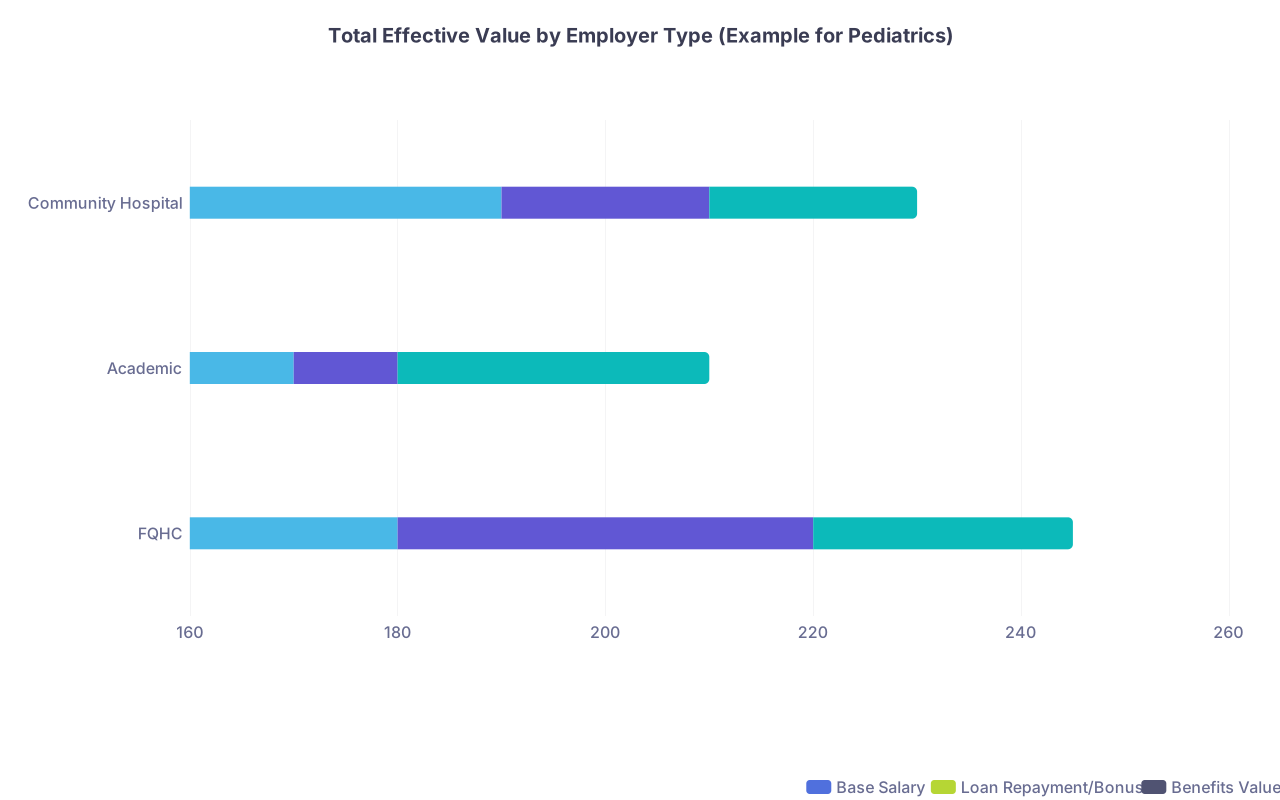
| Category | Base Salary | Loan Repayment/Bonus | Benefits Value |
|---|---|---|---|
| FQHC | 180 | 40 | 25 |
| Academic | 170 | 10 | 30 |
| Community Hospital | 190 | 20 | 20 |
I have watched pediatricians turn down an FQHC that looked “low paying” at $180k base, ignoring the $40k/year of HRSA loan repayment, only to take a $190k community job with no loan help and worse benefits. Over a few years, that decision cost them six figures.
Your timeline should include time to actually run the numbers before signing.
Common Timeline Mistakes in Low‑Paying Specialties
I see the same errors year after year.

Typical mistakes:
Starting job search in March or April of final year.
- Outcome: fewer choices, worse locations, minimal negotiation leverage.
Assuming ‘primary care is in demand’ means you can be casual.
- Outcome: you match demand, but only in places with brutal workloads or chaotic management.
Ignoring licensing timelines.
- Outcome: signed contract, but no license by start date; delayed start = months without income.
Letting HR set the pace.
- Outcome: they “get to it” when they can; you drift into autumn without being fully onboarded.
Not reading pre‑match contracts carefully in MS4.
- Outcome: training in a sketchy program, weaker CV, tougher job market later.
Final Pre‑Start Countdown: 90, 60, 30 Days
Assume again you are starting work August 1.
90 Days Out (Early May)
At this point you should:
- Confirm your license is issued and hospital credentialing is on track.
- Lock in housing in your new city or area.
- Clarify your orientation schedule and first clinic day.
60 Days Out (Early June)
At this point you should:
- Verify payer enrollments are in progress.
- Arrange your move if you are relocating.
- Review your contract one more time:
- Know your call schedule.
- Know your bonus structure (if any).
- Know your expectations in year 1.
30 Days Out (Early July)
At this point you should:
Set up basic personal finance infrastructure:
- Direct deposit.
- Retirement account elections.
- Any needed disability/life insurance.
Confirm:
- Start date.
- Reporting time and location.
- First week’s schedule.
What You Should Do Today
You do not need to fix your entire future this afternoon. You do need to take one concrete step.
Open your calendar and block one hour this week labeled “Pre‑Match to First Contract Plan.” In that hour, list your training year, your expected graduation month, and then write out, month‑by‑month, what you should be doing from now until your first job start date.
If that month‑by‑month plan does not exist on paper yet, that is your first problem. Fix it.