

Residency will never feel “rich,” but the lowest-paid specialties can quietly put you years ahead—or years behind—depending on what you do between PGY-1 and PGY-3.
Big Picture: What You’re Actually Up Against
You’re in peds, family, psych, IM with no fellowships planned, maybe neurology or OB in a lower-paying market. Translation: your attending salary won’t magically fix everything. You do not have “I’ll just out-earn my mistakes later” as a safety net like ortho or derm.
Broad strokes of what these three years should do for you financially:
- PGY-1: Stop the bleeding. Build systems. Avoid dumb contracts.
- PGY-2: Attack the biggest leaks. Build real buffers. Position for attending life.
- PGY-3: Lock in your launch: contracts, housing strategy, loan plan, and protection.
Here’s the timeline—month by month, then year by year—of what you should actually be doing.
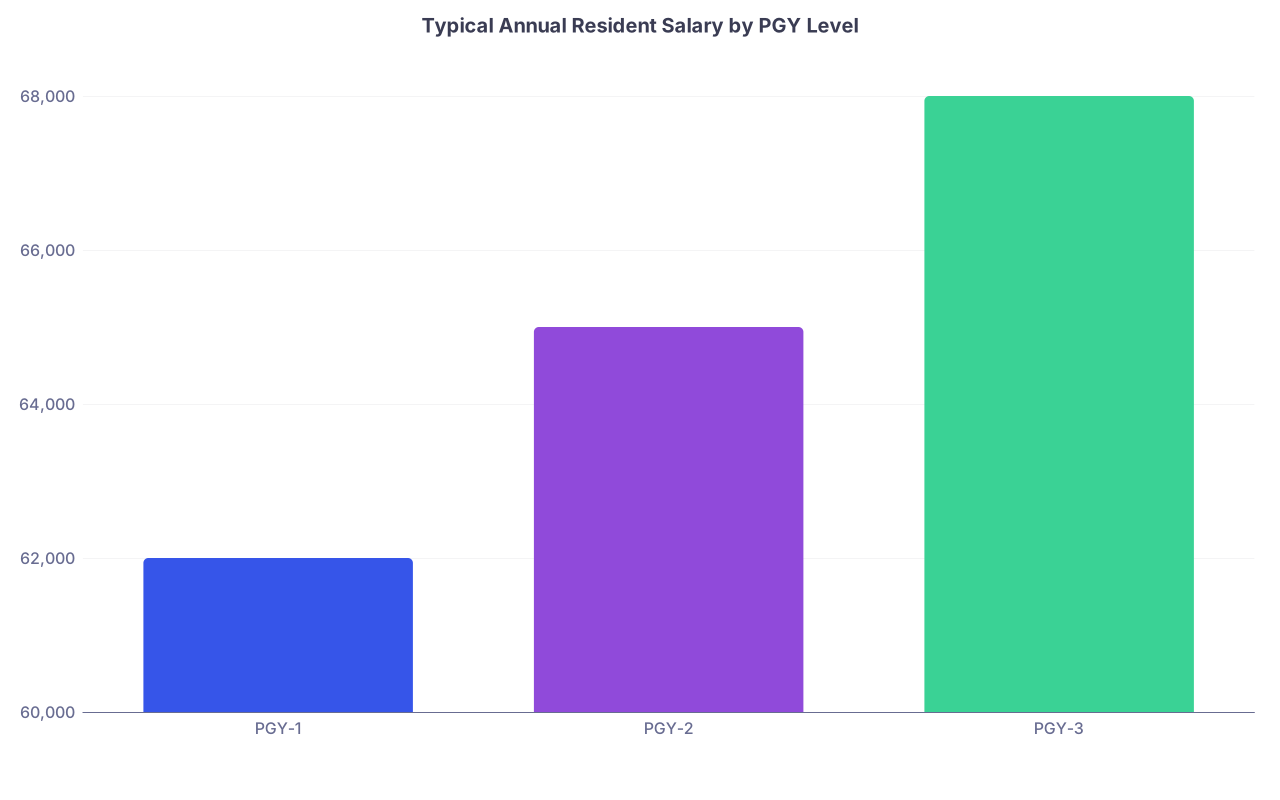
| Category | Value |
|---|---|
| PGY-1 | 62000 |
| PGY-2 | 65000 |
| PGY-3 | 68000 |
The Pre-Residency Setup (March–June Before PGY-1)
If you’re already in PGY-1, skim this and make sure you didn’t miss something crucial.
March (Match Month): Lock the foundation
By this point you should:
Know your starting salary and benefits
- Pull the actual GME contract from the institution website or HR:
- Base salary
- Meal allowance (if any)
- Parking
- Health, disability, and life insurance
- If you do not see disability insurance details, make a note: you’ll fix this later with your own policy.
- Pull the actual GME contract from the institution website or HR:
Estimate your net monthly pay
- Rule-of-thumb:
- $60–70k salary → $3,400–$3,900/month take-home after taxes, retirement, and insurance.
- Put an actual number on paper. Not vibes. Not “should be enough.”
- Rule-of-thumb:
Decide your high-level living plan
- Options:
- Live alone, close, expensive
- Share with roommates, cheaper, maybe farther
- Live with partner/family and share costs
- Lowest-paying specialties cannot afford the “luxury apartment alone because I work hard” fantasy. Not without tradeoffs.
- At this point you should already be thinking: housing must be ≤30% of my take-home pay.
- Options:
April–May: Transition logistics, not lifestyle upgrades
Your goals in these two months:
- Kill expensive med school habits
- Replace Postmates/DoorDash with actual groceries.
- Replace constant Uber/Lyft with a bus pass or used car + careful insurance.
- Plan your move with a hard cap
- Move budget: aim ≤$2,000 if in-state, ≤$3,000 cross-country.
- Use:
- U-Haul + friends
- Sell heavy furniture, rebuy used at destination
- Do not put an entire move on a credit card with no payoff plan. That balance will still be there in PGY-3. I’ve seen it.
June: Final prep before the check hits
At this point you should:
- Set up the right bank structure
- One checking
- One “bills” checking (optional but smart)
- One high-yield savings (emergency fund)
- Turn on autopay for federal loans (if in grace / deferment ending later)
- You want this in place before life gets chaotic.
- Create a bare-bones starter budget
- Use last year’s GME salary posted online.
- Categories: Housing, Utilities, Food, Transportation, Insurance, Minimum debt, Misc.
PGY-1: Survival Year With a Purpose
The goal of PGY-1 in low-paying specialties is not to build wealth. It’s to avoid landmines and set up a financial structure that won’t collapse when you become an attending.
Month 1–2 (July–August): Get control, not cute
You’re exhausted, disoriented, and on nights. Do less, but make it count.
At this point you should:
Nail down your real monthly numbers
- Track every dollar for 30 days. Not forever. One month.
- You want:
- Actual rent + utilities
- Actual food spend (grocery vs eating out)
- Gas/transportation
- Random leaks (subscriptions, parking tickets, late fees)
Choose your student loan strategy (temporary version)
- By end of August:
- Decide: income-driven repayment (IDR) vs forbearance vs PSLF path.
- Low-paying specialties often should consider:
- PSLF if:
- You’re at a 501(c)(3) hospital (most academic centers).
- Debt ≥1.5x your future starting salary.
- Aggressive payoff only if:
- Debt is relatively low (<1x expected attending income).
- PSLF if:
- Do not bounce between forbearance and random plans. You waste time and forgiveness credits.
- By end of August:
Set a minimum emergency buffer target
- PGY-1 goal: $1,000–$2,000 saved by the end of the year.
- Tiny? Yes. Life-changing when your car explodes? Also yes.
Month 3–6 (September–December): System-building
You’re settling in. Now your decisions start compounding.
At this point you should:
Lock your housing cost until PGY-3
- If your lease is painful but survivable and safe, consider staying put.
- Constant moving = constant moving costs = constant furniture churn.
Tune your budget to a simple rule:
- 50–55% Needs (rent, utilities, groceries, transportation)
- 10–15% Financial goals (loans, savings)
- Remainder = lifestyle and sanity
- You’re not aiming for FIRE. You’re trying to not be 35 and furious at your PGY choices.
Get minimal but real insurance in place
- By December you should:
- Enroll in hospital health insurance (done at onboarding, but confirm details).
- Understand disability coverage:
- If it’s “60% of salary” and not portable, you’ll still need a personal policy later.
- Confirm any group life insurance (especially if you have dependents).
- By December you should:
Do one-time setup tasks
- Freeze your credit if you’re not applying for new cards/loans.
- Clean up old credit cards with crazy annual fees (downgrade, don’t always cancel).
Month 7–12 (January–June of PGY-1): Clean up and prepare for a better PGY-2
This is where bad habits usually lock in. Do not let that happen.
At this point you should:
Have a clear student loan path for the next 2 years
- PSLF path:
- On an IDR plan (e.g., SAVE).
- Employment certification forms submitted annually.
- Non-PSLF:
- Refinancing research started near the end of PGY-2, not yet.
- Avoid forbearance unless you’re in true crisis.
- PSLF path:
Try to avoid new recurring payments
- Gym? Fine. One.
- Multiple subscription boxes, streaming packages, luxury car leases? No.
Start a Roth IRA if and only if:
- You’ve hit that $1–2k emergency savings target.
- You’re not in active forbearance bleeding interest with no plan.
- You understand this money is for future-you, not 2-years-from-now-you.
PGY-2: From “I’m surviving” to “I have a plan”
PGY-2 is the most dangerous year financially. You get a raise, you feel less incompetent, and lifestyle creep shows up with a grin.
Your job this year: turn your blurry money situation into a structured system that points directly at your attending life.
Early PGY-2 (July–September): Upgrade your structure, not your lifestyle
By this point you should:
Recalculate your pay and adjust your budget
- New salary: maybe +$2–4k/year.
- Do not mentally treat that as “raise to spend.”
- Decide:
- 50% of raise → loans or savings
- 50% of raise → quality-of-life upgrades (selective, not everything)
Set a concrete end-of-PGY-2 savings target
- For low-paying specialties, a realistic goal:
- Emergency fund: $3,000–$5,000 by end of PGY-2
- Label this clearly in your savings account. “Emergency fund” is less tempting to raid than “extra money.”
- For low-paying specialties, a realistic goal:
Clean up any PGY-1 financial damage
- Pay off:
- High-interest credit card debt
- Med school application residue that never died
- If your credit card APR is >15%, that balance is priority #1, even over small extra loan payments.
- Pay off:
Mid PGY-2 (October–February): Planning for attending life starts here
This is where you quietly win or lose the next decade.
At this point you should:
Clarify your long-term job trajectory
- Decide if you’re:
- Pure outpatient (FM, psych, peds)
- Hospitalist track (IM, peds)
- Fellowship-bound (cards/gi, etc. from IM, child psych from adult psych, etc.)
- Why this matters: it drives your realistic attending salary range.
- Decide if you’re:
Build a simple projected attending budget
- Use conservative starting salary estimates for low-paying specialties:
| Specialty | Conservative Start (Academic) | Conservative Start (Community) |
|---|---|---|
| Family Medicine | $190,000 | $225,000 |
| Pediatrics | $185,000 | $215,000 |
| Psychiatry | $220,000 | $260,000 |
| General Internal | $210,000 | $250,000 |
| Neurology | $230,000 | $270,000 |
- Run rough numbers:
- Federal + state taxes
- 403(b)/401(k) 10–15%
- Loans (PSLF vs refinance vs standard)
- Decide your likely student loan endgame
- By February of PGY-2, you should be leaning clearly toward:
- PSLF through at least 10 years of nonprofit work, or
- Aggressive payoff with refinance 1–2 years into attending life.
- Waffling for 5 more years is what traps people.
- By February of PGY-2, you should be leaning clearly toward:
Late PGY-2 (March–June): Career positioning + protection
At this point you should:
Budget for interview and exam costs
- Board exams, in-training exams, potential fellowship interviews.
- Block off $1–2k as a “professional costs” bucket.
Start thinking about disability insurance seriously
- If you’re within 12–18 months of finishing, you’re in the window where:
- A personal, own-occupation policy makes sense.
- You want:
- True own-occupation
- Non-cancelable
- Benefit enough to replace at least 60% of expected attending income
- If you’re within 12–18 months of finishing, you’re in the window where:
Push emergency savings a bit higher
- End-of-PGY-2 stretch goal: $5–7k.
- Why? PGY-3 comes with looming relocation or early attending transitions.
PGY-3: Launch Prep – Money Milestones That Actually Matter
PGY-3 is not just “finish boards, get out.” In low-paying specialties, this is the last cheap chance to avoid feeling stuck as a new attending.
Early PGY-3 (July–September): Lock in the big decisions
At this point you should:
Be very clear on your post-residency plan
- Academic vs community
- Geography (state matters for cost of living and taxes)
- PSLF vs non-PSLF employer
- Fellowship or straight to attending
Start reviewing job contracts (or fellowship offers) early
- Read every line on:
- Call expectations
- RVU bonuses (often meaningless in peds/psych outpatient but can matter)
- Non-competes
- Relocation assistance and clawbacks
- If needed, pay for one-time contract review with a physician contract attorney. Worth it.
- Read every line on:
Update your loan plan with actual numbers
- Use current:
- Debt balance
- Interest rates
- Counts of qualifying PSLF payments
- Calculate:
- Remaining PSLF timeline, or
- Years to payoff if you refinance at realistic attending payments (e.g., $2–3k/month)
- Use current:
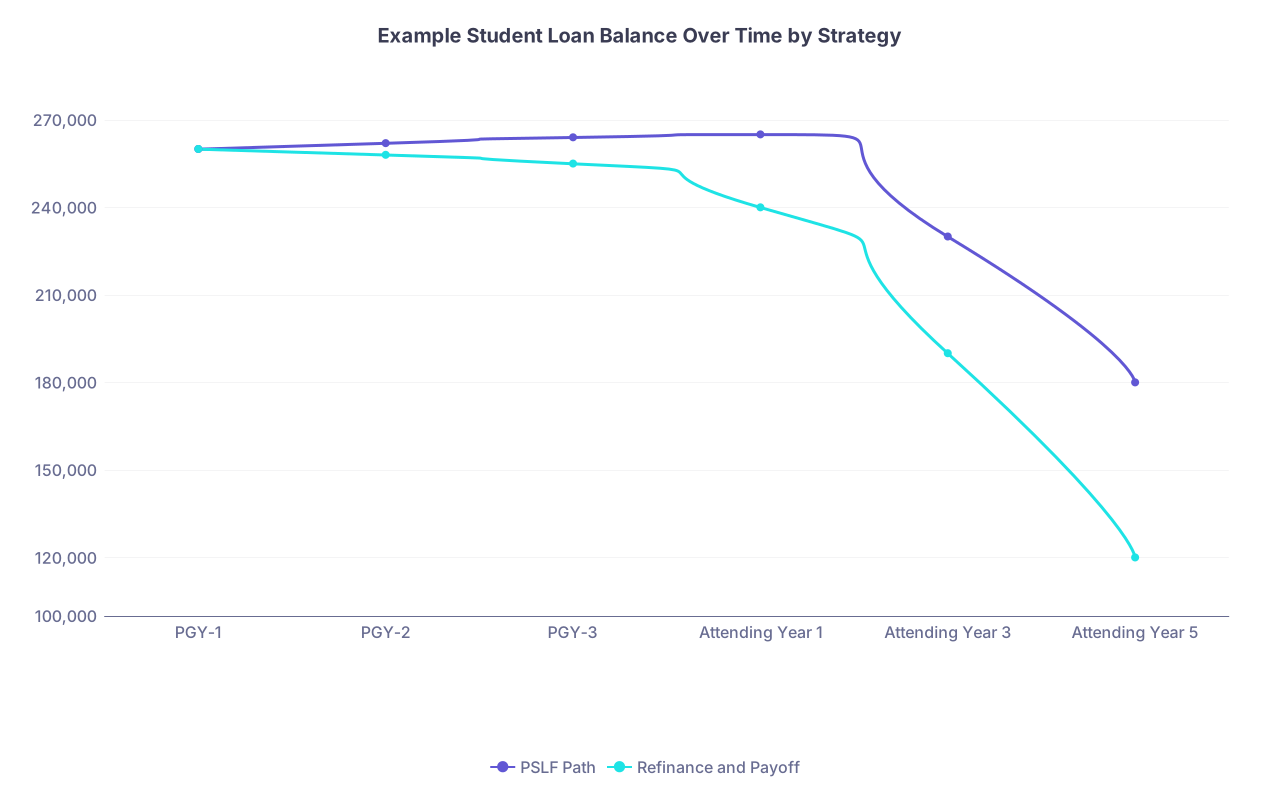
| Category | PSLF Path | Refinance and Payoff |
|---|---|---|
| PGY-1 | 260000 | 260000 |
| PGY-2 | 262000 | 258000 |
| PGY-3 | 264000 | 255000 |
| Attending Year 1 | 265000 | 240000 |
| Attending Year 3 | 230000 | 190000 |
| Attending Year 5 | 180000 | 120000 |
Mid PGY-3 (October–January): Execute the attending transition
This is the heaviest planning window.
At this point you should:
Lock down your first attending job or fellowship
- Ideally signed by:
- December for jobs
- Earlier if fellowship
- Clarify:
- Start date
- Onboarding timeline
- Bonus structure (sign-on, relocation, loan repayment)
- Ideally signed by:
Decide what to do with sign-on and relocation money
- Non-negotiable rule:
- Do not mentally treat a sign-on bonus as “extra.”
- Options ranked:
- Fund 3–6 months of living expenses as an attending transition cushion.
- Kill any remaining high-interest consumer debt.
- Seed a down payment savings fund if you’re buying in 2–3 years, not month 2.
- Non-negotiable rule:
Finalize your emergency fund target by graduation
- PGY-3 minimum: $7–10k
- Ideal if you’re moving/starting job gap: 1–2 months of your expected attending expenses.
Get your personal disability policy in place (if you haven’t yet)
- Do this before you get diagnosed with something annoying that jacks your rates or excludes coverage.
Late PGY-3 (February–Graduation): Tighten the screws
This is where you make final decisions that prevent a financial faceplant as a new attending.
At this point you should:
Plan your move like a project, not a panic
- Create a line-item move budget:
- Movers/truck
- Temporary housing
- Double rent overlap (often 1 month)
- Travel
- Use your emergency fund + any relocation stipend strategically. Do not assume credit cards will magically be fine.
- Create a line-item move budget:
Decide on your first 12 months as an attending: rent vs buy
- My blunt recommendation for low-paying specialties:
- Rent for at least 6–12 months.
- You’re adjusting to:
- New job
- New pay structure
- New city
- You do not need a $600k mortgage on top of that.
- My blunt recommendation for low-paying specialties:
Create a written attending-year money plan
- On one page, answer:
- Target monthly:
- Housing max (≤25–30% of gross is reasonable)
- Student loan payment (PSLF minimum vs aggressive payoff)
- Retirement contribution % (start at 10–15% ASAP)
- Savings (home, future kids, etc.)
- Target monthly:
- Do this before your first attending paycheck hits and lifestyle temptation explodes.
- On one page, answer:

Specialty-Specific Realities You Should Respect
Different “low-paying” specialties have different financial traps. By mid-residency, you should be aware of your specialty’s quirks.
Family Medicine / General Internal Medicine
- Trap: accepting low-structure salaried jobs with hidden RVU expectations.
- Strategy by PGY-3:
- Compare at least 3 offers (academic vs community vs FQHC).
- Understand panel expectations: how many patients/day, how many days/week.
- If PSLF: FQHC or academic + IDR + 403(b)/401(k) match can be a strong combo.
Pediatrics
- Trap: very low pay in certain markets + expensive cities.
- Strategy:
- Be ruthless about geography. HCOL + low peds pay = you feel poor for a long time.
- Strongly consider PSLF if debt is high.
- Push harder to keep housing costs down in the first 5 attending years.
Psychiatry
- Trap: the illusion of “I’m low-paid” when in reality, psych’s floor has risen with demand.
- Strategy:
- Explore community mental health centers (PSLF-eligible) for 3–5 years to crush loans.
- If you moonlight as PGY-3, ringfence that income: 100% to loans or savings.
Neurology
- Trap: being underpaid in academic settings while doing complex, heavy work.
- Strategy:
- Consider starting in a somewhat higher-paying community job for 3–5 years to stabilize financially, then pivot academic if wanted.
- Do not accept “that’s just how neurology pays” without comparing offers across regions.
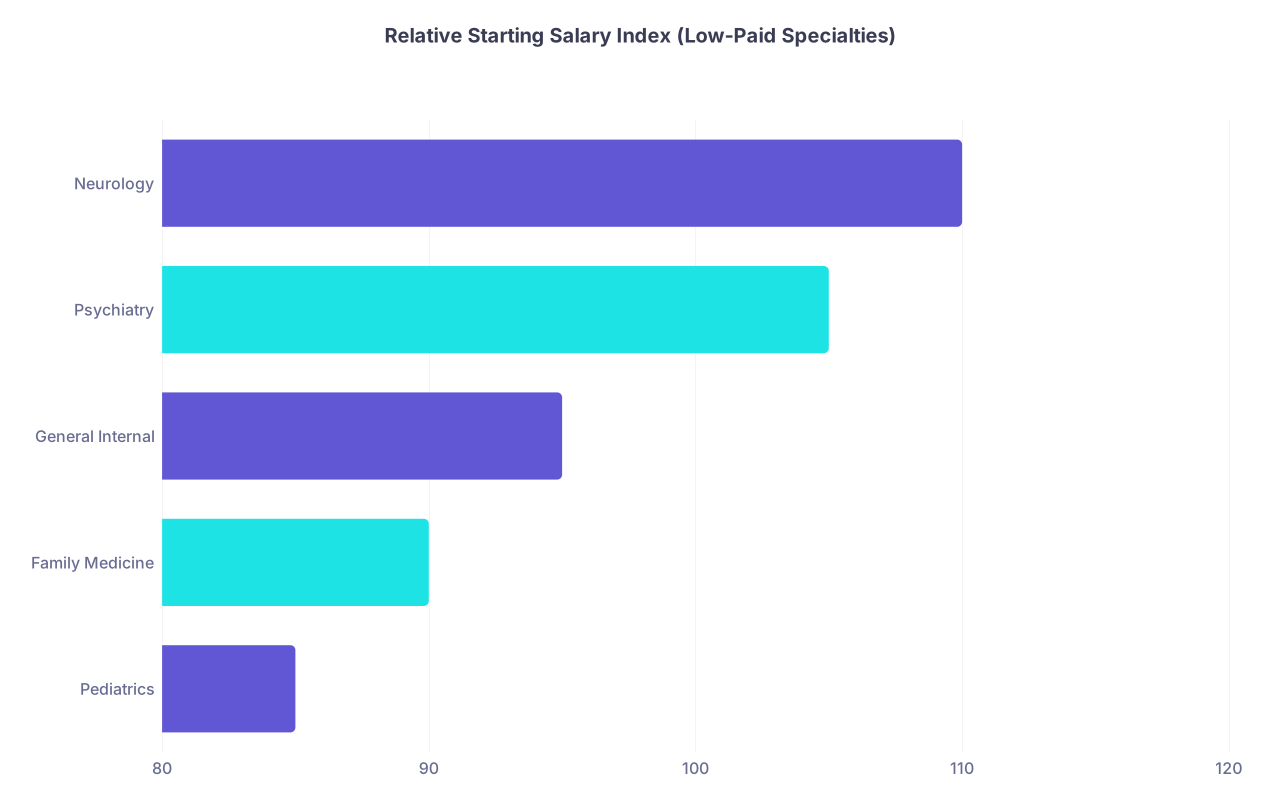
| Category | Value |
|---|---|
| Pediatrics | 85 |
| Family Medicine | 90 |
| General Internal | 95 |
| Psychiatry | 105 |
| Neurology | 110 |
Moonlighting: Where It Fits in PGY 1–3
People will oversell moonlighting as the magic fix. It is not.
When moonlighting actually makes sense
- Program allows it (later PGY usually).
- You’re not drowning clinically or mentally.
- You can direct that income to:
- High-interest debt
- Emergency fund completion
- Future moving/transition costs
When it’s a bad idea
- You’re using it to fund a lifestyle you can’t sustain on base pay.
- Your exhaustion is bleeding into your core residency performance.
- You have unstable mental or physical health and you’re ignoring that for cash.
At this point (late PGY-2 to PGY-3), you should be using moonlighting—if you do it—to accelerate specific goals, not to plug endless holes in an inflated budget.

Final 30-Day Checklist Before You Graduate
You’re 1 month from finishing. Here’s what should already be done:
- Job or fellowship contract signed, start date confirmed.
- Moving budget set and mostly funded.
- Emergency fund at least $7–10k or 1–2 months of expected attending expenses.
- Student loan strategy selected and not theoretical:
- PSLF: employment certification, IDR set.
- Refinance plan: lenders researched, timing decided (usually after first attending paychecks).
- Disability policy in force or actively in underwriting.
- One-page attending budget sketched, with:
- Housing max
- Loan payment target
- Retirement contribution %
- Savings goals
If You Remember Nothing Else
- These three years are about structure, not wealth. PGY-1–3 should give you a clean launch path, not a miracle bank account.
- Low-paying specialties cannot rely on “I’ll just earn my way out of it.” Your geography, loan plan, and housing choices matter more than you think.
- Every year of residency should have a clear money milestone: small emergency fund (PGY-1), stable system and defined loan path (PGY-2), and a fully planned attending transition (PGY-3).


