

It is January of your MS3 year. You just left a clinic day in pediatrics or family medicine and, annoyingly, you loved it. You also have $280,000 in federal loans and a rough sense that “these are not derm or ortho salaries.”
You are now in the danger zone: late enough that debt is real, early enough that you could still make some very expensive mistakes with consolidation, refinancing, or ignoring PSLF.
Let’s walk this out chronologically—MS3 through end of residency—so you know exactly when to commit to a loan strategy if you are heading toward a lower-paying field like:
- Pediatrics (general)
- Child psychiatry
- Family medicine
- Geriatrics
- Endocrinology
- Infectious disease
- Academic primary care
…or anything else where “mid–six figures out of fellowship” is not the norm.
Big Picture: Your Loan Strategy Deadline Map
Here is the rough structure. Then we will go month by month.
- MS3 early–mid: Explore specialties + learn loan vocabulary. No big moves yet.
- MS3 late (6–9 months before ERAS): Narrow specialty. Start sketching PSLF vs non‑PSLF path.
- MS4 spring (around rank list): This is the hard decision point. Your likely career income and residency setting are visible. You should be 80–90% locked on a long‑term plan.
- Intern year (first 3–6 months): Final chance to fix major structural errors (wrong repayment plan, missed PSLF qualifying months, bad consolidation timing).
- PGY2–PGY3: Strategy is set. You only do tuning: overpayments, saving for potential refinancing, deciding fellowship.
- End of residency / fellowship: Second big decision node. Public vs private job. PSLF vs refinance vs aggressive payoff.
You cannot wait until attending life to “figure out loans” if you choose a low‑salary specialty. By then, you have already either wasted or preserved PSLF eligibility, and you do not get to rewind.
MS3: Exploration Year (But Start the Clock)
You are here: rotating on core clerkships, maybe halfway through the year, starting to realize you prefer talking to families and sorting social issues over doing procedures all day.
At this stage, your goal is not to lock in anything. Your goal is to avoid burning future options.
What you should do this year
1. Make all your loans federal, and leave them that way.
If you have:
- Direct Subsidized / Unsubsidized
- Grad PLUS
- Perkins (older folks)
Do not refinance any of these to private. That would nuke PSLF permanently.
If you still have some older FFEL or Perkins loans:
- Flag them now. You will likely want to consolidate them later into a Direct Consolidation Loan for PSLF.
- But do not rush the consolidation during MS3 unless you know exactly why.
2. Learn the three acronyms that actually matter:
- IDR (Income-Driven Repayment) – your monthly payment is a percentage of income.
- PSLF (Public Service Loan Forgiveness) – 120 qualifying payments while working full-time at a 501(c)(3) or government employer.
- SAVE (and sometimes PAYE/IBR for older borrowers) – the specific IDR plans.
If you are eyeing pediatrics, family med, IM with a primary-care mindset, or psych, PSLF will almost always be the dominant default strategy. Low salary, high debt, and public/academic employment line up perfectly.
3. Roughly model your debt vs income path.
One evening. Coffee. Not a 6-hour spreadsheet ordeal.
- Project:
- Debt at graduation (principal + estimated accrued interest).
- Probable residency program type (most peds/FM programs are PSLF-eligible hospitals).
- Attending salary bands for your field.
For example:
| Path | Debt at Grad | Residency Salary | Early Attending Salary |
|---|---|---|---|
| General Pediatrics | $260,000 | $62,000–$70,000 | $170,000–$210,000 |
| Family Medicine | $280,000 | $60,000–$68,000 | $190,000–$230,000 |
| Child Psychiatry | $280,000 | $62,000–$72,000 | $210,000–$260,000 |
| Infectious Disease | $300,000 | $65,000–$75,000 | $200,000–$240,000 |
The conclusion you will likely reach: on a pure math basis, PSLF + low IDR payments during training usually beats refinancing and brute-force repayment for these income levels.
What you should NOT do in MS3
- Do not refinance to a private lender based on a slick email.
- Do not consolidate everything blindly just because you read “consolidate for PSLF.”
- Do not choose a specialty based on loan anxiety alone. You will resent that later.
You are still in reconnaissance mode.
Late MS3 to Early MS4: Narrowing Specialty = Drafting Loan Plan
Now it is July–September before ERAS. You are scheduling sub‑Is: peds at a university hospital, FM at your home institution. At this point, specialty probability is high enough that your loan strategy should begin matching your likely field.
At this point you should…
1. Decide: Is PSLF Plan A or not?
If all three are true, PSLF should be assumed as Plan A:
- You expect to train in a hospital-based residency (which is almost always a qualifying employer).
- You are leaning toward a relatively low-paying specialty.
- Your total loans at graduation will be more than 1.5× your expected starting attending salary.
Example: $300,000 debt vs $200,000–$220,000 FM salary → PSLF heavily favored.
If you are truly planning private practice in a rural FM group, no academic ties, or locums-heavy life, you can mentally tag PSLF as “maybe,” but do not close the door yet. People change jobs. A lot.
2. Start planning your first repayment plan choice.
During MS4 you will enter repayment (or at least start the process). For most new grads now, the best default is:
- SAVE (IDR) as your primary repayment plan.
- File taxes in a way that supports your strategy (more on this at the residency step).
Why SAVE?
- Lowest payments for most borrowers with high debt-to-income.
- More interest subsidy (prevents balances from exploding as fast).
- Fully PSLF‑qualifying.
Decision checkpoint: before ERAS submission
By ERAS submission (September-ish MS4), you should have:
- Confirmed all your loans are federal and identified any that need future consolidation.
- Sketched a “likely PSLF” vs “likely refinance” future based on your chosen specialty.
- Decided: “Unless something dramatic changes, I will start residency on IDR (SAVE) and keep PSLF open.”
You are not locking in yet, but you are choosing the lane you will default into.
MS4 Spring: Rank List = Time to Commit (80–90%)
Now it is February. You are certifying your rank list. You know:
- Which specialties you ranked.
- The nature of the programs (university hospital vs small community, 501(c)(3) vs private).
- Whether you are considering fellowship.
At this point your loan strategy should be basically decided unless you match into something very unexpected.
What you must do around rank list / pre‑Match
1. Explicitly answer 3 questions:
- Am I planning to stay in a hospital/academic/government setting for at least the first 10 years after graduation (including residency/fellowship)?
- Do my income and debt justify PSLF mathematically?
- Am I willing to structure my job search around PSLF‑eligible employers for a while?
If the honest answer to (1) and (2) is “yes” and to (3) is “at least somewhat,” then your plan is:
PSLF + IDR, no private refinancing, consolidate only what is required to get everything Direct.
That is your baseline.
2. Clean up your loan file before graduation
- Make sure your NSLDS record shows:
- All loans as Direct or slated for Direct Consolidation.
- No stray FFEL or Perkins left out of your mental plan.
- Decide whether to consolidate immediately after graduation to start PSLF counting or to time it at the start of residency. There are pros and cons:
- Earlier consolidation → earlier PSLF qualifying months.
- But you can sometimes use a low prior-year income for IDR if you time it well.
For most low-paid specialties, the earlier PSLF clock starts, the better.
Transition to Residency (Match → PGY1 Month 3): Lock the Structure
You matched into peds at a children’s hospital or FM at a county hospital. These are almost always PSLF‑eligible. This is the true structural lock‑in window—roughly Match Day through the first 3–6 months of residency.
At this point, you should implement what you decided, not reinvent the wheel.
Month-by-month: PGY1 early timeline
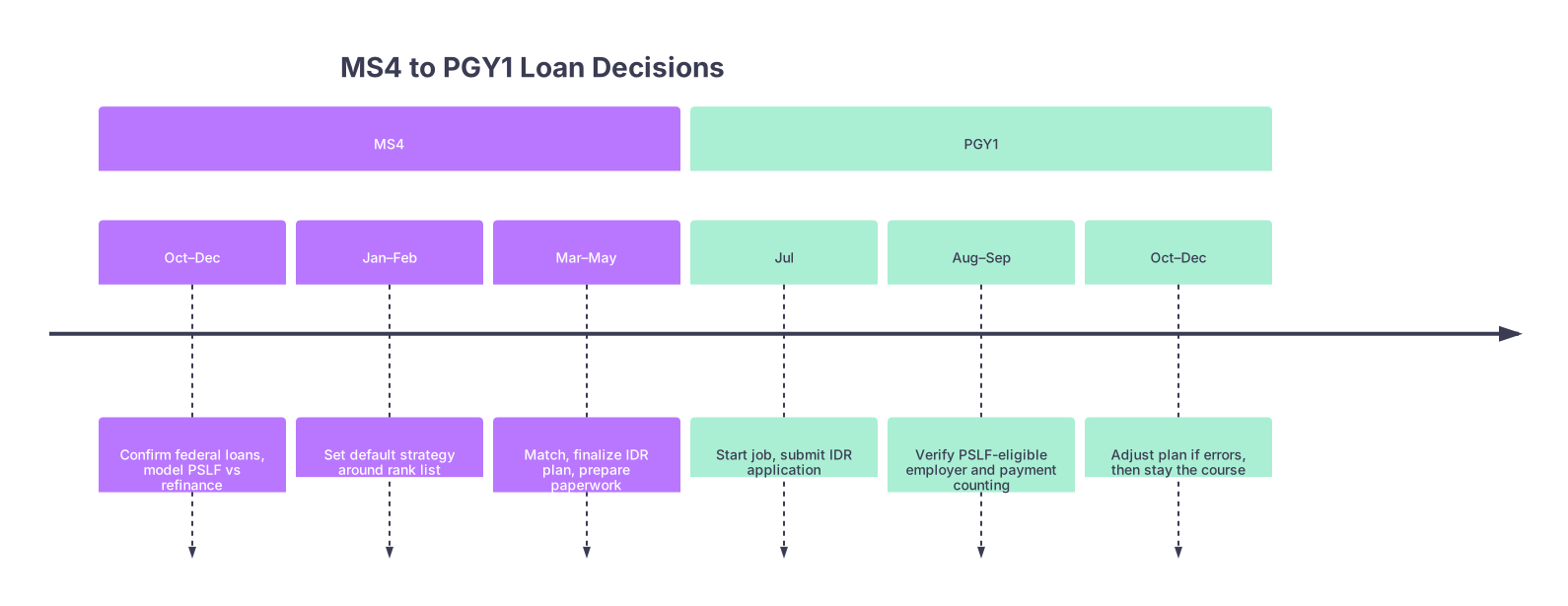
| Period | Event |
|---|---|
| MS4 - Oct–Dec | Confirm federal loans, model PSLF vs refinance |
| MS4 - Jan–Feb | Set default strategy around rank list |
| MS4 - Mar–May | Match, finalize IDR plan, prepare paperwork |
| PGY1 - Jul | Start job, submit IDR application |
| PGY1 - Aug–Sep | Verify PSLF-eligible employer and payment counting |
| PGY1 - Oct–Dec | Adjust plan if errors, then stay the course |
PGY1 Month 0–1 (right after graduation)
At this point you should:
- Consolidate to Direct (if needed).
- Include FFEL/Perkins to make them PSLF‑eligible.
- Do not include Parent PLUS loans with your own loans; that creates problems.
- Select IDR (preferably SAVE) ASAP.
- Apply for PSLF Employment Certification once you have your residency HR info. You want a paper trail from day one.
PGY1 Month 2–3
This is the last realistic window to correct big errors:
- Verify your payment plan is IDR, not a random standard or graduated plan.
- Confirm your employer qualifies for PSLF (501(c)(3) or government; HR can confirm).
- Check that your first payments are showing up as qualifying in your PSLF account (this can lag, but you can at least see if FedLoan/MOHELA has your forms).
If you reach the end of PGY1 still “undecided” about PSLF vs refinance, you are doing it wrong in a low-paid specialty. You do not need the final attending job locked in, but the structural strategy must be.
PGY2–PGY3 (and Fellowship): Stay the Course, Tune the Details
By now, the decision is made:
- You are in pediatrics, FM, psych, or another low-paying field.
- You are on SAVE or another IDR.
- Your employer is PSLF‑eligible.
At this point you do NOT overhaul the plan every year. That is how people lose track and make mistakes.
At this point you should focus on:
1. Tax filing strategy each year
- If you are married or getting married:
- Decide whether to file Married Filing Separately (MFS) to keep your IDR payment based on your income alone.
- This matters a lot if your spouse has high income and low/no debt.
- Re-certify income on time every year. Late recertifications can bump you to the standard plan temporarily and mess with cash flow (but generally do not kill PSLF).
2. Decide about fellowship early
Because in low-paid specialties, fellowship often means more PSLF‑qualifying years at low IDR payments:
- General peds → peds heme-onc, NICU, etc.
- IM → ID, endo, rheum, geriatrics.
- Psych → child, addiction, forensics.
Fellowship can be financially neutral or even favorable under PSLF, because you are stacking more low‑income years toward the 120 payments.
3. Avoid private refinancing temptations
You will see emails offering “resident refinance” at 4–6% vs your current 7% federal rate. In a low-salary field with any plausibility of PSLF, refinancing during training is usually a bad call:
- You forfeit:
- PSLF option.
- SAVE interest subsidies.
- IDR flexibility if life implodes (leave medicine, disability, etc.).
You consider refinancing only if three conditions are met later:
- You are certain you will not use PSLF.
- Your debt-to-income ratio is reasonably low (≤1.5×).
- You have an emergency fund started and stable job prospects.
That is usually attending-level decisions, not PGY2 peds.
End of Residency / Fellowship: Second Big Fork in the Road
Now you are a PGY3 FM resident or a PGY6 child psych fellow. You are looking at job offers. This is the second (and last) major “lock in” moment.
At this point you must line up 3 decisions:
1. Job type vs PSLF status
Look at your offers:
- Academic children’s hospital – 100% PSLF‑eligible.
- Large nonprofit community hospital – usually PSLF‑eligible.
- FQHC / community health center – PSLF‑eligible + sometimes extra loan repayment.
- Private group practice, private equity clinic – usually not PSLF‑eligible.
You line your job choice up with your forgiveness stage:
- If you are < 7–8 years into PSLF payments:
- Strong preference to stay at PSLF‑eligible employers.
- Jumping to private practice now often destroys the value of the forgiveness you have built.
- If you are 10–11 years in (maybe you had pre‑residency payments or no gap years):
- You may finish PSLF early in attending life, then are totally free to go private.
2. Decide: Finish PSLF vs Refinance and Pay Aggressively
You should compare three scenarios right before you sign:
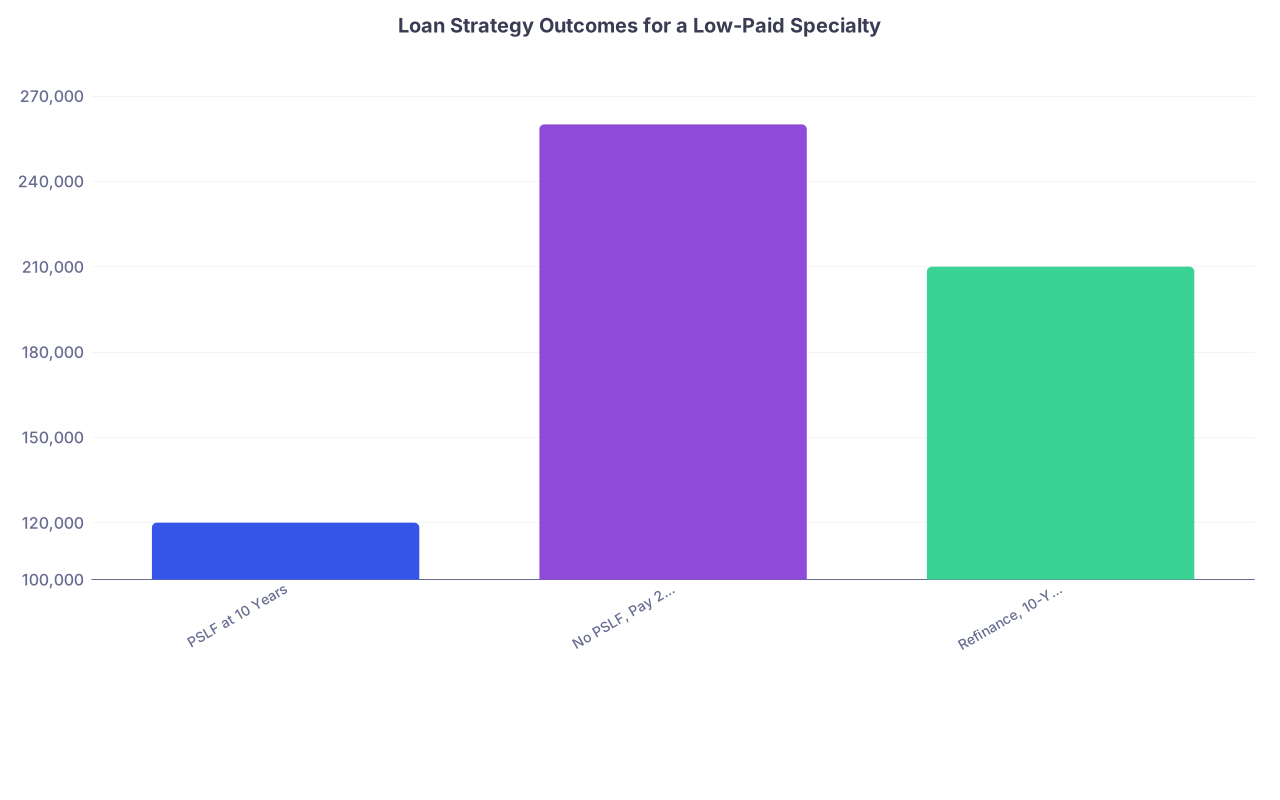
| Category | Value |
|---|---|
| PSLF at 10 Years | 120000 |
| No PSLF, Pay 20 Years IDR | 260000 |
| Refinance, 10-Year Standard | 210000 |
Interpretation (example for $280k debt, family med, modest academic salary):
- PSLF at 10 years – You pay relatively low IDR amounts for a decade and have a large chunk forgiven tax-free. Often the best deal for low-paid fields.
- No PSLF, 20-year IDR – Total paid can be higher, and there may be tax implications at forgiveness.
- Refinance, 10-year payoff – Works only if your income is strong enough and lifestyle modest; more attractive for high-paid fields, less so here.
For most genuinely low-paid specialties, if you have already done 6–7 PSLF years in training, finishing the full 10 is almost always the smartest financial move, unless you marry someone with very high income and low debt and your IDR payments skyrocket.
3. If you skip PSLF, time your refinance tightly
If you decide PSLF is not happening (or you strategically abandon it early because your debt is relatively small):
- Refinance as you start attending pay, not before:
- Use the higher income to qualify for better rates.
- Avoid having large private payments while still on resident salary.
- Pick the shortest term you can reasonably handle (7–10 years) without destroying your quality of life.
Common Mis-Timing Mistakes (That Hurt Low-Salary Specialists)
I have watched these play out repeatedly:
Refinancing during PGY1 “just to get a lower rate.”
You save a bit on interest but lose PSLF – often a six‑figure mistake.Ignoring PSLF paperwork until PGY3.
Payments still count if conditions were met, but documentation is a headache and people miss qualifying months because they were on the wrong plan.Jumping to a non‑PSLF private job in year 7 or 8.
You did the hard part (low income years) then walked away before the benefit. Brutal.Choosing a specialty based on fear of loans instead of fit.
I have seen students avoid peds because “the pay is too low for my loans,” then burn out in hospitalist or procedural fields. With PSLF used properly, low-paid specialties are often entirely viable.
Quick Phase Summary: When You Should Be “Locked In”
| Phase | Loan Strategy Status |
|---|---|
| Early–Mid MS3 | Explore only, keep all federal, no refinance |
| Late MS3 – Early MS4 | Choose PSLF as default or not, no big moves |
| MS4 (rank list to Match) | 80–90% committed to PSLF vs non‑PSLF path |
| PGY1 (first 3–6 months) | Fully lock structure: IDR, consolidation, PSLF |
| PGY2–PGY3 / Fellowship | Stay the course, tune taxes and overpayments |
| End of Training | Final decision: PSLF completion vs refinance |
FAQs
1. I am not 100% sure I will stay in academics. Should I still act like I am doing PSLF?
Yes. In a low-paid specialty, default toward preserving PSLF. Keep loans federal, use SAVE or another IDR, and work at qualifying institutions during training. If you later decide private practice is your future, you can always pivot and refinance. You cannot undo a private refinance.
2. Does it ever make sense to refinance during residency for a low-salary specialty?
Almost never. The only scenario where I would even consider it: relatively low debt (say <$120k), spouse with very high stable income, and you are certain PSLF will not apply because you are going to a non‑qualifying private program and private practice thereafter. That is not the typical peds/FM/psych resident.
3. What if my attending job is half academic, half private? How does that affect timing?
You check who is actually paying you and who your W‑2 lists. If your employer is a 501(c)(3) or government entity, those years count for PSLF even if you moonlight some private work. If your primary employer is a private group, that time will not count, no matter how “academic” the role feels. You base your strategy on the primary employer type.
4. I matched into a PSLF-eligible residency but think I will switch to a higher-paying specialty later. Should I bother with PSLF now?
Yes. Qualifying months are “portable” across specialties. If you switch from peds to anesthesia, your first 2–3 PSLF‑qualifying years in peds still count. That early foundation keeps options open. You only turn off PSLF (via private refinance) when you are confident long‑term high income makes forgiveness unnecessary or less attractive.
Key points:
- For low-salary specialties, you should be functionally committed to PSLF + IDR by the end of PGY1, not “sometime as an attending.”
- Do not refinance to private during training if there is even a moderate chance you will use PSLF. That is the one move you cannot undo.
- Your two real decision checkpoints are: MS4 around rank list / Match and end of training before first real job. Treat those as hard deadlines, not vague intentions.


