

You are here
It is February of your PGY‑2 year in pediatrics (or psych, family med, geriatrics, PM&R). You just finished another 65‑hour week, your checking account is hovering dangerously close to zero, and an attending drops the line that haunts every low‑paid specialty resident:
“So… have you thought about fellowship? You’d be great in [insert niche here].”
You nod. You mumble something about “keeping options open.” But in your head you are doing math:
- Extra 1–3 years at $65–75k
- Loans compounding
- An attending salary that is already on the low end of medicine
- Maybe a small pay bump if you subspecialize. Maybe.
This is not an abstract “career passion” question. It is a timeline problem. You have 12–18 months where your decisions actually matter. After that, doors start to close.
Let me walk you through what to do, month by month and then year by year, so you are not making a six‑figure mistake in a 20‑minute conversation with your program director.
First: Know the financial stakes early (PGY‑1, Months 1–6)
At this point you should stop hand‑waving the money question. You are not above it. No one is.
By the end of PGY‑1, you should have a concrete picture of how fellowship alters your lifetime earnings and lifestyle, especially in low‑paid fields.
Months 1–3 of PGY‑1: Baseline financial reality
By the end of your first quarter as an intern:
Pull real numbers, not vibes.
Do this in one focused evening:- Look up median attending salaries in your field and subspecialties you are already hearing about:
- Pediatrics: general vs NICU vs heme/onc vs PICU
- Psychiatry: general vs child/adolescent vs addiction vs CL
- Family medicine: outpatient vs sports vs geriatrics vs palliative
- PM&R: general vs pain vs sports vs brain injury
- Find local numbers where you realistically might live, not just national medians.
- Look up median attending salaries in your field and subspecialties you are already hearing about:
List your actual debt and interest rates.
Federal, private, undergrad, car loans, everything. One document.Run two very rough scenarios on a back‑of‑the‑envelope level:
- Path A: Finish residency → attendingship
- Path B: Fellowship (1–3 years) → attendingship
You do not need a perfect model. You need to see the order of magnitude difference. That alone will wake you up.
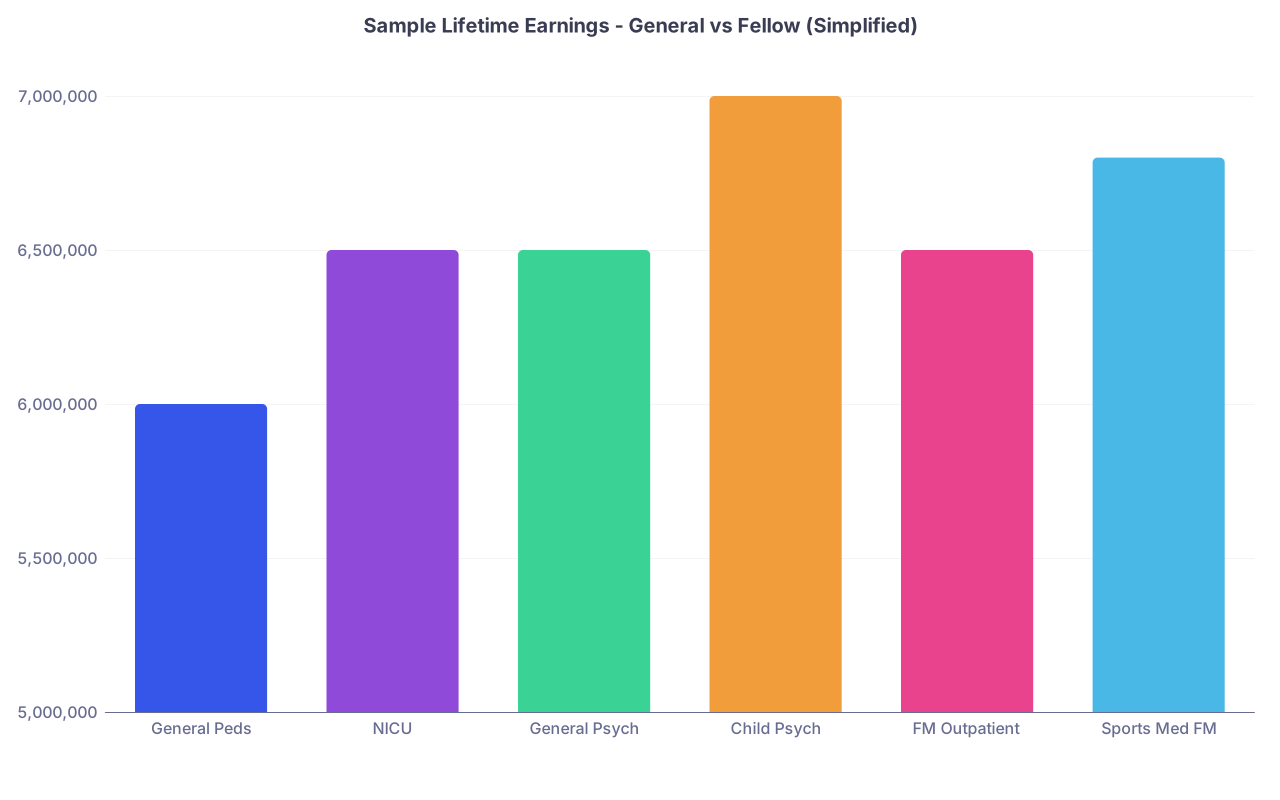
| Category | Value |
|---|---|
| General Peds | 6000000 |
| NICU | 6500000 |
| General Psych | 6500000 |
| Child Psych | 7000000 |
| FM Outpatient | 6500000 |
| Sports Med FM | 6800000 |
Interpretation: Yes, some fellowships bump income a bit. No, they rarely transform a low‑paid field into a derm‑level paycheck. That fantasy needs to die now.
Months 4–6 of PGY‑1: Early exposure, not commitments
At this point you should be sampling, not deciding.
Rotate through or at least shadow the main fellowships attached to your field.
Example for pediatrics:- NICU
- PICU
- Cardiology
- Heme/Onc
- Endocrine
For each, ask yourself three blunt questions:
- Could I tolerate this call schedule for 20 years?
- Do I actually like these patients and problems, or do I just like that the attendings seem “more respected”?
- Would the likely pay bump justify delaying my real salary by 3 more years?
Document your answers in one simple note on your phone after each rotation. Not cute journaling. Just bullet points and a gut‑check sentence.
The decision year starts earlier than you think (PGY‑2, Months 1–12)
By early PGY‑2, the clock is already ticking. Fellowship applications in most fields go in mid‑PGY‑3. That means your decision is essentially made 12–18 months before you hit “submit.”
PGY‑2, Months 1–3: Reality check with people 5–10 years ahead of you
At this point you should be having targeted conversations, not random hallway chats.
Make a list of:
- 2–3 generalists in your field who seem actually content
- 2–3 subspecialists in fellowships you are considering
- 1–2 people who left or avoided fellowship and are blunt about it
Schedule 20‑minute sit‑downs and ask the same structured questions:
- What is your real schedule in an average week (not the brochure)?
- What was your income as a new attending, and what is it now?
- Is your job different enough from general practice to justify the extra training?
- If you had to decide again at my stage, what would you do?
You are looking for patterns. If three pediatric intensivists tell you, “I love the medicine but the nights are aging me 2–3 years per year,” listen.
PGY‑2, Months 4–6: Start drawing paths on paper
Around this time, you should build out 2–3 specific timelines for your own life. On actual paper or a simple document. Not in your head.
Example for a PGY‑2 in psychiatry:
Path A – General Psych Only
- Finish residency: June 20XX
- Start community outpatient job: Aug 20XX, $260k, minimal call
- Qualify for PSLF at 10 years: age 36
- 3–4 days per week by age 40 if desired
Path B – Child & Adolescent Fellowship
- Fellowship: July 20XX–June 20XX+2, salary ~$70k → still living like a resident
- Attending child psych: start July 20XX+2, $280–300k, higher demand
- May have more protected outpatient work and telepsych options
Now the key step: look at those timelines next to your non‑medical life:
- Partner plans
- Kids
- Geographic preferences
- Burnout risk
At this point, clear misfits usually appear. If your partner wants to move closer to family ASAP and start IVF, another 2–3 years of training may be flatly incompatible. That matters more than the “prestige” of a fellowship.
The actual application window (Late PGY‑2 to Mid PGY‑3)
Here is where residents mess up: they treat the fellowship application date as the starting line. It is not. It is the finish line of your decision process.
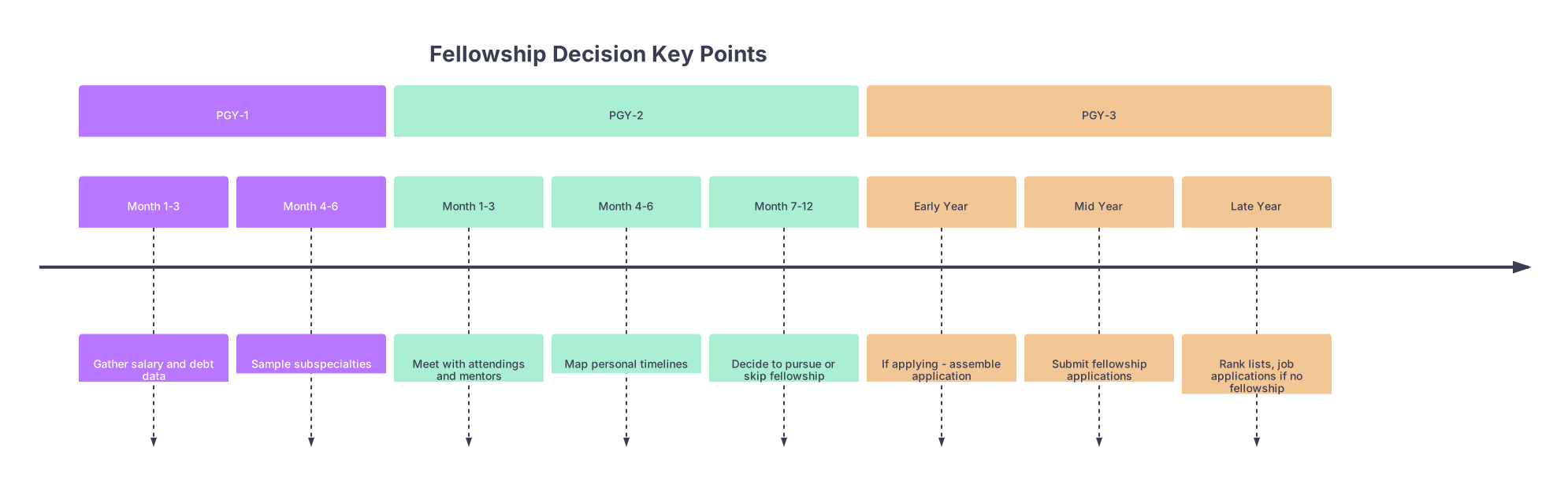
| Period | Event |
|---|---|
| PGY-1 - Month 1-3 | Gather salary and debt data |
| PGY-1 - Month 4-6 | Sample subspecialties |
| PGY-2 - Month 1-3 | Meet with attendings and mentors |
| PGY-2 - Month 4-6 | Map personal timelines |
| PGY-2 - Month 7-12 | Decide to pursue or skip fellowship |
| PGY-3 - Early Year | If applying - assemble application |
| PGY-3 - Mid Year | Submit fellowship applications |
| PGY-3 - Late Year | Rank lists, job applications if no fellowship |
PGY‑2, Months 7–12: Make a provisional yes/no call
By the end of PGY‑2, you should have a working decision:
- “I am likely applying to fellowship in X.”
- “I am very likely not applying to any fellowship.”
Not a 51–49 wobble. Something closer to 80–20. Why? Because the work required diverges sharply here.
If you think you “might as well apply and see,” that is usually code for: “I do not want to make a decision, so I’ll let the match make it for me.” That is how people drift into 2–3 extra years of training they never really wanted.
PGY‑3, Months 1–3 (for likely fellowship applicants): Build the file
If you are leaning yes on fellowship, then at this point you should:
Lock in 2–3 letter writers early.
- At least one from the subspecialty
- At least one from a generalist who can speak to your reliability and work ethic
Clarify your narrative in one paragraph:
- Why this field
- What kinds of patients or problems you want to own
- How you picture your day‑to‑day job after training
If you cannot write that paragraph without cliché (“I love complex patients,” “I value continuity of care”), you probably are not ready to sacrifice 2–3 more years for this.
PGY‑3, Months 1–3 (for likely non‑fellows): Shift energy to job hunting
If you are leaning no on fellowship, do not coast. At this point you should:
- Start tracking job postings in your target cities
- Talk to recently graduated seniors about their job searches
- Identify 3–5 employer types you are willing to consider:
- Academic center
- Large private group
- FQHC
- VA / government
- Hospital‑employed
This is not background noise. A strong job lined up early will do more for your life satisfaction than accidentally landing a mediocre fellowship you feel lukewarm about.
Specialty‑specific fellowship value: Where the math changes
Not all fellowships in low‑paid fields are created equal. Some are economically neutral. Some are career accelerators. Some are borderline irrational unless you are obsessed with the work.
Here is a quick, oversimplified but directionally correct snapshot:
| Base Field | Fellowship Example | Typical Length | Pay Effect | Lifestyle Effect |
|---|---|---|---|---|
| Pediatrics | NICU | 3 years | Moderate ↑ | Nights, intensity ↑ |
| Pediatrics | Endocrine | 3 years | Neutral/↓ | Clinic heavy, calmer |
| Psychiatry | Child/Adolescent | 2 years | Mild ↑ | More outpatient, high demand |
| Family Med | Sports Med | 1 year | Mild ↑ | Procedure heavy, variable call |
| PM&R | Pain | 1 year | Significant ↑ | More procedures, often high RVU |
The point: “Fellowship” is not a single thing. You are choosing a specific job archetype 5–10 years from now, not a generic button that says “+status.”
Red flags and decision traps along the way
There are a few patterns I see over and over that you want to catch early in this timeline.
Trap 1: Using fellowship to avoid the real world
If by mid‑PGY‑2 your main argument for fellowship is some version of:
- “I do not feel ready to be an attending.”
- “I am scared of being on my own.”
- “Everyone else here seems to be applying.”
Then pause. That is not a reason to trade 2–3 years of your life for a title.
At this point you should focus on:
- Asking seniors and attendings what “normal uncertainty” feels like as a new attending
- Taking on more supervised autonomy in residency so you can test yourself in a safer space
Being scared is expected. Doing extra training purely as emotional bubble wrap is not a good long‑term strategy.
Trap 2: Romanticizing subspecialty lifestyle
Residents often see:
- NICU attending working 7 on / 7 off, making decent money, on service maybe 26 weeks/year
- Child psych attending with a half day of telehealth from home
- Sports med FM doc doing injections and ultrasound, no inpatient calls
What you do not see:
- Years of intense night shifts or weekend call
- RVU pressure in pain or sports practices
- Narrow job markets where you have to live where the jobs are
You should explicitly ask:
“If I want to live in [specific city/region], how many real jobs exist for this fellowship path?”
I have seen more than one fellow trapped in a city they dislike or commuting insane distances because the niche job market is so thin.
Year‑by‑year snapshot: What to do, when
Let us zoom out. From the first day of PGY‑1 to the end of PGY‑3, here is your decision scaffolding.
PGY‑1: Exploration and math
Q1:
- Gather salary data and your complete debt picture
- Roughly compare generalist vs 1–2 fellowship paths financially
Q2–Q3:
- Rotate or shadow major subspecialties
- Capture immediate reactions after each
Q4:
- Identify 2–3 attendings to watch more closely over time as “future me” prototypes
Goal by end of PGY‑1:
You can articulate two or three plausible futures for yourself (generalist in X setting, subspecialist Y in Z setting), not just hand‑wave “maybe a fellowship.”
PGY‑2: Decision building, not decision delaying
Q1–Q2:
- Structured 1:1 conversations with generalists and subspecialists
- Build 2–3 written life timelines (career + personal)
Q3:
- Narrow serious fellowship interests to one path, or consciously decide, “I am exploring but leaning away from fellowship.”
Q4:
- Make provisional call:
- Likely fellowship applicant → start lining up letters, research/teaching experience if needed
- Likely non‑fellow → start early job research, CV polishing
- Make provisional call:
Goal by end of PGY‑2:
You have an 80% confidence direction: applying vs not applying, and if yes, in which subspecialty.
PGY‑3: Execution, not discovery
If applying to fellowship:
Early PGY‑3:
- Finalize letters
- Tighten your personal statement around a clear narrative
- Apply on time; do not shotgun every program “just because”
Mid PGY‑3:
- Interview with a mental checklist:
- Will the clinical exposure here actually prepare me?
- What are the alumni doing 3–5 years out?
- How bad is the call schedule really?
- Interview with a mental checklist:
Late PGY‑3:
- Rank based on long‑term fit, not just name prestige
- Start identifying job types you will want post‑fellowship so you are not lost at the end again
If not applying to fellowship:
Early PGY‑3:
- Update CV, get 1–2 strong recommendation letters from attendings who know your work
- Build a simple “job wish list” (location, practice type, rough salary range)
Mid PGY‑3:
- Start applying for attending jobs; do not wait until May
- Compare offers using a simple framework:
- Salary and bonus structure
- Call requirements
- Support staff and team structure
- Loan repayment or PSLF eligibility
Late PGY‑3:
- Lock in a job before graduation if at all possible
- Use the last months of residency to fill in any clinical gaps you foresee in that job
Quick sanity checks at each stage
If you want one‑minute gut checks along the way, use these.
At the end of PGY‑1, ask:
- “If fellowship did not exist, would I be content as a generalist in this field?”
If the honest answer is yes, fellowship needs a very strong positive reason later, not just inertia.
At mid‑PGY‑2, ask:
- “If I were suddenly offered a solid generalist job in my preferred city starting next year, would I happily take it?”
If yes, you probably do not need a fellowship. If no, clarify why not—clinical interests or fear?
At early PGY‑3, ask:
- “If I got into no fellowships, would I feel relief or devastation?”
Relief = your gut is telling you something. Devastation = you probably truly want that path and should commit to the process.
What you should do today
You are somewhere on this timeline right now. PGY‑1, PGY‑2, or PGY‑3. Does not matter.
Your next step is simple and concrete:
Tonight, write down two columns on a blank page: “Generalist Life” and “Fellowship Life.” Under each, list what your typical week would look like 5 years from now: hours, call, patients, pay, city, family situation.
If you cannot fill that page with specifics, your problem is not choosing fellowship or not. Your problem is that you are trying to make a high‑stakes decision in a fog.
Clear the fog first. The timeline above is how you do it, piece by piece, before deadlines force you into a path you did not really choose.


