

The myth that “you can just expand your scope to fix low rural pediatric pay” is wrong.
You are looking at one of the strangest contradictions in American medicine: rural general pediatrics has enormous clinical breadth, massive community impact, and some of the worst compensation relative to workload and responsibility. Everyone keeps telling you, “You will do everything out there, so it is more interesting” while politely ignoring the part where your salary barely beats an urban outpatient adult primary care job in many regions.
Let me break this down specifically.
The Reality: Rural Peds = Big Scope, Small Paycheck
If you are drawn to general pediatrics and you like small towns, you will hear two refrains on repeat:
- “You will have incredible autonomy and a broad scope.”
- “We offer competitive compensation for the area.”
Translation:
- You will be functioning like three specialties in one.
- You will still be underpaid relative to the risk and workload.
Let’s put some numbers into this so we are precise, not vague.
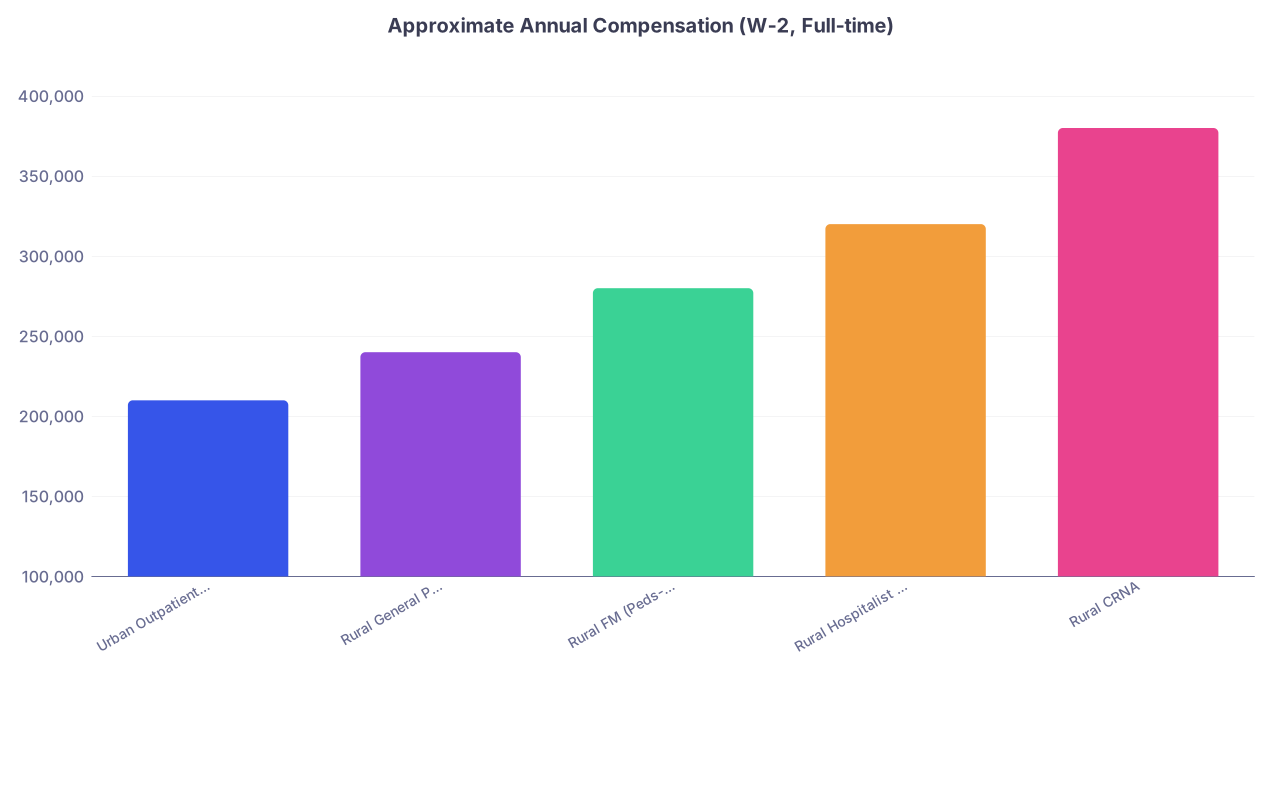
| Category | Value |
|---|---|
| Urban Outpatient Peds | 210000 |
| Rural General Peds | 240000 |
| Rural FM (Peds-heavy) | 280000 |
| Rural Hospitalist (Adult) | 320000 |
| Rural CRNA | 380000 |
These are representative ballpark numbers from recent recruiter emails, MGMA-ish ranges, and what residents compare in real life:
- Urban outpatient pediatrics: 190–230k base, maybe small RVU upside.
- Rural general pediatrics (mix of clinic, call, inpatient newborn/peds floor): 220–270k.
- Rural FM with OB or broad scope: routinely 260–320k+.
- Rural adult hospitalists and CRNAs often clear 300–400k easily.
You read that correctly. You will admit newborns, manage sick kids with no subspecialty backup, sometimes cover a pediatric ward or level 1–2 nursery, do the full preventive care grind, and you still land at the very bottom of the rural physician pay hierarchy.
The system’s unofficial logic is simple: children generate fewer billable procedures, lower RVUs, and many are Medicaid. The “reward” is supposed to be lifestyle and meaning, not money. In rural practice, the “lifestyle” part gets shaky fast.
How Rural General Pediatrics Actually Expands Scope
People throw out words like “expanded scope” and “broad practice” like this is automatically a benefit. You need to know exactly what that tends to mean when you sign a rural pediatrics contract.
1. You Are Not “Just Outpatient”
Urban pediatricians can choose the classic clinic-only track: Monday to Friday, 8–5, no hospital responsibility, maybe share outpatient call. Rural? Very different.
Typical rural general pediatrics scope expansion:
- Newborn nursery coverage (often every day you are on call).
- Inpatient pediatric floor coverage, if the hospital still admits kids.
- ED “peds backup” – the ER calls you to see borderline admits, subtle rashes with systemic concerns, or social admits.
- Higher-acuity outpatient work because there is no easily accessible subspecialist.
I have seen a single rural pediatrician doing:
- Daily rounds on 4–8 newborns.
- 1–2 pediatric inpatients, often social/placement issues plus mild to moderate medical illness.
- Full clinic panel of 18–24 visits/day.
- On-call phone triage through the night every few days plus weekends.
For an internal medicine hospitalist, those newborns and peds floor patients would justify significant differentials and extra pay. For peds? It is often baked into your “base salary” and called “part of the job.”
2. You Become the Default Subspecialist… Without the Pay
Scope expansion in rural pediatrics frequently means you are:
- The de facto behavioral pediatrics specialist.
- The local asthma/allergy person.
- The unofficial endocrine consultant for “complex obesity” and growth issues.
- The first (and sometimes only) screener for suspected neuromuscular or genetic diseases.
In a tertiary center, each of those domains lives in a separate clinic with separate billing rates and longer visits. In a rural clinic, they are all squeezed into 15–20 minute slots because “access is limited, we need to see everyone.”
You will manage:
- Complex ADHD with comorbid anxiety and learning disabilities when the nearest child psychiatrist is 3 hours away, full for 9 months.
- Type 1 diabetes pump patients when the big children’s hospital has a 4–6 month wait for new endocrine visits.
- Seizure follow-ups beyond what you are truly comfortable with because neurology clinic can only see the family every 8–10 months.
Does the system reward this expanded, higher-complexity work? Rarely. RVU systems do not pay more for many of these problems if you cannot code extensive counseling time or higher-level visits consistently. And if half your panel is Medicaid, the absolute numbers stay low.
3. Procedures, If You Push For Them
Some rural general pediatricians build in more procedure volume:
- Circumcisions beyond the newborn nursery.
- Laceration repairs.
- Simple abscess I&Ds.
- Joint injections for juvenile arthritides (if you are comfortable).
- Sedation for imaging or minor procedures.
But here is the catch. Many rural hospitals default these to family medicine, emergency medicine, or surgery. You must explicitly negotiate that you will do them, that the hospital will credential you, and that the practice will not block your schedule in ways that make procedures impossible.
So yes, scope can expand into procedures. But it does not do so automatically. And even when it does, the incremental pay jump is modest compared with the jump in liability and workload.
Where the Money Actually Leaks: Structural Pay Problems
The persistent low pay in rural pediatrics is not a mystery. It is baked into reimbursement, payer mix, and how pediatric work is valued. Let us be blunt.
Medicaid and Payer Mix
Rural pediatric populations are often:
- Higher Medicaid percentage (60–80%+).
- More uninsured or underinsured.
- More social complexity with lower reimbursement.
Adult primary care can offset this with Medicare patients, better-pay commercial contracts, and more billable chronic disease management. Pediatrics does not get Medicare, and kids require high-intensity preventive and developmental care that does not map neatly onto high-RVU codes.
Preventive Care is Time-Intensive and Poorly Reimbursed
You know those 15-minute “well-child” visits? They contain:
- Developmental screening.
- Behavioral counseling.
- Vaccination counseling and sometimes complex vaccine hesitancy conversations.
- Nutrition and growth issues.
- School performance discussion.
- Family dynamics and social determinants of health.
Good pediatricians do all of this. It just does not pay. The system pays more for an adult with five poorly controlled chronic diseases than for a pediatrician who keeps a child healthy for 18 years.
In rural areas, the complexity rises (food insecurity, unstable housing, educational issues), but the codes stay the same.
Call and Inpatient Work Are Undervalued
This is a pet peeve. In many contracts:
- Newborn nursery and pediatric inpatient coverage is treated as “included” in your base.
- Night call is “phone-only” on paper but, in reality, includes driving in for deliveries, stabilizing sick newborns, and supporting an ED that is nervous about kids.
- Weekend call is often Q2–Q4 for the entire region because there might be only 1–3 pediatricians in county-wide coverage.
If you were an adult hospitalist, each shift is itemized and paid. If you were anesthesiology, each extra call is paid. In rural pediatrics, the line is: “Our base includes your hospital responsibilities.” Translation: You are subsidizing the hospital with your underpaid labor.
Scope Expansion: What Actually Helps Pay vs What Is Just Extra Work
This is where people get misled. “Scope expansion” can either modestly improve your financial reality or simply hand you extra responsibility for free. You need to distinguish them.
| Scope Area | Pay Impact | Burnout Risk | Negotiation Leverage |
|---|---|---|---|
| Newborn nursery coverage | Often minimal | Moderate | Medium |
| Peds inpatient/ED backup | Low–moderate | High | High (safety issue) |
| Behavioral health (ADHD etc.) | Very low | Very high | Low without team |
| Extra procedures | Low–moderate | Low–moderate | Medium |
| Telehealth specialty collab | Indirect only | Moderate | Low–medium |
| School/community outreach | Basically none | Moderate | Low |
Let me spell out a few realities.
1. Newborn and Inpatient Coverage: Negotiate Hard or You Lose
If you are covering:
- All newborns born at the hospital (including nights and weekends).
- Any pediatric inpatient admissions, however few.
- ED pediatric consults or backup.
That is not a trivial “add-on.” That is a service line. You should treat it as such.
Practical approach:
- Demand explicit compensation for call. Per shift or per weekend.
- Tie your willingness to admit pediatric inpatients to staffing and safety: nursing ratios, pediatric-trained nurses, access to pediatric equipment and protocols.
- If the hospital wants to keep billing for newborn and pediatric admissions, that is your leverage. They need you more than you need them.
If a contract reads “call included in base salary” for a 12–16 weekends/year setup plus frequent weekday call, you are doing free labor.
2. Behavioral and Developmental Scope: High Work, Low Pay Unless You Restructure
Rural pediatricians effectively become:
- ADHD clinics.
- High-functioning autism initial screeners.
- Anxiety and depression managers.
- School IEP advocates.
This work is brutal without a team. It also rarely pays well unless:
- You optimize for longer visits with appropriate higher-level E&M coding.
- You have integrated behavioral health (psychologist, LCSW, or psychiatric NP) and bill separately.
- You carve out half-days specifically for complex developmental and behavioral cases.
Even then, the economic upside is modest compared with the emotional and cognitive load. If you accept “expanded behavioral scope” without extra staffing, you will burn out. I have watched it happen.
3. Procedures and Hospital Relationships: The Only Real Lever You Have
Procedures in pediatrics do not turn you into a surgeon, but they can tilt the math:
- Circumcisions (newborn and a bit older) can add meaningful RVUs if the hospital routes them to you.
- Sedation for imaging or minor procedures can be well-compensated if done safely and with backup.
- Partnering with the OR for simple peds cases where your presence streamlines throughput can justify stipends or facility-based pay agreements.
You must, however, insist on:
- Appropriate training and credentialing.
- Clear delineation of responsibilities.
- Adequate support (nursing, monitoring, backup services).
Rural hospitals love the idea of “our pediatrician can do more things.” You must turn that enthusiasm into written compensation, not just praise.
Lifestyle vs Money: Rural Peds Is Not Always the “Chill” Option
People romanticize rural medicine. “Less traffic, better community, slower pace.” Occasionally true. Often nonsense.
Let me show you the trade-offs more explicitly.
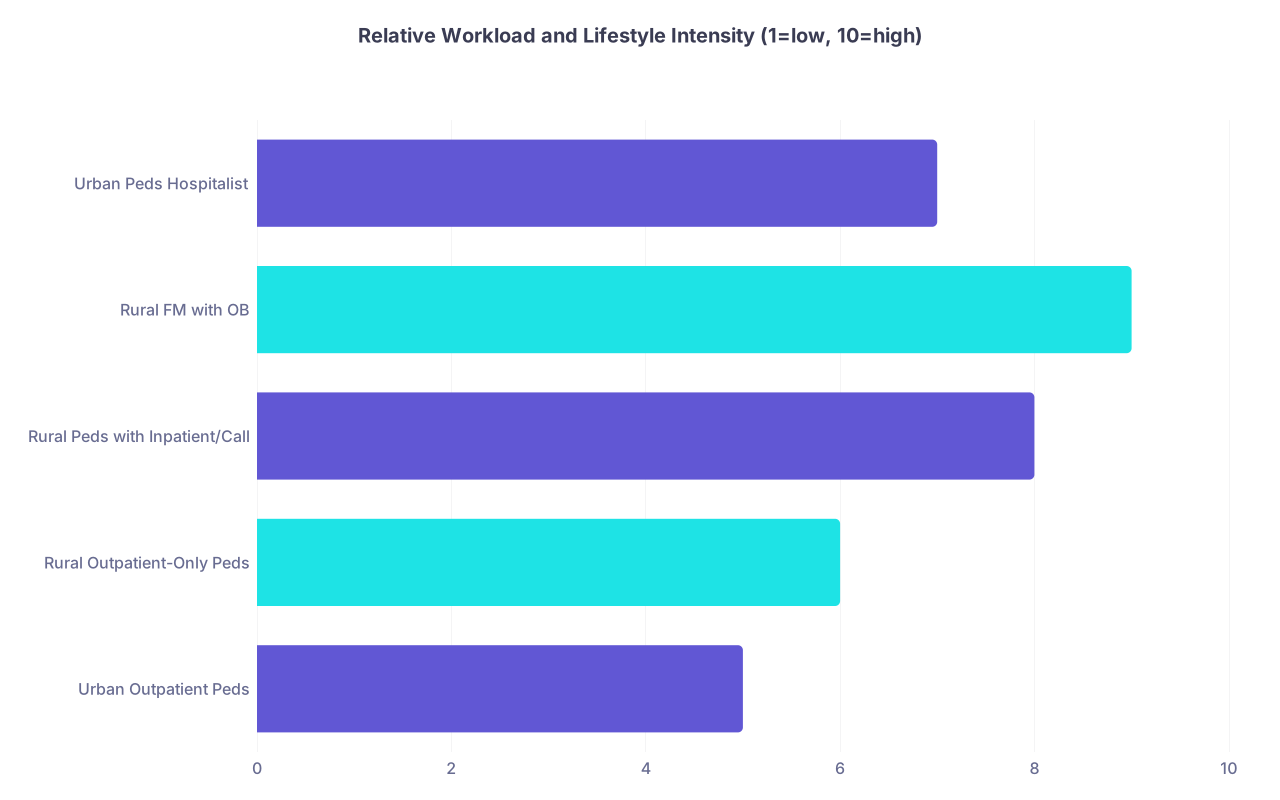
| Category | Value |
|---|---|
| Urban Outpatient Peds | 5 |
| Rural Outpatient-Only Peds | 6 |
| Rural Peds with Inpatient/Call | 8 |
| Rural FM with OB | 9 |
| Urban Peds Hospitalist | 7 |
What actually happens on the ground:
- You will be one of very few pediatricians in the area. Every school, daycare, and social worker knows your name.
- You cannot go to the grocery store without running into patient families. Privacy is minimal.
- Weekends on call are not “sleep through the night” if your ED is nervous with kids or your L&D unit is delivering at 2 am.
- Covering sick newborns in a hospital without a NICU is stressful. Stabilization and transfer decisions are on you.
Some rural positions carve out reasonable, outpatient-only, limited-call setups with midlevel support and decent boundaries. They exist. But many positions are disguised as “family-friendly rural jobs” while quietly embedding heavy call and broad responsibilities—without proportional pay.
If you care about both meaning and money, you need to scrutinize the details, not the brochure.
Tactical Advice: How to Make Rural General Pediatrics Viable for You
Let me give you concrete levers that actually move the needle. Not vague “negotiate better” slogans.
1. Treat Inpatient/Call as Separate Work, Not a Bonus
When you are evaluating a job:
- Ask: “What would the hospital do if you refused inpatient and call?” If the answer is “they would be in trouble,” you have leverage.
- Insist on either:
- Separate call stipends (per night / per weekend), or
- A meaningfully higher base that explicitly reflects the inpatient scope (not a token 10k).
If they insist call is “expected as part of full-time” but you are basically pediatric coverage for an entire region, walk away or counter with a clear alternative (clinic-only, no inpatient, lower FTE).
2. Push For Team-Based Behavioral Health or Set Firm Limits
For behavioral and developmental expansion:
- Do not be the only one in the system dealing with all complex ADHD/autism/anxiety without extra help.
- Ask explicitly: “Do you have an embedded behavioral health team? Psych NP? LCSW? School partnerships?”
- If they do not, define a hard cap:
- Specific number of complex mental health slots per week.
- Specific criteria for when you refer out or require tele-psych.
- Protected time to coordinate care and fill school forms.
Scope expansion that kills you mentally for no pay is self-sabotage.
3. Build a Procedural Niche if You Enjoy It
If you like procedures, use that as a bargaining chip:
- Identify needs: circumcisions, sedation, joint injections, derm procedures.
- Ask what volume exists and who is doing them now (FM, EM, surgery?).
- Propose a structured pathway:
- Hospital credentials you for specific procedures.
- Your clinic schedule reserves blocks for procedures.
- Compensation recognizes incremental RVUs or a stipend if the hospital gains facility fees.
This is one of the few areas where scope expansion can legitimately improve financial and professional satisfaction.
4. Use Telemedicine Smartly
You will not out-earn hospitalists with telemedicine, but you can protect your sanity:
- Partner with children’s hospitals for tele-endocrine, tele-neurology, tele-psych so you are not clinically isolated managing high-risk cases alone.
- Use structured telehealth follow-ups for stable chronic conditions (asthma check-ins, med refills) to reduce no-show chaos and improve continuity.
- Push your system to bill appropriately for telehealth. Many underbill or ignore pediatric telehealth possibilities.
The goal is not money here. It is making your expanded clinical scope sustainable.
Who Should Actually Choose Rural General Pediatrics?
Let me be direct. Rural general pediatrics is:
- A terrible choice if your primary goal is income maximization.
- A risky choice if you hate being “the only one” and prefer subspecialty backup on-site.
- A potentially great choice if:
- You genuinely like longitudinal relationships with families.
- You want clinical breadth and are comfortable being pushed to the edge of your training.
- You are willing to negotiate hard and walk away from exploitative setups.
You need a very particular mindset:
- You do not depend on your job for identity so much that you accept abusive call patterns.
- You are comfortable saying “No, this is beyond what a general pediatrician should do without team support” and sticking to it.
- You recognize that you are subsidizing the healthcare system with underpaid, high-impact work and are still willing to do it—within limits you set.
The “scope expansion” part can be deeply satisfying clinically. Many rural pediatricians will tell you: they know every family, they have babies they admitted now applying to college, they watch full arcs of life. They are specialists not just in disease, but in that community.
Just do not walk into it thinking that broader scope will magically erase the “lowest paid specialties” reality. It will not.
FAQ (Exactly 6 Questions)
1. Can I realistically negotiate higher pay as a rural general pediatrician, or is the ceiling fixed?
There is some room, but the ceiling is undeniably lower than comparably trained specialties. Your best leverage points are:
- Being the only or one of very few pediatricians in the catchment area.
- Taking inpatient and nursery call that the hospital urgently needs covered.
- Willingness to do procedures that otherwise require importing outside help.
You are unlikely to jump from 230k to 350k base just by negotiating, but you might push a 220k offer to 260–280k if the hospital is desperate and you frame your services as essential hospital coverage, not just clinic time.
2. Is it smarter financially to do rural family medicine instead if I still want to see children?
Often yes, purely on money and bargaining power. Rural FM, especially with OB, tends to:
- Command higher base pay and better sign-on bonuses.
- Capture more adult chronic disease management and Medicare billing.
- Share call more broadly across age groups.
You give up some depth of pediatric specialization and may see more adults than you prefer, but from a financial standpoint, rural FM with a peds-heavy panel usually beats rural general pediatrics.
3. Will doing NICU or inpatient peds electives in residency improve my rural job prospects or pay?
It will improve your competence and confidence much more than your base salary. Rural hospitals care that you can safely manage newborns and the occasional sick kid until transfer. They will like that you have stronger inpatient training. But most administrators will not add 40k to your offer simply because you have more NICU months. It does, however, give you more leverage when you push back on unsafe expectations because you can credibly say what is and is not appropriate outside a tertiary center.
4. How bad is rural pediatric call really, compared with urban pediatric call?
It varies wildly. In some towns with low birth volume and cautious EDs, you might get:
- A few calls a night on busy days, but rarely called in after midnight.
In other places: - You are at every delivery on your call weekend, stabilize sick neonates without immediate NICU backup, and field ED consults all night for anything under age 18.
The key is to ask for hard data: annual births, pediatric ED visits, average call-backs per night, how many times they call you in after midnight on typical weekends. If they cannot or will not give specifics, assume it is heavier than they are letting on.
5. Does doing more procedures actually move the income needle, or is it mostly cosmetic?
For pediatrics, it moves the needle modestly, not dramatically. Extra circumcisions, sedation cases, and simple procedures can add several tens of thousands a year in RVUs if volume is real and coding is correct. But you are not suddenly turning a 220k job into 400k. The bigger reason to do procedures is often professional satisfaction and regional necessity rather than massive salary changes. You should still negotiate for appropriate recognition—procedure blocks in your schedule, RVU credit, and, if the hospital is pushing you into OR-based work, maybe a stipend.
6. If I love pediatrics but want better pay, should I avoid rural and stick to urban or suburban practice?
Not necessarily, but you should be strategic. Urban and suburban outpatient pediatrics often pay slightly less than rural on paper, but:
- You may have no inpatient or call duties or only light phone call.
- There is more opportunity to move into higher-paying roles over time (administrative, large-system leadership, urgent care, niche clinics).
- You can combine peds with side work (urgent care shifts, locums, tele-peds) more easily when you are not the only pediatrician in town.
If maximum pay is your priority within pediatrics, you usually do better as an urban/suburban pediatric hospitalist, nocturnist, or by moving into higher-acuity or leadership roles than by counting on rural scope expansion to solve the low-pay problem.
Key Takeaways
- Rural general pediatrics absolutely expands your clinical scope—but most of that expansion is unpaid labor, not a salary multiplier.
- Inpatient coverage, call, and “being the only pediatrician” create real leverage; use it aggressively or you will subsidize the system with your time and sanity.
- If you choose this path, do it with eyes open: for meaning, autonomy, and community impact, not because someone told you scope expansion would magically fix the “lowest paid specialty” reality.


