
The belief that defensive medicine protects you from lawsuits is largely a fantasy.
Physicians order extra tests, admit marginal patients, over-consult, over-document – and tell themselves they’re “protecting against malpractice.” But when you actually look at the data, defensive medicine is a very expensive security blanket with surprisingly little legal payoff.
If you’re practicing medicine primarily to “cover yourself,” you’re probably burning money, time, and patient trust without meaningfully changing your malpractice risk profile.
Let’s tear this apart.
What “Defensive Medicine” Really Is – Not the Story You Tell Yourself
Defensive medicine is not “being thorough.” It’s care you’d skip if you weren’t afraid of getting sued.
Typical defensive moves:
- Ordering imaging “just in case” when guidelines don’t support it
- Admitting low-risk patients mainly to avoid a bounce-back ED visit
- Calling unnecessary consults to “share liability”
- Keeping patients longer than medically necessary
- Documenting in absurd detail, padding your note with boilerplate nonsense
In real life, you’ve heard the soundtrack:
- “I don’t think this is anything, but let’s get the CT to cover our bases.”
- “We could send her home, but if she comes back septic, I’m screwed.”
- “Throw in a line in the note that I discussed XYZ risk, just in case.”
Important distinction: defensive tests and treatments vs defensive documentation. They have different risk–benefit profiles. Lumping them together is one of the big mistakes in this whole conversation.
The Core Myth: “If I Do More, I’ll Get Sued Less”
This is the myth malpractice insurers and health systems love to leave unchallenged because it conveniently justifies higher utilization and “risk management trainings” that change little.
The narrative: plaintiffs only sue when something is missed or not done. So if you do more – more tests, more consults, more documentation – you reduce both the chance of missing something and the chance a lawyer can say you were negligent.
The truth is uglier and a lot less linear.
What the Claim Data Actually Shows
There’s a famous JAMA Internal Medicine paper (defensive practice intensity vs malpractice risk) that gets quoted constantly: higher-spending physicians within the same hospital had slightly lower malpractice claim rates. People cherry-pick this as proof that defensive medicine “works.”
Look closer:
- The absolute difference in claim rates was small
- It’s observational, not causal
- “Higher spending” is a crude proxy – not all extra care was defensive, some was legitimately indicated
- Specialty, local legal culture, and patient mix confound the hell out of the data
You can’t make a clean leap from “higher spending correlates with slightly fewer claims” to “my extra CT scan tonight will stop a lawsuit next year.”
On the flip side, multiple surveys of physicians who’ve been sued show something uncomfortable: many had already done “defensive” things. They still got sued. The plaintiff’s attorney still found some angle: wrong test, late test, misinterpreted test, poor follow-up, bad communication.
Here’s the rough reality: lawsuits track bad outcomes far more than they track adherence to defensive rituals. A catastrophic outcome + an angry or alienated patient/family is rocket fuel. Your extra MRI rarely changes that equation.
Where Defensive Medicine Fails to Protect You
Defensive medicine fails in three main ways: legality, psychology, and probability.
1. Legally: Extra Tests Don’t Magically Equal “Met Standard of Care”
Malpractice hinges on standard of care and causation, not “did you do more stuff.”
A lawyer’s playbook looks like this:
- Identify the outcome
- Show that a reasonable physician would have done something different
- Argue that this difference would likely have avoided the harm
If you got three unnecessary CTs but forgot to re-examine the patient before discharge, the plaintiff’s expert will say the CTs were irrelevant noise and the real negligence was your failure to re-assess or communicate.
Doing non-indicated tests can actually hurt you:
- Incidental findings you then fail to fully work up
- False reassurance from a low-yield negative test
- Conflicting documentation where one note sounds blasé and another sounds alarmed
More data = more potential contradictions in the record. That is gold for plaintiff experts.
2. Psychologically: You’re Targeting the Wrong Triggers
Patients and families don’t sue for the reason you think.
Study after study of malpractice plaintiffs shows core themes:
- Felt ignored or dismissed
- Perceived dishonesty or “cover up”
- Poor communication about risks, prognosis, or what to expect
- Lack of empathy when things went south
The classic: the “nicest but slightly error-prone doctor” being named in fewer suits than the “brilliant jerk” who rarely makes obvious mistakes.
Your extra CT scan doesn’t change whether:
- You interrupted the patient repeatedly
- You made them feel stupid for asking questions
- You ghosted their family during a complication
- You never clearly explained what might realistically go wrong
But those are exactly the things that push someone to call a lawyer.
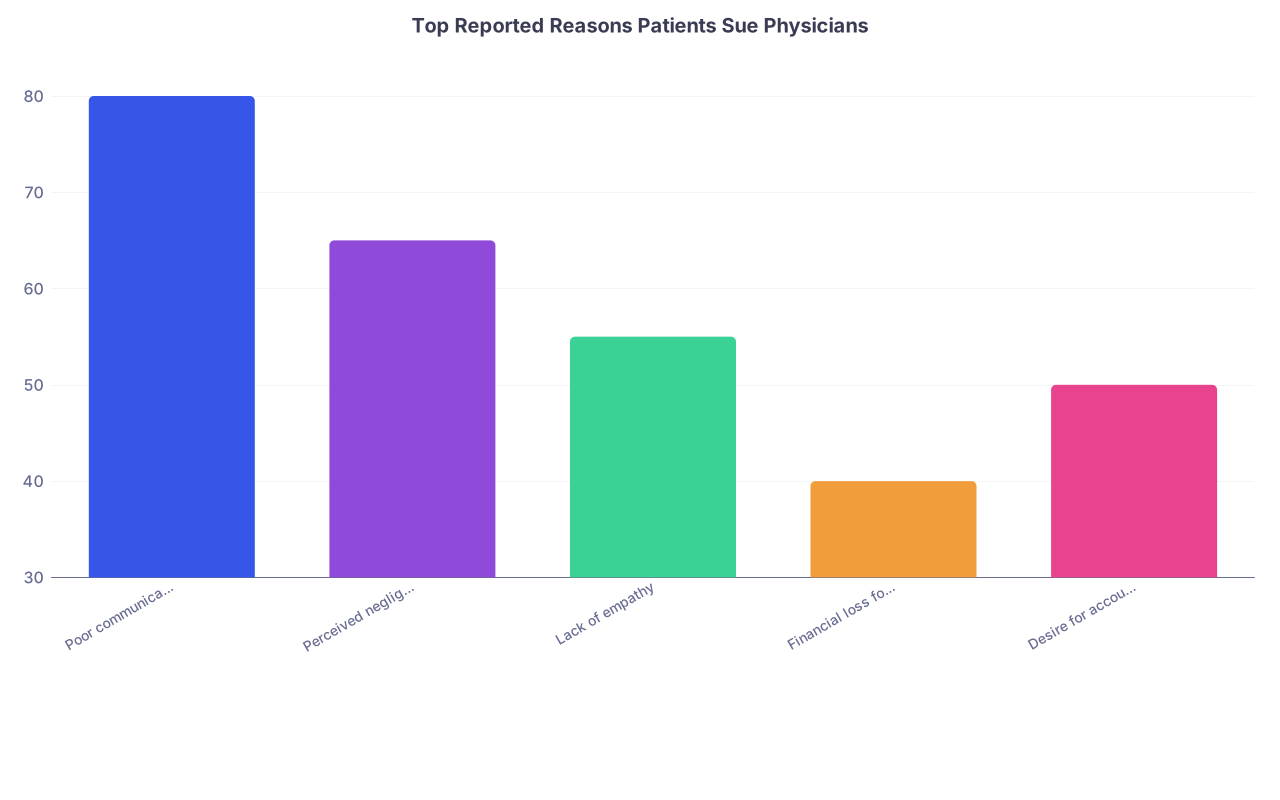
| Category | Value |
|---|---|
| Poor communication | 80 |
| Perceived negligence | 65 |
| Lack of empathy | 55 |
| Financial loss focus | 40 |
| Desire for accountability | 50 |
3. Probabilistically: You’re Chasing Edge Cases With Blunt Tools
Defensive medicine over-targets extremely low-probability events with high-cost interventions.
Classic ED example: low-risk chest pain with normal ECG and negative high-sensitivity troponins. You admit “just in case,” run serial enzymes, maybe stress test. Why? Fear of the one-in-several-thousand miss that turns into a case study in a plaintiff’s slide deck.
But from a probability perspective:
- You massively inflate cost and downstream testing
- You expose the patient to iatrogenic harm (contrast nephropathy, incidentalomas, procedural complications)
- You make almost no dent in the already tiny risk of catastrophe
If the freak event happens anyway, the fact that you admitted and tested the patient may or may not shield you. Plaintiff experts can always argue: different test, earlier test, different consultant, earlier cath, etc.
Your risk goes from 0.01% to 0.009%. That’s not legal armor. That’s superstition with billing codes.
What Actually Correlates With Fewer Malpractice Claims
Let’s be concrete. There are things that matter more than ritualistic defensive orders.
Based on malpractice insurer data, claims reviews, and closed-case analyses, three things repeatedly show up as protective:
- Communication quality and accessibility
- Team and systems reliability
- Documentation that tells a coherent clinical story
Not “ordered every test in the book.”
| Factor (Physician Belief) | Actual Impact on Claims (Evidence-based) |
|---|---|
| Ordering extra tests | Low–moderate, inconsistent |
| Admitting “borderline” cases | Low, context-dependent |
| High-quality communication | High, consistently protective |
| Strong follow-up systems | High, especially in outpatient care |
| Clear, narrative documentation | High, in both winning and losing cases |
1. Communication and Relationship
I’ve sat in risk meetings where a surgeon who clearly had a complication – not negligence, a known risk – avoided a suit because the patient said: “She was with me every step, she told me this could happen, I trust her.”
Contrast that with cases where technically acceptable care still led to big payouts because the family felt blindsided and dismissed.
Protective behaviors that actually matter:
- Using plain language, not jargon, when explaining risks
- Repeating key warnings and expectations, especially around discharge
- Being reachable or having a clear system for questions
- Showing up early after a bad outcome to explain, not hide
None of this is about ordering an extra CT. It’s about not making your patient feel like a billing unit.
2. Systems and Follow-up
Many lawsuits don’t stem from dramatic ED misses. They come from boring, systemic failures:
- Abnormal labs not acted upon
- Critical imaging findings not communicated
- Lost referrals
- No tracking of high-risk follow-ups
A beautifully defensive workup on Day 1 means nothing if an abnormal result sits in the EMR unchecked, or the patient can’t get through to anyone when they worsen.
Programs that reduce malpractice claims focus heavily on:
- Reliable results management
- Clear follow-up instructions
- Nurse call-backs
- Care coordination, especially after discharge
Notice: this is system-level defensive medicine, not “order every test” defensive medicine. Very different beast.
3. Documentation That Makes Sense (Not Just Long Notes)
There’s a dangerous myth that “more documentation = more protection.” No. Better documentation = more protection.
Plaintiff attorneys don’t get scared by 5,000-word notes. They love inconsistency, vagueness, and missing reasoning.
Good, protective documentation:
- Clearly states your differential and why you ruled options in or out
- Documents key discussions about risks, benefits, and uncertainties
- Captures the patient’s understanding and preferences (“patient prefers outpatient workup after discussion of risks”)
- Shows clinical reasoning, not just checkboxes
Bad defensive documentation:
- Copy-paste garbage from prior notes
- Contradictory ROS/physical (e.g., “no distress” while ordering emergent CT for “severe distress”)
- Wall-of-text boilerplate with no real clinical thought
One well-written paragraph of reasoning often protects you more than a dozen irrelevant labs and five templated pages.
The Financial Illusion: You’re Paying For This Twice
Now to the “financial and legal aspects” part that people like to pretend is abstract economics. It’s not.
Defensive medicine is part of why your malpractice premiums are what they are, and why your RVUs feel like a hamster wheel.
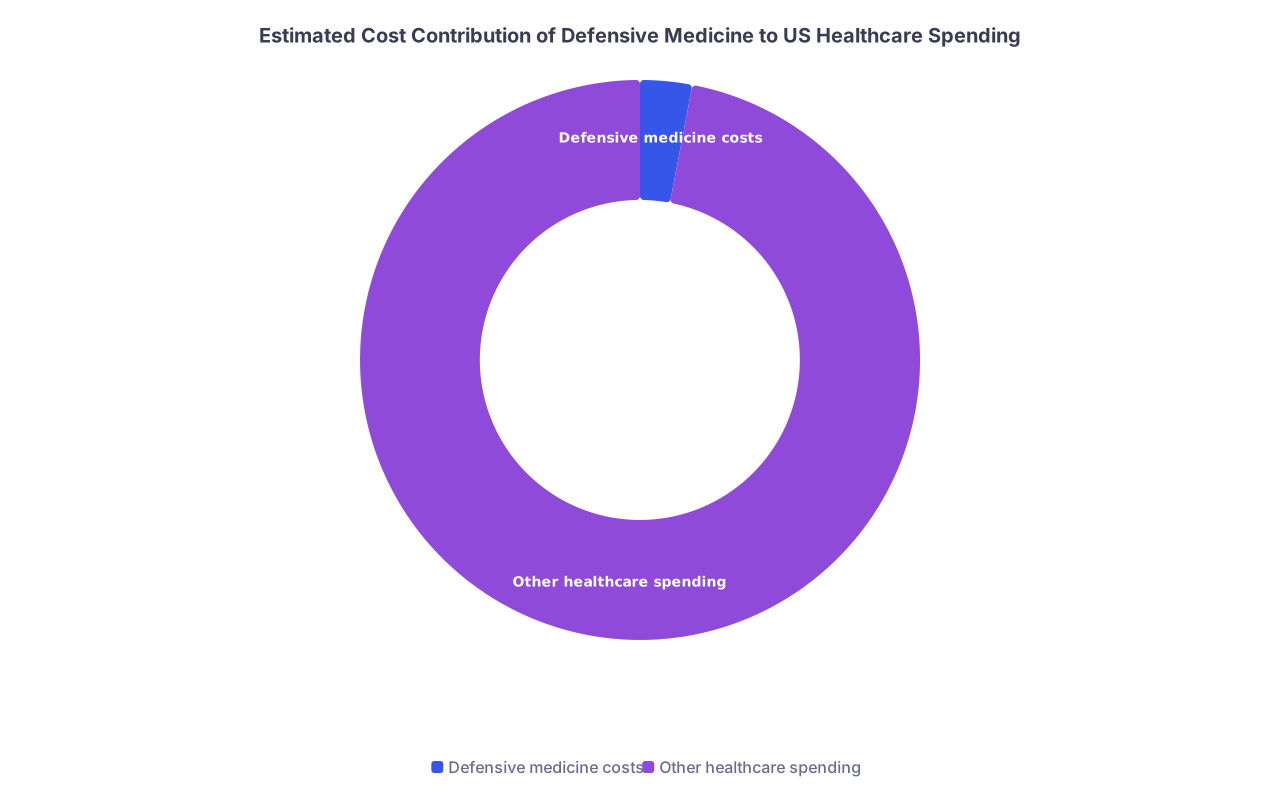
| Category | Value |
|---|---|
| Defensive medicine costs | 90 |
| Other healthcare spending | 2910 |
Rough estimates (depending on study) put defensive medicine at tens of billions per year in the U.S. system. Even if you distrust the exact number, the scale is clear: it’s not trivial.
You pay for it in three ways:
- Direct time and effort – staying late for unnecessary consults, documenting things you don’t clinically care about
- Burnout – practicing out of fear corrodes job satisfaction and feeds attrition
- System costs – which show up as lower pay, pressure for higher volumes, or limited resources where they actually matter
And for what? A hypothetical marginal reduction in already-rare lawsuits that might be better addressed with an apology training workshop and a functioning results-callback system.
The Rare Case Where “Defensive” Care Actually Helps
To be fair, not all “defensive” instincts are useless. Some reflect legitimate uncertainty where guidelines are thin and stakes are high.
Examples:
- Marginal head trauma in an anticoagulated elderly patient – slightly lower CT threshold is rational
- Unclear sepsis picture in a fragile patient – early admission and observation may truly reduce mortality
- Early involvement of a consultant in a gray-zone surgical abdomen – can both improve care and reduce liability
But notice the pattern: these are situations where clinical risk is significant and defensive choices plausibly improve outcomes, not just your legal posture.
That’s the test: if you stripped away the malpractice fear, would a thoughtful, guideline-aware, experienced clinician still be on the fence? If yes, then “defensive” and “good medicine” overlap. That’s not what most people mean when they say they’re practicing defensive medicine.
So What Should You Actually Do If You Want Fewer Claims?
Let me be blunt: if your goal is to actually reduce malpractice risk – not just feel less anxious – you should reallocate your “defensive energy.”
Shift it from:
- Low-yield extra testing
- Reflexive admissions
- Mindless chart padding
To:
- Relentless clarity in communication
- Robust follow-up and accessibility
- Clean, narrative documentation of thought process
- Participation in system-level safety improvements
If you want a personal checklist that’s actually legally protective, it’s closer to:
- “Does this note show why I made this decision?”
- “Have I explained to the patient what we are watching for and when to come back?”
- “Are abnormal results going to land somewhere a human will act on them?”
- “Did I treat this person like a human being or like a problem to move off my list?”
If you do those consistently, you can safely dial back a decent chunk of the fear-driven testing – and your malpractice risk will not explode.
Bottom Line: Does Defensive Medicine Reduce Malpractice Claims?
Short answer: not in the way most physicians think, and not enough to justify how much you’re contorting your practice around it.
Key points:
- Ordering more tests and doing more procedures is a weak, inconsistent shield against malpractice. It sometimes correlates with slightly fewer claims but at enormous cost and with no clear causal proof.
- Communication, trust, and systems reliability beat defensive test ordering. The drivers of lawsuits are bad outcomes plus poor relationships and broken processes, not just “missed tests.”
- Smart risk management is about better medicine, not more medicine. Clear reasoning, honest conversations, and robust follow-up will protect you more – legally and financially – than trying to CT-scan your way out of every possible lawsuit.