
Malpractice Insurance Myths: Why “Good Doctors Don’t Get Sued” Is Wrong
What do you think when a colleague gets sued: “They must have messed up,” or “There but for the grace of God go I”?
Only one of those matches the data. And it is not the first one.
Let me be blunt: “Good doctors don’t get sued” is one of the most toxic, fact-free myths in medicine. It distorts how you practice, how you buy malpractice insurance, how you document, and how you emotionally survive this career. And it quietly fuels shame and silence around lawsuits.
The numbers are ugly and very clear.
What the Data Actually Shows About Who Gets Sued
You can have excellent skills, good outcomes, and glowing patient reviews—and still end up as the defendant in a malpractice case. Repeatedly.
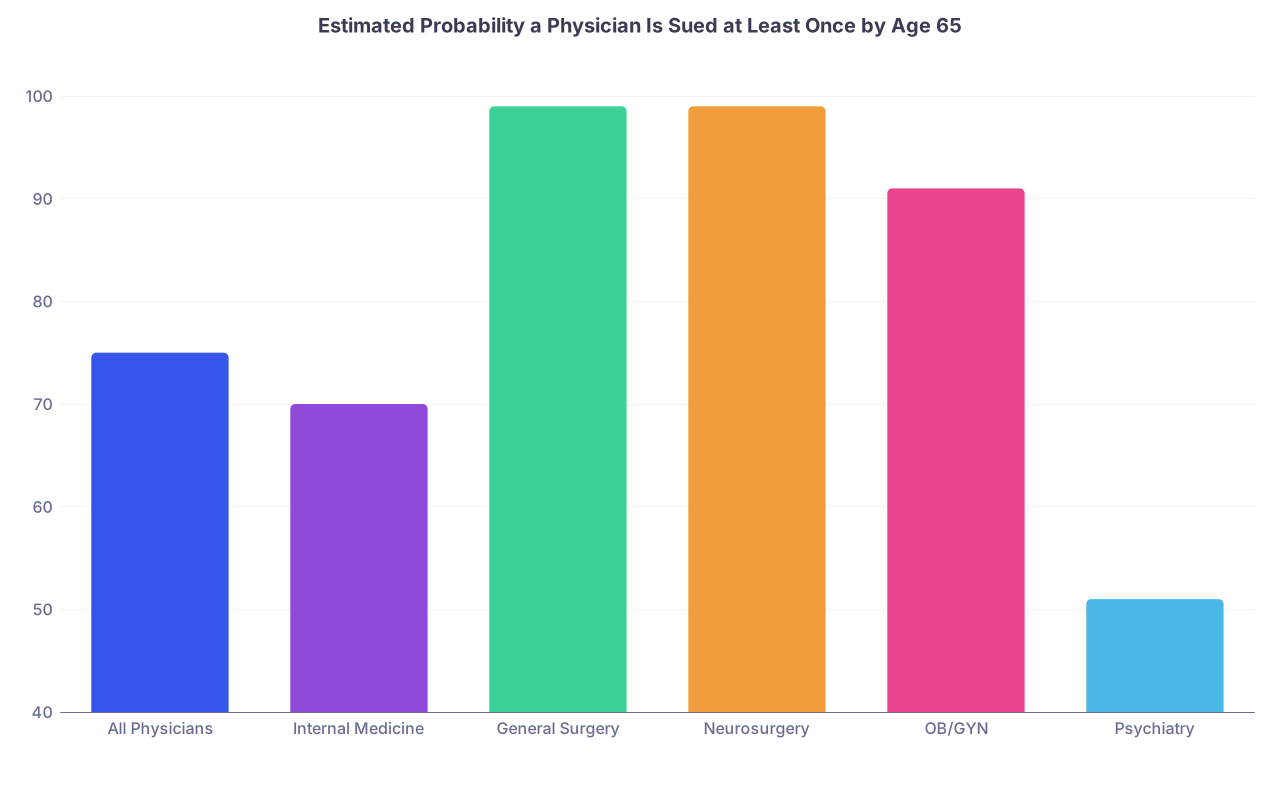
Large studies from the New England Journal of Medicine and JAMA have made the pattern painfully obvious:
| Category | Value |
|---|---|
| All Physicians | 75 |
| Internal Medicine | 70 |
| General Surgery | 99 |
| Neurosurgery | 99 |
| OB/GYN | 91 |
| Psychiatry | 51 |
By age 65, roughly:
- Around 75% of physicians in the U.S. have faced at least one malpractice claim.
- In high-risk specialties (neurosurgery, cardiothoracic, OB/GYN, general surgery), it’s effectively everyone, with estimates near or above 90–99%.
- Even lower-risk fields like psychiatry still see more than half of doctors sued at least once over a career.
So unless you think 75% of physicians are “bad doctors,” the myth collapses immediately.
Even more inconvenient:
- Most claims don’t involve objectively negligent care.
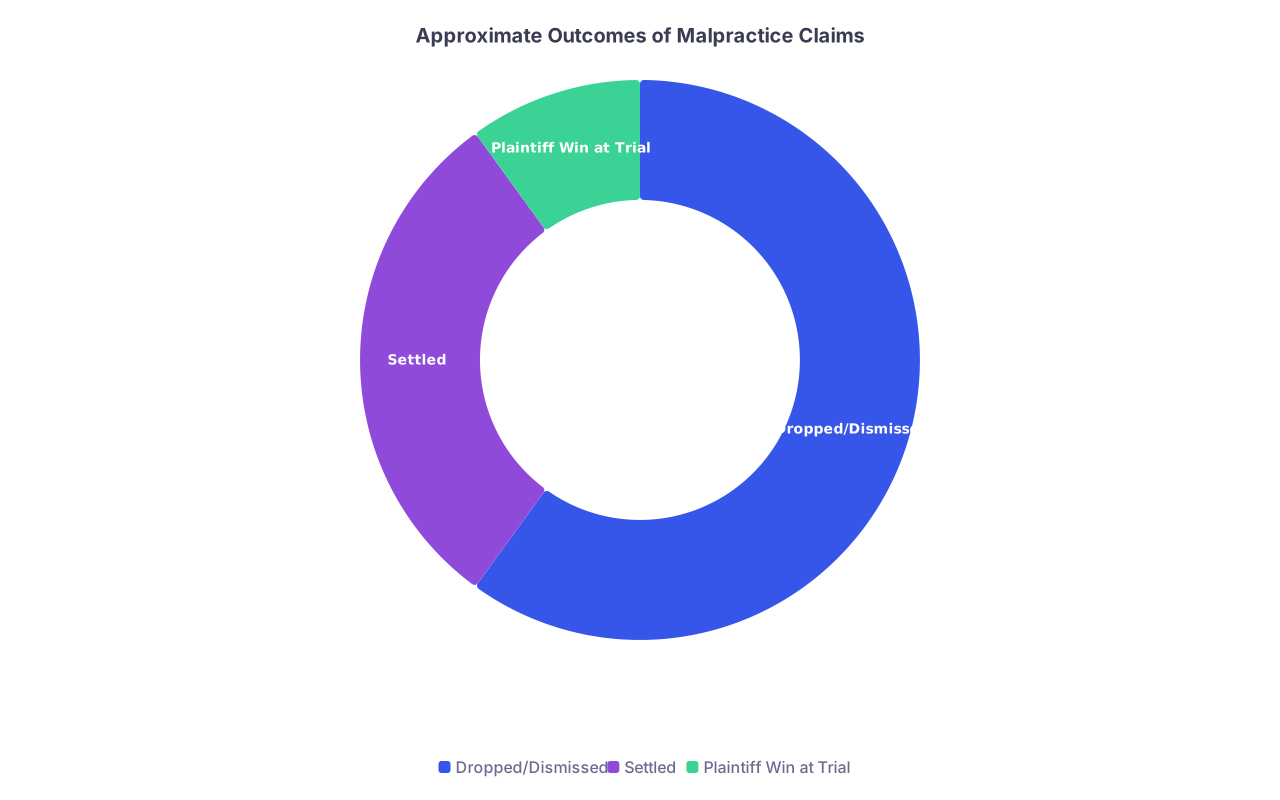
- A significant portion of claims result in no payment to the plaintiff.
- Many payouts are in the “gray zone” where care may be defensible but the risk of trial is too high for the insurer.
| Category | Value |
|---|---|
| Dropped/Dismissed | 60 |
| Settled | 30 |
| Plaintiff Win at Trial | 10 |
That’s the national pattern: most claims end without payment, some settle, and a small fraction go to trial—and fewer still result in a plaintiff verdict. Yet every one of those cases is emotionally and professionally brutal for the physician.
“Good doctors don’t get sued” is just numerically false.
Good doctors get sued all the time.
Where the Myth Comes From (And Why It Won’t Die)
This myth survives because it’s psychologically convenient—for everyone except the defendant.
It reassures people:
- Administrators: “If we pick good clinicians and have policies, we’ll be fine.”
- Clinicians: “If I just work hard and care a lot, I’ll be immune.”
- Patients and families: “Lawsuits only happen after really terrible care.”
Reality is messier.
1. Hindsight bias and outcome bias
A baby with cerebral palsy. A missed cancer. A postop death. Those are emotionally devastating outcomes. After the fact, everyone starts connecting dots backwards.
Poor outcome → must mean poor care.
Lawsuit filed → must mean someone obviously failed.
Except that’s not how risk and uncertainty work in medicine. We make decisions under incomplete information. Bad outcomes sometimes follow good decisions. That’s built into the job.
But juries—and colleagues over coffee—are prone to hindsight bias: “They should have known.” You rarely hear, “That could have been any of us on call that night.”
I’ve heard this on M&M rounds more years than I care to admit:
“If they had just ordered a CT sooner…”
“If they’d taken them to the OR earlier…”
People forget what was actually known at the time. The myth thrives on that amnesia.
2. Moral distancing among physicians
There’s a quieter, darker truth: doctors throw each other under the bus to feel safer.
When someone is sued, the instinct is to create distance: “They must be a little careless… I’m more thorough… I’d never miss that.” Because if they did nothing uniquely wrong, it means you’re exposed too.
The myth becomes a shield. “Good doctors don’t get sued” translates subconsciously into “I am good, therefore I won’t be sued.” It’s emotional self-protection, not logic.
3. Simplistic media narratives
The public story is always binary: hero doctor vs. villain doctor. Or victim patient vs. reckless system. No nuance, no 2 a.m. real-life context, no resource limitations.
The media rarely covers the thousands of cases where:
- The medicine was ambiguous
- The guideline had wiggle room
- Risk and benefit were finely balanced
- Documentation was imperfect but care was reasonable
But that gray is exactly where many malpractice suits live.
The Real Risk Drivers: It’s Not Just “Being Careful”
Now let’s talk about what actually influences your malpractice risk. Spoiler: it’s not simply “be a good doctor.”
There are several consistent, evidence-backed risk factors.
Specialty and clinical exposure
If you’re in neurosurgery, OB/GYN, trauma surgery, EM, or anesthesia, your baseline risk is just higher.
Why?
- Higher acuity.
- Higher stakes outcomes (neurologic injury, maternal-fetal issues, death).
- More procedures and invasive interventions.
- More “no good options” scenarios.
You could be technically excellent and still accrue multiple claims simply because your denominator (number of high-risk encounters) is massive.
Internal medicine hospitalists, FM, and pediatrics see fewer suits per doc, but still not trivial. So yes, some specialties are more exposed—but none are truly “safe.”
Patient communication and relationship quality
Here’s where the myth gets twisted. People say “Good doctors don’t get sued,” but what they really mean—often without realizing it—is “Doctors who connect well with patients get sued less.”
It’s not the same thing.
Studies have repeatedly shown that:
- Physicians with more patient-centered communication (listening, explaining clearly, inviting questions) are less likely to be sued.
- Time spent, tone of voice, and perceived empathy all matter.
- Patients are more likely to sue when they feel ignored, dismissed, or disrespected—even if the technical care was reasonable.
You can be clinically superb and still have a brusque, rushed style that infuriates people. That will show up in your risk profile.
Flip side: a warm, attentive doctor who makes a genuine error may still get sued—but the odds of escalation are often lower, and early resolution is more likely.
What Actually Happens When You’re Sued
Now let’s talk about malpractice insurance itself and what it does—and doesn’t—do for you. Another myth: “If something goes wrong, my insurance will handle it and I’ll be fine.”
Not exactly.
First, the financial mechanics.
| Feature | Occurrence Policy | Claims-Made Policy |
|---|---|---|
| Coverage Trigger | When care occurred | When claim is filed |
| Need Tail Coverage? | No | Yes, after leaving job |
| Premium Cost | Higher | Lower initially |
| Portability | Good | Depends on tail/prior acts |
Most physicians in the U.S. are on claims-made policies. That means:
- If the claim is filed after you leave a job or switch carriers, you need tail coverage from the old policy (or prior-acts/nose coverage from the new one).
- No tail = you might be personally exposed for events that happened years ago.
Now layer the emotional part on top.
Being sued is not a paperwork event. It’s an identity crisis:
- Your name is literally on the docket as “Defendant.”
- Your care is dissected out of context, line by line, by people who have never seen a busy call night.
- Colleagues may quietly distance themselves.
- Your own memory of the case is often fuzzy, and you’re forced to rely heavily on documentation you wrote at 3:12 a.m.
I’ve watched excellent physicians lose sleep for months, start second-guessing every order, and burn out faster after a lawsuit. Not because they were bad doctors, but because the system is punishing—even when you ultimately “win.”
Malpractice insurance protects your assets and pays legal defense and settlements. It does not protect your reputation, your mental health, or your sense of professional competence. Pretending only “bad” clinicians go through this just adds shame to an already brutal process.
How the Myth Screws Up Your Malpractice Strategy
Once you reject the idea that only “bad doctors” get sued, your approach to malpractice insurance has to become more adult and less magical thinking.
Here’s where I see people get burned.
1. Underestimating coverage needs
If you secretly believe you’re unlikely to be sued because you’re “careful,” you are more likely to:
- Accept bare-minimum coverage limits.
- Skip reading policy exclusions.
- Ignore tail coverage details on job changes.
- Assume your employer’s policy priorities are aligned with your own.
This is how physicians get surprised by:
- Gaps between state minimums and what plaintiffs actually seek.
- Reputational damage when carriers settle quickly for business reasons, not merit.
- Large deductibles or self-insured retention structures in some groups.
2. Ignoring tail coverage until it’s expensive
The classic mistake: switching jobs and discovering at the last second that you’re on the hook for a six-figure tail premium.
If you work under the illusion that the risk of a late-filed claim is low “because I practice good medicine,” you’re more tempted to cut corners. Or assume it’s someone else’s problem.
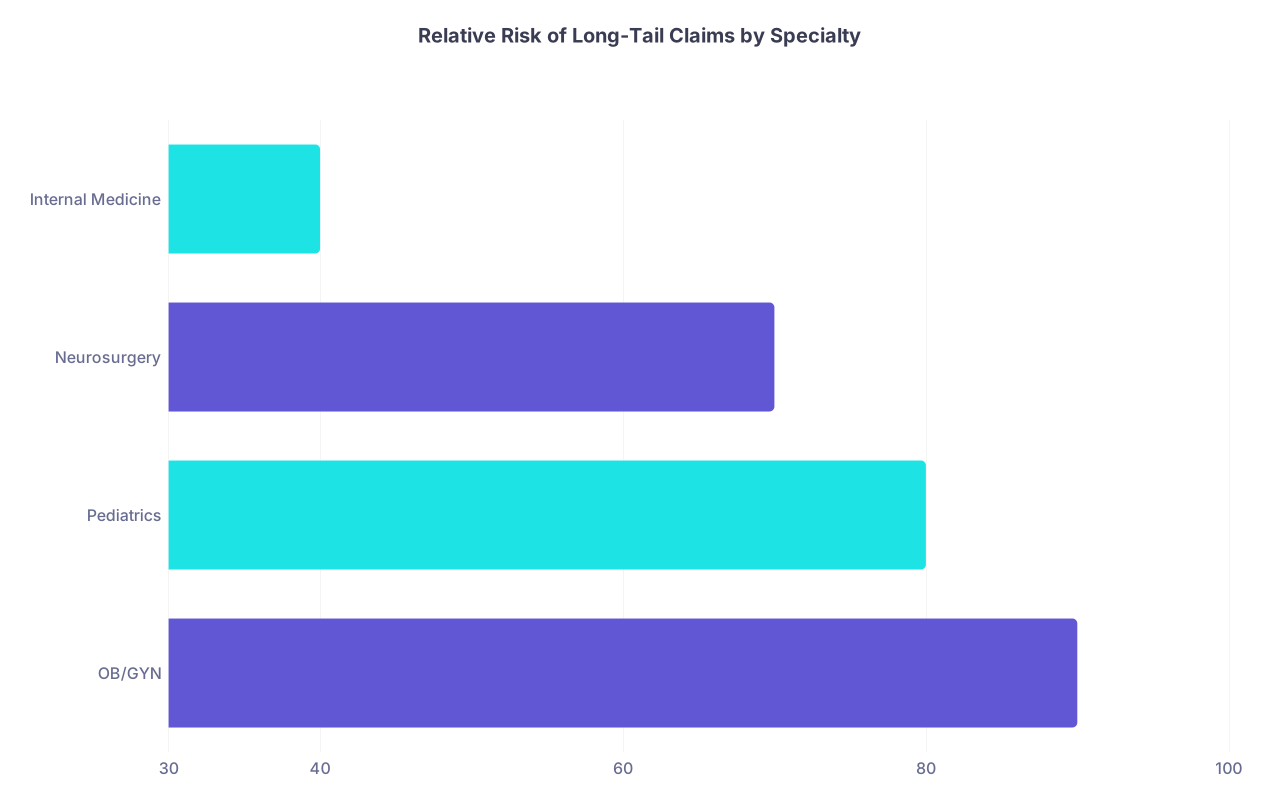
It isn’t. Tail liability is real, especially in specialties with long statute-of-limitations tails (peds, OB).
| Category | Value |
|---|---|
| OB/GYN | 90 |
| Pediatrics | 80 |
| Neurosurgery | 70 |
| Internal Medicine | 40 |
Those percentages are approximate relative risk, but the ranking is the key point: outcomes that take years to fully manifest = longer claim risk window.
3. Not documenting for your future legal self
If you believe lawsuits only hit gross malpractice, you’re less rigorous about documenting clinical reasoning. Because “any reasonable doctor” would understand what you did, right?
Wrong. Years later, people will comb your notes with zero memory of the patient or the shift context. If the chart doesn’t show your thinking, it might as well not have happened.
Examples I’ve seen in real cases:
- No documentation of shared decision-making for declining a test.
- Vague language like “patient stable” without objective data.
- No note on why you deviated from a guideline (often for good reasons at the time).
That doesn’t mean defensive chart novels. It means clear, concise, key reasoning: what options you considered, risks discussed, why you chose X over Y.
You’re not writing to impress your attending; you’re writing to protect Future You sitting in a deposition.
What You Should Actually Do If You Care About Risk
Let’s be practical. If “just be a good doctor” is not a real risk strategy, what is?
Accept that risk is structural, not purely moral.
Your specialty, practice setting, patient population, and procedure mix matter. Assuming you’re immune because you’re conscientious is delusional.Buy malpractice insurance like a realist, not a hero.
- Understand your policy type (claims-made vs occurrence).
- Know your limits, exclusions, and who pays tail.
- Get independent advice if your situation is complex (multi-state, moonlighting, telemedicine, locums).
Treat communication as risk management, not a “nice-to-have.”
Slow down a little on the most emotionally charged encounters—bad news, high-risk procedures, diagnostic uncertainty. Those are exactly the conversations that turn into “They never told me” later.Assume you will be sued at some point and plan for it.
That’s not pessimism; it’s statistics. Learn the basics now:- Do not alter charts after an event.
- Do not discuss the case casually over email/text.
- Know how to trigger your carrier’s reporting process.
Do not isolate colleagues who get sued.
If you’re in leadership and you still say things like “We don’t tolerate doctors who get sued,” you’re being both ignorant and dangerous. Support your people. Learn from real errors; don’t blame away the risk.
The Bottom Line
Three things to walk away with:
- “Good doctors don’t get sued” is factually wrong. Volume, specialty, and communication patterns drive risk far more than simple clinical virtue.
- Malpractice insurance is not a moral scorecard; it’s a financial and legal shield in a system where even excellent care can end in litigation.
- Your best move is not magical thinking, but clear-eyed preparation: solid coverage, honest documentation, and communication that treats patients like partners—not adversaries in waiting.