
The belief that a prior malpractice claim destroys your career is exaggerated, lazy, and mostly wrong. The data simply does not support the idea that “one claim and you’re done.”
It can hurt you. It can follow you. It is not an automatic death sentence.
Let’s strip the drama away and talk about what actually happens to doctors with prior malpractice claims—what the numbers show, how insurers really think, and what hospitals and groups actually look for when your name passes credentialing with a big red “CLAIM” next to it.
The Myth vs. Reality: What Claims Really Mean
Here’s the myth that gets repeated on rounds, in residents’ lounges, and by that one catastrophizing attending:
“If you ever get sued and it pays out, good luck. You’re uninsurable and unemployable.”
That line sounds scary. It’s also factually wrong for the vast majority of physicians.
Let’s start with what we know from claims data.
Multiple large analyses, including work published in the New England Journal of Medicine and JAMA, looked at decades of malpractice claims across hundreds of thousands of physicians. A few patterns show up again and again:
- Most physicians are sued at least once over a career, especially in high-risk specialties.
- A large share of claims close with no payment.
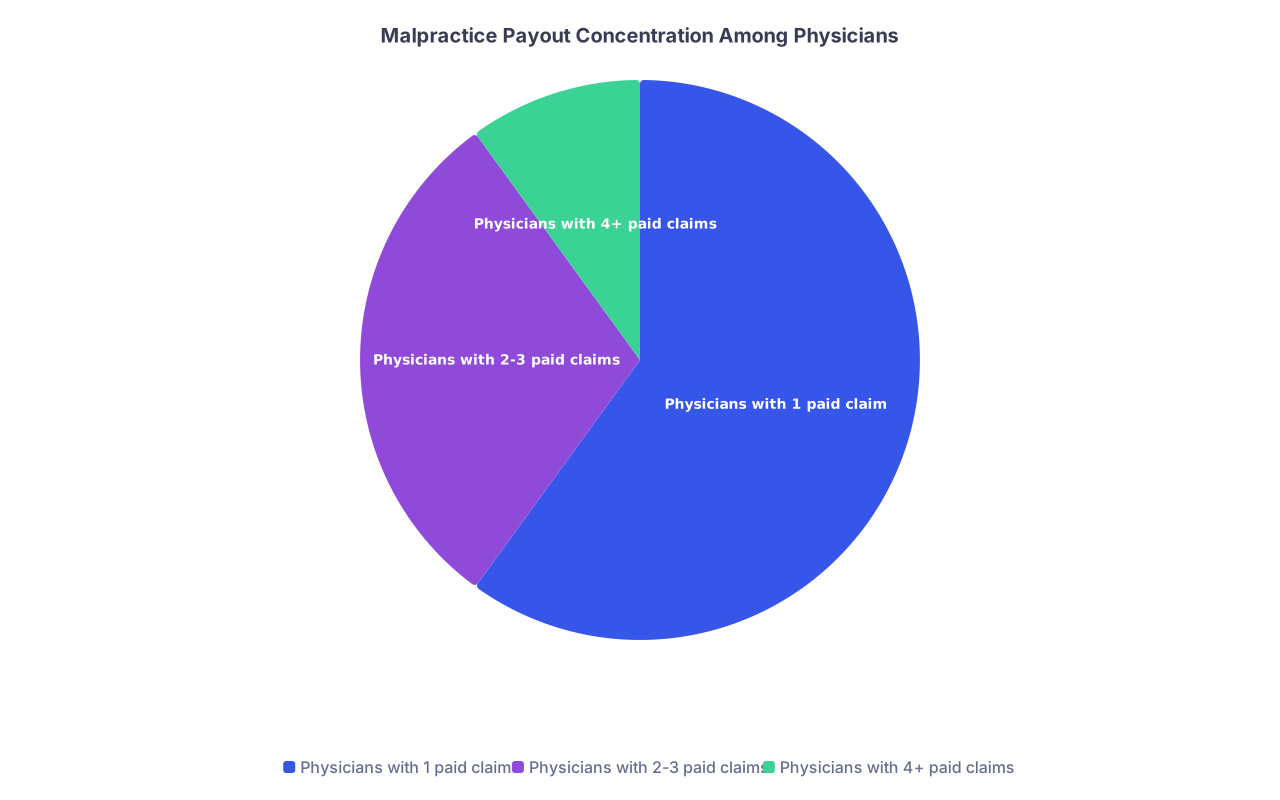
- A small fraction of physicians accumulate many claims and are responsible for a disproportionate share of payouts.
- One isolated claim is not what worries insurers the most; repeat, similar, high-payout events are.
If you’re looking for career death sentences, that last bullet is where the real risk lives.
To make this concrete:
| Category | Value |
|---|---|
| Physicians with 1 paid claim | 60 |
| Physicians with 2-3 paid claims | 30 |
| Physicians with 4+ paid claims | 10 |
That “10% with 4+ paid claims” group accounts for a wildly outsized share of total indemnity dollars. That’s where insurers get nervous. That’s where hospital boards start asking “pattern of unsafe care?” Not the one-time shoulder dystocia case from residency that settled for policy limits.
So if you’re walking around with a single prior claim, even one that paid out, you’re not radioactive. You’re normal in a system that sues normal, competent doctors every day.
How Insurers Actually View Prior Claims
Insurers aren’t superstitious; they’re actuaries with lawyers. They price risk. They care about three things when they look at your history:
- Frequency (how many claims)
- Severity (how big the payouts / how bad the allegations)
- Pattern (same type of issue over and over, or scattered bad luck)
They also care what kind of doctor you are—because OB, neurosurgery, and emergency med don’t live in the same malpractice universe as dermatology.
Here’s roughly how the market behaves in practice:
| Physician Profile | Typical Insurance Response |
|---|---|
| No claims, low-risk specialty | Standard rates, little friction |
| 1 prior claim, closed with no payment | Usually standard rates, minor questions |
| 1 paid claim, moderate payout | Insured with modest surcharge, more scrutiny |
| 2–3 paid claims, similar allegations | Higher premiums, possible exclusions |
| 4+ paid claims or very large payouts | Non-renewal, surplus lines or niche markets |
You’ll notice what’s missing: nowhere does “1 prior claim” translate into “no coverage available.” The market is simply not that fragile.
What does change:
- Your rates can go up.
- Underwriting will ask more questions.
- You may lose access to the cheapest, most selective carriers.
- You may need to work with a broker who actually knows what they’re doing.
But being more expensive and more scrutinized is not the same as being finished.
The Credentialing Reality: Hospitals and Groups
This is where the folklore gets really dramatic: “Once you have a claim, no hospital will touch you.”
Credentialing committees are cautious, sometimes political, often annoying. But most are still tethered to reality. They know:
- A malpractice-free physician over 15–20 years in a high-risk specialty is unusual.
- Claims can reflect system failures, bad documentation, or a bad outcome—not necessarily incompetence.
What they actually look at:
- How many claims you’ve had over what time period.
- How similar the allegations are (e.g., 4 delayed diagnosis of cancer cases… all missed?).
- Whether there were adverse licensure actions or NPDB reports.
- Your references, peer reviews, and quality metrics.
Here’s how this usually plays out when you apply for privileges with a prior claim:
- The application flags your claims history.
- You’re required to submit explanations (narrative summaries).
- Credentialing may ask follow-up questions or request additional documentation.
- They assess whether there’s a pattern or a red flag.
- For many applicants with 1–2 mixed claims, they grant privileges with no special conditions.
I’ve seen physicians with one ugly shoulder dystocia case (large payout, jury trial) get hired by major hospital systems… because their overall record was excellent, their references were strong, and they could clearly explain what happened and what changed afterwards.
On the flip side, I’ve seen a surgeon with multiple similar bile duct injuries, a board complaint, and a license restriction get quietly sidelined. Not because of a claim. Because of consistent, reproducible quality concerns.
Specialty Differences: Some Fields Live in Claim Territory
If you’re in OB/GYN, neurosurgery, emergency medicine, anesthesia, or certain surgical subspecialties, you’re playing on “hard mode” from a malpractice standpoint.
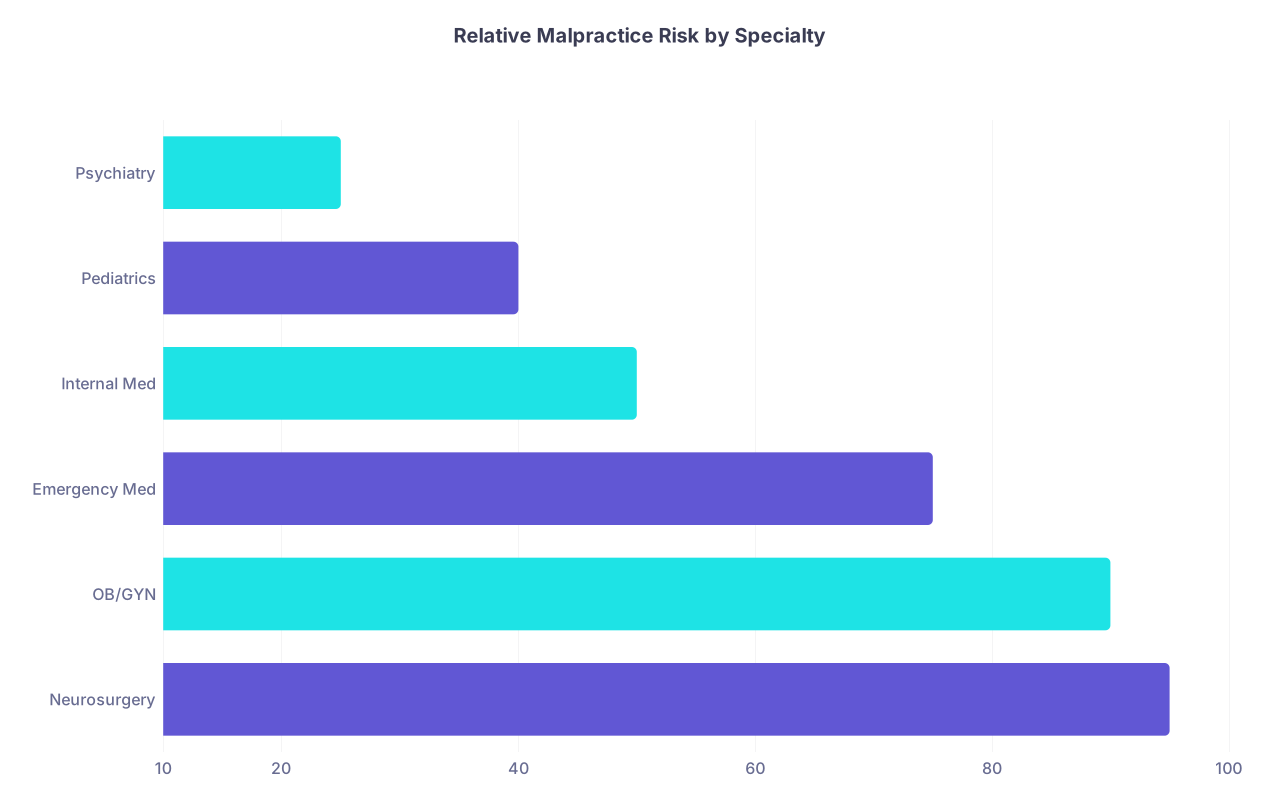
The claim environment isn’t equal. Claims and payouts cluster by specialty.
| Category | Value |
|---|---|
| Neurosurgery | 95 |
| OB/GYN | 90 |
| Emergency Med | 75 |
| Internal Med | 50 |
| Pediatrics | 40 |
| Psychiatry | 25 |
(This is a relative index, not exact percentages—point is, risk isn’t evenly distributed.)
So two things follow:
- A prior claim in a high-risk field is… expected.
- Hiring committees in those specialties know this. They don’t assume “claim = bad doctor.”
They do, however, expect you to:
- Have learned from the case.
- Show evidence of practice change if appropriate.
- Not have a string of similarly bad events.
Residents especially love to catastrophize about “matching into OB or EM means I’ll get sued and then I’m finished.” No. It means the base rate of being sued is higher. It doesn’t mean your career ends at the first claim.
The Financial Hit: Premiums, Surcharges, and Access
Now, let’s not sugarcoat it. A paid claim can be expensive in ways that show up for years.
You can see three main financial impacts:
- Higher premiums. Surcharges for prior claims are real. Depending on carrier and state, you might see 10–50% increases after a significant paid claim.
- Restricted carrier options. Some “A++ best pricing” carriers will quietly say no, and you end up in a slightly more expensive or less prestigious market.
- Tail coverage complications. If your prior claim is tied to a policy with messy tail coverage, you may pay more to exit or move.
But notice what’s missing again: “no one will insure you at any price.” That’s extremely rare and generally reserved for physicians with:
- Multiple severe, recent claims
- Adverse licensing actions
- Documented impairment or boundary violations
- Refusal to cooperate with risk management or remediation
For most physicians, the more honest statement is: “A prior claim will probably cost you money, but it won’t end your ability to practice.”
The Legal and NPDB Angle: What Actually Follows You
If a claim results in a payment on your behalf by an insurer, that payment is generally reportable to the National Practitioner Data Bank (NPDB). That doesn’t mean it’s public on Google, but it does mean:
- Hospitals will see it during credentialing.
- Some large groups and insurers will pull it in background checks.
What they look at:
- The allegation (e.g., failure to diagnose, surgical error, medication error).
- The amount of the payment.
- How old the case is.
- Whether there are multiple similar entries.
The presence of an NPDB report is not a ban. It’s a prompt for questions. And your answers matter.
A weak answer sounds like:
“Lawyers handled it; I don’t really remember the details.”
A strong answer sounds more like:
“This was a 2016 case involving X. The key issues were A and B. Since then, I changed my workflow to include C and D, and we implemented E at the institutional level. I haven’t had a similar case since.”
One of those makes a committee think “risk.” The other makes them think “self-aware, teachable, lower risk now than before.”
What Actually Raises Red Flags (Beyond Just Having a Claim)
There are specific features that move you closer to “career problem” territory:
- Clustered similar claims (e.g., three missed MI diagnoses in 5 years in an ED doc).
- Recent, large verdicts (multi-million dollar judgments within the last 1–3 years).
- Board or license actions tied to patient safety.
- Unresolved behavioral or professionalism issues that show up in references.
- Non-cooperation with risk management, peer review, or remediation plans.
Claims by themselves are blunt instruments. Patterns plus behavior tell the real story.
That’s what sophisticated insurers and serious hospital systems are actually evaluating. They don’t expect perfection. They expect signal amidst the legal noise.
How to Carry a Prior Claim Without Letting It Carry You
You can’t erase history, but you can control how it’s documented, framed, and understood.
Here’s what I’ve seen work for physicians with prior claims who still landed competitive, well-paying positions:
Own a clean, factual narrative.
One page. Plain language. No self-incrimination, no blame-shifting tantrums. What happened, your role, the outcome, what changed after.Align your story with your record.
If your CV, references, and case volumes all scream “solid, consistent clinician,” that narrative about a rare bad outcome is believable.Invest in documentation and communication skills.
A surprising amount of claim exposure is documentation and communication, not raw clinical instinct. Fix those, and your future risk drops.Get serious about risk management.
Take the CME. Do the quality improvement work. If you’ve been through a rough case, you should be able to articulate specific practice changes.Use a real malpractice broker, not just whoever HR uses.
If you’ve got a complicated history, you need someone who can place you in the right market and explain your file to underwriters. This is not a DIY hobby.Be proactive in interviews.
When you know they’ve seen your claims history, don’t play dumb. Brief, confident, and factual works: “You’ll see I had one prior paid claim in 2018. I’m happy to walk through what happened and what changed if that’d be helpful.”
It’s the physician who tries to hide, minimize, or act offended that anyone even asks who tends to make committees nervous.
The Real “Death Sentences” (They’re Not What You Think)
If you want career-killing behavior, it’s not “having a prior malpractice claim.” It’s:
- Repeating the same unsafe patterns after being warned.
- Ignoring feedback from peers and risk management.
- Lying or omitting relevant information on applications.
- Letting bitterness from a bad case poison how you treat patients and colleagues.
Those are the things that turn a claim history into a career problem.
One prior claim—especially in a high-risk field, especially over a long career—does not define you. At worst, it’s a cost, a complication, a permanent line in your professional story that you need to know how to tell.
If you stay in medicine long enough, your record will collect scars. Some will be clinical. Some will be legal. Neither has to be fatal.
Years from now, you won’t be measured by whether you ever got sued. You’ll be measured by how you practiced after you did.