
More malpractice coverage does not magically paint a target on your back. But it absolutely changes the game once something goes wrong.
The usual hallway wisdom goes like this: “If you carry high limits, the sharks will smell the money and sue you more.” I have heard that line from attendings, risk managers, and one particularly loud surgeon who thought his $1M/$3M policy was “begging to get sued.”
The data does not support that story. At least, not in the simplistic way people repeat it.
The truth is more uncomfortable: coverage limits don’t drive whether you get sued nearly as much as they drive how bad it is for you once you are. Frequency vs severity. Two very different beasts.
Let’s separate the mythology from what malpractice claims data and insurer behavior actually show.
The Core Myth: “Higher Limits Attract More Lawsuits”
Here’s the belief: plaintiff attorneys supposedly look up your malpractice limits, see that you have a rich $2M/$6M policy, and slam you with lawsuits that they’d skip if you only had $200k/$600k.
Three problems with that story.
First, in most states, policy limits are not discoverable before a lawsuit is filed. Plaintiffs don’t get to see your coverage details just because they’re thinking about suing you. They have to file, then litigate, to get that information. That’s time and money without any guarantee.
Second, plaintiff attorneys are not lottery players. They do basic math. They look at liability (can we prove negligence?), damages (is there real injury with economic value?), and collectability (is there a solvent defendant?). The presence of some insurance matters. The difference between $1M and $2M almost never drives the decision to file.
Third, when researchers have actually looked at what predicts who gets sued, limits are not high on the list.
You see much stronger associations with:
- Specialty (OB, neurosurgery, CT surgery, EM – the usual suspects)
- Patient volume and case complexity
- Communication skills and perceived empathy
- Prior claim history
- Practice environment (system issues, documentation quality)
Limits barely register compared with those.
So no, going from a $1M/$3M to a $2M/$6M policy does not suddenly triple your lawsuit rate. That’s not how this ecosystem behaves.
But here is where the myth contains a grain of truth: once you are sued, higher limits can absolutely change the dynamics of the case.
What Coverage Actually Does: Frequency vs Severity
Think of malpractice risk in two pieces:
- How often someone files a claim against you (frequency)
- How big the financial damage is when they win or you settle (severity)
Coverage limits influence #2 far more than #1.
Most malpractice claims never result in payment. Depending on specialty and dataset, somewhere around 60–70% of claims close with no indemnity payment. Defense costs, yes. Payout, no.
But when there is a payout, the distribution is skewed. A small number of big cases account for a large share of dollars. That’s where coverage limits matter.
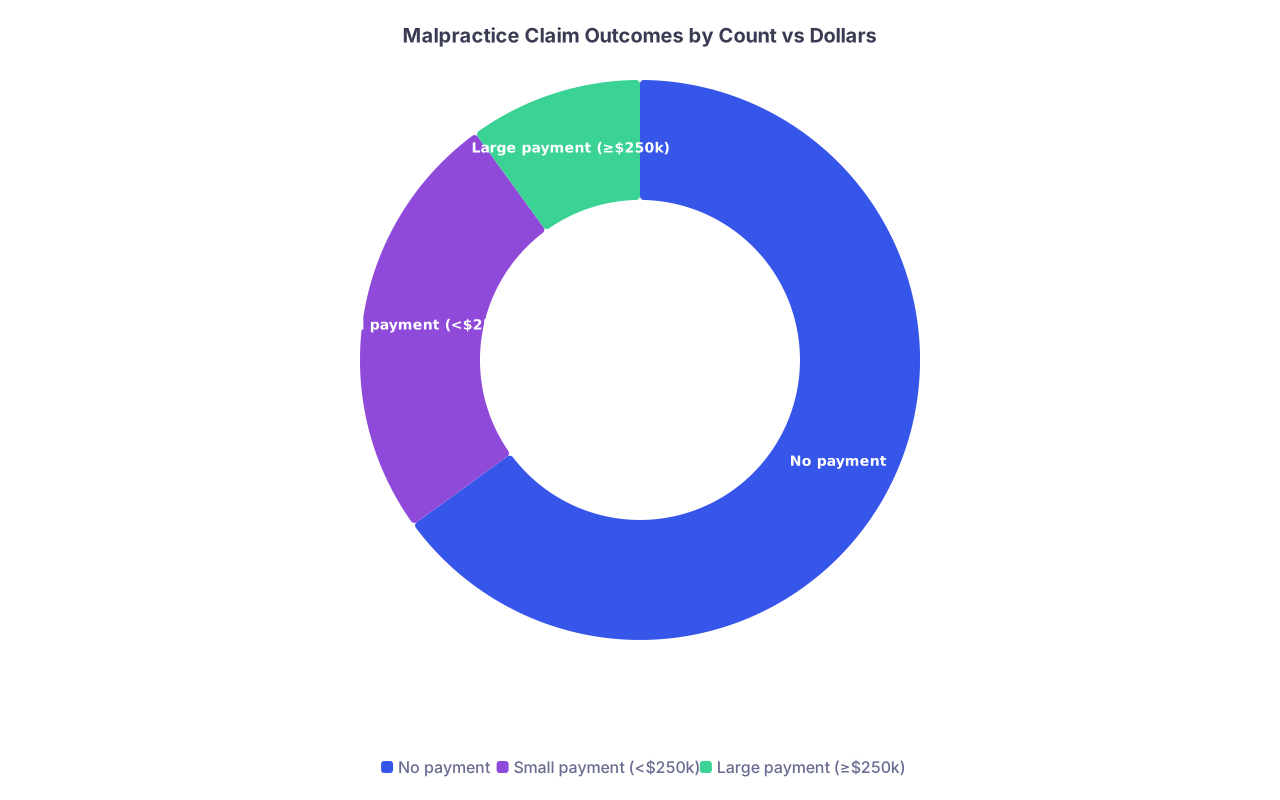
| Category | Value |
|---|---|
| No payment | 65 |
| Small payment (<$250k) | 25 |
| Large payment (≥$250k) | 10 |
Roughly:
- Most claims = no payment
- Some claims = modest payments
- Few claims = big hits
If you have low limits, that caps the insurer’s exposure. If you carry high limits, there’s more room above the floor for a settlement or verdict to expand into. That doesn’t cause the adverse event, or the lawsuit, but it changes how everyone behaves once the claim is on the table.
This is where physicians get burned by misunderstanding. They focus on “Will this make me more likely to be sued?” instead of “If something catastrophic happens, will I personally be on the hook above my limits?”
Because plaintiffs may not know your limits on day one. But you can be absolutely sure they know them by the time settlement negotiations get serious.
How Plaintiff Attorneys Actually Think About Your Coverage
I’ve sat with defense counsel who repeated the same line: “They’ll ask about limits as soon as they think this is a real case.” It’s built into the workflow.
Before filing, plaintiffs evaluate three things in broad strokes:
- Liability – Was the care plausibly negligent?
- Damages – Is the injury severe and economically significant (lost income, long-term care, death)?
- Collectability – Is there a facility, a group, or an insured clinician to pay a judgment?
That third factor is where insurance lives. It’s binary first: is there coverage at all? If yes, the details come later. If no, the case often dies, unless a hospital is involved or the injury is extraordinary.
Once the case is underway, they absolutely want to know:
- Your individual limits
- Group/practice limits
- Hospital/system coverage
- Any excess/umbrella coverage
Then something predictable happens: the settlement range tends to expand up to—but usually not beyond—total available coverage. Not because of greed or magic, but because everyone recalibrates their risk tolerance.
If you have $1M and the case is solid, the “reasonable” settlement might anchor around $800k–$1M. If there’s $5M on the table and a catastrophically injured child, the “reasonable” number shifts upward. Same case, different ceiling.
That’s not superstition. That’s how negotiation works when both sides are risk-averse and insurers are doing expected-value math.
So does more coverage create more lawsuits? Not really. It creates more room for large cases to grow into.
The Real Drivers of Being Sued: Not Your Limits
If you want to change your odds of being sued at all, your coverage limits are almost irrelevant compared to other factors. The malpractice literature is tedious but remarkably consistent here.
Some of the strongest predictors:
Specialty
OB/GYN, neurosurgery, orthopedics, EM, anesthesia, and certain high‑risk surgical subspecialties live in a different universe than dermatology, psychiatry, or pathology. Same country, different battlefield.Case mix and volume
High-acuity, high-volume, emergency, and procedure-heavy practices have more events simply because of exposure. More darts thrown at the board.Communication quality
This is not just soft-skill fluff. There are studies showing physicians with more patient complaints and poorer communication styles have significantly higher claim rates. Patients sue people they feel ignored or disrespected by.Practice environment
Chaotic systems, bad handoffs, poor documentation workflows, understaffing – all of that shows up in claims as “system failure” and creates fertile ground for plaintiff experts.
Your decision to carry $1M vs $3M? Compared with those factors, it’s in the statistical noise for whether the suit gets filed.
Where it does matter is who pays and how much pain you personally feel if you get a bad outcome with a high verdict.
When Low Limits Backfire: The Personal Asset Risk
Here’s the part people really do not like thinking about.
Low limits can, in theory, make you slightly less appetizing as a target in borderline cases. But they also make it far more likely that in a truly catastrophic case, the only money left to reach for is yours.
If a jury comes back with a $3M verdict and you have a $1M per-claim limit, that extra $2M does not vanish. It becomes a question of:
- Post‑trial motions, appeals, and remittitur
- Whether the plaintiff will settle down to policy limits
- Whether the plaintiff’s attorney will chase your personal assets
Defendants almost always settle within limits because all parties want to avoid that scenario. But “almost always” is not “always.” I’ve seen enough defense-side stories where:
- The insurer refused to offer limits early
- The plaintiff’s settlement demand exceeded policy and was “unreasonable”
- The case went to verdict, overshot limits, and the physician had to hire separate personal counsel to protect assets
Now, can plaintiffs really take your house, your 401(k), everything? Often not. Retirement accounts are heavily protected. Homestead laws in some states shield your primary residence. But wage garnishment, liens on non-protected assets, and years of anxiety are not imaginary.
Underinsuring as a strategy to “look poor” to plaintiffs is like driving without seatbelts so thieves won’t steal your car. You are solving the wrong problem.
What Insurers Actually Care About When Pricing You
If higher limits truly created more lawsuits out of thin air, insurers would be screaming at you not to buy them. Their entire business model depends on not encouraging avoidable claims.
Instead, what you see:
- Insurers price coverage roughly proportionally to limits. Twice the limits does not usually mean twice the premium, but it is more.
- They are far more obsessed with your specialty, location, claims history, and hours worked than your exact per-claim limit.
- They do not give you deep discounts for cutting your limits down to the bone, because from their perspective the claim frequency risk barely changes.
Here’s how it roughly shakes out when you compare policy structures for, say, a mid‑career OB/GYN in a moderate-risk state:
| Policy Limits (per claim / aggregate) | Relative Annual Premium |
|---|---|
| $500k / $1.5M | 0.8 × baseline |
| $1M / $3M | 1.0 × baseline |
| $2M / $6M | 1.25 × baseline |
| $5M / $15M | 1.7 × baseline |
You pay more for higher limits, yes. But insurers are not acting like those limits triple your chance of being sued. They treat them mainly as a severity multiplier, not a frequency switch.
Where More Coverage Clearly Matters: High-Risk Scenarios
There are specific, very real situations where higher limits are not a luxury. They are survival.
Catastrophic pediatric injuries – Cerebral palsy, severe hypoxia, major birth trauma. Lifelong care, lost earnings, and non-economic damages stack quickly into multi-million-dollar valuations.
Wrong-site or clearly preventable high-impact errors – Wrong-level spine surgery, retained foreign objects with permanent disability, obvious ER misses with death or severe neurologic injury.
High-income plaintiff with permanent loss of earnings – Think 40‑year‑old professional with seven-figure lifetime income potential, rendered unable to work.
In those cases, low limits can make you marginally less attractive as the sole defendant—but large systems and hospitals often sit beside you with deep pockets anyway. Plaintiffs are going after the entity that can actually pay. You do not become invisible because you shaved your limits.
What you do become is vulnerable to contribution claims, cross-claims, and settlement dynamics where your carrier tenders policy limits early and you are left awkwardly in the suit as an underinsured defendant.
That’s the part physicians rarely hear about in residency.
So How Should You Actually Think About Coverage Limits?
Stop asking, “Will more coverage make me more likely to be sued?” and ask two better questions:
If I have a worst-case catastrophic claim, would I rather the money on the table be insurer dollars or personal dollars?
If the answer is “insurer dollars,” you already know where this is going.What is the realistic size of a worst-case verdict in my specialty and jurisdiction?
Look at state verdict data, caps on non‑economic damages (if they exist), and typical high-end awards. That defines your real risk zone, not your personal tolerance for premiums.
Then remember this simple tension:
- Extremely low limits might slightly deter marginal suits but dramatically increase your personal exposure in rare but devastating cases.
- Adequate or high limits won’t meaningfully change how often you get sued but will shape how painful it is—and whose money is used—when the big one lands.
You’re trading invisible, hypothetical “deterrence” for very visible, very real asset protection. That’s the true equation.

| Step | Description |
|---|---|
| Step 1 | Start - Choose limits |
| Step 2 | Research local verdicts |
| Step 3 | Check typical limits in region |
| Step 4 | Consider higher limits |
| Step 5 | Standard limits acceptable |
| Step 6 | Balance premium vs asset protection |
| Step 7 | High risk specialty? |
| Step 8 | Catastrophic case could exceed $1M? |
Bottom Line: What the Data Actually Shows
Three takeaways, stripped of folklore:
More coverage does not meaningfully increase how often you are sued. Specialty, communication, and practice environment dominate that risk. Limits are a weak player on the frequency side.
Coverage limits strongly influence severity and settlement dynamics once you are sued. They shape how high negotiations go, how much of a verdict is insurer versus personal money, and how painful the worst 1% of cases can be.
Using low limits as “lawsuit repellent” is a bad trade. You gain a theoretical, tiny deterrent effect—if any—and give up substantial protection in exactly the catastrophic scenarios most likely to end your career or wreck your finances.
More coverage doesn’t make you a target. It makes you less of a victim when the system, your patient’s biology, or your own fallibility finally catches up with you.