
Going bare on malpractice coverage is not universally insane. But most physicians who do it are betting on the wrong risks for the wrong reasons.
Let’s strip this down to what actually happens in courtrooms and claim files, not in locker-room chatter or med Twitter threads.
You’ve probably heard some version of this:
- “Plaintiffs don’t sue bare doctors; there’s no money.”
- “If you’re judgment-proof, you don’t need malpractice insurance.”
- “Coverage just paints a target on your back.”
- “The real risk is your license, not your assets.”
Some of that contains a grain of truth. Most of it is dangerously oversimplified.
Below is what malpractice claims data, verdict reports, and actual legal mechanics say about going bare—especially in the later-career, “almost set” phase where a lot of docs start flirting with this idea.
What “Going Bare” Really Means (Legally, Not Emotionally)
Quick definition before people start talking past each other.
“Going bare” means:
- You carry no professional liability (malpractice) insurance
- You practice in a way where claims are defended and paid—if at all—out of your own pocket, or more realistically, out of your future wages and attachable assets
- You are not protected by an employer’s coverage (e.g., employed hospitalist with institutional coverage is not “bare,” even if you personally don’t buy a policy)
There are three very different scenarios physicians lump together:
- Pure employed doc with strong hospital coverage – not bare
- Independent doc with minimal/cheap policy – underinsured, but not bare
- Independent doc with no policy at all – actually bare
We’re talking about #3.
| Setup Type | Who Pays Defense | Who Pays Judgment | Personal Asset Risk |
|---|---|---|---|
| Employed, covered | Hospital/Insurer | Hospital/Insurer | Low |
| Independent, insured | Insurer | Insurer (to limits) | Moderate (above limits) |
| Independent, bare | You | You | High |
Myth #1: “Plaintiff Lawyers Don’t Sue Bare Doctors”
This is the flagship myth. I hear it from older surgeons and some boutique concierge types who are otherwise very smart.
Here’s what the data and incentives actually show.
How plaintiffs’ attorneys actually think
Contingency-fee med mal lawyers are not idiots. They don’t sue just anyone. They run a simple mental model:
- Is there liability? (Did the doc plausibly screw up?)
- Is there causation? (Did that screwup likely cause substantial harm?)
- Is there collectible money at the end?
The third part is where “bare” matters. But here’s the twist: “no policy” does not equal “no recovery.” Lawyers know:
You may have:
- Retirement accounts (some protected, some not, and protection rules vary by state)
- Home equity (sometimes shielded, sometimes not, depends on homestead laws)
- Future wages
- Ownership in ASC, imaging center, group practice
A judgment against you:
- Can be renewed, often every 10 years, sometimes indefinitely
- Can follow you across state lines
- Can impact your credit, licensure, credentialing, hospital privileges
So, do some plaintiff firms screen out bare docs? Yes.
Do all of them? Absolutely not.
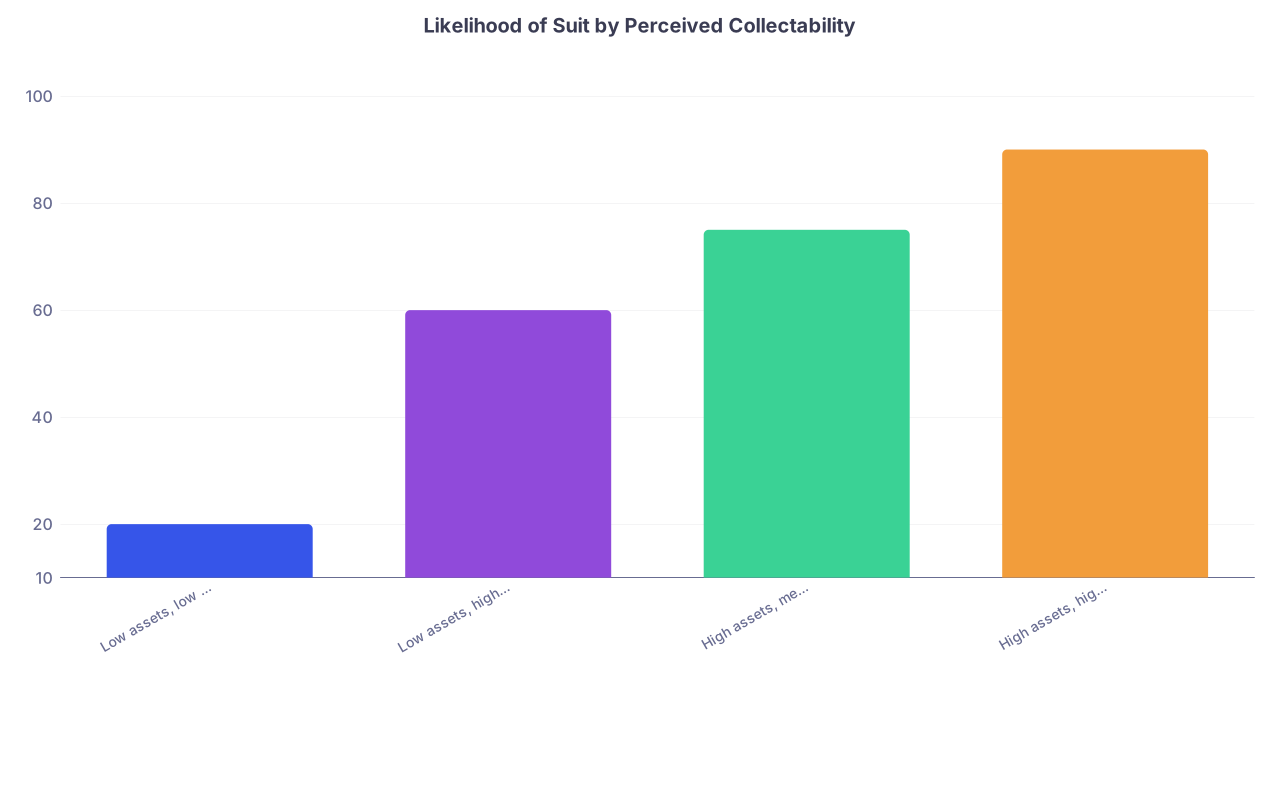
Where it really matters is expected case value. If you’re a bare low-asset doc with modest income and thin collectability, you’ve made yourself less attractive prey. If you’re a bare high-earning proceduralist with a paid-off $1.5M house? You’re still a very interesting target.
| Category | Value |
|---|---|
| Low assets, low income | 20 |
| Low assets, high income | 60 |
| High assets, medium income | 75 |
| High assets, high income | 90 |
(Values here are conceptual, but that’s the direction the incentives push.)
Bottom line: going bare can reduce the chance of being sued if you are truly judgment-proof. But most mid- to late-career physicians are not even close to judgment-proof, and plaintiff lawyers know it.
Myth #2: “If I’m Almost Retired, I’m Safe Because My Assets Are Protected”
This is where people get dangerously confident after half-hearing something from an asset-protection seminar.
Retirement and homestead protections are a patchwork. Not a force field.
What actually happens to your stuff
401(k) / ERISA plans
Often strongly protected from creditors, including med mal judgments. But:- Rollovers to IRAs can change the level of protection
- State law matters for IRAs, SEP, SIMPLE, etc. Some states have near-total protection; others have caps or weaker rules.
Homestead / primary residence
- Florida and Texas: famously generous. People lean on this to justify going bare there.
- Many other states: capped homestead protection. A $150k equity cap does nothing for your $800k house.
Brokerage accounts, cash, non-qualified investments
Frequently not protected. Easy to attach.Practice ownership, real estate LLC shares, ASC equity
Very attractive to plaintiffs. They may not take over the business, but they can attach distributions or force unhappy arrangements.Future income
Wage garnishment or forced payment arrangements are absolutely on the menu in many jurisdictions.
If you’re thinking, “Well, I’ll just hide everything in LLCs and trusts,” that’s where you start flirting with fraudulent transfer territory. Courts and plaintiffs’ counsel are very familiar with “suddenly assetless doctor right after the bad outcome.”
You do have some real legal shields. But they’re not perfect. And they don’t prevent:
- Years of litigation
- Aggressive post-judgment discovery into your entire financial life
- Pressure settlements that cost you anyway
Going bare because “my assets are safe” is often based on half-accurate bar-talk law, not actual state statute and case law.
Myth #3: “Insurance Makes You a Bigger Target”
The “big pot of money” story: if your policy shows $1M/$3M, suddenly plaintiffs go wild and pile on.
Here’s what the data and claims teams actually see.
What really drives filing decisions
The primary driver is injury severity and liability strength, not coverage limits.
State and national med mal data show:
- The vast majority of claims that go to suit involve:
- Death
- Permanent major injury
- Significant, life-altering harm
Nobody files a full med mal suit for a day of extra nausea unless they’re unhinged or weaponized by another motive.
Insurers do watch something important: claim frequency and severity by specialty and setting, not by individual policy limits. A bare neurosurgeon is still a golden ticket if the case is strong and damage is catastrophic.
What insurance does change:
- Plaintiffs and defense both know the policy limit is the default “ceiling” for settlement.
- Many plaintiff attorneys quietly price their cases around “what can we probably squeeze up to the limit?”
- When there’s a catastrophic injury and clear liability, everyone in the room knows the true damage number might exceed policy limits—but settlement often lands at or slightly under those limits.
So yes, if you have an obvious $500k+ case and $1M in coverage, your limits create a realistic, collectable target.
But here’s the contrarian twist: going bare doesn’t magically drop case value. It just changes how painful the outcome is for you.
What Outcomes Actually Look Like: Paid vs Unpaid, Settled vs Verdict
Let’s talk distributions, not anecdotes.
Most cases don’t go to trial
Malpractice insurers, big ones, publish their numbers:
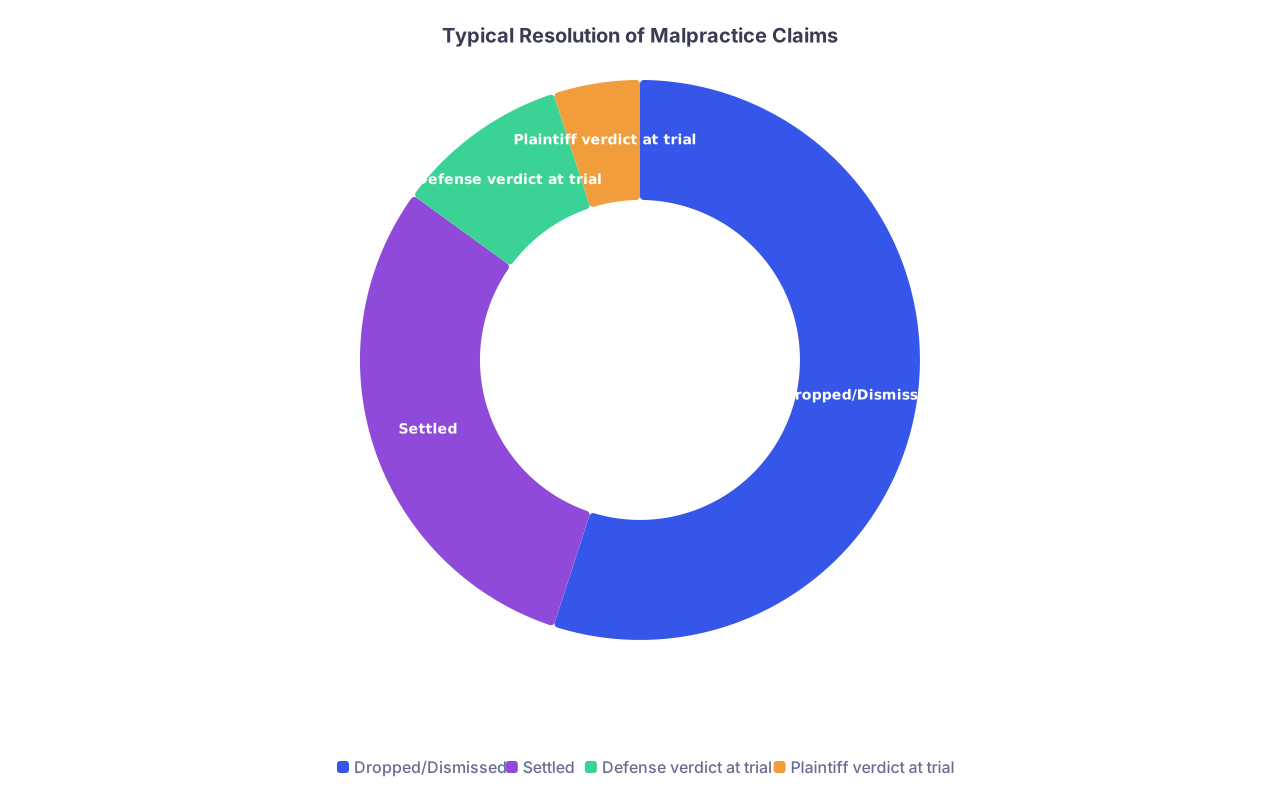
- The majority of claims are dropped or dismissed before trial.
- Of those that survive:
- Many settle before trial
- A small minority result in plaintiff verdicts
- Defendants often win at trial, but that’s not free—you paid in time, stress, and reputation
When you’re insured:
- The carrier pays for defense counsel
- They fund experts, depositions, motions
- They pay settlements and judgments up to your limits
When you’re bare:
- You’re writing checks to your own attorney. Five figures just to start.
- Six figures easily if the case is complicated or drags on.
- You’re negotiating your own risk tolerance on both liability and bankruptcy.
| Category | Value |
|---|---|
| Dropped/Dismissed | 55 |
| Settled | 30 |
| Defense verdict at trial | 10 |
| Plaintiff verdict at trial | 5 |
Again, the exact percentages vary by state and specialty, but insurers’ public data largely cluster around this picture.
Saying “I’ll just defend myself bare; most cases get dropped” ignores the cost and chaos of the minority that do not.
The Real Financial Tradeoff: Premiums vs Tail Risk
At some point, every doc who flirts with going bare is asking a quiet math question: “What’s the probability-weighted hit vs the cost of premiums?”
Let’s be clinical.
The cost side (insured)
- Typical mature claims-made premium for a proceduralist: high four to low five figures per year (varies wildly by state and specialty).
- Defensive benefit:
- Defense costs fully covered
- Settlements/verdicts up to limits covered
- Often license-defense riders or add-on coverage
The cost side (bare)
You save the premium. Every year you don’t get sued, you “win.”
But when you lose:
- Defense: $75k–$200k+ is not a “crazy” range for a hotly contested med mal suit.
- Settlement:
- Modest injuries may still end up in the low- to mid-six figures
- Severe/permanent injuries can easily justify seven figures in economic + non-economic damages, even capped states

You’re essentially writing yourself a giant, uninsured stop-loss contract with no upper bound. Saving $30k a year to absorb a potential $1M+ hit is sometimes rational—for the physician with true asset protection, short time horizon, and a very clear legal/financial plan.
For most? It’s Russian roulette with a variable number of bullets in the cylinder, and you don’t get to inspect it before you spin.
Non-Obvious Risk: Licensing, NPDB, and Reputation
Docs dramatically underestimate the collateral damage from a bare-bones defense.
Another thing coverage buys you: professional defense infrastructure.
When insured:
- Your carrier picks experienced med mal defense counsel
- They pay for expert witnesses to rebut plaintiff’s experts
- They manage documentation, discovery responses, and strategy
- They’re highly motivated to avoid adverse verdicts and nasty NPDB entries
When bare:
- You choose (and pay for) your own lawyer
- If you cheap out, you get what you pay for
- Licensing board responses, NPDB implications, hospital credentialing letters—these all become harder to manage if the underlying case was handled sloppily
That “I’ll just settle quick and move on” approach? It still triggers:
- NPDB reports for most settlements
- Flagging at hospital credentialing
- Extra scrutiny on license renewal in some states
You’re not just risking money. You’re risking how easy the next decade of your professional life will be.
When Going Bare Might Actually Be Rational
Now for the part nobody likes because it doesn’t fit the absolutist narrative: there are situations where going bare can be a defensible decision.
Not common. But real.
Typical pattern where it can make sense:
- Older physician, very close to retirement
- Practice in a strong asset-protection state (think generous homestead and retirement protections)
- Most net worth in strongly protected buckets (ERISA 401(k), homestead, etc.)
- Low-risk specialty or practice scope tightly controlled/limited
- Very clear, customized asset protection and estate plan set up years before any incident
- Realistic acceptance of the nonfinancial cost (time, stress, reputation, licensing friction)
In that narrow lane, the math can pencil out: you’re paying large late-career premiums for a shrinking window of risk, and a catastrophic loss may be uncollectible in practice.

| Step | Description |
|---|---|
| Step 1 | Thinking of going bare |
| Step 2 | Already covered - do not go bare |
| Step 3 | Going bare usually irrational |
| Step 4 | Consider going bare with legal counsel |
| Step 5 | Employed with coverage |
| Step 6 | High net worth and assets exposed |
| Step 7 | Strong asset protection state |
| Step 8 | Near retirement and low risk scope |
If that’s not you, and you’re 42 with kids, big mortgage, mix of protected/unprotected assets, and a high-income specialty? Going bare is typically delusional bravado dressed up as “legal strategy.”
The Biggest Miscalculation: Overestimating Control
Physicians love control. They overestimate how much they’ll have in a real lawsuit.
Here’s reality from actual case files:
- You don’t control the plaintiff’s personality or lawyer
- You don’t control the expert witness who says you violated the standard of care
- You don’t control the judge’s pretrial rulings
- You don’t control a jury that heard three weeks of carefully curated emotional testimony
I’ve seen careful docs lose ugly cases. I’ve seen sloppy docs skate because causation was shaky. Your personal virtue and careful documentation reduce risk; they do not eliminate it.
Malpractice insurance is not a vote of no-confidence in your skills. It’s recognition that medicine is practiced in an environment where randomness and bias exist—and that juries are not Bayesian statisticians.

So, Is Going Bare Ever Smart?
Sometimes. For a narrow slice of physicians with:
- Right state laws
- Right asset structure
- Short time horizon
- And genuinely informed legal guidance
For most practicing physicians, the “bare” strategy is built on:
- Overconfidence in “I won’t get sued”
- Misunderstanding of which assets are actually protected
- Underestimation of defense costs and collateral damage
- Cherry-picked anecdotes from the one guy in the physician lounge who “did fine” (and who you’ve never seen under oath)
If you really want to be contrarian and smart instead of just contrarian and loud, run your numbers with:
- A qualified malpractice/healthcare attorney in your state
- A real asset-protection/estate planning lawyer (not a seminar hawker)
- Your actual balance sheet: what is and is not shielded under real law, not fantasy law
Then decide if saving those premiums is still worth it.
| Category | Value |
|---|---|
| Retirement accounts | 85 |
| Primary home | 80 |
| Practice ownership | 40 |
| Brokerage/cash | 30 |
| Future income | 25 |
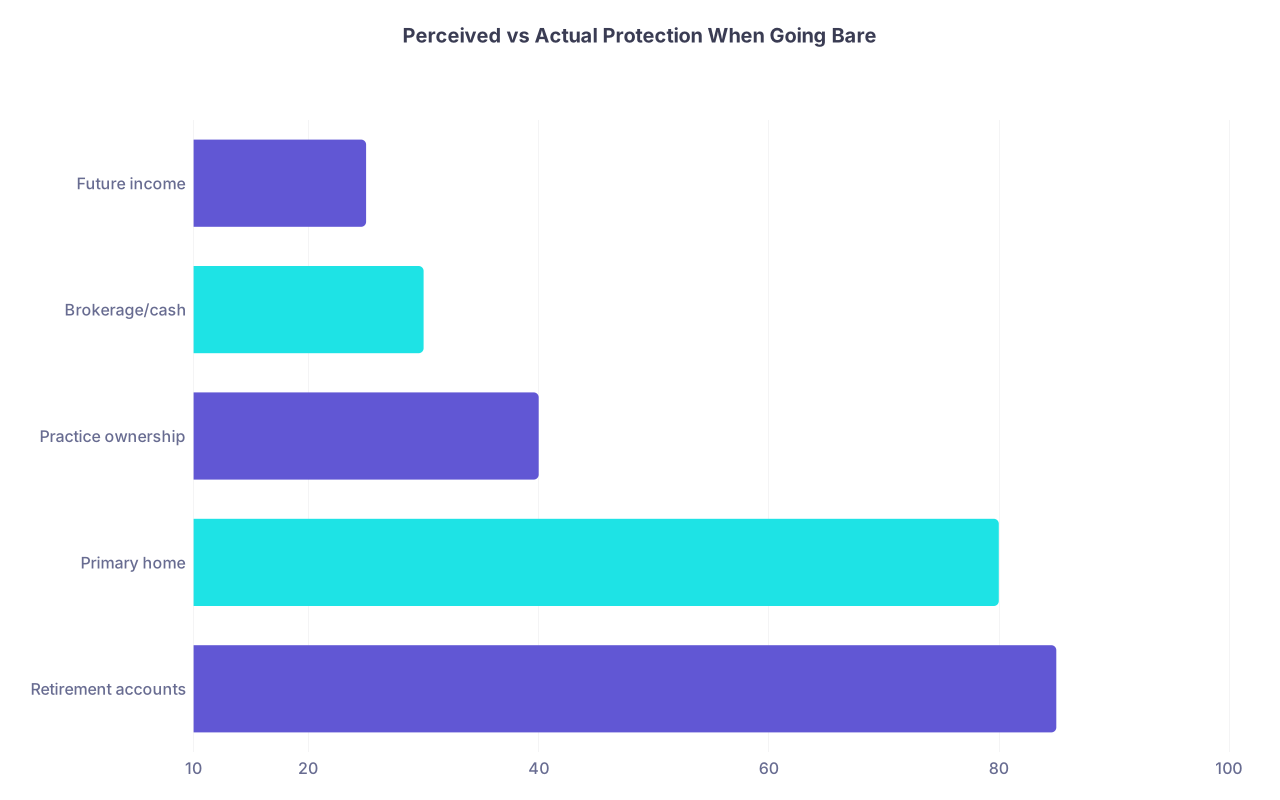
(The point: most docs perceive much higher protection than statutes and courts actually provide, especially for non-retirement investments, cash, and future earnings.)

FAQ (Exactly 5 Questions)
1. Is it ever illegal to practice without malpractice insurance?
Yes. A few states and specific practice settings (e.g., some hospital medical staff bylaws, certain health plans) effectively require coverage. Some states have patient compensation funds or statutory schemes that make coverage practically mandatory. You need to check your state’s medical board rules and any hospital/plan contracts, not just “the law in general.”
2. If I’m employed and the hospital covers me, am I still “bare”?
No. If your employment agreement or medical staff bylaws include malpractice coverage for your clinical activities, you’re insured under their policy. You might still want your own supplemental coverage in some situations (e.g., moonlighting, side gigs, or gaps), but you’re not bare for your core employed practice.
3. Does going bare help me avoid NPDB reports since there’s no insurer to report?
No. NPDB reporting is triggered by payments made “for the benefit of” a practitioner in resolution of a malpractice claim, no matter who writes the check. If you personally pay a settlement or judgment, that can still be reportable. Going bare doesn’t magically keep you off the grid.
4. Can I just form an LLC or corporation and have that take the hit instead of me personally?
Not really. Corporate structures can help with some business liabilities, but in med mal, plaintiffs routinely name both the entity and the individual physician. Professional negligence is usually a personal obligation. You can’t reliably shield yourself from malpractice by hiding behind an entity; courts and plaintiffs’ lawyers know this game.
5. If I want to consider going bare, what’s the minimum due diligence?
At bare minimum: a state-specific consult with a healthcare/malpractice attorney, a separate meeting with a real asset-protection/estate lawyer, a detailed inventory of every asset and its legal protections, and a hard, unromantic look at your specialty’s claim frequency and severity data. If your “plan” is mostly based on what you heard from a colleague at dinner, you’re not being strategic—you’re gambling.
Key Takeaways:
- Going bare reduces attractiveness to plaintiffs only if you’re truly hard to collect from—most mid/late-career physicians are not.
- Insurance isn’t just about payouts; it buys you competent defense, procedural protection, and insulation from catastrophic tail risks.
- For a tiny, very specific subset of doctors with strong protections and short horizons, going bare can be rational—but for most, it’s a high-stakes bet built on bad assumptions, not data.