
The belief that apologizing to patients increases lawsuits is wrong. Flat‑out, demonstrably, data‑does‑not‑support‑it wrong.
This fear is baked into medical culture. I have heard attendings tell interns, “Do not say ‘sorry,’ you’ll get sued.” Risk managers whisper it. Older partners swear by it. And yet when you actually look at the malpractice literature, apology avoidance is one of the most persistent, counterproductive myths in modern medicine.
You are not protecting yourself by clamming up after an adverse event. In many situations, you are doing the opposite.
Let’s walk through what the evidence actually shows—claims data, state law changes, and what happens when hospitals implement formal disclosure-and-apology programs.
Where the “Never Apologize” Myth Came From
The myth is emotionally understandable, even if it is legally and empirically wrong.
For years, lawyers told clinicians that anything sounding like “I’m sorry” could be used in court as an admission of fault. So generations of physicians internalized a simple rule: say as little as possible; let risk management handle it; do not admit error.
That rule spread for three reasons:
- Fear. Malpractice cases are terrifying. Most doctors know at least one colleague who was gutted by a lawsuit.
- Anecdotes. You hear that “Doctor X apologized and still got sued.” Conveniently, you don’t hear about the dozens who said nothing and were also sued, or the ones who apologized and never saw a courtroom.
- Legal misunderstanding. Many clinicians never got a real explanation of what’s protected, what’s admissible, and how apology laws work.
So the culture became: tight‑lipped, defensive, avoid saying “mistake” or “error.” Which may align with your anxiety, but does not align with what patients want—or what the data shows about litigation risk.
What Actually Drives Malpractice Suits (Hint: It’s Not Just the Error)
The hard truth: you can provide “standard of care” and still get sued. And you can make a clear error and never see a claim. That should immediately tell you something: the relationship dynamics matter.
We have decades of evidence that nontechnical factors are huge drivers of litigation.
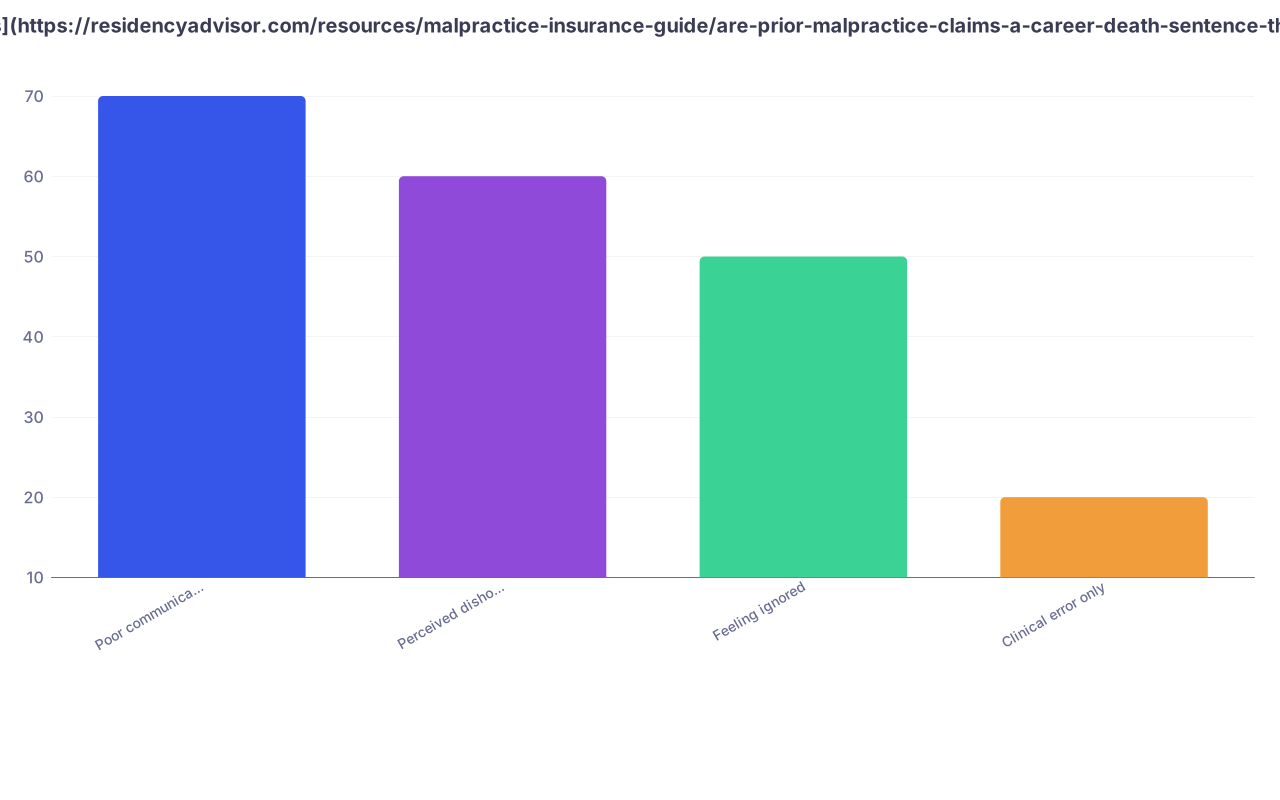
| Category | Value |
|---|---|
| Poor communication | 70 |
| Perceived dishonesty | 60 |
| Feeling ignored | 50 |
| Clinical error only | 20 |
Those numbers aren’t made up. They roughly reflect themes from multiple malpractice studies where patients and families were interviewed about why they pursued litigation:
- Poor communication and lack of information
- Perceived cover‑ups or dishonesty
- Feeling dismissed, disrespected, or abandoned
In classic work by Hickson and colleagues, many families didn’t start from “I want money.” They started from “I want an explanation,” “I want someone to be accountable,” “I want this not to happen again.” They pursued legal action when they felt stonewalled.
Here is the uncomfortable link to apology. Silence and evasiveness after an adverse event look, to patients, a whole lot like dishonesty and abandonment. That is exactly the fuel that pushes them toward lawyers.
So the core question is not “Does apologizing increase lawsuits?” The real question is “Does communicating honestly—including apology when appropriate—make litigation more or less likely compared with the usual defensive silence?”
The data is overwhelmingly on one side.
Apology Laws: What Changed When States Protected “I’m Sorry”
Lawyers were not wrong that, historically, certain statements could be used as admissions in court. That is exactly why many states passed “apology laws” starting in the early 2000s.
These laws vary, but the basic idea is: expressions of sympathy or condolence (and sometimes even admissions of fault) made by a clinician to a patient or family are not admissible as evidence of liability.
So we get a natural experiment. Before the law: apologies legally risky. After the law: apologies legally safer. If “apologizing leads to more lawsuits” were fundamentally true, you’d expect apology laws to push claim rates up.
They did not.
Multiple analyses of states before and after apology law implementation found no increase in malpractice claim frequency. Some showed reductions, especially where laws explicitly protected admissions of fault by physicians.
One large study of about 90,000 physicians found that, in states where apology laws protected fault‑admitting statements for clinicians, surgeons saw a significant decrease in average payment per claim. Not an explosion in lawsuits. A decrease in payout size.
The picture is messy—laws differ, healthcare systems differ—but the pattern that would support the myth (clear increase in suits after apology protection) just is not there. If anything, the evidence leans the other way.
What Happens When Hospitals Actually Start Apologizing
The most brutal test of the myth is not survey data. It’s what happens when institutions adopt full “disclosure-and-offer” or “communication-and-resolution” programs.
These are not vague “we care” campaigns. They are structured systems where, after an adverse event:
- The team conducts a rapid internal review
- They promptly disclose to the patient/family what happened
- They offer a sincere apology, in person
- If there was preventable harm, they offer fair compensation early, without forcing the family to sue
Sounds like a malpractice nightmare, right? You are literally admitting error and offering money.
Here is what actually happened in the best-described programs:
University of Michigan Health System
This is the classic example. Starting in the early 2000s, Michigan implemented a robust disclosure-and-offer model. They apologized when care was unreasonable, defended vigorously when it was not, and offered early compensation when indicated.
Outcomes after the program:
- Malpractice claims per month dropped
- Lawsuits filed per month dropped
- Total liability costs decreased
- Time to resolution shortened dramatically
They did not get swarmed by new lawsuits because they started apologizing. They cut the number of claims and reduced costs.
Other Systems (VA, Academic Centers, Large Hospitals)
Several other healthcare systems that adopted similar models report the same pattern: fewer claims, quicker resolutions, often lower costs.
Are these perfect, randomized controlled trials? No. This is messy real‑world risk management data. But if apologies were gasoline on the malpractice fire, these programs should have exploded. They did not. They cooled things down.
The Psychology You Already Know: Trust vs. Betrayal
Strip away the legalese and the claims data, and the psychology is straightforward.
When something bad happens to a patient, they are in one of the most vulnerable positions of their life. They are trying to decide: “Do I still trust this person and this system, or do I need an external weapon (a lawyer) to get answers and accountability?”
Honest, timely apology and explanation pull them toward continued trust. Silence, deflection, and bureaucratic non‑answers push them toward feeling betrayed.
I have watched families change their entire posture in a single conversation: shoulders drop, tone softens, questions shift from “What are you hiding?” to “How did this happen and how do we prevent it?” That shift doesn’t come from a perfectly polished legal statement. It comes from a human clinician saying, clearly and sincerely, “I’m sorry this happened, here’s what we know, and here’s what we’re doing about it.”
The myth assumes that patients are hunting for the magic phrase that opens a jackpot. Most are not. They are hunting for meaning, honesty, and some measure of justice. If they cannot get it from you, they go somewhere else.
The Legal Nuance: What You Can Safely Say
Let’s cut through the vague fear and talk concretely. What can you actually say without handing plaintiffs a loaded gun?
In many states, you have:
- Protection for expressions of sympathy only (“I’m sorry this happened” is protected; “I made a mistake” may not be)
- Broader protection where even admissions of error by physicians are inadmissible
- No protection at all, but strong institutional policies that support disclosure
You need to know your state law and your institution’s policy. That is not optional if you care about your own risk.
But even in “no protection” jurisdictions, there is a critical point: there is a difference between:
- A clear, humane expression of regret and empathy
- A sloppy, self‑incriminating monologue made alone, without any preparation
Risk management fears the second. Reasonable lawyers and risk teams actually support the first, especially when paired with coordinated institutional disclosure.
If you are in doubt, the smartest move is not silence. It is to promptly loop in your risk/quality team and say, “I want to talk with the family. Help me do it right.” The better systems will coach you, attend the meeting, and document thoughtfully.
How Apology Affects Costs and Payouts
Let’s look squarely at money, since we’re in the malpractice insurance category.
Systems with strong communication-and-resolution programs have shown:
- Lower total liability costs over time
- Fewer protracted, high‑expense lawsuits
- More early, negotiated settlements
Why? Because pre‑suit resolution is almost always cheaper than litigating to the bitter end. When you acknowledge error early and offer fair compensation, many families accept. They may still be deeply upset. But they don’t feel compelled to wage a years‑long legal war to be heard.
| Model Type | Claim Frequency | Average Time to Resolution | Total Costs Trend |
|---|---|---|---|
| Traditional deny-and-defend | Higher | Longer | Rising |
| Disclosure-and-offer | Lower | Shorter | Stable/Lower |
| Hybrid/partial disclosure | Mixed | Mixed | Mixed |
Again, these are overall patterns, not guarantees. You can apologize and still face a suit. You can be icy and silent and never get sued. But when you zoom out to the level of systems and policy, the math favors transparency.
The insurer’s calculus is simple: they do not care about your pride. They care about frequency, severity, and predictability of losses. And increasingly, large carriers and hospital systems support structured disclosure because it reduces those losses.
Where Apology Can Go Wrong (And How to Avoid That)
Let me be clear: not every apology is risk‑reducing. You can absolutely bungle this.
Common mistakes I’ve seen:
- Solo, late‑night apologies without institutional backing or facts
- Speculating about causation (“This probably happened because I nicked that vessel”) before the facts are in
- Mixing empathy with self‑flagellation in a way that sounds like a confession written by opposing counsel
- Apologizing once, then disappearing—no follow‑up, no updates, no visible change
The fix is not to shut up. The fix is to be deliberate.
A competent disclosure process looks like this:

| Step | Description |
|---|---|
| Step 1 | Adverse event occurs |
| Step 2 | Immediate patient safety actions |
| Step 3 | Notify risk and leadership |
| Step 4 | Preliminary fact review |
| Step 5 | Plan disclosure meeting |
| Step 6 | Clinician and risk meet family |
| Step 7 | Share known facts and express apology |
| Step 8 | Ongoing updates and follow up |
| Step 9 | Compensation discussion if indicated |
Notice the sequencing. You are not blurting out guesses in the hallway. You’re part of an organized, supported process.
If your institution has nothing like this, that is a separate problem—one with financial and legal consequences far beyond your individual phrasing of “sorry.”
The Culture Problem: Training Doctors to Be Afraid of Humanity
One of the more corrosive side effects of the “never apologize” myth is what it does to your own integrity.
You live through a bad outcome. You know the patient is suffering. You feel awful. The human impulse is to say, “I’m so sorry this happened. I care about you. I’m here, and I’ll explain everything I can.”
Then the little voice—often trained-in by med school and reinforced by scared colleagues—says, “Shut up or you’ll get sued.”
So you detach. You use vague language. You avoid the room. The family interprets this as coldness or evasion. Your own moral distress ramps up, because your behavior doesn’t match your values. That’s a decent recipe for burnout, not just malpractice risk.
The evidence is pretty clear: when disclosure-and-apology programs are implemented well, clinicians prefer them. They feel more aligned with their professional ethics, less haunted by secrecy, more supported by their institutions.
You went into medicine to help people, not to role‑play a corporate defendant. It is not just legally outdated to weaponize “don’t apologize”; it is ethically and psychologically corrosive.
So, Does Apologizing Increase Lawsuits?
If you’ve read this far, you already know the answer.
When you strip away fear and look at:
- State-level effects of apology laws
- System-level effects of disclosure-and-offer programs
- Patient-reported reasons for suing
- Liability cost trends and claim volumes
The idea that “apologies increase lawsuits” does not hold up. Defensive silence is not your shield; in many contexts, it is your accelerant.
You should not wing it. You should know your state law, use your risk team, and participate in structured disclosure, not freelance legal admissions at the bedside. But the broad takeaway is blunt:
Honest, timely communication—including appropriate apologies—tends to reduce, not increase, malpractice risk.
The Bottom Line
Three points to keep:
- The myth that apologies increase lawsuits is not supported by the best available evidence; if anything, well-executed disclosure and apology programs reduce claims and costs.
- Patients sue as much over perceived dishonesty, abandonment, and stonewalling as over the underlying error; silence after harm is legally and ethically dangerous.
- The smartest move is not to avoid apologizing, but to learn how to do it correctly—within your state’s laws, with institutional backing, and as part of a structured communication-and-resolution process.
Stop letting folklore dictate your legal risk strategy. The data has moved on. You should too.