
71% of physicians who volunteer assume the clinic’s malpractice policy fully protects them.
It usually does not. And sometimes it barely protects the clinic, let alone you.
Let me be blunt: “Don’t worry, our clinic covers you” is one of the most expensive sentences in medicine when it comes to malpractice. I’ve heard it said casually during rushed onboarding, right after, “We’re so grateful you’re here.” Gratitude doesn’t pay for defense counsel. And it sure doesn’t restore your name once you’re personally named in a complaint.
You’re reading this because you suspect something’s off with the “automatic coverage” story. You’re right. Let’s break down what’s myth, what’s real, and where you’re personally exposed.
The core myth: “If I’m volunteering, I’m automatically covered”
Here’s the fantasy version of how this works:
You show up to a free clinic. You sign a quick volunteer form. Someone vaguely mentions “We have malpractice insurance.” You exhale and think, “Okay, I’m good.”
Except you have no idea:
- What limits they carry
- Whether you’re actually a named insured
- Whether the coverage applies to your specific role
- Whether any governmental immunity actually applies to you in this context
Clinics are often underfunded, administratively thin, and frankly over-optimistic about their risk posture. They’re focused on access to care and keeping the lights on. You are focused on not having your career derailed by one bad outcome. Those are different priorities.
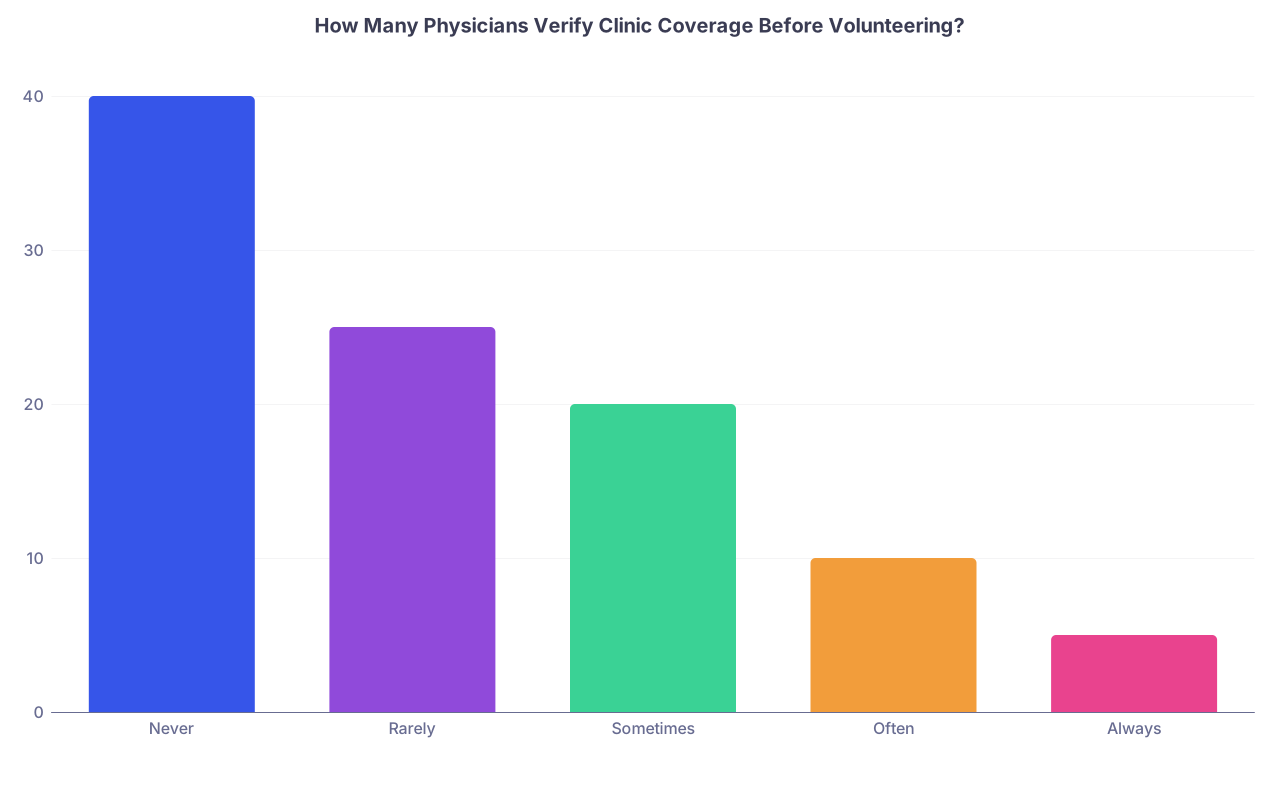
| Category | Value |
|---|---|
| Never | 40 |
| Rarely | 25 |
| Sometimes | 20 |
| Often | 10 |
| Always | 5 |
If you actually pulled the policies of 20 typical free or volunteer clinics, you’d see the same pattern I’ve seen:
- Policies that only name the entity, not individual clinicians
- Policies with low per-claim limits and even lower aggregate limits
- Exclusions for certain procedures, prescribing, or telehealth
- Coverage only for licensed staff on payroll, not ad‑hoc volunteers
And yes, I’ve seen clinics that simply assumed their general liability policy covered malpractice. It did not.
How malpractice coverage really works in volunteer settings
Malpractice coverage in these clinics usually comes from one of a few buckets. Almost none of them are as broad or automatic as people think.
1. The clinic’s own malpractice policy
Many community health centers and free clinics carry a professional liability policy. Key problems:
You may not be defined as an “insured.”
Some policies limit coverage to employees, partners, or contracted providers. A “volunteer” status is not magic language.There may be strict scope-of-duties language.
If your work drifts even slightly outside the clinic’s defined services—telehealth from home, off-site advice, follow-up calls with medical decision-making—you may be outside coverage.Limits are shared.
I’ve seen policies with $1M/$3M limits shared across dozens of clinicians. One catastrophic case can burn through a year’s aggregate.
And here’s the part clinics rarely admit: they often haven’t updated their policy endorsements to match how they’re actually using volunteers now (expanded telehealth, complex chronic care, off-site charting, etc.). The underwriting was done when the clinic looked very different.
2. State volunteer or charitable immunity laws
People love to wave around “Good Samaritan” and volunteer immunity like talismans. Legally, they’re paper-thin compared to what you think.
- Many state immunities apply only to emergency care, not routine clinic visits.
- Some protect the clinic or broad categories of volunteers, but carve out licensed professionals for anything beyond gross negligence.
- Most do not protect you from being sued; they only provide a defense in certain narrow situations or limit damages under certain conditions.
I’ve seen physicians comfort themselves with, “We’re a free clinic; patients signed a disclaimer.” That disclaimer is not going to stop you from being named in a suit if something goes badly and a plaintiff’s attorney is looking for every name they can find in the chart.
3. Federal Tort Claims Act (FTCA) for FQHCs and similar entities
Federally Qualified Health Centers (FQHCs) and certain look‑alikes can have their clinicians deemed federal employees for malpractice purposes under FTCA. This is often sold as: “You’re covered. The federal government steps in.”
Reality check:
- Not all clinics are FQHCs. Plenty of “free clinics” are just 501(c)(3) nonprofits with no FTCA coverage.
- Not all services are covered, even at FQHCs. Off-site care, non-patient-facing activities, or certain procedures might be outside the scope.
- There are eligibility and credentialing requirements that must be met and documented. If your paperwork isn’t right, your deemed status might not apply at all.
And no, FTCA does not prevent you from being named in a suit initially. It changes how the case ultimately gets handled, but you can still end up dragged through the early stages before substitution happens.
Where the real gaps show up: specific failure points

Let’s go through the actual ways physicians and advanced practice providers get burned.
Gap 1: You rely on your primary employer’s policy
You’re a hospitalist or employed outpatient doc. You think, “My employer malpractice follows me; I’m fine.”
Often wrong.
Employer policies are typically limited to work you perform within the scope of employment, for that employer, in that setting. Volunteer work across town, under a separate medical record, for a separate entity, with separate billing (even if it’s $0) is almost always excluded unless you have an explicit endorsement.
I’ve seen policies with language like: “Coverage applies only to professional services rendered on behalf of [Hospital System X].” That’s pretty clear. Your Saturday free‑clinic gig is not on behalf of Hospital System X.
Gap 2: You assume “volunteer endorsement” means full coverage
Some individual malpractice policies have a “volunteer” add‑on. Sounds great. Until you read the fine print.
Common limitations:
- Caps on the number of hours or days per year
- Restrictions to specific settings (e.g., free clinics in your home state only)
- Requirements that care be provided without any billing whatsoever
- Exclusions for surgical procedures, obstetrics, or invasive interventions
If you’re doing procedures, prescribing controlled substances, or managing high-acuity patients, your volunteer endorsement may not touch that exposure at all.
Gap 3: You practice beyond the clinic’s defined scope
This is a silent killer.
Clinic bylaws and insurance applications often define their services narrowly: basic primary care, simple procedures, immunizations, chronic disease management.
Then in real life, they add:
- Telehealth follow-ups
- After-hours phone advice
- More complex procedures as they recruit skilled volunteers
- On-site or off-site specialty consults
If the clinic never told its carrier about this expanded scope, the insurer can later argue those services weren’t within the insured risk. You might still get some defense, but you’re now fighting both a malpractice claim and a coverage dispute. Not a position you want.
Gap 4: Residents and students assume someone else handled it
Residents rotate through community or free clinics all the time. They assume one of two things:
- “The residency program handles it.”
- “The clinic handles it.”
Sometimes both are wrong. The residency’s coverage might explicitly limit sites to those with signed affiliation agreements and proof of coverage. The clinic may assume the residents are covered by their institution.
I’ve seen affiliation agreements with language that puts the responsibility squarely on the sending institution—and the institution didn’t read the fine print. Again, assumptions all around. Protection nowhere.
What you actually need to confirm (without being a lawyer)
You do not need to become an insurance expert. But you do need to stop taking “You’re covered” at face value.
Here’s the minimum you should nail down, out loud and on paper:
Am I specifically covered as an individual?
Not just “clinicians,” not just “volunteers.” Are you explicitly an insured or expressly included under the policy definition.What services are covered and where?
In-clinic only? Telehealth? Off-site events? Procedures? OB? Minor surgery? Make someone draw the line.What are the limits and are they shared?
A $1M per-claim limit shared by 40 clinicians is not the same as $1M per-claim per clinician.Is there any government or FTCA coverage, and do I meet all conditions?
Deemed status is not a vibe. It is paperwork. If your name is not in the right place in the right federal file, don’t count on it.Does my personal or employer policy recognize this work?
If not, ask what it would take to add a volunteer endorsement or separate secondary policy.
Here’s a simple snapshot of common assumptions vs reality:
| Belief | Reality |
|---|---|
| Clinic automatically covers all volunteers | Often limited to employees or named insureds |
| Good Samaritan laws protect me | Usually only emergency, not routine care |
| FTCA covers any free clinic | Only specific entities with strict conditions |
| My employer policy follows me everywhere | Typically limited to work for that employer |
Why “it’s a free clinic” doesn’t magically lower your liability
There’s a quiet moral argument people make: “We’re doing good; who would sue us?”
Answer: people who are scared, grieving, or financially desperate. Same as everywhere else.
Plaintiff attorneys look at:
- The severity of harm
- The presence of alleged negligence
- The existence of any pocket (insurance, entity assets, etc.)
They do not give you a discount because the copay was $0. And if a patient’s long-term earning potential is destroyed by a missed cancer, a delayed stroke workup, or a catastrophic drug interaction, the damages are the damages.
I’ve seen cases where the clinic itself had modest coverage, got tendered quickly, and the remaining pressure shifted to the individual physicians who thought they were just “helping out.”
Volunteering is morally admirable. It is not a legal defense.
Practical, grown-up way to handle this
If you want to keep practicing in these settings (and you should, because the need is real), you handle this like a professional, not a hopeful amateur.
You:
- Ask for the declarations page and relevant endorsement pages. Not just a verbal “we have malpractice.”
- Confirm in writing—email is fine—that you are covered for the services you’ll actually provide.
- Talk to your own carrier or broker and say plainly: “I volunteer at a free clinic doing X, Y, and Z. Am I covered? If not, what do I need?”
- Refuse to be guilted or rushed into starting until this is clarified. A decent clinic leadership team will respect that. A sloppy one might get defensive. That tells you something too.
If you’re a resident, push your program to put real language in the affiliation agreements about who covers what. Do not assume GME leadership has already done this correctly; some have, some haven’t.
FAQ (exactly 4 questions)
1. If the clinic has any malpractice policy at all, isn’t that better than nothing?
Sure, it’s better than true zero, but that doesn’t mean it protects you. Coverage can be exhausted, limited to the entity, or exclude your specific actions. Remember, insurance is contractual, not emotional. The only thing that matters is what’s on paper. A small, shared limit with tight definitions can be functionally worthless in a worst-case scenario.
2. Do I really need my own individual malpractice policy just to volunteer?
Often, yes—or at least a volunteer endorsement on an existing policy. If your employer policy explicitly excludes outside work and the clinic’s coverage is thin or unclear, you’re exposed. A basic individual policy or rider is usually cheap compared to the financial and career risk. Think of it the way you think about disability insurance: annoying until the day it’s the only thing between you and ruin.
3. Aren’t Good Samaritan laws supposed to protect doctors who help for free?
Mostly they protect against liability for true emergencies—the roadside crash, the in-flight cardiac arrest—not structured, scheduled clinic medicine. Once you’re staffing a regular clinic, maintaining charts, and managing ongoing conditions, you’re in full professional malpractice territory. Courts don’t usually treat that as spontaneous emergency aid, no matter how low the fee.
4. I’ve volunteered for years and never had a problem. Doesn’t that prove I’m safe enough?
No. It proves you’ve been lucky so far—or that no bad outcome has yet intersected with a plaintiff attorney. Malpractice risk is low-frequency, high-severity. You can go an entire career without a claim. Or have one case, in one clinic, that changes everything. The absence of prior lawsuits is not evidence of coverage; it’s just evidence that no one has seriously tested your arrangements yet.
Key takeaways:
Most volunteer and free clinics do not automatically cover your malpractice exposure the way you think they do. Verbal assurances are meaningless without policy language that clearly includes you and your actual scope of work. If you care about your license, your finances, and your future options, you treat volunteer malpractice coverage like any other serious professional risk: you verify it, document it, and plug the gaps—before you pick up a single chart.