
The biggest mistake new attendings make with malpractice is assuming “the hospital will handle it.” That’s how you end up uninsured, underinsured, or on the hook for a six‑figure tail you did not budget for.
This is a financial and legal project. Treat it like one. Here’s your month‑by‑month, then week‑by‑week, then day‑of checklist so you do not learn about malpractice the hard way.
Big Picture: Your 6–9 Month Malpractice Timeline
You’re aiming to control three things:
- Who buys your coverage (you, the group, the hospital)?
- What kind of coverage you get (claims‑made vs occurrence, limits, tail)?
- How your risk and cost change when you leave (tail, nose, prior acts).
We’ll walk from about 6 months before start date through the first month on the job.
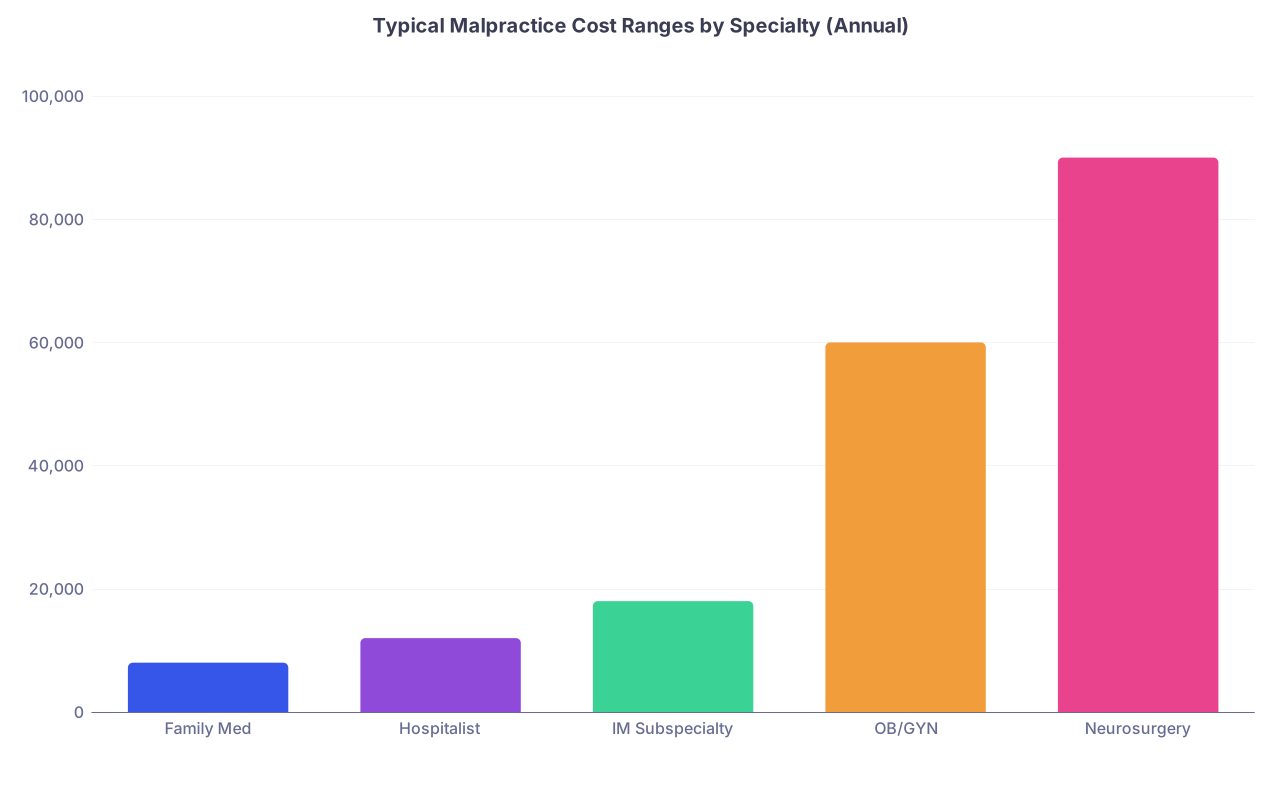
| Category | Value |
|---|---|
| Family Med | 8000 |
| Hospitalist | 12000 |
| IM Subspecialty | 18000 |
| OB/GYN | 60000 |
| Neurosurgery | 90000 |
6 Months Before Start Date: Foundation Work
At this point you should be interviewing and starting to see offers. This is where you quietly get your malpractice house in order.
Task List This Month
- Pull your current policy info (resident/fellow coverage, moonlighting coverage).
- List every state and site you’ve practiced in.
- Get clear on your risk profile.
1. Inventory your current coverage
Sit down with:
- Your residency/fellowship GME office
- Any locums agency
- Any moonlighting employer
Ask, out loud, and write it down:
- “Is my current coverage claims‑made or occurrence?”
- “Does coverage follow me after graduation, or end on my last day?”
- “If claims are made later for current patients, am I covered?”
- “Who is responsible for tail coverage when I leave?”
You want this in email, not just hallway reassurance.
2. Define your risk profile
This is boring but essential. Write a one‑page profile:
- Specialty and subspecialty
- Procedures you actually do (central lines vs endoscopies vs C‑sections)
- Any past claims, board actions, or patient complaints
- States where you’ll be licensed in the next 12 months
- Practice setting you’re targeting:
- Employed by large health system
- Private group (buy‑in later)
- Locums / 1099 mix
You’ll use this same profile repeatedly with recruiters, brokers, and lawyers.
3. Decide your preference: claims‑made vs occurrence
Let me be blunt: most physician employment in the US is claims‑made. Occurrence is simpler but more expensive and less common for groups.
Still, at this point you should decide your bias:
- If you want simplicity:
- Prefer occurrence or claims‑made with employer‑paid tail guaranteed.
- If you want max flexibility / locums:
- You’ll accept claims‑made, but you budget for tail like a car purchase.
4–5 Months Before Start Date: Contract Draft & Policy Type
By now you should have at least a draft attending contract or a verbal offer. Time to drill into malpractice structure.
At this point you should be:
- Reading the malpractice clause line‑by‑line.
- Getting hard numbers (not vibes) about cost and who pays.

| Step | Description |
|---|---|
| Step 1 | Offer Received |
| Step 2 | Read Malpractice Clause |
| Step 3 | Confirm Limits and Start Date |
| Step 4 | Confirm in writing |
| Step 5 | Request cost estimate |
| Step 6 | Negotiate tail or higher salary |
| Step 7 | Claims made or Occurrence |
| Step 8 | Who pays tail |
Week‑by‑Week Breakdown
Week 1: Dissect the malpractice clause
Pull out the contract. Find the “Professional Liability” or “Malpractice Insurance” section. Highlight three things:
- Type of coverage
- Exact words you’re looking for:
- “claims‑made basis”
- “occurrence‑based coverage”
- “coverage written on a claims‑made form with prior acts coverage”
- Exact words you’re looking for:
- Policy limits
- Typical: $1M per claim / $3M aggregate per year
- Some states or hospitals require $2M / $4M
- Tail responsibility
- Exact language matters:
- “Employer will purchase extended reporting (tail) coverage”
- vs “Physician will be solely responsible…”
- vs vague trash like “tail to be negotiated at termination” (red flag)
- Exact language matters:
If you cannot find these words, the contract is incomplete or sloppy. Do not accept “we always cover that” as a substitute for text.
Week 2: Ask for concrete numbers
Now you contact:
- The practice manager or HR
- Their malpractice broker (they’ll often give you contact info)
- Optionally, your own independent broker
Questions to ask, and yes, ask them exactly like this:
- “What carrier do you use? (e.g., MedPro, The Doctors Company, MLMIC)”
- “What are the annual premiums for someone like me, last year’s numbers?”
- “If I left after 2 years, what would tail coverage cost, approximate range?”
- “Are your policies claims‑made with retroactive coverage from day one?”
You are not trying to become an actuary. You’re just making sure the math isn’t insane.
| Item | Target Answer / Range |
|---|---|
| Policy Type | Claims-made or Occurrence |
| Limits Per Claim | At least $1M |
| Annual Aggregate | At least $3M |
| Who Pays Tail | Employer (in writing) |
| Retroactive Date | Your first day of practice |
Week 3: Decide if you need your own broker
If you’re:
- Doing 1099 work, or
- Joining a small private group with sketchy answers, or
- Doing high‑risk stuff (OB, neurosurgery, interventional pain)
At this point you should:
- Email or call one independent malpractice broker in your target state.
- Send them your one‑page risk profile.
- Ask for:
- A quote for an individual occurrence policy
- A quote for claims‑made + tail if you buy it yourself
You’re not necessarily going to buy your own policy. You want leverage and numbers. When you can say, “I’ve been quoted $14k/year occurrence with no tail,” you negotiate differently.
3 Months Before Start Date: Contract Negotiation & Tail Strategy
You should be finalizing your attending contract now. This is your last clean chance to fix malpractice risks without paying real money.
This Month’s Non‑Negotiables
At this point you should either:
- Lock in employer‑paid tail, OR
- Lock in a realistic financial plan for tail if you leave.
Week 1–2: Tail and prior acts language
Here’s what you want your contract to actually say (or close to it):
- “Employer shall provide professional liability insurance on a claims‑made basis with limits of not less than $1,000,000 per claim and $3,000,000 annual aggregate.”
- “Upon termination of this Agreement for any reason, Employer shall purchase extended reporting (tail) coverage for all acts performed by Physician on behalf of Employer.”
If they push back and insist you pay tail, your next step is contingency planning, not blind trust.
Options you negotiate:
- Tail forgiveness schedule
- Example: “If Physician remains employed for 3 or more years, Employer shall pay 100% of tail premium; 2 years = 50%; <1 year = 0%.”
- Sign‑on bonus earmarked for future tail
- Fine, they won’t pay tail? Increase sign‑on or base salary to match projected tail.
- Nose coverage at next job
- Sometimes your next employer will pay for prior acts (nose). Only counts if this is realistic in your market.
Week 3–4: Model realistic tail cost
Now you actually do the math. Use their numbers or your broker’s.
Rule of thumb: tail = 1.5–2.5 times the annual premium.
So if an internal medicine claims‑made premium is $12k/year:
- Tail likely in the $18k–$30k range.
You build 3 scenarios for yourself:
- Leave after 1 year
- Leave after 3 years
- Leave after 5+ years
Plug in actual tail estimates. Decide if you’re comfortable self‑funding that risk. If you’re not, you go back to the contract.
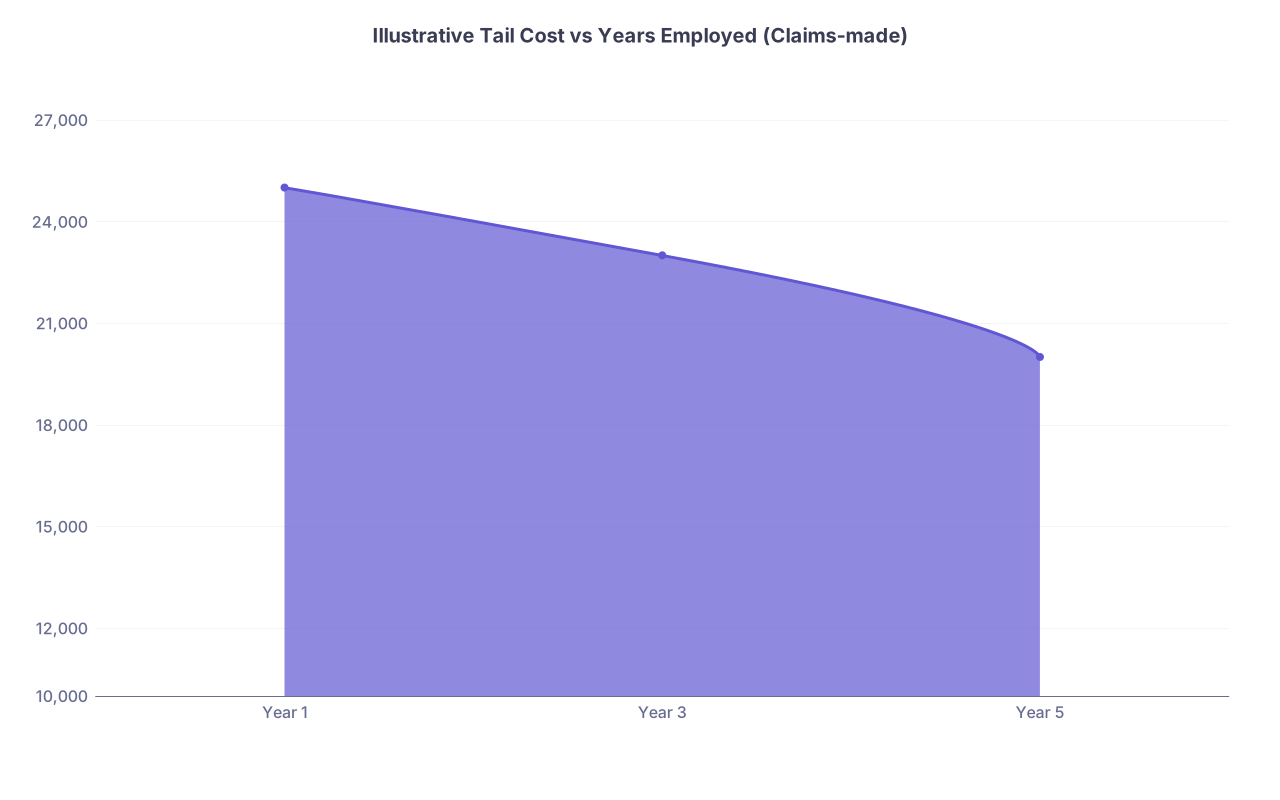
| Category | Value |
|---|---|
| Year 1 | 25000 |
| Year 3 | 23000 |
| Year 5 | 20000 |
2 Months Before Start Date: Carrier, Licensure, and Coverage Gaps
By now your contract should be signed or close. They’ll start credentialing. This is when small mistakes create big gaps.
At this point you should:
- Confirm the carrier and policy structure in writing.
- Make sure no gap exists between your training coverage and new job.
Week‑by‑Week
Week 1: Confirm policy details in writing
Ask HR or the practice manager to send:
- Name of the carrier
- Policy limits
- Policy type (claims‑made vs occurrence)
- Your anticipated retroactive date (usually your first day)
You want this in an email, not just an onboarding packet you’ll see later. Save this in a “Malpractice” folder.
Week 2: Check for coverage gaps with training / prior jobs
Look at dates:
- Training coverage end date
- Locums/moonlighting end dates
- New job start date
You’re checking for:
- Any gap days or weeks with no coverage.
- Any patients you saw during residencies/moonlighting that might not have tail.
If your residency coverage stops on June 30 and you start on August 1, that’s fine—claims from training are usually covered under the residency’s policy. But if moonlighting at an urgent care did not provide tail and you finished there 6 months ago, you might need a standalone tail or a prior‑acts rider.
This is where an independent broker earns their keep. Send them those dates and ask, “Is there any uncovered period or risk here?”
Week 3–4: State‑specific requirements
Some states and hospitals have minimum limits or reporting rules. Quick checklist:
- Does your new hospital medical staff office require specific limits (e.g., $1M/$3M vs $2M/$4M)?
- Is proof of coverage required before credentialing is finalized?
- Does your state require you to notify a board if coverage lapses?
You’re not going to dig through statutes yourself; just ask:
- Medical staff office
- State medical society
- Broker
1 Month Before Start Date: Finalize Documents and Proof
This is when things get real: credentialing deadlines, payer enrollment, hospital privileges.
At this point you should:
- Have evidence of coverage in hand (or very close).
- Verify that what you were promised is what is actually being issued.
Week 1–2: Get proof of coverage
Request from HR or the practice manager:
- A certificate of insurance (COI) listing:
- Your name
- Policy limits
- Effective date
- Policy type if listed
- Named insured (you vs group vs hospital)
Print it. Save it. Screen‑shot it. This document will be emailed to you several times over your career.

Compare against what the contract promised:
- Limits match?
- Policy type as expected?
- Effective date = your start date?
If anything is off, you catch it now, not after a claim.
Week 3–4: Double‑check tail and exit scenarios
Quick thought exercise:
- If I quit after 18 months, who is buying tail?
- If I’m terminated without cause, who is buying tail?
- If I’m terminated for cause, who is buying tail?
Those three scenarios should be explicitly handled or at least understood. If the contract says nothing about different termination scenarios, assume worst case: it’s on you.
If you’re on the hook in any scenario, start a dedicated “Tail Fund” now, even if you’re just mentally allocating money.
First Week On the Job: Verify Reality vs Paper
Day 1 is not just badge photos and EMR logins. Spend 30 minutes on malpractice.
At this point you should:
- Confirm your status with the carrier.
- Know exactly who to call if there’s a bad outcome tomorrow.
Day‑by‑Day Micro‑Checklist
Day 1–2
- Ask the practice manager:
- “Can you confirm my malpractice coverage is active as of today?”
- “Which carrier? Who’s our contact person?”
- Call the carrier or log into their portal if they have one.
- Verify your name, specialty, and locations are correct.
Day 3–5
- Ask risk management or your lead physician:
- “What’s our process after an adverse event?”
- “Who decides when to notify malpractice?”
- “Do we have a claims hotline or internal form?”
You do not want to be inventing this process the night a code goes wrong and the family starts screaming lawsuit.

| Step | Description |
|---|---|
| Step 1 | Start Job Day 1 |
| Step 2 | Confirm coverage active |
| Step 3 | Verify details with carrier |
| Step 4 | Meet risk management |
| Step 5 | Learn adverse event process |
| Step 6 | Save contact info and COI |
First Month On the Job: Clean‑Up and Future‑Proofing
By the end of month one, the malpractice basics should be boring. That’s the goal.
At this point you should:
- Have documentation stored and backed up.
- Have a basic long‑term plan for promotions, side gigs, and leaving.
Week 2: Organize all malpractice documents
Set up a simple digital folder (“Malpractice”) with:
- Employment contract (final, signed)
- Any offer letters that reference malpractice
- Certificate(s) of insurance
- Any emails confirming:
- Who pays tail
- Policy type
- Limits
- List of:
- Carrier name
- Policy number (if accessible)
- Claims contact number
- Internal risk management contact
Treat this folder like your passport + Social Security card combo. Back it up.

Week 3–4: Plan for side gigs and career moves
This is where new attendings quietly blow up their coverage: moonlighting, telemedicine, or side gigs.
Go down this list:
- Planning urgent care shifts, telehealth, or aesthetics on the side?
- Ask your main employer in writing:
- “Does your malpractice coverage apply to outside work?”
- (99% of the time: no.)
- Ask your main employer in writing:
- If not covered, talk to:
- Your broker about an additional policy or rider.
- The side gig employer about their coverage:
- Policy type
- Limits
- Tail responsibility
Do not assume your main job’s policy covers “practicing medicine anywhere.” It usually covers “practicing medicine for this employer, at these sites, doing these services.”
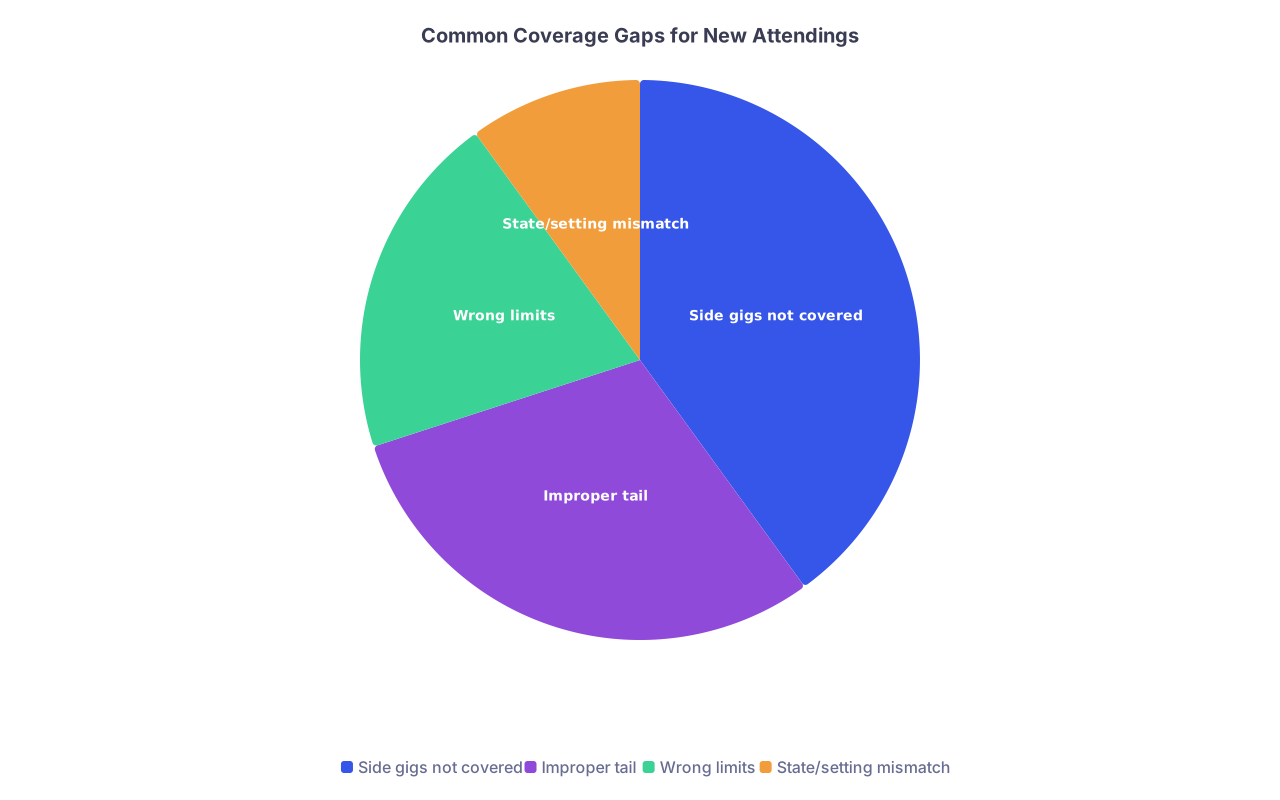
| Category | Value |
|---|---|
| Side gigs not covered | 40 |
| Improper tail | 30 |
| Wrong limits | 20 |
| State/setting mismatch | 10 |
Quick Specialty‑Specific Considerations
Not all malpractice risk is created equal. Brief reality check:
| Specialty | Pressure Level | Typical Must‑Haves |
|---|---|---|
| Hospitalist | Low–Moderate | Employer-paid claims-made + tail |
| Outpatient IM/FM | Moderate | Solid limits, clear side-gig rules |
| EM | High | Occurrence if possible, or strong tail |
| OB/GYN | Very High | Crystal-clear tail, no gaps |
| Procedural (Cards, GI) | High | Right limits, site-specific clarity |
OB, EM, high‑risk procedural: you do not casually accept “we’ll see about tail later.” That’s how you end up with a $70k problem.

The Three Things You Absolutely Do Not Skip
Strip away the noise and it comes down to this:
- Get it in writing. Policy type, limits, and tail responsibility must be explicit in the contract or email. Verbal reassurance is worthless when a claim hits.
- Know your exit cost. Before you sign, you should have at least a ballpark number of what tail will cost if you leave early. Then you either negotiate it away or plan for it.
- Protect against gaps. Training to first job, job to job, and side gigs—every time you change who you’re working for, ask one question: “Who is covering me, and for what period?”
If you handle those three at each point in this timeline, your first attending contract won’t come with a malpractice time bomb attached.