
What if the thing you were afraid of actually happened—not failing to match, but matching somewhere you secretly never wanted to go?
The Ugly Truth You’re Probably Too Embarrassed to Say Out Loud
You matched at your “safety” program.
Not your dream. Not your top 3. Maybe not even your top half.
And instead of being purely relieved that you didn’t go unmatched, you’re sitting there thinking:
- “Did I just ruin my career?”
- “Will everyone know this place was my backup?”
- “Did I undersell myself? Or am I actually not that good?”
You’re not crazy for thinking that. I’ve watched people spiral hard after matching at a safety program. Group chats blowing up, some people crying in stairwells while everyone’s posting “#blessed” on Instagram in front of shiny institution logos.
Let me say this bluntly:
You’re allowed to feel disappointed. You’re allowed to grieve the version of your life where you matched at your dream program.
But then you need to understand what’s actually real versus what’s just anxiety running wild.
What “Safety Program” Actually Means (Not What Your Brain Says It Means)
Your brain: “Safety = bad program, bottom of the barrel, doomed.”
Reality: “Safety” usually means:
- They were more likely to rank you highly
- Their Step averages or research profile weren’t as intense
- Their name isn’t as shiny on paper
- You felt you probably could match there
It does not automatically mean:
- The training is poor
- The graduates don’t match into good fellowships
- Attendings are incompetent
- Your career options are dead
| Perception | More Realistic Translation |
|---|---|
| “Lower tier” | Less brand name, solid training |
| “Backup only” | Good fit, less competitive |
| “No research” | Less famous labs, enough projects |
| “No prestige” | Less name power, more hands-on |
I’ve seen residents from so-called “safety” community programs match into GI, Cards, Hem/Onc, Derm, you name it. The path is harder sometimes, but not impossible. The door is not closed. It’s just less propped open for you.
The problem is this: you’re not just evaluating a program. You’re tying your entire sense of worth as a future physician to the name that showed up in your Match email.
And that’s what’s eating you alive.
Why This Hurts So Much (Even Though You “Should Be Grateful”)
There’s this disgusting unspoken hierarchy in med school:
- University vs community
- “Top tier” vs “mid-tier” vs “lower-tier”
- Big-name vs “Where is that again?”
And you’ve spent years absorbing the idea that your value = where you match.
So when you land at your safety, your mind runs wild:
- “Everyone will think I wasn’t good enough.”
- “Did the programs I loved hate me?”
- “Maybe my letters were trash.”
- “Maybe that one awkward moment in that one interview tanked me.”
- “Maybe I’m not fellowship material anymore.”
Let me hit you with something harsh but freeing:
Most people are way too busy worrying about their own result to obsess over yours.
On Match Day people notice the big-name matches. They also notice the horror stories (going unmatched, SOAP chaos). You know what gets forgotten quickly? Where exactly you ranked on your own list, or whether a program was your “safety” or “reach.”
They literally can’t see your rank list. Only you know that this place was far down.
And in 3 months, what will people care about?
- Are you a good intern?
- Do your notes make sense?
- Do you show up on time?
- Are you reliable on call?
- Are you not a nightmare to work with at 3 am?
That stuff will matter a lot more than your internal monologue about your rank list.
The Career Damage Question: Are You Actually Screwed?
Let’s talk about the worst-case scenario your brain is obsessed with:
“Did matching at my safety tank my chances at competitive fellowships or academic careers?”
Sometimes program name helps. I’m not going to lie to you. Certain fellowships are obsessed with pedigree. Some PDs love saying, “We only interview from X, Y, Z programs.”
But that doesn’t mean you’re done. It means you’ll need to be more intentional.
There are 4 big things fellowship directors actually care about:
- Your performance as a resident
- Your letters (especially from people they trust)
- Your research/output and genuine interest in the field
- How you interview and present your story
Name-brand may open doors, but resident performance keeps them open.
I’ve watched this in real life:
- A resident at a smaller community IM program busted it, did research through a nearby university, got killer letters, and matched Cards at a huge academic center.
- Another resident at a top-10 university program with a big name, mediocre evaluations, minimal research, and meh letters — ended up in a very average fellowship after a rough application cycle.
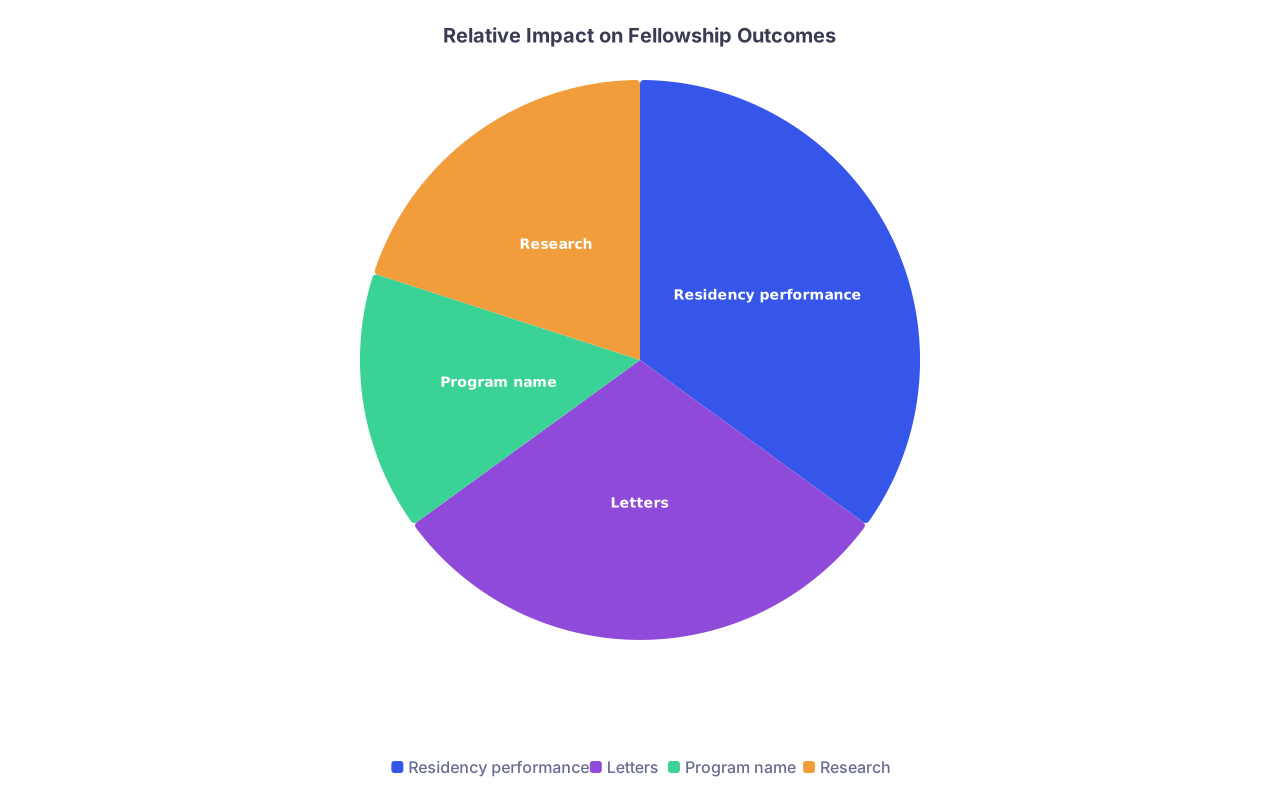
| Category | Value |
|---|---|
| Residency performance | 35 |
| Letters | 30 |
| Program name | 15 |
| Research | 20 |
Is program name irrelevant? No. It helps.
Is it the only thing? Not even close.
Matching at your safety doesn’t shut doors. It just means you won’t get as many automatic “Oh, you’re from X, sure we’ll interview you.” You’ll have to make them notice you another way.
Annoying? Yes.
Impossible? No.
How to Stop Spiraling and Actually Do Something With This
There’s the emotional side and the practical side. You’ve got to deal with both.
Step 1: Let Yourself Mourn the Dream
You had a vision: that city, that prestige, that research powerhouse, that one attending who wrote the textbook.
You didn’t get it.
You are allowed to be sad. Even angry. Even bitter. You’re not ungrateful. You’re human.
Give yourself a few days where you:
- Vent to 1–2 trusted people who won’t minimize it
- Avoid doom-scrolling other people’s “dream match” posts
- Don’t force yourself to fake over-the-top excitement
Then—after you’ve actually felt it—you draw a line. Not “I’m thrilled now.” Just: “OK. This is what happened. Now what?”
Step 2: Get Real Information About Your Program (Not Just Vibes)
Your perception right now might be based mostly on:
- Reputation gossip
- A rushed interview day
- What upperclassmen said in passing
- Where it sat on your rank list
Go back and look at facts:
- Fellowship match list: Where do people actually go?
- Board pass rates
- Does the program support research, away electives, conferences?
- Resident workload and culture
| Question | Why It Matters |
|---|---|
| Where do grads go? | Shows outcomes vs reputation |
| Board pass rates | Training quality signal |
| Research/case report opportunities | Academic potential |
| Resident satisfaction | Your day-to-day life |
If you can’t find this on their website, email a current resident. Ask directly:
“I matched here and I’m excited but also nervous. How supported do you feel for fellowship/academics/work-life?”
Most residents are honest, especially one-on-one.
Step 3: Decide on a Narrative That Doesn’t Destroy You
If your internal story is: “I was only good enough for my safety,” you’re going to show up as the defeated resident from day one.
You need a new story that’s still true but less soul-crushing. Something like:
- “I matched at a place where I’ll get a ton of hands-on experience and I’m going to squeeze every drop out of it.”
- “I didn’t get my dream program, but I’m going to make myself stand out from this ‘safety’ in ways they won’t ignore.”
- “My path isn’t what I imagined, but I’m not done writing it.”
Cheesy? A bit. But the alternative is: “I’m already behind, so why even bother?”
And that attitude will absolutely sabotage you.
Step 4: Build a “Make This Count” Plan
If you’re worried about your career options, turn that anxiety into a plan before intern year starts.
Think in 3 buckets:
Reputation inside your program
- Be the resident people trust.
- Do your work cleanly.
- Don’t be the one constantly late, missing notes, leaving others to pick up your mess.
Network outside your program
- Find academic mentors (even if they’re at another institution).
- Go to conferences. Present posters or case reports if you can’t do big research yet.
- Reach out early to people in your desired fellowship with a genuine, non-cringy email.
Evidence of interest in your field
- Early: case reports, QI projects, chart reviews.
- Later: multi-center studies, serious research if that’s available.
- Join relevant societies (ACG, ACC, etc., depending on your specialty).
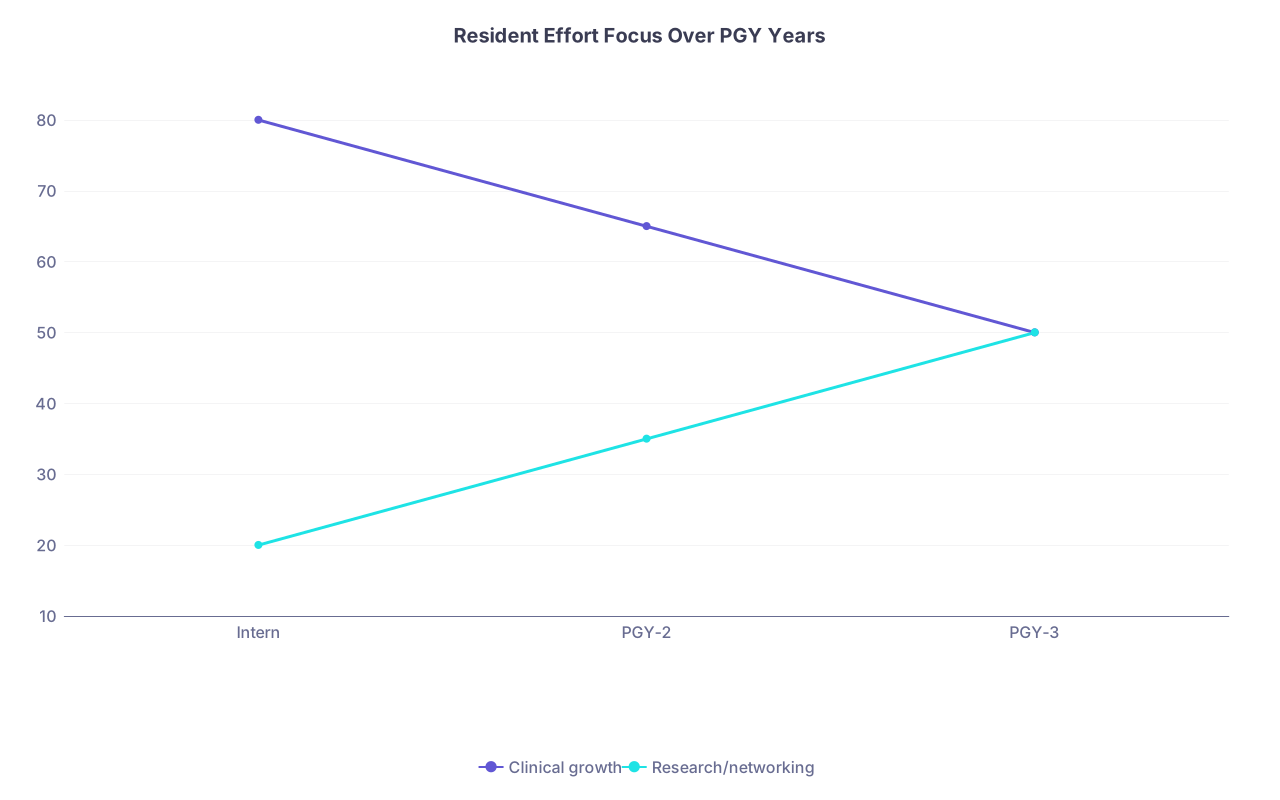
| Category | Clinical growth | Research/networking |
|---|---|---|
| Intern | 80 | 20 |
| PGY-2 | 65 | 35 |
| PGY-3 | 50 | 50 |
You don’t have to do everything at once. But if you start thinking like this now, you won’t waste 18 months feeling sorry for yourself and then panic when it’s time to apply.
But What If I Honestly Just Hate the Idea of Going There?
Here’s the darkest fear:
“What if I hate this place? Like actually hate it. Culture, location, support—everything.”
First, remember: you ranked them.
Not to shame you, but to remind you that at some point you decided this was acceptable compared to not matching or going through SOAP hell.
Second, there are only a few real options if things are truly unbearable:
- Stick it out and make the best of it – what most people do
- Try to transfer programs later – very hard, very rare, depends on openings
- Reapply in the future – also rare, messy, and risky
Most people who swear on Match Day that they’ll “never survive there” eventually adapt more than they expected. It might not become your dream program. But it usually becomes “my program.”
Give it at least 6–12 months before you decide it’s unsalvageable. The learning cliff, the exhaustion, the culture shock — those things distort how everything feels at the beginning.
And if it really is toxic, unsafe, or destroying your mental health?
Then you quietly document, talk to trusted mentors, and explore transfer or alternative plans. That’s not a Match problem; that’s a human survival problem.
How to Handle Social Comparison Without Losing Your Mind
Your class group chat is now a landmine.
Everyone dropping: “OMG Mayo!” “MGH!!!” “UCSF!!!” with 10 reaction emojis.
You look at your own result and think, “They’ll pity me.”
Here’s what you do:
- Don’t volunteer your internal ranking story. No one needs to know this was your safety.
- When people ask where you matched, you say the name confidently and stop talking. Don’t add, “I know it’s not top-tier…” or “It was kind of my backup…”
- Mute the group chat if it makes you feel constantly worse. Protect your brain.
You are not obligated to broadcast your disappointment.
You’re also not obligated to perform fake euphoria.
Some people will low-key judge. Some will flex their prestige. Let them. They’re going to be very busy soon doing the same scut work as you.
FAQs (You’re Not the Only One Thinking These)
1. Be honest—did I basically fail by matching at my safety?
No. Failure in the Match world is going unmatched. You didn’t fail. You got a contract, a salary (however depressing), and a chance to train. Matching at a safety might not be your fantasy outcome, but it’s still a win in a brutally competitive system.
2. Will fellowship programs secretly judge my residency program name?
Some will. Many won’t. What they absolutely will judge is: your letters, your performance, your research or scholarly output, and how you present yourself. If your safety program has decent training and you perform at the top of your class, you can absolutely compete. Not for every single fellowship in existence, but for a lot of them.
3. Should I consider reapplying or trying to transfer instead of going?
Reapplying or transferring is higher risk and way messier than people think. Transfers depend on random openings. Reapplying means explaining why you walked away from a guaranteed spot. Unless the program is clearly toxic, unsafe, or a catastrophic fit, starting there and making the most of it is usually the smarter path.
4. What if my program doesn’t have much research and I want a competitive fellowship?
Then you get creative. Look for: case reports, QI projects, collaborations with nearby academic centers, remote research mentors, multicenter registries. Present at regional or national conferences. You won’t magically have the same CV as someone from a research powerhouse, but you can still build a compelling story that says, “I went above and beyond given my environment.”
5. How do I stop feeling embarrassed when I tell people where I matched?
You practice saying it without apology. Literally rehearse it if you have to: “I matched at [Program Name] in [Specialty].” Full stop. No nervous laughter, no self-deprecation. The more you say it neutrally, the less loaded it feels. And remember: in a few months, what will define you in the hospital isn’t where you matched—it’s how you work.
Key points:
- Matching at your “safety” is not a career death sentence; it’s a different starting point, not the end.
- You’re allowed to grieve the dream while still choosing to show up and make this program work hard for you.
- Your performance, relationships, and initiative in residency will matter far more than how high this place was on your rank list.