
The fantasy that “once I match, everything will be fine” is a lie.
You can match and still wake up dreading going in. You can get your “dream” specialty and feel like you’ve made a terrible mistake. And yes—people do hate their residency after matching. More than anyone wants to admit publicly.
Let me walk straight into the question you’re actually asking:
“If I hate my residency… am I trapped? Did I just ruin my life?”
No. You’re not trapped forever. You do have options. None of them are painless. But you’re not doomed, and you’re not the first person to feel exactly like this.
First: Is This “I Hate Residency” Or “I Hate Medicine”?
This distinction matters, because your options are very different depending on which one is true.
There’s the “normal” misery:
- You’re exhausted
- You hate call
- You feel stupid all the time
- You’re overwhelmed, anxious, and low-key regretting everything between midnight and 3am
That’s… honestly, pretty standard.
Then there’s the more alarming feeling:
- You dread literally every shift
- You feel no connection to the work itself
- The specialty values don’t match yours at all (e.g., you matched surgery but hate the hierarchy, the OR, and the lifestyle)
- You catch yourself thinking, “I cannot do this for decades” and it doesn’t feel like a passing thought—it feels like a fact
Here’s the messy truth: at PGY‑1/PGY‑2, it’s very hard to separate “this is objectively wrong for me” from “I’m in a high-stress, low-autonomy, borderline-abusive system and of course I’m miserable.”
So start by asking ruthless but specific questions:
- Are there any parts of my day I like? A kind of patient, a certain rotation, procedures, clinic, consults, teaching?
- Do I feel better on lighter rotations? Or does the dread stay even when hours are decent?
- If someone magically cut my hours by 40% but kept the same specialty, would I feel okay? Or still wrong?
- Do I hate this hospital/program culture, or do I hate what this specialty actually is?
If you only hate this program’s flavor of your specialty, that’s one path.
If you hate the core identity of the specialty, that’s another.
Neither path means you’re stuck forever.
What Are My Actual Options If I Hate My Residency?
Let’s be brutally honest. These are the main categories of options:
| Option | Timeframe |
|---|---|
| Stay and finish current program | Immediate–3+ years |
| Switch programs (same specialty) | 6–18 months |
| Switch specialties | 1–3+ years |
| Transfer out after prelim year | 6–18 months |
| Leave medicine / non-clinical | Variable |
I’ll walk through each with the real pros/cons, not the glossy version.
1. Stay And Finish Where You Are
This is the option everyone throws at you: “Just get through, it’s only X more years.”
Sometimes, that’s actually the least-bad move.
When this makes sense:
- You don’t love it, but you also don’t hate the core work
- You see parts of the specialty you can imagine liking in a less-toxic setting
- Your program isn’t malignant—just demanding
- You’re too burned out to blow everything up right now
Staying and finishing gives you:
- A board-eligible specialty (massive for future flexibility)
- A clear path to better jobs, different practice settings, or even later fellowships
- Financial stability sooner than re-applying or switching
But here’s the thing nobody says out loud:
Sometimes “just finish” is coming from people who are projecting their own sunk-cost fear onto you. They’re terrified of admitting they’d change things if they could go back, so they tell you to stay.
Here’s how to know if “staying” is avoidance vs. a strategic decision:
- If you say, “I want to stay because I can see how I’ll use this later” → strategic
- If you say, “I’m staying because I’m too scared to move or rock the boat” → avoidance
Neither is immoral. Just don’t lie to yourself about which one you’re doing.
2. Switch Programs In The Same Specialty
Sometimes the problem is not “I hate Internal Medicine,” it’s “I hate this IM program.”
Maybe:
- Your program is malignant
- The culture is humiliating and unsafe
- You’re bullied, gaslit, or unsupported
- The schedule is inhumane compared to every other place you hear about
In that case, a lateral move to another residency in the same specialty can make your life radically better without blowing up your whole identity as a future doctor.
How it usually works (not the sugarcoated version):
- These are often unofficial, quiet processes
- You email PDs directly asking if they have off-cycle or unexpected vacancies
- Sometimes people swap programs; sometimes you just fill a spot someone left
- There’s no centralized “re-match” for most transfers—you hustle individually
The scary part: you’ll have to tell your current PD something. And this is where everyone panics.
You don’t have to say: “I hate this program and you personally.”
You can say something like:
- “I’ve realized I’d be a better fit geographically/academically/family-wise at X type of program.”
- “My partner/family situation has changed and I’m hoping to transfer closer to them.”
- “I’m exploring transfer options to align my training with my long-term goals in [X area].”
Yes, they may not love it. Yes, they could be petty. But I’ve seen more PDs be surprisingly professional about transfers than vindictive.
If you’re in a toxic environment where you truly fear retaliation, you may need:
- To quietly seek external support (GME, ombudsperson, union if you have one)
- To document issues (for your own sanity and in case things escalate)
- To network with attendings or mentors outside your program who can help
Switching programs is stressful. But staying in a malignant environment for years just because you’re scared to email another PD? That’s how people end up broken.
3. Switch Specialties (Yes, After You’ve Matched)
This is the nightmare scenario in your head:
“I matched into Surgery but I think I actually want Psych. Is that even allowed, or do I just silently die inside?”
You can switch specialties. It’s not a fairytale; it’s happened thousands of times. But it’s not clean or easy.
There are a few main pathways:
A. Switch Early (PGY‑1/PGY‑2) With Another Match
- You finish part of your current residency
- You apply again through ERAS/NRMP into a new specialty
- Your prior clinical time might count toward the new program’s training requirements (or not; depends on specialty/board rules)
The cost:
- You lose time (extra years training)
- You may lose income temporarily if there’s a gap
- You go through applications and interviews again while working full-time
The upside:
- You don’t wake up at 40 thinking, “I knew this was wrong in PGY‑1 and I stayed because I was scared.”
B. Use A Prelim/Transitional Year As A Pivot
If you’re in:
- A prelim medicine/surgery year
- A transitional year
You’re in a built-in pivot moment.
You can:
- Complete your prelim
- Then apply into something else (anesthesiology, radiology, neurology, PM&R, etc.)
Or:
- If you already had an advanced position (e.g., you were supposed to start Rads after prelim) but hate the idea → you can step off that track and re-apply elsewhere
Programs do NOT love last-minute changes, but it’s your life. I’d rather have them annoyed at me for one season than be misaligned for decades.
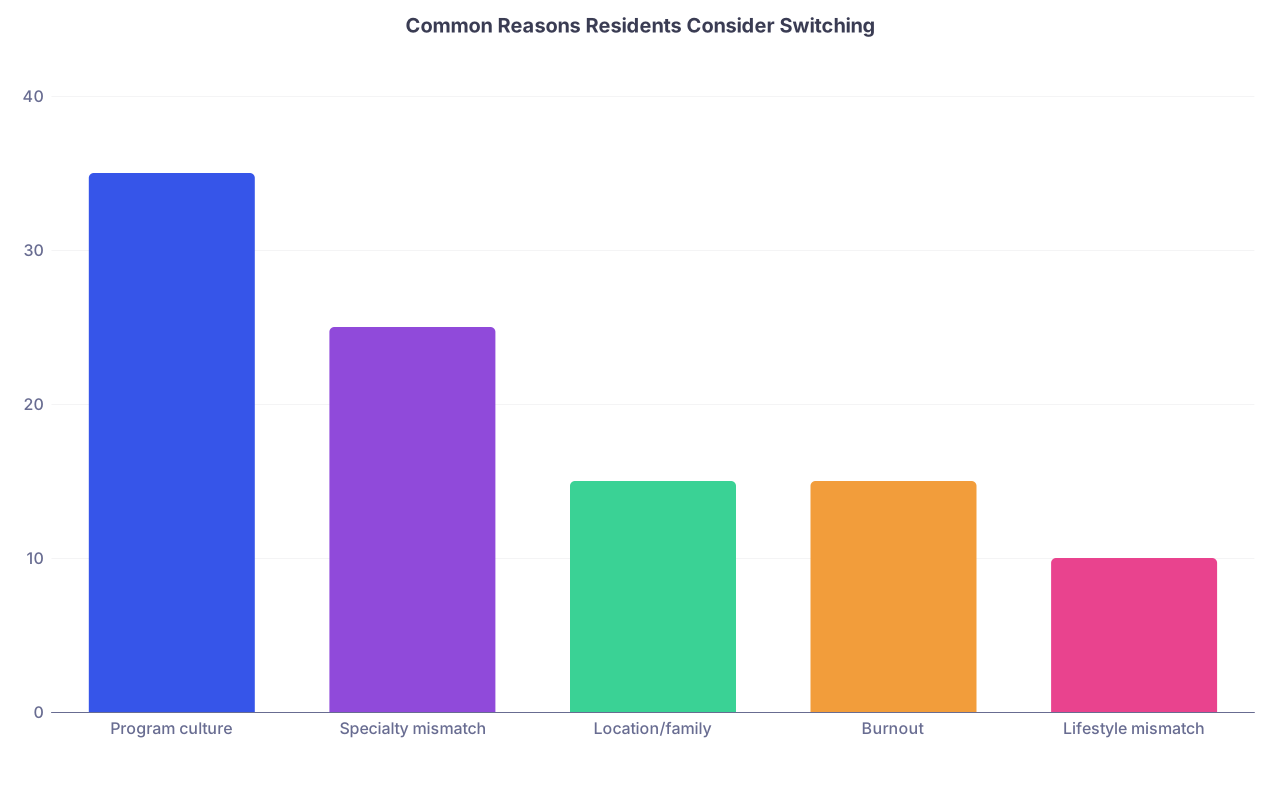
| Category | Value |
|---|---|
| Program culture | 35 |
| Specialty mismatch | 25 |
| Location/family | 15 |
| Burnout | 15 |
| Lifestyle mismatch | 10 |
4. What If I’m On A Visa? (IMG / Visa-Specific Panic)
This deserves its own mini-section, because the fear level here is off the charts.
If you’re on a J‑1 or H‑1B, your internal monologue is probably: “If I switch or leave, I get deported. So I have to just suffer.”
Reality is more nuanced:
- Switching programs in the same specialty is often feasible visa-wise if you line things up and don’t create large gaps
- Switching specialties is harder but not automatically impossible
- Dropping out with no plan = visa nightmare, yes
You cannot wing this.
You must:
- Talk to your program’s GME office / international office (annoying, but necessary)
- Get actual immigration legal advice, not vibes-based advice from co-residents
- Understand your exact constraints before making any moves
The anxiety here is real, and I won’t sugarcoat it: visa holders have less flexibility. That doesn’t equal zero flexibility, but you have to plan more cautiously. The stakes are higher. Which is exactly why you shouldn’t rely on hallway gossip.
How To Even Start This Conversation Without Blowing Yourself Up
This is what keeps most people frozen. You hate your situation, but you’re terrified to say it out loud.
Here’s a rough sequence that doesn’t involve detonating your life overnight:

| Step | Description |
|---|---|
| Step 1 | Notice serious dread |
| Step 2 | Track patterns for 2-4 weeks |
| Step 3 | Talk to trusted senior/mentor |
| Step 4 | Explore transfer same specialty |
| Step 5 | Research other fields |
| Step 6 | Quietly contact other PDs |
| Step 7 | Discuss reapplying with mentor |
| Step 8 | Plan timing and visa/logistics |
| Step 9 | Talk to PD with clear ask |
| Step 10 | Problem is program or specialty |
Step-by-step, more humanly:
Collect data on your misery.
For 2–4 weeks, jot down:- What rotations make it worse/better
- What specific tasks drain you vs. energize you
- How you feel on lighter vs. heavier days
This isn’t for a diary; it’s for making a coherent case for yourself later.
Talk to someone outside your head.
- A trusted senior resident
- An attending you actually like
- A mentor from med school
Say the quiet part: “I think I may have chosen the wrong specialty/program. I need reality testing, not platitudes.”
Clarify your goal before you talk to your PD.
Walking in with, “I’m miserable, fix it,” will go nowhere.
Walking in with, “I’m seriously considering [transferring / reapplying / adjusting track]. I’d like your advice and support if possible,” is clearer.Accept that it will be uncomfortable.
There’s no way to do this and feel “safe” the whole time. You are rocking the boat. But you’re doing it in service of not burning out entirely.
Worst-Case Scenarios (And What Actually Happens)
Let’s drag the monsters out from under the bed.
“If I admit I hate this, my career is over.”
Do some PDs react badly? Yes. Do most immediately try to destroy you? No.
Most common real life outcomes when someone speaks up:
- The PD is surprised but professional
- They try to see if there’s a way to adjust your schedule, mentors, or rotations
- If you’re serious about leaving, they may help identify openings elsewhere because an unhappy resident is a liability anyway
Could you get labeled as “not a team player” by some petty people? Sure. But people also respect residents who can articulate their needs clearly and take ownership of their careers.
“If I switch specialties, no one else will want me.”
Programs see transfers every year. You won’t be the first story they’ve heard.
What they don’t like:
- People who can’t explain why they’re switching
- People who trash their current specialty/program in every sentence
- People who seem impulsive or disorganized
What actually helps:
- A coherent narrative: “I’ve realized I’m much more drawn to longitudinal care/psychosocial focus/procedural variety/etc., and X specialty fits that better.”
- Evidence you’ve thought hard about it: electives, shadowing, talking to residents in the new field
- A letter or at least neutral comment from your current PD, not a burning bridge
Okay, But What If I Just… Quit?
This is the nuclear option everyone secretly considers at 3am post-code.
Some people do leave:
- They go into industry (pharma, consulting, tech, health systems)
- They pivot to non-clinical roles (informatics, admin, education)
- They leave medicine completely
Leaving isn’t moral failure. It’s just a very heavy decision. The main risks:
- Debt still exists
- Imposter feelings and shame can be brutal
- You may need to rebuild identity and career from scratch
If you’re seriously thinking of walking away:
- Talk to a therapist who understands physicians
- Talk to at least 2–3 people who actually left medicine and are a few years out
- Don’t make the decision in the middle of a brutal month; give yourself some distance on a lighter rotation if possible
You’re allowed to decide that this system, this profession, this path isn’t for you. But make that call with full information, not pure panic.

How To Survive While You Figure It Out
Even if you’re planning a switch, you still have to live through the next few months.
Some concrete, un-glamorous survival tactics:
Shrink the time horizon.
Don’t think “3 more years.” Think: “I need to get through this week while I plan my exit.”Find one small island of control.
A clinic you like, an attending you trust, a type of patient you enjoy. Even a non-medical ritual: a specific coffee run post-night float, a 20-minute walk, a protected weekly call with a friend.Stop comparing to classmates who ‘love’ their specialties.
People curate what they say. The peds intern posting hearts and rainbow scrubs on Instagram also cried in the call room last week.Document your work and evaluations.
If you leave or transfer, having good evals and a record that you showed up and did the job—despite being unhappy—actually matters.Get your mental health treated.
You cannot accurately judge your life path if you’re severely depressed, anxious, or sleep-deprived to the point of psychosis. That’s not “weakness”; that’s just neurobiology.

The Quiet Truth Nobody Tells You On Match Day
Here’s what I wish they told people during all those cheesy Match Day speeches:
- The Match is a start, not a life sentence.
- You’re allowed to change your mind after seeing the reality up close.
- Plenty of attendings quietly wish they’d pivoted earlier and will support you if you choose to.
- The fact that you’re even worried about this means you’re thoughtful, not flaky.
You’re scared of wasting time. Scared of regret. Scared of looking weak.
All valid. But staying in a path that feels deeply wrong because you’re scared of short-term disruption? That’s its own kind of regret.
If you remember nothing else, keep these in your back pocket:
- Hating your residency doesn’t automatically mean you chose the wrong specialty—but it also doesn’t mean you’re stuck forever if you did.
- You have real options: stay strategically, transfer programs, switch specialties, or eventually leave medicine—and none of those choices erase your worth or intelligence.
- Don’t decide alone in your own head. Talk to mentors, get mental health support, learn the logistics, and then make a choice that your future self can live with, even if it’s scary right now.