
The fear you feel about PGY‑1 right now is not a red flag. The silence about it is.
Match Day is supposed to be this big celebratory moment, right? Balloons, champagne, Instagram stories with “I matched!!!” plastered all over them. And maybe you did that for a few hours.
But then it hits you:
“Oh my god, I actually have to do this job. What if I’m terrible? What if my program regrets ranking me? What if I can’t keep up? What if I hurt someone?”
And suddenly the high from Match Day feels like it evaporated in about four seconds.
Let me say this directly: being anxious — even really anxious — about your PGY‑1 performance right after Match Day is painfully normal. The red flag isn’t the anxiety. The red flag is when people pretend they don’t have it, never talk about it, and then implode quietly six months in.
You’re not broken for feeling this way. You’re paying attention.
What you’re feeling is exactly what programs expect (they just don’t say it out loud)
Most people think residents show up July 1 like:
“I’m so excited, can’t wait to take care of patients, I feel so ready.”
That’s the Instagram version.
The actual internal monologue of a lot of brand‑new interns?
- “I don’t remember anything from third year.”
- “Everyone else in my class seems more competent.”
- “How do they not see I have no idea what I’m doing?”
- “What if I can’t handle nights / cross‑cover / codes?”
No one advertises that. But attendings and PDs know it’s there.
Programs assume new PGY‑1s will:
- Be slow at literally everything
- Need help prioritizing tasks
- Miss stuff in notes and presentations
- Panic on call at some point
- Call for help too late sometimes, and too early other times
They built the system knowing that.
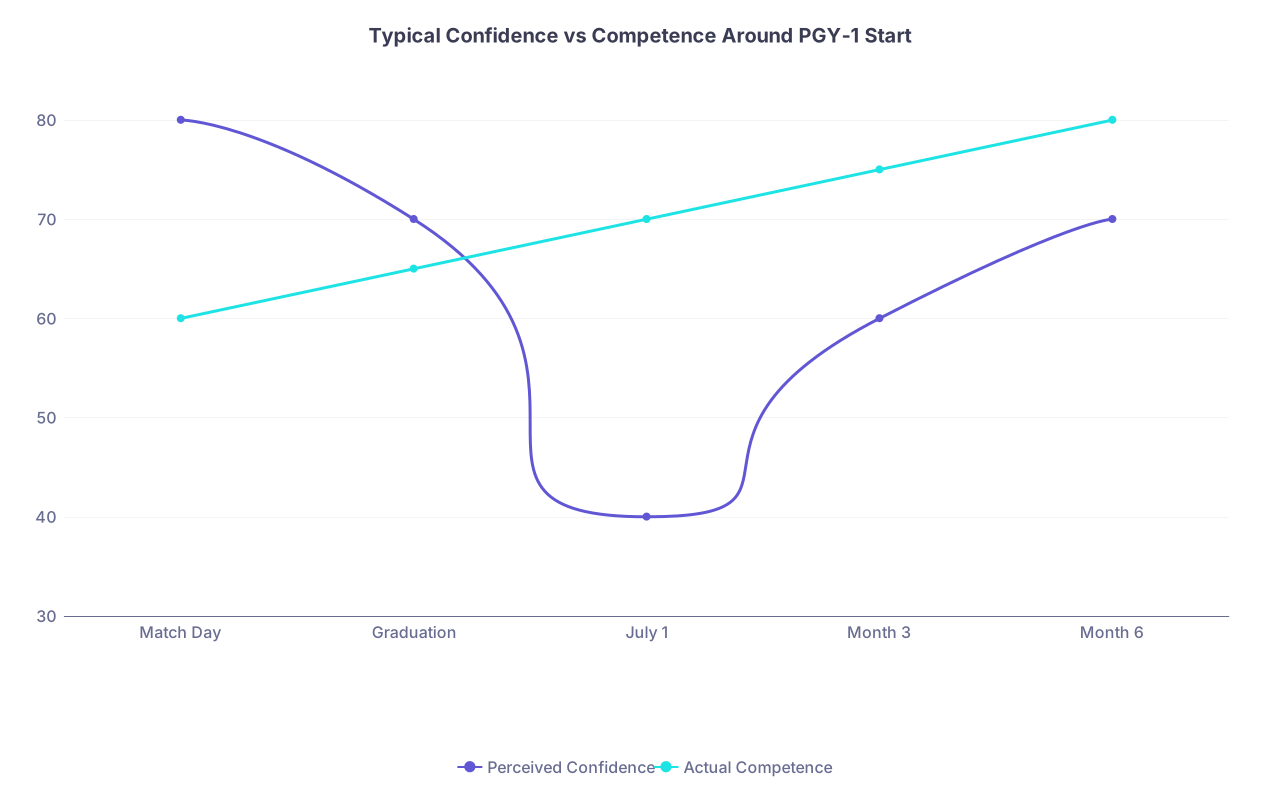
| Category | Perceived Confidence | Actual Competence |
|---|---|---|
| Match Day | 80 | 60 |
| Graduation | 70 | 65 |
| July 1 | 40 | 70 |
| Month 3 | 60 | 75 |
| Month 6 | 70 | 80 |
Here’s the messed‑up part: your confidence drops just as your actual competence starts to climb. You’re not uniquely behind; you’re just now close enough to the fire to see how hot it really is.
So if your brain is going, “Everyone else is ready, I’m the only disaster,” realize: everyone else is having the same spiral in their car, in the shower, or at 2 a.m. staring at the ceiling.
Normal PGY‑1 anxiety vs actual red flags
Let’s be blunt: anxiety isn’t the enemy. Denial is.
You’re probably trying to figure out if what you’re feeling is just standard-issue intern panic or something more serious. So let’s draw a real line.
What feels awful but is actually normal
These are the things that feel like giant neon warning signs to you but are completely expected by your program:
- You’re terrified of being alone on night float or cross‑cover.
- You re‑check orders 3–4 times before clicking “sign.”
- You imagine worst‑case scenarios constantly (code blues, missing an MI, messing up insulin).
- You stalk your future program’s website and residents on LinkedIn and convince yourself you’re the lowest-achieving one.
- You’re already planning how to apologize to nurses in advance “for being slow.”
- You’re scared they’ll regret ranking you when you show up and don’t know the EMR, workflow, or basic logistics.
- You read about imposter syndrome and think, “That’s me, but like 100x.”
None of that is a red flag. That’s your brain doing “threat assessment” in a new environment.
What starts to move into concerning territory
Now here’s where I stop hand‑holding and get honest.
If the anxiety:
- keeps you from sleeping more nights than not
- makes you physically sick at the thought of going in (vomiting, severe GI issues, chest pain that’s not just “butterflies”)
- leads to constant thoughts like “They’d all be better off if I wasn’t a doctor at all”
- pushes you toward self‑harm thoughts or using substances heavily, “just to get through”
…that’s no longer “normal adjustment.” That’s a red flag — not about your ability to be a good resident, but about your mental health needing actual support.
Different thing. Different problem. Still fixable. But it needs attention before July.
What programs actually care about in a PGY‑1 (spoiler: not perfection)
Match brain loves to catastrophize: “If I mess up one thing, they’ll hate me. I’ll never get a fellowship. I’ll be That Intern everyone warns students about.”
Let me give you the lens programs are actually using.
| What you obsess over | What they actually notice |
|---|---|
| Not knowing every guideline | Do you look things up and ask? |
| Being slow at notes/orders | Do you get faster over time? |
| Asking “too many” questions | Do you ask *before* unsafe mistakes? |
| One bad shift / mistake | Patterns across weeks and months |
| Awkward presentations | Growth in clarity & organization |
I’ve seen interns who:
- Forgot to recheck a potassium
- Missed a med they should’ve held
- Botched a presentation in front of the entire team
They did not get labeled “bad residents” for those things alone. They got labeled based on how they responded:
Own it vs. deflect. Ask for feedback vs. hide. Show improvement vs. repeat the same thing.
Your nightmare is: “What if I screw up?”
A program’s nightmare is: “What if they screw up and don’t tell anyone?”
They care way more about your honesty, willingness to ask for help, and ability to learn than about you walking in July 1 as some kind of half‑price attending.
The catastrophes your brain is inventing (and what actually happens)
Let me walk through a few of the common doomsday scripts playing in your head and translate them into reality.
“What if I don’t know enough and they regret ranking me?”
They already know you don’t know enough. That’s why it’s PGY‑1, not “junior attending year.”
You worry you’ll show up blank. They expect to teach you:
- How to admit a patient without forgetting half the orders
- How to call consults without sounding lost
- How to run a list, preround efficiently, and not die under pages
The people who struggle most aren’t the ones who know the least day 1. It’s the ones who pretend they know things they don’t and then make avoidable mistakes.
“What if I can’t handle the hours and fall apart?”
Everyone worries about this and then… they adapt more than they thought.
Will it be brutal at times? Yes. You’ll be exhausted, you’ll cry in your car, you’ll fantasize about quitting during one particularly unfair weekend.
But residency is designed as a ramp, not a cliff. Orientation, shorter initial shifts, more supervision at the start — those aren’t decorative. They’re there so you can grow into the role.
Real red flag: you hit a wall and feel yourself slipping into severe burnout or depression and tell no one. You keep white‑knuckling it. That’s where people crack.
“What if I harm a patient?”
This is honestly the fear that means you actually should be a doctor. The people who scare me are the ones who never think this.
Does harm ever happen in medicine? Yes. Even when people are careful. That’s the hardest part of residency: at some point, something will go badly, and you’ll be involved.
The only way through it is:
- you asked for help
- you communicated what you knew
- you followed reasonable practice
- you learn from it, not hide from it
You being anxious about this now is not predictive that you will harm someone. It’s predictive that you’ll double‑check, ask questions, and not blow off changes in vital signs because “they were fine earlier.”
That’s not a flaw. That’s safety.
How to channel your anxiety into something useful before PGY‑1
You’re not going to meditate your way into feeling totally calm about intern year. That’s a fantasy. But you can turn the “oh my god what if” loops into something at least semi‑productive.
1. Stop trying to “learn everything” before July
This one is a trap. I’ve watched people burn themselves out before residency even starts, trying to grind through entire textbooks or massive question banks in April–June.
You won’t remember most of it in the moment anyway. Your brain learns best when it’s attached to a patient or a real situation.
If you need to study to calm your nerves, keep it narrow and applicable:
- Common admission H&Ps for your field (chest pain, SOB, fever, abdominal pain, confusion)
- Basic orders: fluids, pain control, DVT prophylaxis, insulin, antibiotics
- How to structure an oral presentation and problem list
That’s it. Not complete mastery of cardiology.
2. Do a dry‑run on logistics, not just knowledge
A lot of PGY‑1 anxiety has nothing to do with “can I manage DKA.” It’s: “Where do I park? Will I be late? What if I can’t find the call room? How do I use the EMR?”
These feel stupid to stress about, but they’re not. They’re what make the first week feel like drowning.
If your program has:
- pre‑orientation materials
- EMR training modules
- resident handbooks or “survival guides”
Read them. Not because you’re a gunner. Because less cognitive load on logistics = more brain for patients.
3. Plan your support now like you’re expecting turbulence
Don’t wait until you’re crying at 3 a.m. on a night float weekend to figure out who you can text.
Line this up before you start:
- One co‑intern you can be honest with (even if it’s just “I’m freaking out too”)
- One senior resident you feel safe asking “dumb” questions
- One non‑med friend / family member who can remind you you’re a person, not just a resident
And if you already know you carry anxiety or depression? Find a therapist near your program before PGY‑1 starts. Don’t wait until you’re in full crisis mode.
When anxiety really is a signal you need more than reassurance
Let me be brutally clear: sometimes the problem is not “you’re overthinking.” Sometimes the problem is your brain chemistry is on fire and your environment is gasoline.
If, in the weeks after Match Day or as July approaches, you notice:
- You can’t sleep even when you’re exhausted
- You’re avoiding opening emails from your program because they trigger panic
- You’re thinking: “I wish I hadn’t matched” or “Maybe an accident would get me out of this”
- You’re drinking or using substances way more “to calm down”
That’s not you being weak. That’s your nervous system being overwhelmed.
That is a flag. Not that you shouldn’t be a doctor. That you deserve real support before you walk into a 60–80 hour/week job where people’s lives are involved.
Residents see psychiatry. Residents take meds. Residents need FMLA sometimes. That doesn’t get printed on the graduation program.
You’re not disqualified for struggling. You’re in more danger if you insist you’re fine when you’re not.

| Step | Description |
|---|---|
| Step 1 | Anxiety about PGY1 |
| Step 2 | Normal intern fear |
| Step 3 | Consider mental health support |
| Step 4 | Prepare with realistic goals |
| Step 5 | Talk to professional |
| Step 6 | Plan support before July |
| Step 7 | Able to function daily |
So… is your anxiety normal or a red flag?
Here’s the uncomfortable truth: a lot of what feels intolerable right now is within the range of “normal” for someone about to start PGY‑1. You’re standing on the edge of a cliff you’ve been walking toward for a decade. Of course your legs are shaking.
Your brain is going to worst‑case scenarios because that’s its job. It’s trying to protect you. It’s just really bad at timing.
What matters is not “do I feel anxious?”
What matters is:
- Does this anxiety still let me live my life, or is it choking everything?
- Am I willing to be honest about it with at least one other human?
- Will I ask for help when the job actually starts, or will I armor up and pretend I’m fine until I crash?
Your anxiety right now doesn’t mean you’re going to be a bad PGY‑1. In a twisted way, it’s a sign you care enough to be scared.
The red flag is refusing to turn that fear into honesty, preparation, and getting help when you need it.
You don’t need to be calm to be ready. You just need to be real.