
The part nobody warns you about on Match Day isn’t the email. It’s the conversation after.
You know the scene everybody posts on Instagram: people screaming, hugging, champagne popping, signs with “I matched at X!!!” and coordinated couples photos.
Here’s what they don’t show:
You sitting there, staring at your screen, thinking, “How the hell am I going to tell my partner / my parents / my entire nosy extended family this result?”
Maybe you didn’t match where they expected.
Maybe you didn’t match where you expected.
Maybe you SOAPed. Or matched far away. Or into a different specialty. Or at a “lower tier” program your dad already made a joke about months ago.
And now you’re stuck with the ugliest feeling: shame plus dread plus performance anxiety.
Let’s walk through this like you and I are sitting in a quiet corner somewhere, and you’re telling me all the worst-case scenarios playing in your head. Because I promise you: you’re not the first person who’s been scared to say out loud where they matched.
The Part That Feels So Bad You Don’t Want To Admit It
You’re not just scared to share the match result. You’re scared of what it’ll mean to the people you care about.
Your brain is probably doing some version of this:
- “If I tell my partner I matched across the country, they’ll resent me or break up with me.”
- “If I tell my parents I didn’t match at the ‘prestigious’ place, they’ll think I failed.”
- “If I tell my family I only matched after SOAP, they’ll feel embarrassed for me.”
- “If I tell anyone I switched specialties, they’ll say I gave up.”
It’s not really about geography or rank list or SOAP vs. main match. It’s about identity. You’ve spent years building this story of yourself as “the one who’s going to be a [insert dream specialty] at a big-name place.”
Now you’re imagining all the reactions:
The pause on the phone.
The “Oh… okay.”
The “But I thought you wanted X?”
The “Is that a good program?”
The silent recalculation in their eyes.
Yeah. I’ve seen this. I’ve watched someone stand with their unopened envelope in the hallway because they didn’t want their parents in the room when they read it. I’ve seen people hide in stairwells on Match Day making whispered calls, practicing their tone to sound “happy enough” so nobody worries.
You’re not dramatic. This is actually really hard.
Before You Tell Anyone: Get Yourself Grounded (Or At Least Less Spinning)
You can’t control how your partner or family will react, but you can absolutely control the order of operations.
Step one is not “tell everyone.” Step one is “stabilize yourself.”
You need at least a tiny bit of emotional footing before you let other people’s reactions crash into you.
Here’s what that can look like:
Give yourself permission to feel exactly how you feel
If you’re disappointed, jealous, numb, relieved, terrified—whatever. That’s allowed.
You don’t have to immediately jump to “I’m just grateful I matched.” You can hold both: gratitude and grief for the version of your future that didn’t happen.Get the facts straight about your program
Because you know someone’s going to ask: “Is it good?” “How’s the training?” “What city is that again?”
Spend 5–10 minutes skimming the program website, looking at their board pass rates, fellowship matches, call schedule, whatever. Not because you need to sell it to yourself, but because having concrete facts steadies you when emotions are high.Decide your own narrative sentence
If you don’t choose your main line, your anxious brain will default to: “I failed and this was the best I could do.”
You need a 1–2 sentence frame like:
- “I matched in Internal Medicine at [Program]. It’s a solid program, great training, and I’m going to get really good clinical experience there.”
- “I matched in [Specialty] at [City]. It’s not where I originally pictured myself, but it’s a good fit and I’m going to grow a lot there.”
You don’t have to fully believe it yet. You just need something that isn’t self-sabotage.
- Choose your first person wisely
Do not start with the person whose reaction you fear the most. Start with the safest person. The friend who actually gets med training. The mentor who told you, “Any match is a win.”
Let yourself have one conversation that’s not emotionally dangerous. It’ll give you proof that not everyone is going to crush you with their reaction.
How To Tell Your Partner (Especially If The Match Complicates Everything)
This is the big one for a lot of people. Because Match Day plus relationship logistics is like a stress casserole.
Let’s split this into a few ugly-but-real scenarios.
Scenario 1: You matched far away from your partner
You’re thinking: “I just blew up our life.”
I’m going to be blunt here: distance + residency is hard. It’s not impossible. I’ve seen couples make it with time zones and brutal call schedules and FaceTime dates at 11:30 p.m. while still in scrubs. I’ve also seen couples not make it.
Your job on Match Day is not to solve the next 3–7 years in a single conversation. Your job is to share the information with honesty and invite them into the problem-solving—without taking full responsibility for everything.
Something like:
“Hey, I just got my result. I matched at [Program, City]. I know that’s far from you, and I’m honestly still processing it. I really want us to talk about what this could look like together. I’m scared and I don’t have all the answers yet, but I want to figure it out with you.”
You don’t have to sound thrilled. You just have to sound open.
Scenario 2: You matched somewhere “worse” than they expected
Maybe they were already talking like you’d be in Boston or NYC and you’re going to a smaller community program in the Midwest. Your fear is: “They’re going to be disappointed in me.”
Say this directly before your brain spirals:
“I want to tell you where I matched, but I need you to know I’m feeling a little vulnerable about it because it’s not one of the places people tend to brag about. I matched in [Specialty] at [Program]. From what I’ve read and heard, I’ll get strong training there. I need you on my team with this, even if it’s not what we all pictured.”
You’re allowed to ask for how you want them to show up.
Scenario 3: You SOAPed or didn’t match your first specialty
This is the shame spiral special. People love simple stories: “I wanted X, I got X.” Your reality is messier.
Your instinct might be to minimize or hide this. That usually backfires. Secrets plus residency stress is a recipe for resentment.
Try something like:
“The match didn’t go how I originally wanted. I didn’t match in [Original Specialty], and I ended up going through SOAP. I matched in [New Specialty] at [Program]. It has been emotionally rough, I won’t lie, but I’m starting to see what this path could look like. I’m going to need some time and support to adjust, but I wanted you to know the real story.”
You don’t owe them every gory detail on day one. But being honest up front gives your relationship a chance to be real, not performative.
Telling Family: Managing Expectations, Guilt, And Random Opinions
Family reactions are a whole circus of their own. You’ve probably got a mix of:
- The parent who brags about you to everyone and now you feel like you “ruined their script”
- The relative who has strong opinions about “top programs” based on absolutely nothing
- The sibling who doesn’t get why you can’t just choose a city like a normal job
Let’s be clear: most of them don’t actually understand how the Match works.
| Misconception | Reality |
|---|---|
| You pick where you go like a regular job | It’s an algorithm with a rank list and limited spots |
| Prestige of name = quality of training | Many “no-name” places have excellent clinical training |
| SOAP = failure | SOAP is common and often leads to solid positions |
| Staying local is just a preference | Geography is often out of your control |
| Any specialty change = giving up | Plans change for legitimate reasons |
You don’t need to hold a lecture, but you can set some boundaries and expectations.
You can shrink the audience. You’re not obligated to call 12 people on Match Day. You can tell 1–2 key people, and let them spread the news if you’re comfortable with that.
You can script the message. If saying it out loud feels like choking, text is allowed. Something like:
“I matched in [Specialty] at [Program, City]. I’m still processing a lot of feelings around it, so I might be a bit quiet today, but I wanted you to know. I’ll share more when I’ve had time to catch my breath.”
That does two things: gives them the info, and pre-empts the barrage of questions.
Handling The Reactions You’re Dreading
Let’s play out the worst-case scenarios your brain is chewing on, and what you can actually say back. Because having language ready lowers the panic by a solid 20%.
The subtle (or not subtle) disappointment
Them: “Oh… I thought you were aiming for [Big Name Program]. What happened?”
You:
“The Match isn’t a simple ‘aim and get’ thing. There are way more strong applicants than spots at the big-name places. I built a list that balanced competitiveness and where I’d get good training. This is where I matched, and I’m going to focus on becoming a strong doctor there.”
You’re not required to defend every decision. One clear explanation, then done.
The prestige obsession
Them: “Is that a good program?”
You (even if you are still questioning it a bit):
“It’s solid. People graduate, pass boards, and get good jobs and fellowships. I’ll get a lot of hands-on experience there, which matters a lot for residency.”
If they keep poking, you can just repeat some facts: board pass rate, case volume, fellowship matches.
The geography guilt trip
Them: “So you’re really leaving us? So far away?”
You:
“I didn’t get to just choose like a regular job. This is where I matched. I know it’s far and that’s hard. I’m sad about that too. But this is the next step in my training, and I hope we can figure out ways to stay connected.”
You are not abandoning anyone. You are starting your career.
A Quiet Secret: Most People Care Less About The Name Than You Think
You’re living inside the med school bubble where everyone talks about program tier, “malignant” vs “chill,” fellowship pipeline, all of it. That’s your world. It makes sense.
Your family? Your non-med friends? Half of them can’t tell the difference between “university-affiliated community program” and “top 5 academic center.” They’re mostly watching you.
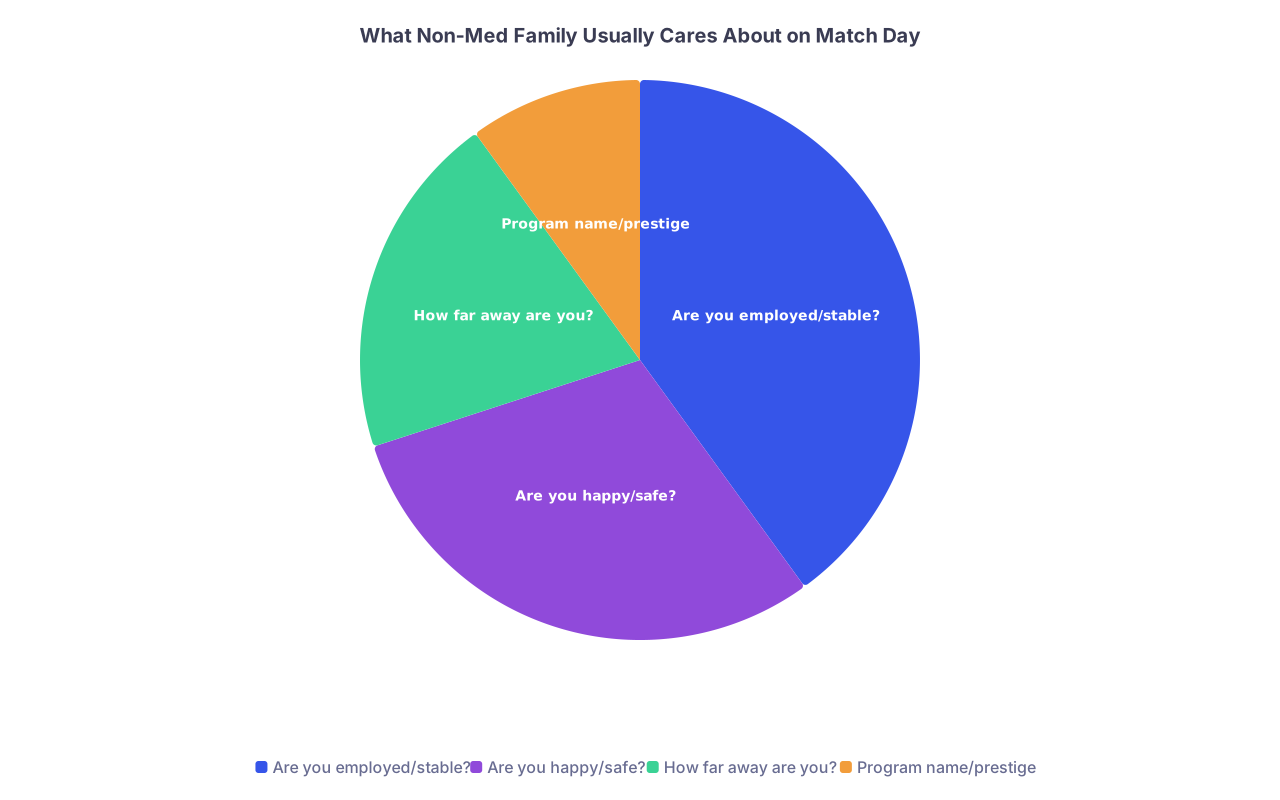
They’re checking: Do you sound okay? Are you safe? Are you moving forward?
| Category | Value |
|---|---|
| Are you employed/stable? | 40 |
| Are you happy/safe? | 30 |
| How far away are you? | 20 |
| Program name/prestige | 10 |
That last 10%—the prestige stuff—is often amplified by your anxiety, not their actual priorities.
I’ve watched parents quietly Google the name of a program under the table, then decide, “Okay, looks legit” and move on. They mainly want a sentence they can repeat at work: “My kid matched in [Specialty] in [City].”
You can give them that sentence, even if you’re still processing your own mixed feelings underneath.
If You’re Deeply Disappointed: How To Talk Without Faking It
Let’s say your match result really hurt. Like, cry-in-the-bathroom hurt. You feel like you “settled,” or like the system chewed you up.
You might feel this pressure to slap on a smile and pretend, because “people would kill for a match” and “at least I’m not unmatched.”
Here’s the thing: you don’t have to choose between pretending you’re thrilled and dumping your entire emotional breakdown on someone who doesn’t know what to do with it.
You can split it.
To your therapist/closest med friend/mentor: “I’m honestly crushed by where I matched. I know rationally it’s a job and training is training, but emotionally I feel like I failed. I need space to grieve the future I thought I’d have.”
To your parents: “It’s been a complicated day emotionally. I matched, which is a big deal, but it wasn’t one of my top choices. I’m working on accepting it and finding the good parts. I’m glad I have a spot and I’ll make the most of it.”
Both are true. You’re not lying. You’re just calibrating depth to the audience.
Setting Boundaries Around Match Talk (Yes, You’re Allowed)
You’re allowed to say:
- “I’m not ready to talk about the details yet, but I can tell you the basics.”
- “I don’t want to compare programs with other people right now.”
- “It’s been an overwhelming week; can we talk about normal life stuff?”
You’re also allowed to mute the group chat that’s spamming photos and “Where did everyone match?” messages, and answer later. Or never.
You don’t need to post on social media immediately, or at all.

| Step | Description |
|---|---|
| Step 1 | Got Match Result |
| Step 2 | Tell close people directly |
| Step 3 | Text brief update |
| Step 4 | Delay calls and social media |
| Step 5 | Let parents/partner share |
| Step 6 | Keep circle small for now |
| Step 7 | Feel okay sharing? |
| Step 8 | Want wider circle to know? |
This isn’t you being “ungrateful” or “dramatic.” This is you being a human with a nervous system.
A Quick Reality Check On “Bad” Programs And “Wrong” Matches
Your brain is probably catastrophizing:
“I’ll never get a good fellowship.”
“Everyone else is ahead of me.”
“My partner will leave me because this path is worse.”
“I’ll be miserable for years.”
Let me say something that’s going to annoy perfectionists but is true:
Where you matched matters less than what you do once you’re there.
I’ve seen:
- People from tiny community programs match competitive fellowships because they did good work, got strong letters, and owned their education.
- People at brand-name places burn out, check out, and coast because they assumed the name would do the work for them.
- Couples survive long-distance between random midwest town and coastal city with a lot of communication, flights, and late-night calls.
- SOAP matches who end up saying, “Honestly, I’m glad this is where I landed. It fits me better than my original plan.”
No, it’s not all “everything happens for a reason” fairy dust. Some situations really are harder. But “not ideal” doesn’t equal “doom.”
Your partner and family don’t need to see the whole path right now. They just need to see that you’re still moving. Still in the game. Still you.
What You Can Actually Do Today
Don’t try to fix your whole life tonight. Do something small and concrete.
Here’s a simple step you can take right now:
Write out the exact 2–3 sentences you’ll use to tell your partner or family where you matched. Say it out loud once, by yourself. Then decide who the safest person is to send it to first—text or call—and do just that.
One conversation. Not ten. Not a family-wide announcement. Just one.
You don’t have to feel ready. You just have to start.
FAQ (Exactly 6 Questions)
1. What if my partner reacts badly when I tell them where I matched?
Then you’ve learned something important, fast. A bad initial reaction doesn’t always mean the relationship is doomed, but it does show you their stress style. If they lash out or guilt-trip you, you can say, “I get that this is a shock, but I need us to talk about this as a team, not as me ruining everything.” If they stay stuck in blame instead of shifting into problem-solving over time, that’s a bigger relationship red flag—and that’s not on the Match, that’s on them.
2. Is it okay to not tell my whole extended family the full story (like SOAP or not getting my top choice)?
Yes. Completely okay. You’re not obligated to send out a press release with your rank list and NRMP report. You can keep it simple: “I matched in [Specialty] in [City].” If someone presses you on “Was it your top choice?” you can say, “It was a good option for me” and move on. Your mental health is more important than satisfying their curiosity.
3. How do I talk about my match if I’m honestly not happy with it?
Use a “both-and” approach. Something like, “I’m grateful to have matched, especially with how competitive things are. At the same time, it wasn’t exactly what I pictured, so I’m still adjusting emotionally.” That’s honest but contained. Then save the deeper, messier feelings for people who can actually hold them: close friends, a mentor, or a therapist.
4. What if my family is obsessed with prestige and keeps comparing me to other people’s matches?
You can shut that down. Try, “I know program name matters to some people, but for residency, the day-to-day training and fit are huge. I’d really appreciate it if we didn’t compare my path to other people’s—it’s not helpful for me.” If they keep at it, you can literally change the subject or cut the call short: “I’ve got to go, but we can talk later.” You’re allowed to protect yourself.
5. Should I wait until I’ve processed my feelings before telling my partner/family?
You don’t need to be fully processed (nobody is on Match Day), but it helps to be slightly grounded. Even 10–20 minutes to breathe, cry, walk, or talk to a safe person first will make a difference. Don’t sit on it for days with your partner, though—that can create distance or feel like hiding. Aim for: get grounded → tell one safe person → then tell the harder audience.
6. I feel ashamed of where I matched. How do I stop feeling like I failed?
Shame feeds on isolation and comparison. Start by getting out of the comparison trap: mute group chats, log off social media for a bit. Then talk to at least one honest attending or resident; they’ll tell you what every med student forgets—by PGY2, almost nobody cares where you trained, they care if you show up, learn, and don’t make their lives harder. Your worth as a human and as a future doctor is not equal to your Match line. You didn’t scam your way into a spot; you earned it. Now your job is to grow into it.