
What if you just matched into the program everyone on Reddit calls “toxic”… and you’re stuck there for years?
Because that’s what this feels like, right? You see the name of your program, your stomach drops, and then you start remembering every horror story you ever read about “malignancy,” malignant attendings, crushed residents, 80 hours that are “fake 80,” gaslighting PDs, no support, no time off, broken people.
So now you’re thinking: Did I just ruin my life?
Let’s walk through this like two people sitting in a call room at 2 a.m., refreshing SDN and doomscrolling Reddit instead of sleeping.
First: What does “malignant” actually mean?
Everyone throws the word around, but they’re not all talking about the same thing.
Some people say “malignant” when they mean:
- The attendings yell, belittle, or humiliate
- The PD is punitive and retaliatory
- The culture is “you’re weak if you ask for help”
- Hours are excessive and nobody cares about rules
- Residents disappear (suddenly not around, “quietly fired”)
- People say things like “we all suffered, so you will too”
Other times, “malignant” = “this program is just hard”:
- High volume, high acuity, constant admissions
- Minimal hand-holding; they expect you to figure things out
- You’re tired, but senior residents actually support you
- PD is strict but fair
- It’s intense, but people actually graduate competent and match into good fellowships
Those are not the same thing.
The scary part: from the outside, they can look identical. You see “hours are brutal,” “expect to work,” “you’ll be pushed” and it’s hard to tell: is this an excellent training environment… or a soul grinder?
And now you’re matched. There’s no “undo.” So your brain immediately jumps to: It must be the worst version.
But here’s the first honest answer:
You probably don’t actually know yet if your program is truly malignant. You know what people say about it. Not what you, personally, have lived there.
That’s terrifying, yes. But it also means the story in your head right now is mostly a projection. Worst-case scenario brain filling in gaps.
How much do online horror stories really predict your life?
Let me be blunt: The loudest voices online are often:
- People who had legitimately awful experiences
- People who were not a good fit and are still angry
- People repeating third-hand stories they never experienced
And the quietest voices?
- Residents who are coping, busy, and just trying to get through
- People who think “it’s hard, but it’s worth it”
- People who matched there, work hard, and then go live their lives
When I hear “that program is malignant,” my reflex now is: “According to who and when?”
Programs evolve. New PDs. New chairs. A couple toxic attendings retire or get pushed out. A former “hell program” can slowly become just “a tough but solid training site.” And the opposite is true too.
Here’s the hard part about being you right now:
You matched based on information that is always incomplete. Everyone does. There is no version of this where you get perfect intel upfront.
Your fear is: What if I ignored the red flags?
But the more realistic version might be: I made a decision with limited info, like everyone else, and now I have to live in the reality and get data in real time.
Which is horrible for anxiety, by the way. Uncertainty is gasoline on the fire.
Actual worst-case scenarios (and how rarely they happen)
Let’s name the real fears sitting in your chest, not the vague ones.
Fear #1: “I’ll be abused and destroyed”
You’re picturing:
- Constant humiliation on rounds
- Being screamed at in front of patients
- Being told you’re stupid, slow, incompetent
- Crying in the stairwell so often it becomes a habit
Does that happen in some programs? Yes. I’ve seen it. It’s not mythical.
But here’s the nuance: Even in “bad” programs, the experience is not uniform.
Some residents are targeted; some aren’t. Some services are awful; others are fine. Some attendings are human garbage; some are incredible mentors who quietly keep people afloat.
You’re not signing up for an unbroken chain of suffering. You’re signing up for a likely mix of:
- Rough rotations
- Neutral rotations
- And sometimes, surprisingly good ones
You can survive a program with some malignant elements if:
- There are at least a few decent humans in power
- Your co-residents have your back
- You learn how to emotionally disengage from some of the toxicity
Is that ideal? No. But it’s not “my life is permanently destroyed.”
Fear #2: “I’ll be worked to death, literally”
You’re imagining:
- 90–100 hour weeks
- No days off for months
- Constant post-call abuse (“just finish these 8 discharges”)
- Residents fainting in the OR or crashing cars after call
Here’s something to remember:
The ACGME actually does look at resident surveys. Duty hours violations and safety issues are not just abstract. Programs do get citations. PDs do get scared of losing accreditation.
Do some places push it? Absolutely. But they can’t run completely wild for years without consequences. They game the system, they massage reported hours, but if they’re that extreme, eventually:
- Residents report more
- Word spreads to med schools
- The program struggles to fill
- The institution panics
Your fear is “nobody will care if I’m suffering.” Realistically, someone cares—maybe not for the right reasons, but accreditation fear is still leverage.
Is that comforting? Only slightly. But it means you’re not completely helpless.
Fear #3: “I’ll never get a good fellowship or job from there”
“Malignant” and “no future” are not the same thing. There are brutal programs that churn out insanely competent residents who get amazing fellowships. There are “nice,” cushy programs where you’ll struggle to place into competitive specialties.
Programs with a reputation for being malignant often:
- Have high volume, high complexity, big academic centers
- Produce residents who are comfortable managing sick patients
- Have attendings with connections, whether or not they’re kind
From a purely career standpoint, many “scary” places still open doors.
That doesn’t justify abuse. But if your fear is “I ruined my future,” that’s usually wrong. You might be signing up for a harder path emotionally, but not necessarily a weaker one career-wise.
How to tell if your specific program is actually malignant
Now the practical part. You need data, not just dread.
Step 1: Revisit what you actually know
Write it down somewhere, not just in your head:
- What did current residents say on interview day?
- Did anyone subtly hint “we work hard but we support each other”?
- Did anyone look dead behind the eyes? Or did they seem tired, but normal tired?
- Did they dodge questions about hours, wellness, or mistreatment?
Programs that are truly awful usually:
- Have residents who give weird, vague answers like “we’re a strong clinical program”
- Offer scripted lines about wellness
- Avoid 1:1 time with applicants
- Have a defensive vibe from faculty
Think back honestly. You might realize your memory was colored by post-Match anxiety more than red flags.
Step 2: Check recent trends, not 10-year-old reputation
Talk to:
- Recent grads from your med school who went there
- Upperclassmen who interviewed there this year or last year
- Advisors who actually know someone in that department
Ask very specific questions, not “is it malignant?” Try:
- “Do residents feel supported when they struggle?”
- “If someone needs mental health help, is that punished or helped?”
- “Do chiefs back up juniors when attendings are unreasonable?”
- “Have there been any residents who left or were pushed out recently?”
You’re trying to figure out:
- Is the malignancy current and systemic?
- Or is it “this is a heavy program, not for everyone, but survivable”?
Step 3: Look at resident outcomes
Where do they go after? What fellowships? What jobs?
If a program is truly dysfunctional, you’ll often see:
- Residents leaving or transferring
- Struggles with board pass rates
- Weird gaps in PGY classes
- Chairs/PDs turning over rapidly
If instead you see:
- Solid fellowship placement
- People staying on as faculty
- Classes that are full and stable
Then at least some people are getting something worthwhile from this place.
If it really is malignant: what then?
Let’s say worst case: you land there, and your gut says, “This is bad-bad, not just hard.”
You still have more options than “suffer silently for 3–7 years.”
Here’s what survival actually looks like in a rough program:
You build your own micro-support system:
- Co-residents you trust (even one or two)
- One or two humane attendings who see you as a person
- A therapist outside the hospital, if at all possible
- Family or friends who understand you might disappear but still care
You emotionally detach from the nonsense:
- You stop taking yelling personally. You’re not broken; the system is.
- You think in terms of “I’m here to collect cases, skills, and letters, not approval.”
- You treat some attendings like bad weather: annoying, potentially dangerous, but not defining your worth.
You document and protect yourself:
- Save emails, document patterns, if there’s real boundary-crossing or retaliation.
- Use official reporting channels strategically if you trust the GME office.
- Quietly track your own hours, sick days, and violations.
You keep an eye on the escape hatches:
- Transfers (rare, but do happen)
- Switching specialties or programs if it truly becomes untenable
- Taking a leave of absence for mental health if you hit a wall
No, that’s not the happy, shiny version of residency people fantasize about. But it’s not “no way out.”
A lot of residents in tough programs aren’t “thriving” in an Instagram way. They’re surviving, growing, and quietly setting up their post-residency life to be radically better.
You can do that too if you have to.
How worried should you be… realistically?
Let me answer this the way I’d want someone to answer me.
You’re allowed to be scared. This is your life, your sanity, your 20s/30s, your body. You didn’t just pick an apartment—you picked a medical training environment that will shape you.
But here’s my read, based on watching many people go through this:
- You probably did not match into the one absolutely worst program in the country.
- You did match into a place that will be harder than you want, because almost all residencies are.
- Some of the horror stories you’ve read will never happen to you.
- Some of them might. But not all at once, and not all the time.
- There will be good days. Patients who hug you. Co-residents who make you laugh at 3 a.m. Attendings who quietly defend you. Small, stupid joys: snacks in the work room, a fast code that actually goes well, feeling your own competence growing.
The question is less “is my program malignant?” and more:
- “If it turns out to be rough, how will I protect myself?”
- “What can I do now to not walk in blind and alone?”
You don’t control the entire culture. You do control:
- How early you seek allies
- How quickly you set boundaries where you can
- How seriously you take your own mental health
- Whether you allow the worst people there to define you
You are not weak for being scared. Honestly, I’d worry more about the people who shrug and say, “Whatever, it’ll be fine” without thinking it through.
You’re anxious because you care about yourself. That’s not a flaw.

| Step | Description |
|---|---|
| Step 1 | Matched at scary reputation program |
| Step 2 | Reality better than feared |
| Step 3 | Plan survival strategies |
| Step 4 | Enter with cautious optimism |
| Step 5 | Build support and protections |
| Step 6 | Monitor and adjust |
| Step 7 | Reassess each year |
| Step 8 | Gather real info |
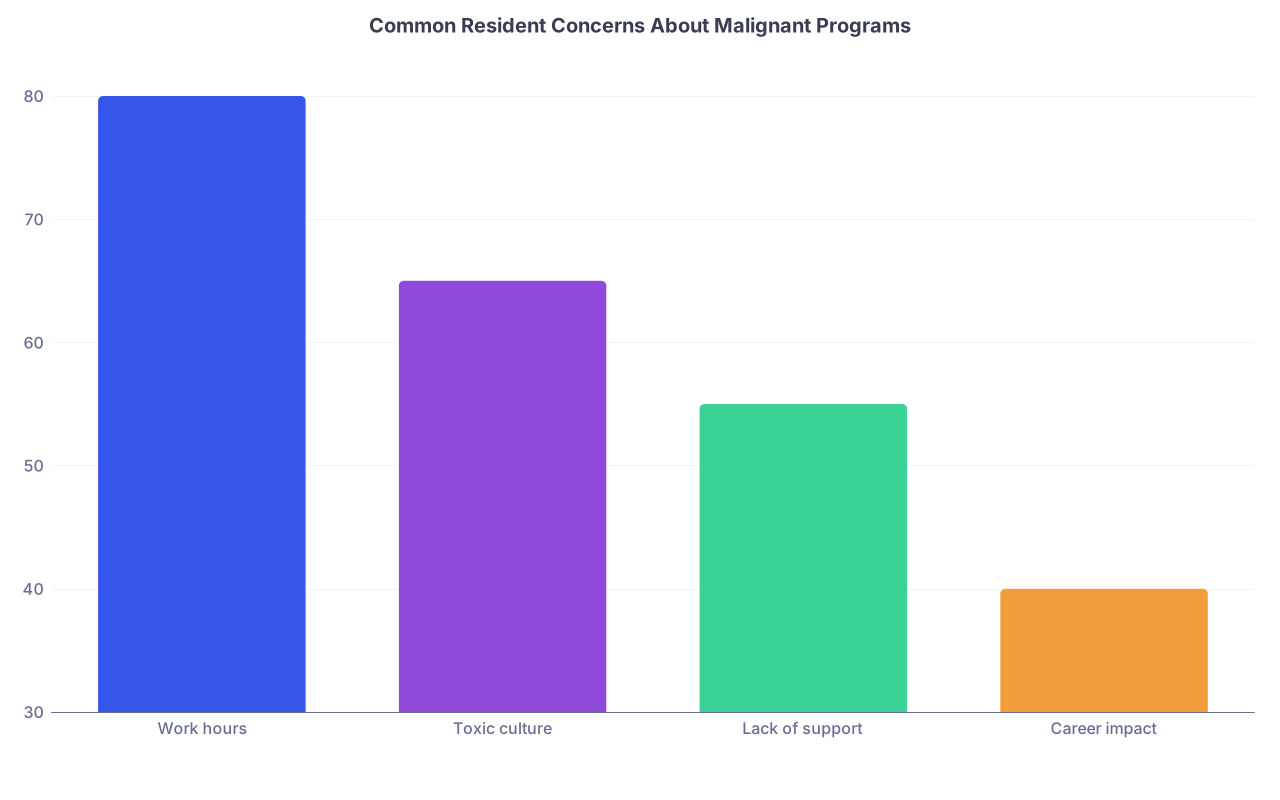
| Category | Value |
|---|---|
| Work hours | 80 |
| Toxic culture | 65 |
| Lack of support | 55 |
| Career impact | 40 |

| Situation | Likely Malignant Red Flag | Hard But Healthy Sign |
|---|---|---|
| Residents discussing hours | Vague, fearful, evasive | Honest, specific |
| Feedback from attendings | Personal attacks, shame | Direct but respectful |
| Response to struggles | Punitive, gossip | Help, referrals |
| Talking about graduates | Disappeared, vague | Clear success stories |

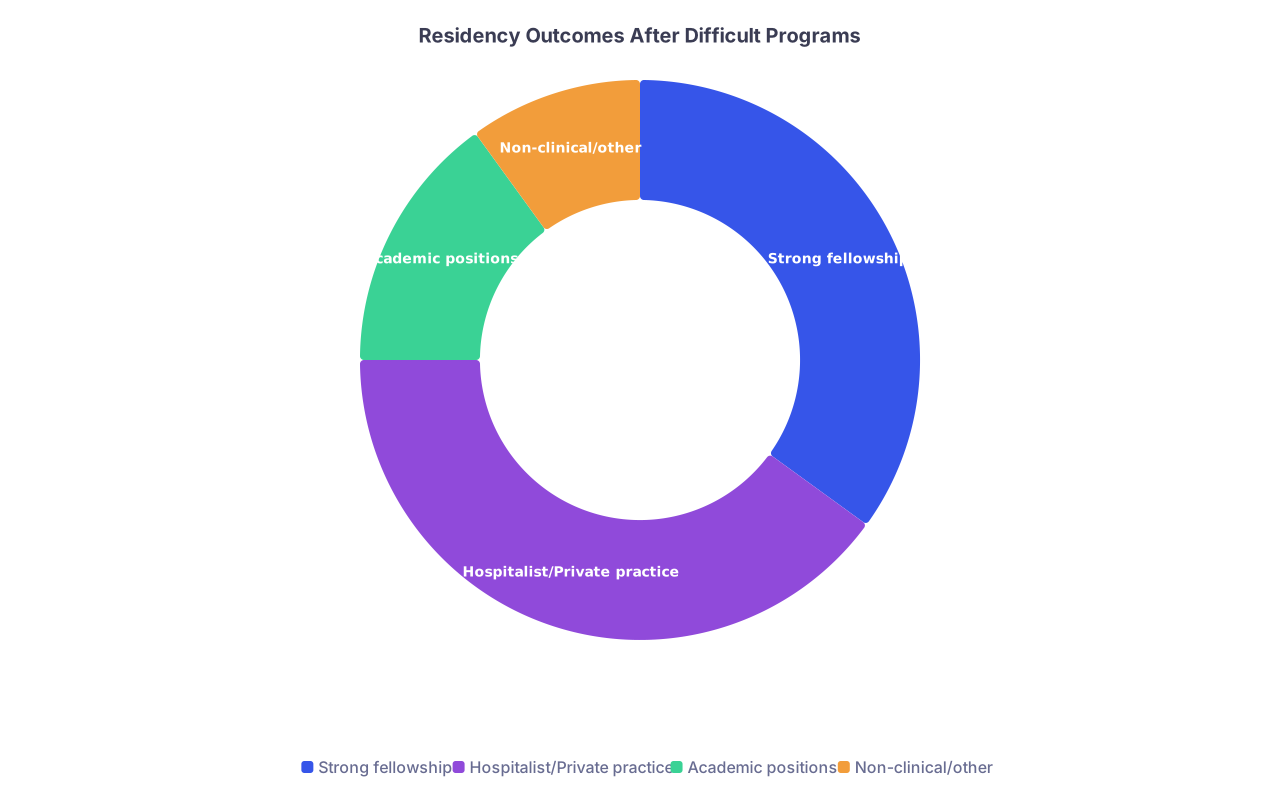
| Category | Value |
|---|---|
| Strong fellowship | 35 |
| Hospitalist/Private practice | 40 |
| Academic positions | 15 |
| Non-clinical/other | 10 |

FAQ (4 questions)
1. Should I try to transfer before I even start if I’m this worried?
Usually, no. Programs almost never take transfers who haven’t even begun PGY-1 yet. And you don’t actually know what your day-to-day reality will be. The smarter move is: start, collect real data for a few months, and if it’s truly unsafe or toxic, quietly explore transfer options with someone you trust (advisor, PD at your home med school, or GME office). Premature panic-transfer attempts mostly just burn energy and relationships.
2. If my program is malignant, will that show up on my record or hurt me forever?
Residency program reputation is context, not a permanent stain. Future employers and fellowship directors care more about: your performance, letters, skills, and how you talk about your experience. You don’t go around saying, “I trained at Malignant Memorial Hospital.” You frame it as a rigorous, high-volume place where you learned a ton. People in medicine know that some tough programs produce excellent clinicians. The key is to avoid sounding bitter or victimized when you talk about it later, even if parts of it were awful.
3. How soon into intern year will I be able to tell if it’s actually bad?
Honestly? Within the first 2–3 months you’ll have a strong gut sense. Maybe not about the entire program, but about the culture. Pay attention to: how seniors treat you when you’re drowning, how attendings respond to honest “I don’t know,” and how leadership reacts when someone makes a mistake. You don’t need years of data. Patterns will show up quickly. That said, remember July–August are rough everywhere, so don’t mistake normal chaos for uniquely malignant behavior.
4. What can I do right now, before July, to protect my sanity if I’m terrified of this match result?
Pick two priorities: building support, and setting expectations. For support: identify 1–2 classmates or friends you can text anything, anytime, and tell them you’re scared about this program. If possible, get the contact info of one current resident there and ask them for an honest, off-the-record chat. For expectations: write down a short list—“What I actually need from this residency” (e.g., board eligibility, basic competence, 1–2 good mentors), not perfection. Having a concrete list will help you filter experiences later instead of thinking “everything is ruined” every time something sucks.
Open your email or messages right now and send one note to a current resident or recent grad who knows your program: ask them, plainly, “Off the record—what’s it really like there, and what should I prepare myself for?”