
What exactly are you supposed to do between Match Day and orientation when you’ve got a toddler who still wakes up at 2 a.m. and a baby who eats every three hours?
Let’s not romanticize this. Matching is a relief, but if you have young kids, the relief lasts about 48 hours. Then reality hits: new city (maybe), new schedule, daycare logistics, call nights, and the lovely question, “Who is watching the kids when I’m on nights and my partner is also working?”
This phase between Match and PGY‑1 is your only real runway. You will not get this kind of planning time again for a long while. Use it well and PGY‑1 will still be hard, but survivable. Waste it, and you spend the first six months of residency in constant crisis mode.
I’ll walk you through what to do, in what order, and how to think about it as a resident parent, not as a theoretical “work–life balance” project.
Step 1: Get Ruthlessly Clear on your PGY‑1 Reality
Before you plan childcare, housing, or anything else, you need facts. Not vibes. Not what you “heard.” Hard data from your specific program.
Here’s what you need from your residency:
- Typical daily schedule on each major rotation
- Call schedule (frequency, type, post‑call expectations)
- Weekend expectations
- Vacation blocks and when they’re assigned
- Any known night float blocks and rough dates
- Orientation dates and whether they’re full days
Do not guess these. Email or call your program coordinator. Something like:
“I’m a matched incoming PGY‑1 with young children at home and need to finalize childcare and housing. Can you share: typical PGY‑1 daily schedule ranges, call structure, and approximate vacation block timing?”
Most coordinators are human. They’ll help.
Once you have data, sketch the “worst weeks” of your year: think ICU + call, wards + q4 call, or night float.
Then answer:
- Earliest you might need to leave home?
- Latest you might get home?
- How many weekends in a row could you realistically be working?
- How many nights in a row on night float?
Write this down. This is the backbone of every other decision.

| Step | Description |
|---|---|
| Step 1 | Get Residency Schedule Info |
| Step 2 | Identify Worst Case Weeks |
| Step 3 | Plan Childcare Coverage |
| Step 4 | Choose Housing Location |
| Step 5 | Assign Household Roles |
| Step 6 | Create Backup Plans |
Step 2: Design Childcare for Your Worst Week, Not Your Best
Most resident parents mess up here. They design childcare around some fantasy “average” week. Then the first time they’re post‑call and their partner is on days, the whole system collapses.
You plan for the ugliest scenario. Then normal weeks feel easy.
Core coverage: who is on the kids, when?
You need a primary plan and backup options.
Common setups I’ve seen work:
- Daycare or preschool + partner with flexible job
- Daycare + nanny for early mornings / evenings
- Grandparent or relative nearby + part‑time daycare
- Full‑time nanny share with another resident family
- Partner as stay‑at‑home parent (with clear boundaries & support)
Make yourself answer these specific questions on paper:
Who covers:
- Weekday mornings from first parent leaving until drop‑off?
- Weekday evenings from pick‑up until bedtime?
- Middle‑of‑the-night wakeups when you’re on call the next day?
What happens:
- When daycare calls at 2 p.m. with a fever?
- When your call night runs late and you miss pick‑up time?
- When your partner’s work schedule suddenly changes?
If your answer is “we’ll figure it out,” you haven’t planned.
Daycare vs nanny vs hybrid
Here’s a rough comparison for resident families:
| Option | Pros | Cons |
|---|---|---|
| Daycare | Cheaper, socialization | Fixed hours, sick policies |
| Full-time Nanny | Flexible, home-based | Expensive, employer duties |
| Nanny + Daycare | Coverage + socialization | Most complex to coordinate |
| Family Care | Trusted, flexible sometimes | Not always reliable or nearby |
A few hard truths:
If your program is malignant or very time‑intense (surgery, OB, some IM), daycare alone rarely covers everything unless your partner has near‑total flexibility.
If your kids are chronically sick, daycare can become a disaster: frequent exclusions, constant scramble. You may need a nanny or a “backup babysitter list” for illness days.
Be very honest about money. A nanny is expensive, but so is repeated job loss for a partner who keeps leaving work early. Do the math annually, not monthly.
Lock in backup care now
Do this before PGY‑1:
Identify at least 2–3 sitters who can cover:
- Early mornings in an emergency
- Sick days
- Occasional evenings
Ask nearby co‑residents with kids who they use. Most programs have an informal network of trusted sitters. It’s gold.
Write your backup plan down like a protocol:
“If daycare calls and I’m on call and [partner] can’t leave, we text X, then Y. If no one is available, we call [neighbor/grandparent].”
It sounds over‑engineered. You’ll be grateful at 3:27 p.m. on a Thursday when your attending wants one more admission.
Step 3: Choose Housing for Lifestyle, Not Ego
Matching at a big‑name hospital in a trendy city and then choosing a “fun” neighborhood 35 minutes away is how you end up never seeing your kids awake.
Your priority now is proximity and predictability, not the perfect loft.
Here’s the formula I recommend:
Commute under 20 minutes door‑to‑door if at all possible. Under 15 is better. This is the difference between:
- Seeing your baby for 20 minutes before bed vs 2 minutes
- Getting 6 hours of sleep post‑call vs 5
Single‑stop childcare logistics.
Ideal: home → daycare → hospital is a direct, simple route.
Or: partner can drop off/pick up without insane detours.Parking and late‑night safety.
If you’re coming home post‑call, half delirious, at 11 p.m., you want:- Safe, well‑lit path from car to front door
- Not circling for parking for 25 minutes
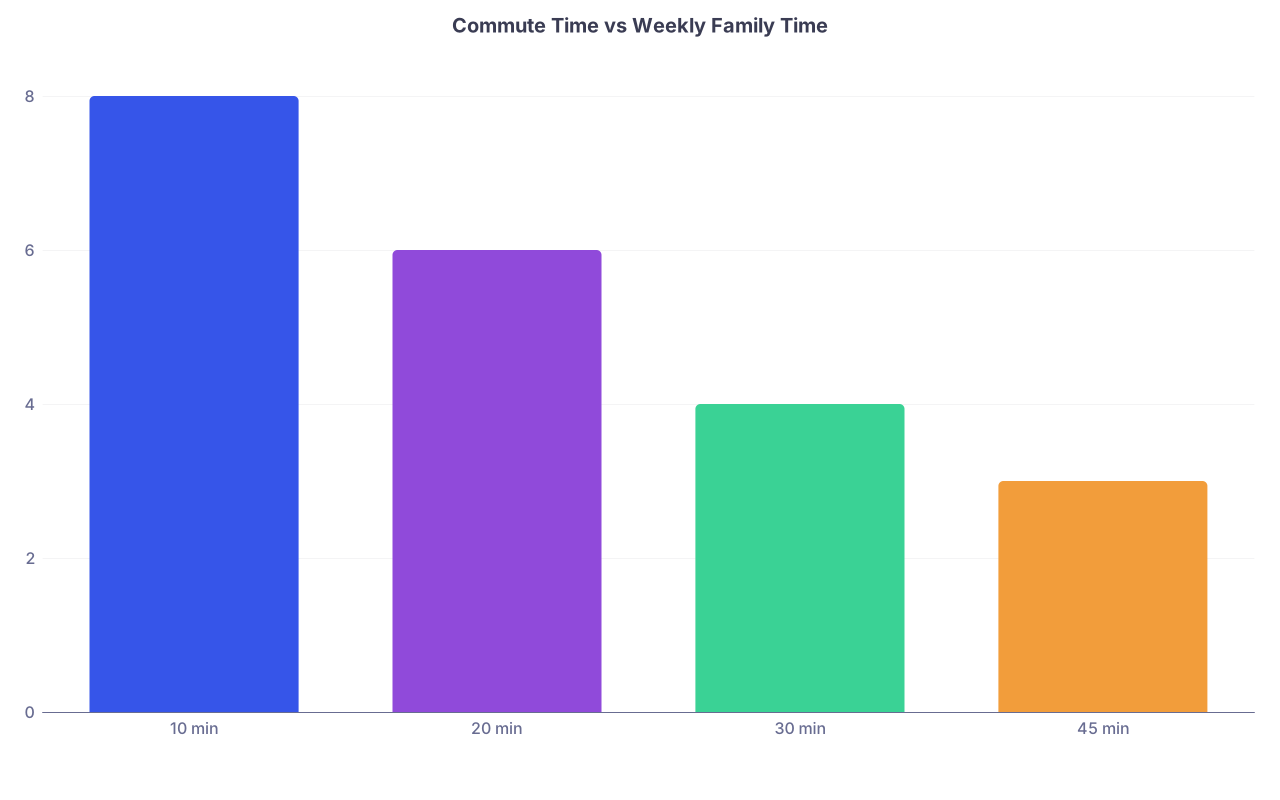
| Category | Value |
|---|---|
| 10 min | 8 |
| 20 min | 6 |
| 30 min | 4 |
| 45 min | 3 |
(Values represent rough extra hours per week with kids you reclaim by shorter commutes.)
Do not underestimate this. I’ve seen residents move closer mid‑year simply because they couldn’t stand losing an hour a day to traffic.
Housing features that actually matter
You’re not staging a Pinterest board. Focus on:
- In‑unit laundry. Non‑negotiable with kids and 80‑hour weeks.
- Dishwasher. You won’t have time for hand‑washing.
- Enough bedroom separation that someone can sleep while kids are awake.
- Space for:
- A crib or toddler bed
- A simple “command center” (more on this later)
- A quiet corner to sleep post‑call even when kids are playing
Nice‑to‑have but very helpful:
- Ground floor or elevator (strollers + car seats + diaper bags).
- Play area or park within walking distance.
- Grocery store within 10–15 minutes.
Things that do not matter as much as you think:
- Granite countertops
- Walkability to restaurants and bars
- “Character” of the building
You won’t use them as much as you think.
Step 4: Divide Roles at Home Like You Mean It
Vague agreements like “We’ll both pitch in” are a trap. You’ll default to whoever is most tired or most guilty. That will usually be you.
You need explicit role division between you and your partner (or any adult living with you).
Start with the big buckets:
- Childcare routines (morning, bedtime, weekends)
- Cooking / meals
- Cleaning / laundry
- Logistics (bills, insurance, paperwork, kids’ appointments)
- Emotional load (scheduling, remembering, anticipating)
Then assign primary responsibility. Not sole responsibility. Primary.
Example structure that works for many resident couples:
Resident:
- Primary: Finances setup, insurance, big‑ticket scheduling (leases, car, childcare contracts)
- Shared: Bedtime routine when off; one weekend morning “on duty”
- Minimal: Weekday cooking
Partner:
- Primary: Day‑to‑day meals, laundry, daycare coordination, sick‑day coverage if job allows
- Shared: Bedtime, weekends, park trips
You adjust based on who works more hours. But you must be direct and honest.
Have the hard conversation now:
- “When I’m on nights, I will be useless from 8 a.m. to 4 p.m. That is sleep, not optional.”
- “Which things will we just buy our way out of? Cleaning? Grocery delivery?”
- “What are we okay lowering our standards on?”
Make specific trade‑offs:
- Maybe the house is only truly clean every 2 weeks.
- Maybe meals are repetitive and boring but fast.
- Maybe screen time limits are more generous than your pre‑kid ideals.
Welcome to survival mode. That’s not failure. That’s strategy.
Step 5: Build Systems, Not Heroics
The answer is not “try harder.” You’re about to be a new doctor with new responsibilities, operating on too little sleep. You need systems you can run on autopilot.
The home command center
Set up one physical spot in your home where “family operations” live:
- Large wall calendar or whiteboard
- Printed daycare schedule and emergency contacts
- Rotation schedule, call nights, and vacation blocks
- Contact info for:
- Program coordinator
- Pediatrician
- Daycare
- Sitters
- Nearby friend/neighbor who can step in
Every Sunday, sit with your partner and do a 15‑minute run‑through:
- Who’s doing drop‑off/pick‑up each day
- Any late days, calls, or conferences
- Meals for the week (simple is fine)
- Any appointments for kids
Routine sounds boring. It’s what keeps you afloat.
Automate the boring stuff
Before July 1:
- Put every recurring bill on autopay.
- Set up pharmacy delivery if your area has it.
- Pick one grocery delivery or pickup service and stick to it.
- Order duplicates of:
- Phone chargers
- Work bag essentials
- Kid comfort items (favorite stuffed animal for daycare, etc.)
Also: simplify everyone’s wardrobes. This is not the year to fight your 3‑year‑old about complex outfits.
- Capsule wardrobe for you: scrubs + 3–4 easy‑wash outfits.
- Kids: lots of interchangeable, comfortable sets. Stain‑friendly.

Step 6: Protect Sleep Like It’s a Medication
Residency with young kids and no plan for sleep is how people end up unsafe at work and snappy at home.
You won’t get perfect sleep. But you can make it less terrible.
Set house sleep rules
Examples that work:
- “When I’m post‑call, I get protected sleep from 9 a.m. to 1 p.m. No exceptions unless someone is actually injured.”
- “No one wakes the off‑duty parent for household questions that can wait.”
- “On my day off post‑nights, I sleep until at least noon; partner handles kids fully that morning.”
For wake‑ups:
- If your partner’s schedule is lighter: they own most night wakeups except when you’re both off.
- If both are heavy: alternate nights or use a “one parent handles all wakeups until 3 a.m., other handles after 3 a.m.” system.
You also adjust your expectations:
- You may need to go to bed embarrassingly early on non‑call days.
- Social life will be limited. That’s not forever; it’s this season.
Optimize your sleep environment
Make your bedroom a cave:
- Blackout curtains
- White noise machine
- Earplugs for post‑call sleep if kids are loud
And be honest: you might need a second sleep space (sofa bed, office) for one of you if kids are very noisy or co‑sleeping.
Step 7: Administrative Stuff Nobody Warns You About
You have to protect your family legally and financially before you’re drowning in wards.
Non‑negotiables before PGY‑1:
Health insurance for the whole family
Figure out whether resident benefits or partner’s job gives better coverage for kids. Compare premiums, deductibles, out‑of‑pocket max.Life and disability insurance for you
You are about to become your family’s future earning engine. Get:- Term life insurance (cheap, basic policy is fine)
- Own‑occupation disability insurance if at all possible
Will or at least guardianship docs
Not fun. Essential. Decide:- Who would take your kids if both you and your partner died
- Who handles finances
Do the paperwork. Many hospitals offer legal clinics; ask GME.
Pediatrician and emergency plan
- Choose a pediatrician near home or daycare, not the hospital
- Know your nearest urgent care and children’s ED
- Make a simple “if kid has X, we call Y” guide for you and partner
You’re not being dramatic. You’re being a parent.
Step 8: Emotionally Reset Expectations
This isn’t about “having it all.” It’s about not burning out or blowing up your family in the first year.
Here’s what I’d tell you if we were talking in a cafeteria at 10 p.m. after sign‑out:
- You will miss some bedtimes.
- You will feel guilty, a lot.
- Your partner (or co‑parent) will probably feel alone and resentful at times.
- You will look at pictures of your kids at work and feel like you’re missing their entire childhood.
None of that means you’re a bad parent or a bad doctor.
You’re doing something brutally hard. Both things can be true: you love your kids and you love medicine. There will be seasons when one takes more space.
So, before you start PGY‑1:
- Have explicit conversations with your partner about what “good enough” parenting looks like right now.
- Decide what you will not sacrifice:
- Maybe it’s Saturday morning pancakes whenever you’re off.
- Maybe it’s reading one book at bedtime on any night you’re home before 8.
- Maybe it’s a monthly “family day” you protect like a procedure day.
Then let go of the rest. Instagram families are curated. They’re not on call.
Quick Timeline: What to Do When
Use this as a loose checklist.
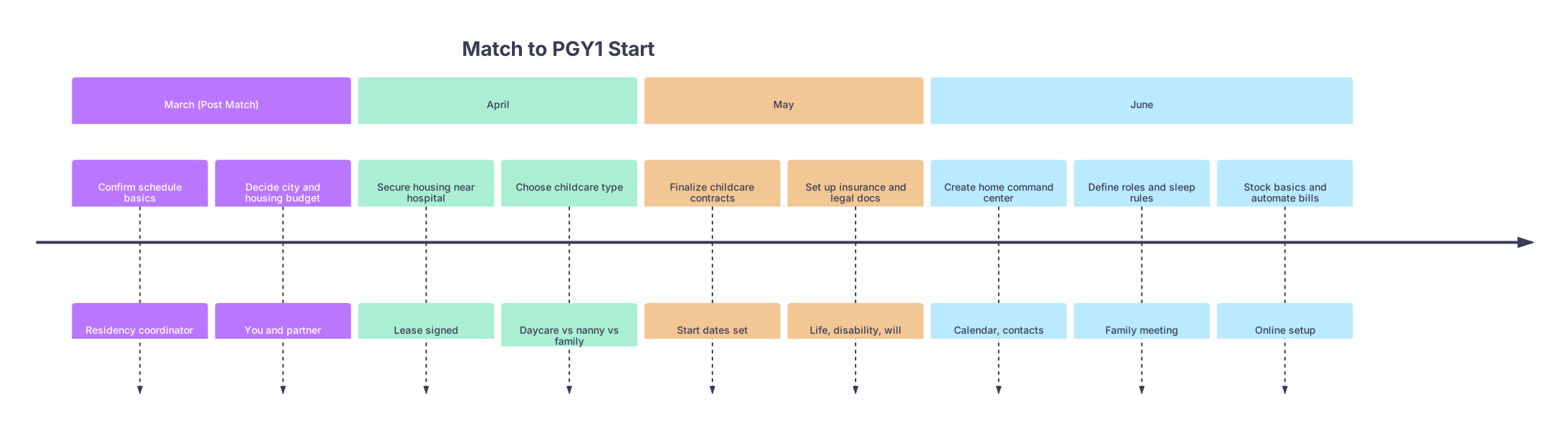
| Period | Event |
|---|---|
| March (Post Match) - Confirm schedule basics | Residency coordinator |
| March (Post Match) - Decide city and housing budget | You and partner |
| April - Secure housing near hospital | Lease signed |
| April - Choose childcare type | Daycare vs nanny vs family |
| May - Finalize childcare contracts | Start dates set |
| May - Set up insurance and legal docs | Life, disability, will |
| June - Create home command center | Calendar, contacts |
| June - Define roles and sleep rules | Family meeting |
| June - Stock basics and automate bills | Online setup |
If you’re reading this late and it’s already June? Fine. Start at the top and move quickly. Imperfect planning is still better than none.

FAQs
1. My partner is also a resident. Is this even realistic with young kids?
Yes, but only if you treat logistics like a part‑time job for both of you. You’ll need:
- Aggressive schedule comparison and trading when possible
- Serious backup childcare (reliable sitter, maybe family support)
- Willingness to pay for flexibility (nanny, extra help)
And you must drop the fantasy that you’ll both attend every school event or bedtime. You’ll be alternating “present parent” roles a lot. It’s doable, but you can’t wing it.
2. We don’t have family nearby and can’t afford a full‑time nanny. What now?
Then your priorities become:
- Daycare with the widest possible hours (7–6 is much better than 8–5)
- Building a roster of sitters early (college students, neighbors, other residents’ sitters)
- Partner maximizing flexibility if at all possible (remote work, part‑time, shift‑based jobs)
You might also look at:
- Nanny share with another resident family
- Occasional cleaning help so your limited money and time go to childcare and sleep, not scrubbing floors
3. How do I talk to my program about being a parent without looking “less committed”?
You do not need to apologize for having kids. But you also don’t send a long emotional email.
Instead, be brief and practical:
“I’m an incoming PGY‑1 and a parent of two young children. I want to make sure I set up safe childcare and support so that I can be fully present during training. Is there a resident parent group or someone you recommend I speak with about typical schedules and logistics?”
That’s professional, focused on being reliable, and signals responsibility, not neediness.
4. Should we move closer to family even if it means a worse commute or school district?
If your kids are under 5, “school district” is irrelevant for now. Help is not. I’d choose:
- Short commute + actual usable family help
over - Great schools in 6 years + daily chaos and zero backup
If being near family means a 45‑minute commute each way, though, it gets trickier. That’s 90 minutes a day you’re not with your kids. Sometimes hiring help locally is better than a long commute to be near rarely‑available relatives.
5. Is it selfish to start residency with very young kids at home?
No. What’s selfish is refusing to plan and then making everyone around you live in preventable chaos. You’re allowed to pursue your career and still be a good parent.
If you:
- Take this planning window seriously
- Protect your family’s basic needs (safety, stability, sleep, some connection)
- Stay honest with your partner and adjust when things are clearly unsustainable
…then you’re doing the job. Perfect parenting is a myth. Competent, deliberate parenting as a resident? That’s what you’re aiming for.
Bottom line:
- Plan around your worst‑case PGY‑1 weeks, not your fantasies.
- Design childcare, housing, and home roles like a system, not heroic improvisation.
- Accept this is a hard season, not a moral failing—and build just enough structure that your family bends but does not break.