

The idea that “I ranked them first and matched there, so they must have loved me the most” is wrong. Flat out.
If you walk away from Match Day thinking your #1 program was also your #1 fan, you’re misunderstanding how the algorithm works, how program behavior looks in the real world, and what your result actually says about your application.
Let me be blunt: the Match is not a mutual-love scoreboard. It’s a constrained optimization problem trying to honor applicant preferences first, under some rules. That distinction matters, because it kills a whole set of myths people cling to for emotional comfort (or unnecessary self-blame).
Let’s unpack what your “Ranked them first, matched there” result really means—and what it absolutely does not mean.
How the Match Actually Works (Without the Fairy Tale Spin)
Before you start reading tea leaves from your match result, you need the machinery straight.
The NRMP algorithm is applicant-proposing. Translation: it tries to give you the most preferred program on your rank list that also has you on theirs, subject to capacity.
Stripped to basics, this is the logic:
- The algorithm starts with your #1.
- If that program has an open spot and has ranked you somewhere, you’re tentatively placed there.
- If later a higher-ranked applicant for that same program comes along and takes that seat, you’re “bumped” and the algorithm moves on to your next choice.
- This repeats until either:
- You land somewhere that doesn’t bump you, or
- You run out of ranked programs and go unmatched.
Notice what’s missing: anywhere in this process does it check whether the program ranked you #1? No. The key question is binary:
Did this program rank you high enough to still have a spot for you when the dust settles?
“High enough” could mean 3rd. Or 12th. Or 37th out of 200. The algorithm does not care about your ego.
The biggest conceptual error I see every March: students treating “We matched at each other” as “We were each other’s top pick.” That’s not what the math says. At all.
Why Matching at Your #1 Does Not Mean You Were Theirs
Here’s the uncomfortable truth: you can be a program’s backup plan and still match there as your #1.
Let’s use some real-ish numbers.
Say you’re applying to Internal Medicine. Your dream program is “MetroMed IM.” You rank them:
- MetroMed IM
- City General IM
- Suburban Health IM
…
MetroMed, meanwhile, has 30 spots and ranks 300 applicants. Totally normal.
Your position on their list could be:
- 1–30: You’re a “top pick.”
- 31–60: You’re very solid but not their first wave.
- 61–150: You’re still very rankable, but they’re basically saying, “If we don’t fill from the cream, we’re happy with this group.”
- 151–300: Insurance. These people might never see a spot.
Now imagine their top 40 applicants mostly match into more prestigious or geographically desirable programs. That happens constantly. Applicants “trade up” to places they ranked higher.
MetroMed starts walking down their list, filling their 30 spots. They get to you at #55. By then, a bunch of higher-ranked people have already matched elsewhere, so those slots are gone. Your name appears. You’ve ranked MetroMed #1. You match.
You’re ecstatic: “We picked each other first!”
Reality: they ranked you 55th, you ranked them 1st, and you met in the middle because of supply and demand, geography, and everyone else’s decisions. That’s not romance. That’s combinatorics.
To hammer this home, think about the reverse:
You could:
- Rank Program A #1
- Have Program A rank you #80 out of 220
- And still match there.
Because enough of those 79 people above you chose somewhere else or bumped each other out. The algorithm just kept going until it found the first alignment: Program A still has a seat; you still want them more than any place that can take you.
None of that implies you were their favorite.
What the Data Actually Shows About Rank Positions
We do not have perfect transparency on every program’s rank behavior, but the NRMP publishes data that gives the game away if you’re willing to look.
| Specialty Type | Applicants Ranked per Position* |
|---|---|
| Internal Medicine (Categorical) | 7–10 |
| General Surgery | 9–13 |
| Emergency Medicine | 8–11 |
| Psychiatry | 6–9 |
| Orthopaedic Surgery | 12–18 |
*Ranges based on NRMP Program Director Survey and Charting Outcomes trends.
What this means in practice: if a surgery program has 5 spots, they might rank 60–90 people. Many programs report ranking 8–15 applicants per position, sometimes more in competitive specialties.
Now layer in this: the majority of programs over-rank because they expect a ton of people to match elsewhere. They know the “top 20” on their list are heavily applying to brand-name places. So they rank deep.
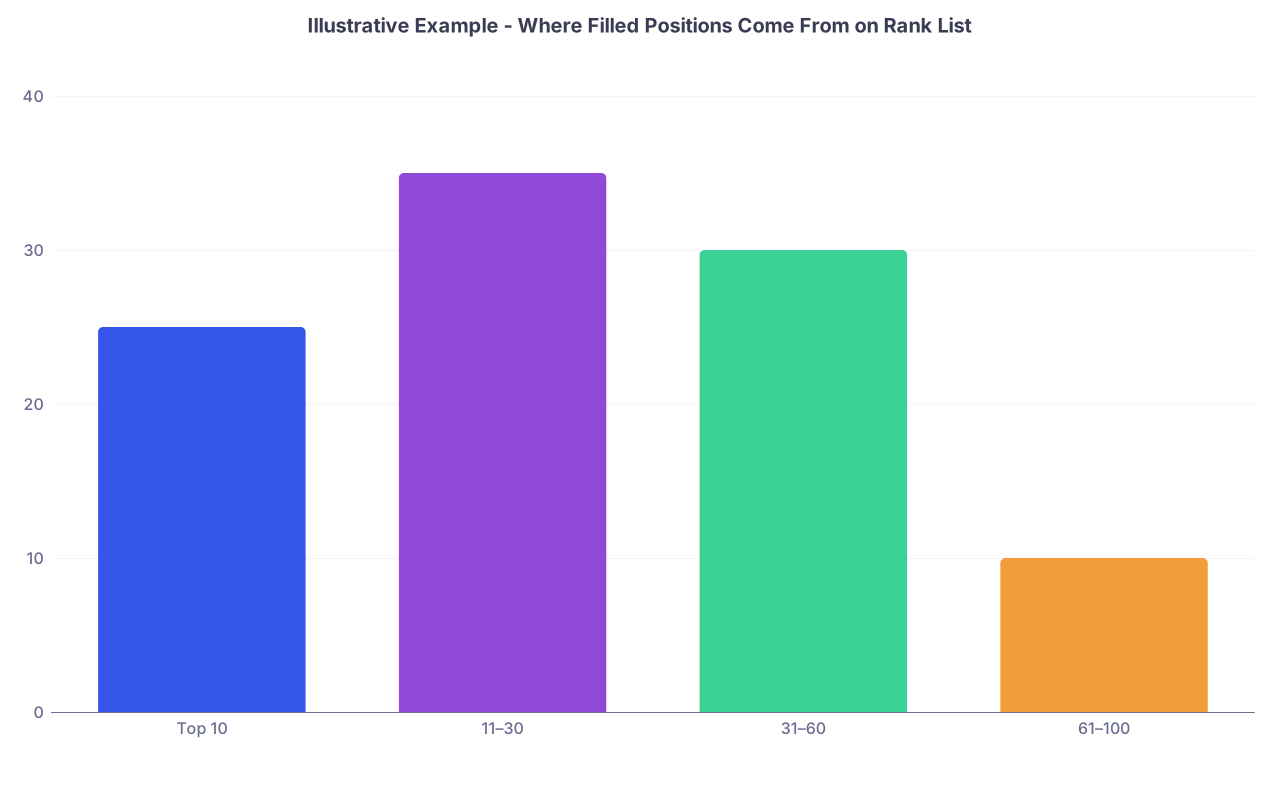
| Category | Value |
|---|---|
| Top 10 | 25 |
| 11–30 | 35 |
| 31–60 | 30 |
| 61–100 | 10 |
This hypothetical bar chart (mirroring what many PDs informally describe) shows something critical:
Not all filled positions come from the “top 10” on the list. A huge chunk of filled spots are from the middle tiers of the rank list. If you matched at your #1, your odds of being in the top 5 on their list are not nearly as high as your ego would like them to be.
Are there applicants who are #1 on their #1’s list? Absolutely. Are most people in that situation? No.
Programs don’t broadcast this because “You were probably 47th on our list but hey, welcome” is not exactly a warm orientation-day speech.
Stop Treating Match Order Like Relationship Hierarchy
Another toxic misconception: “Matched at my #1 = I was ‘meant’ to be there.”
No. You ended up at the best program on your list that could fit you under algorithm rules. That’s it.
Let me translate common emotional interpretations into algorithmic reality:
“They loved me most.”
→ They ranked you somewhere high enough that a spot was still available when the algorithm got to your name.“This proves I should have gunned even higher.”
→ Or it proves that over-ranking a ‘reach’ on your side sometimes pays off because the same people you think are ‘untouchable’ are, in fact, denying each other.“If I didn’t match at my #1, they must have hated me.”
→ Or their list filled above you because they’re pulling from an absurdly deep applicant pool, especially in competitive specialties.
I’ve watched people convince themselves they were a program’s star because they matched there. Then log into the post-Match NRMP data and realize that program ranked 400 people for 15 spots.
You don’t need this fantasy relationship narrative to thrive there. You just need to stop misreading what the match signal actually means.
Where the Algorithm Is Biased—And Still Misunderstood
The NRMP algorithm is explicitly applicant-favoring. That’s not a slogan; it’s the design.
If you compare program-proposing vs applicant-proposing stable matching, you get:
- Applicant-proposing: Applicants tend to get better outcomes relative to their preferences, programs get slightly worse (from their perspective).
- Program-proposing: Programs do better; applicants do worse.
The NRMP chose the applicant-favoring version. So structurally, the system is trying to maximize how high you land on your list among all feasible matches.
Yet medical students invent this weird mythology where they read their match like it’s:
- A referendum on their personal worth
- A rank of who loved them most
- A spiritual sign that they “belong” exactly where they landed
No. It’s a constrained optimization, not a cosmic dating app.

| Step | Description |
|---|---|
| Step 1 | Applicant rank lists |
| Step 2 | Algorithm starts at applicant top choice |
| Step 3 | Tentative match |
| Step 4 | Try applicant next choice |
| Step 5 | Higher ranked takes spot, previous bumped |
| Step 6 | Match final |
| Step 7 | Program ranked applicant and has spot |
| Step 8 | Higher ranked applicant appears |
Once you see the logic, you stop making up stories about “they fought for me” or “they wanted me more than others.” The algorithm doesn’t encode that level of nuance.
What Your Match Result Actually Tells You (And What It Doesn’t)
Let’s be precise.
If you ranked a program #1 and matched there, what do we actually know?
- You were ranked somewhere on their list.
- You were high enough that they still had an unfilled position when the algorithm hit your name.
- Relative to every program that would accept you, this was your most preferred.
That’s it.
What we do not know from that outcome:
- Your exact position on their rank list
- Whether you were in their “top tier,” “mid tier,” or “we’re getting nervous we won’t fill” tier
- Whether they liked you more than the applicants who matched above you at more competitive programs
- Whether they were “thrilled” or “relieved” or “fine with it” when your name filled a slot
And frankly, none of that is knowable via the match outcome alone unless a program director sits down and literally shows you their list. Which, obviously, they’re not doing.
Even if a PD tells you “We were so excited to get you,” that’s qualitative, not positional. Could be true. Could also be standard onboarding enthusiasm. Either way, you shouldn’t build your identity on it.
The Dark Side of Misreading Your Match
This isn’t just semantics. Misunderstanding this stuff hurts people.
I’ve watched three predictable problems:
Inflated ego that backfires.
Someone matches at their #1, decides they must be a top-1% superstar, then gets wrecked when they realize half their co-interns have stronger Step scores and deeper research. They misinterpret “good outcome” as “I am obviously better than everyone else here.”Unnecessary self-blame.
Someone ranks a dream program #1, doesn’t match there, and internalizes: “They hated me. I wasn’t good enough.” Meanwhile the program had 3 spots, 900 applicants, ranked 150, and filled all 3 from their top 10.Fantasy “meant to be” thinking that blocks mobility.
People stay in toxic or poorly fitting programs because they’ve convinced themselves the match result was destiny. “If I’m miserable here, maybe something’s wrong with me.” No. Maybe the algorithm dropped you into a suboptimal human environment that just happened to be the best option under the constraints of that year.
The Match is not an oracle. Treating it like one is how smart people gaslight themselves.
How to Interpret Your Match Like an Adult
So how should you actually read “Ranked them first, matched there”?
Try this instead of the fairy tale:
“I played my side of the strategy right.”
You took advantage of the applicant-favoring structure, ranked your actual preferences, and the algorithm found a feasible solution at the top of your list. That’s success.“This program committed to training me.”
At minimum, they considered you acceptable and trainable enough to rank. At maximum, they genuinely loved you. You don’t need to know where in that spectrum to start doing good work.“Where I matched is a starting point, not a verdict.”
You’re not stuck in a permanent romance narrative. If you discover misfit, you can push for fellowships, research years, leadership roles, or even transfers. None of that depends on whether you were their #3 or #73 originally.
Instead of obsessing over “Did they love me most?”, ask sharper questions:
- Do I have the resources here to become the physician I want to be?
- Who are the faculty I can learn the most from, regardless of how much they lobbied for me?
- What can I control now that the algorithm is done—cases, feedback, mentorship, scholarly work?
The Match is done. The story you tell yourself about it is not.
The Bottom Line
Keep this tight:
- Matching at your #1 does not mean you were their #1—and the algorithm was never designed to tell you that.
- Your match outcome reflects feasible preferences under constraints, not love, destiny, or personal worth.
- Treat the program that ranked you high enough to land you as an opportunity, not a soulmate. What you do after Match Day matters far more than where you sat on anyone’s list.


