
It’s mid-March. You’ve got your Match email, you’ve done the champagne, your family has posted twenty blurry photos with terrible captions. You know where you’re going in July.
What you do not see is this: three floors above some random clinic, in a dull conference room with bad coffee, your name is already sitting in a spreadsheet on a projector. And a group of people—who you’ve never met—are arguing about when you’re coming, what you’re allowed to do, and how much of a mess you’re going to make during July.
That’s orientation planning.
Let me walk you through what actually happens once you match and while you’re just trying to enjoy your “last free months ever.”
The Moment Your Name Hits Their Inbox
Programs find out their matched list before you do on Match Day morning. There’s a very short window between scrambling relief and logistical panic.
Here’s the real sequence.
The NRMP sends the program a list: names, AAMC IDs, med schools, maybe a note like “prelim only” or “categorical.” That list immediately gets copied into three places:
- A giant “master resident roster” Excel/Sheets file they live in all year
- An email chain with GME (Graduate Medical Education) and HR
- A group chat where the PD, APDs, and chief residents start doing commentary:
- “Oh, we got that UCLA guy, nice.”
- “Wait, isn’t this the one who was weird in the interview?”
- “This DO school consistently sends strong residents.”
Within 24–48 hours, the program is forced to switch from recruitment mode to implementation mode. Orientation planning is one of the earliest heavy lifts.
Some programs are organized and already have a skeleton July schedule built. Others… do not. Those are the ones where you’ll get six slightly contradictory emails in April.
Who Actually Plans Orientation (It’s Not Who You Think)
You probably imagine the program director (PD) sitting down and designing a thoughtful, educational, resident-centered orientation.
No.
The PD sets guardrails and priorities. The real work is done by three groups:
- The program coordinator (or admin team)
- The chief residents
- GME office
The coordinator is mission control. They build the detailed calendar, talk to HR, track every ridiculous hospital requirement (TB, fit test, PPD, HIPAA quizzes), and send you those “URGENT – DUE TOMORROW” emails in May and June.
The chiefs do all the “resident reality” parts. They decide:
- How many orientation days are didactic vs shadowing vs paperwork
- When you meet your seniors
- Who gives which talk (“Don’t Be The Intern Who…” etc.)
- How early they can reasonably make you show up without a mutiny
GME is the mothership. They control:
- Hospital-wide orientation
- EMR training slots
- Badge photos
- Parking/ID/access
- Payroll and benefits onboarding
- Mandatory corporate trainings (“Managing Diversity in the Workplace” at 7:15 a.m.—you know the vibe)
So when you get that July calendar later, know that each block of time usually exists because at least three different groups argued over where to put it.
The First Big Meeting: The “Interns Are Coming” Summit
Within 1–2 weeks after Match, there’s almost always a meeting that sounds like:
“202X–202Y Incoming Class Planning Meeting”
I’ve sat through these. They’re part logistics, part gossip, part damage control.
The people in the room (or on Zoom):
- PD and APDs
- Chief residents
- Program coordinator(s)
- Sometimes a representative from GME
- Occasionally someone from IT or EMR training
They pull up last year’s orientation schedule. And then the real talk starts.
You’ll hear lines like:
- “The EMR training last year was a disaster. We cannot put all the interns in the 3 p.m. slot again; half of them left early.”
- “We need more time for ACLS. The June course overflowed.”
- “The ICU director wants them earlier for shadow shifts. I told him no.”
- “We got destroyed on the ACGME survey about not knowing policies. We need more policy slide decks. Unfortunately.”
They’ll scroll column by column through July: “Week 0,” “Orientation Week,” “First Call,” etc. Every colored block they move is your future.
And right here is where your class starts getting stereotyped.
Someone will mention: “We took more IMGs this year; we may need extra EMR support.” Or, “Lots of people from strong home programs; we can lean down on basic lectures.”
They’re not always right. But these early impressions absolutely shape what they build for you.
How They Decide What You Learn That First Week
Most residents think orientation is random chaos. It’s not. It’s just built from competing priorities that do not actually align.
Here’s the tension they’re juggling secretly.
1. GME / Hospital Compliance
Non-negotiable. There are things the hospital must do before they let you touch a patient:
- Online modules (HIPAA, OSHA, harassment, cybersecurity)
- Employee health clearance (immunizations, drug screen, TB, N95 fit test)
- EMR training
- Safety training (fire, codes, restraints)
These chunks eat entire days if the hospital is clumsy. The program has zero control over what is covered. Only when.
2. The PD’s Agenda
Every PD has a pet obsession.
Some are obsessed with professionalism. You’ll get long, dry sessions about documentation, duty hours, and “fitness for duty” with some horror stories.
Some are obsessed with quality improvement. Those programs shove QI, safety events, incident reporting systems, and “how to avoid being named in a lawsuit” into day one.
Others focus heavily on wellness, burnout, mental health. You’ll see small group sessions, “meet your advisor” activities, maybe reflective writing.
Remember: orientation is their only guaranteed, undisturbed block of time with you before the ward eats you alive. They will use it to hammer their priorities.
3. The Chiefs’ Reality Check
Chiefs know what actually hurts interns in July.
They’ve just finished a year of watching fresh interns drown. They know:
- People don’t know how to admit a patient in your specific EMR
- They don’t know how to order insulin correctly
- They don’t know when to call the attending vs the senior
- They’re terrified of procedures but bad at speaking up
So the chiefs fight to insert practical content:
- “How to admit and write a note here” demonstrations
- “How to call consults without sounding clueless”
- “Real” code blue expectations on your floors
- A walk-through of the physical layout: where the hell is radiology, CT, blood bank, central supply
These sessions actually save your life. But they get squeezed by HR/GME fluff and PD pet projects.
So the behind-the-scenes battle during planning goes like:
Chiefs: “We need 3 hours for practical EMR and admission flow.”
GME: “We must schedule 2 hours for sexual harassment training that cannot be moved.”
PD: “I want 2 hours for professionalism and communication with consultants.”
Your calendar ends up reflecting who wins each fight.
Your Name in Their Spreadsheet: Tracking Who’s “Ready”
Let me show you how you’re viewed right after Match.
Your program coordinator usually builds a big onboarding tracker. Something like:
| Column | Example Entry |
|---|---|
| Name | Alex Johnson |
| AAMC / NRMP ID | 12345678 |
| Med School | UCSF |
| Visa Needed | No |
| Contract Returned | Yes / No |
| Background Check | Cleared / Pending |
| Drug Screen | Completed / Not Done |
| Immunizations Uploaded | Complete / Incomplete |
| EMR Training Date | 6/25 |
| ACLS | Valid / Needs Course |
That sheet gets opened in almost every planning meeting from April through July.
If you’re wondering why your inbox is full of “We still need X from you” messages, it’s because on their screen, you’re literally a red cell in a column labeled “Missing.”
No one remembers that you scored 265 or honored everything. In these meetings you are “the one who still hasn’t done the employee health stuff” or “the Canadian grad who needs credentialing exceptions.”
And yes, the PD will occasionally say: “Why is this one still red?” The coordinator shrugs, “They haven’t replied to my last three emails.”
You do not want to be discussed that way. That absolutely colors the tone they have with you in July.
The Orientation Calendar You Eventually See vs What They Hide
By late April or May, they’re usually ready to leak some version of the orientation schedule.
What shows up in your email: a semi-clean PDF/Google calendar of:
- “Institutional GME Orientation – Day 1”
- “Program Orientation – Lectures”
- “EMR Training”
- “ID Badge Photos”
- “Welcome Lunch”
- “Meet Your Mentor”
- “Shadow Shifts (Optional/Required)”
What you don’t see:
- The hour-long argument about whether you should do shadow call your first weekend or be left completely free to “enjoy your last days off”
- The ICU director asking for you on day 2 for “training” and the PD telling them: “You’re not touching them until July 1”
- The chiefs complaining that last year they started interns on nights too early and this year they want a slower ramp
- GME insisting that orientation slides include some boilerplate that no one reads but must be signed
You also don’t see the version of the calendar with color-coded “MUST ATTEND / GOOD TO ATTEND / CAN SKIP BUT WE WON’T SAY THAT IN EMAIL.”
Internally, they know exactly which things are flexible. They just can’t say that in writing because of liability and fairness.
The Hidden Debate: How Soon Do You Touch Patients?
This is one of the biggest behind-the-scenes philosophical fights.
Some programs believe in throwing you in early: “You only learn by doing.” They want:
- Shadow call within the first week
- “Supernumerary” days where you follow the team but don’t carry patients (brief)
- Real responsibility by the second or third week
Other programs are more protective:
- Two full weeks of orientation, shadowing, skills, lectures
- Slow exposure to call
- No independent admits until you’ve been observed doing a few
Here’s what drives this argument in those meetings:
- Recent bad outcomes. If there was a near-miss or serious event involving a brand-new intern last year, they will dial back responsibility for your class. No one says this in the email. It’s discussed in that room.
- ACGME citations. If the program was criticized on supervision, they’ll be more obnoxious about “you may not do X without Y level present.”
- Culture. Surgical programs are usually harsher from day one. Peds and psych lean slower. IM is all over the map.
Expect that during orientation planning, someone raises this exact question: “On what date are they allowed to write orders without a co-signer?”
That date ends up baked silently into your schedule.
The Social Piece: Who Plans the “Fun Stuff”
Those welcome dinners, resident happy hours, intern-retreat-looking-things—you think the program “generously” does that?
Behind the scenes:
- Chiefs and rising seniors do most of the planning. They pick venues, dates, and then argue about inclusivity, transportation, and cost.
- Budget is always an issue. Many programs get a tiny pot of “education funds” to use. Some throw that at food and socials. Others hoard it for simulation, exam prep, etc.
There’s usually a separate meeting or at least a long email thread:
- “Do we do welcome dinner before or after they meet the attendings?”
- “Is it weird to have a bar event if several incoming residents do not drink?”
- “We should schedule one event where they can bring partners and families.”
The real goal of these events, which no one says out loud: chiefs and senior residents want to read you before you’re in crisis.
They’re watching for:
- Who is excessively anxious and may need more support
- Who is loud, overconfident, possibly a future problem
- Who seems checked out or bitter about being there
Do some chiefs over-interpret these first impressions? Absolutely. But they start forming their “feel” of your class at these orientation socials, and they use that mental model the whole year.
EMR and Skills: The Unglamorous Core Battles
There’s always a behind-the-scenes negotiation about EMR training.
The IT/EMR people want a full day, maybe two. They love going through every button you’ll never use. The residents and PDs push back hard.
Conversation sounds like this:
- Chiefs: “They do not need a 45-minute lecture on scanning documents.”
- EMR team: “We must cover all system functionality.”
- PD: “You can have 3 hours. We’ll teach the rest on the wards.”
Same with procedure training.
Some programs actually build intern bootcamps:
- Central line workshops
- Arterial lines
- LP practice
- Suturing, knot-tying
- Ultrasound-guided procedures
Others shove procedures to “whenever you get to the ICU.”
During orientation planning, the PD has to decide:
- How many hours to take from lectures to give to hands-on skills
- Who will teach those skills (faculty vs senior residents vs sim staff)
- Whether to schedule mandatory sessions or “drop-in” labs
You’ll never see the friction, but you live with the result: a practical bootcamp that actually helps you, or a flat PowerPoint marathon you’ll forget by July 3.
What They Say About You Before You Arrive
This part is touchy, but I’ll be honest.
When they plan orientation, they do talk about your class as a group. Sometimes as individuals.
Typical comments:
- “Strong Step 2 scores across the board, we can speed through some basic content.”
- “We have several IMGs who’ve already practiced abroad—lean more on transition to US system.”
- “We matched two people from our own med school; they’ll know the hospital already.”
- “We have three people who needed extra time for Step—keep an eye on their test-related stress.”
If anything unusual came up in your file—LOA, professionalism report, health issue—it may already be in the PD’s mind when they plan orientation. They might:
- Assign that resident an advisor early
- Make sure wellness resources are explicitly highlighted
- Quietly tell the chief: “Just check in with them a bit more in July”
No one will never tell you: “We discussed you in the meeting.” But orientation planning absolutely includes subtle triage of who might need a softer landing.
A Glimpse at the Orientation Timeline
To give you a mental model, here’s what the “hidden work” looks like across months.
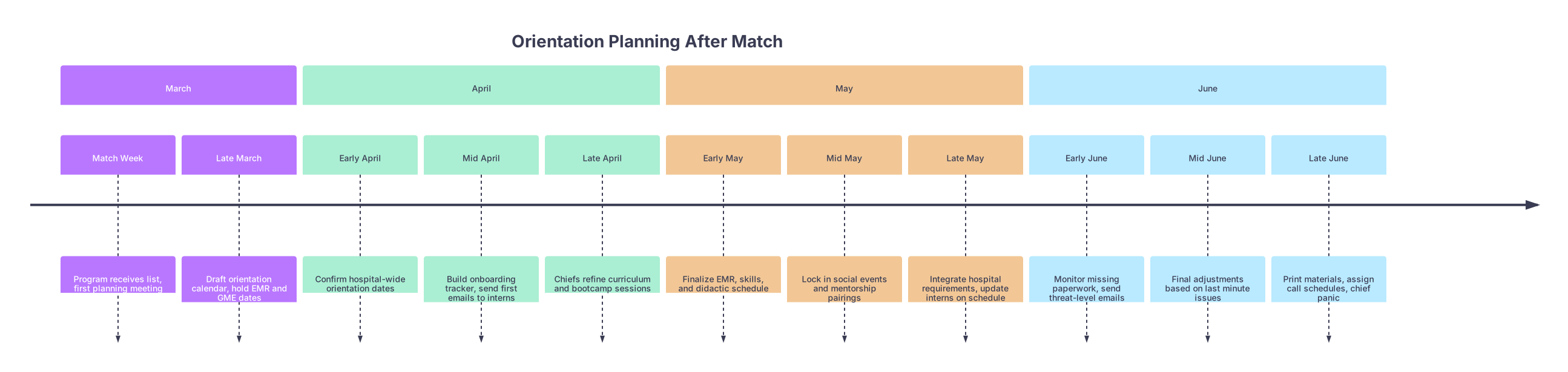
| Period | Event |
|---|---|
| March - Match Week | Program receives list, first planning meeting |
| March - Late March | Draft orientation calendar, hold EMR and GME dates |
| April - Early April | Confirm hospital-wide orientation dates |
| April - Mid April | Build onboarding tracker, send first emails to interns |
| April - Late April | Chiefs refine curriculum and bootcamp sessions |
| May - Early May | Finalize EMR, skills, and didactic schedule |
| May - Mid May | Lock in social events and mentorship pairings |
| May - Late May | Integrate hospital requirements, update interns on schedule |
| June - Early June | Monitor missing paperwork, send threat-level emails |
| June - Mid June | Final adjustments based on last minute issues |
| June - Late June | Print materials, assign call schedules, chief panic |
While you’re on vacation trying to forget medicine exists, they’re in endless meetings trying to make sure you do not crash and burn on your first overnight shift.
What You Can’t See But Should Know
You will never be invited to that first “intern planning” meeting. You won’t read the emails where they debate that extra half-day of EMR vs one more round of “how to write an admit note.”
But their mindset in those months affects your daily reality.
A few truths from the inside:
- They remember last July’s failures more than your CV. Orientation is built to prevent last year’s disasters, not your hypothetical ones.
- Chiefs have veto power in subtle ways. If they hated some component last year, they’ll quietly kill it for your class.
- You are “an investment” in the room. There’s real money, reputation, and accreditation tied to you functioning competently. Orientation is not just about being nice; it’s risk management.
- Programs are more scared of you being unsupervised than you realize. That’s why so much time is spent on supervision rules, escalation, calling attendings, etc.
Join a few years later as a chief or faculty, and you’ll see it from the other side. The panic is real.
What This Means For You (Practically)
You’re not at the table where these decisions are made. But you’re absolutely affected by them.
A few insider takeaways:
- When you get those early emails about paperwork, EMR sign-ups, health forms—handle them quickly. Internally, that moves you from “red problem cell” to “green, reliable.” That reputation sticks.
- During orientation, pay more attention to the sessions the chiefs and near-peer residents lead. Those are the ones built directly from last year’s pain points. The EMR person will forget you; the chief remembers the night an intern almost ordered the wrong potassium dose.
- If something in orientation truly doesn’t make sense (safety-wise, logistics-wise), speak up privately to a chief. They’re often looking for feedback to fuel the next year’s change debates.
And no, you are not expected to know all this political machinery. But understanding that there is machinery makes your experience feel a lot less random.
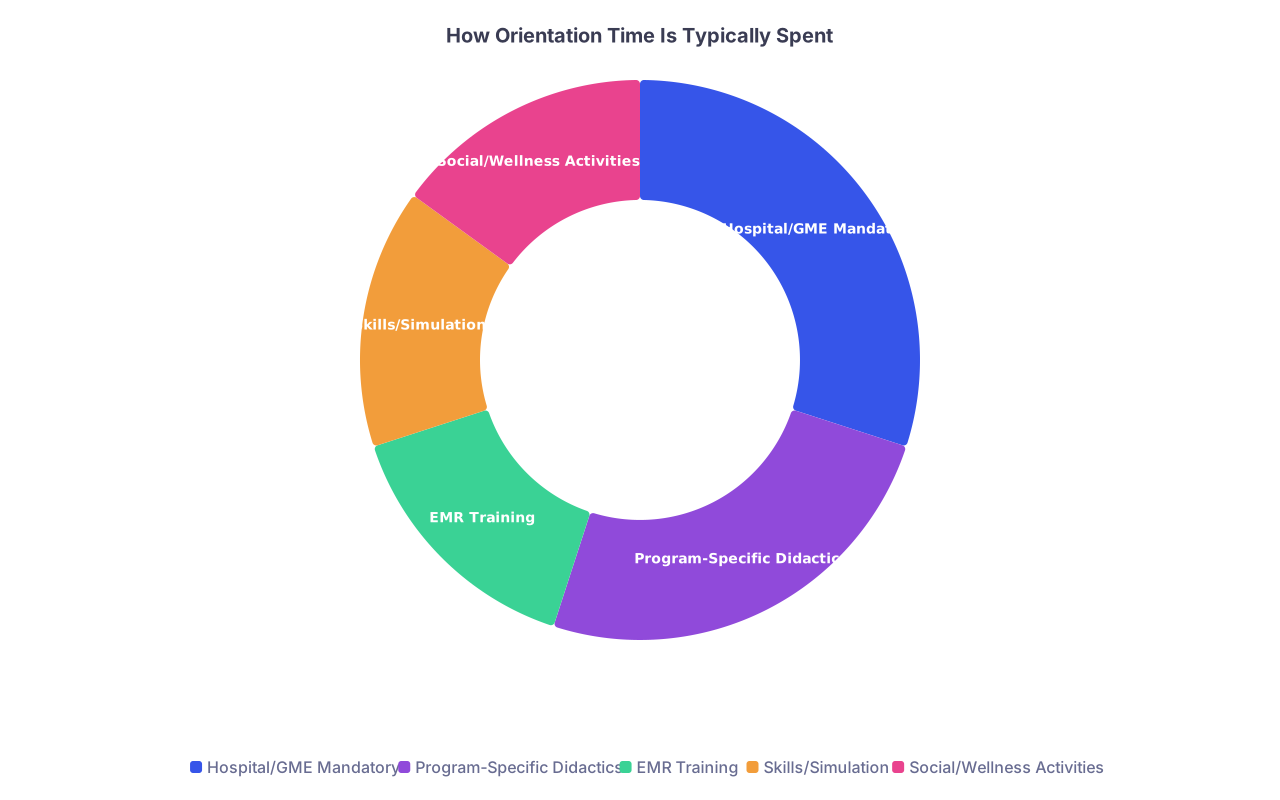
| Category | Value |
|---|---|
| Hospital/GME Mandatory | 30 |
| Program-Specific Didactics | 25 |
| EMR Training | 15 |
| Skills/Simulation | 15 |
| Social/Wellness Activities | 15 |
The rough breakdown above isn’t universal, but it’s close to what I see across internal medicine, surgery, peds, and EM programs. Every percentage point had an argument behind it.
FAQ: What Actually Happens at Orientation Planning After You Match
1. When do programs actually start planning orientation after the Match?
Within days. Most places hold a “post-Match” meeting the same week or the next. Initially it’s high-level: class composition, numbers, big issues. By early April they’re already locking in dates with GME, EMR training, and simulation. By May, the structure is mostly set, and June is spent chasing paperwork and fine-tuning.
2. Do they talk about specific residents when planning orientation, or just the class as a whole?
Both. They absolutely discuss the class profile—schools, test scores, IMG ratios, prior training. If there are flagged issues in a file (long leaves, professionalism concerns, health accommodations), they may quietly build in extra support or make sure an advisor is assigned early. They’re not gossiping for fun, but they are risk-managing.
3. Who actually decides how intense or “soft” the first month will be?
Culturally, this is set by the PD and senior faculty, but chiefs have serious influence. The PD decides philosophy: “We ease them in” vs “hit the ground running.” Chiefs then translate that into concrete schedules: earlier vs later call shifts, more vs fewer supernumerary days, when you independently carry patients. ACGME citations and prior bad outcomes can force everyone to be more conservative.
4. How much control does the program have vs the hospital/GME office?
Less than you think. Hospital/GME controls HR onboarding, benefits, institutional orientation, many online modules, and frequently EMR training dates. The program gets to arrange everything around those anchors. That’s why your July feels chopped up. The program fights for blocks of time, but some sessions are non-negotiable from the hospital’s standpoint.
5. Can incoming interns influence orientation content at all?
Not for your own year—by the time you match, the skeleton is mostly in place. You might tweak small stuff by communicating early needs (visa issues, disability accommodations, pregnancy, etc.), which forces adjustments. Where you do influence it is retroactive: your feedback and complaints in July–August get replayed in those planning meetings for the next class. Orientation is very much built from the scars of the year before.
Years from now, you won’t remember which day you sat through the EMR lockout training or when they handed you your N95. You’ll remember whether, when you walked onto the floor at 2 a.m. that first night, you felt completely abandoned or just appropriately scared.
All those boring, unseen meetings after Match? They’re the reason that moment goes one way or the other.