
The silence after Match Day is a lie. Your med school and your new program are talking about you more than you think.
Let me pull back the curtain on the backchannel that nobody explains to students, but every program director, dean, and coordinator lives in all year.
The Myth: “Once You Match, It’s Done”
You’ve been told the story: NRMP is a black box, rank lists lock, the algorithm runs, and Match Day is the end of the road. You matched → it’s a contract → see you July 1st.
That’s the public story.
Behind the scenes, the second that email drops, a parallel system starts humming:
- Schools and programs quietly comparing notes.
- Program directors asking, “Is this one going to show up? Can they actually function?”
- Deans trying to protect their students and their match statistics at the same time.
And none of that is in a handbook.
The rules forbid certain things: no post-interview communication that influences rank lists, no collusion to alter the match. But after the match? There’s a huge gray zone. And everyone uses it.
Let me walk you through what actually happens, in phases.
Phase 1: The Immediate Aftermath – Who Matched Where?
The morning Match results are released to programs, an unofficial game begins: figure out what we just got.
Here’s what goes on that you never see:
Programs receive their full match lists before you’re popping confetti. The PD and coordinator are in an office, coffee in hand, highlighter in the other. They go line by line.
- “Who’s this from School X?”
- “Oh good, we got that AOA from School Y.”
- “Wait, this one failed Step 1 once, right? Did they ever pass Step 2?”
If they do not already know you well from interviews, this is where the backchannel starts.
The Quick Recon Calls
Within 24–72 hours after Match Day, there are emails and calls between:
- Program directors
- Student affairs deans
- Clerkship directors who know you well
- Sometimes even advisors who have informal relationships with PDs
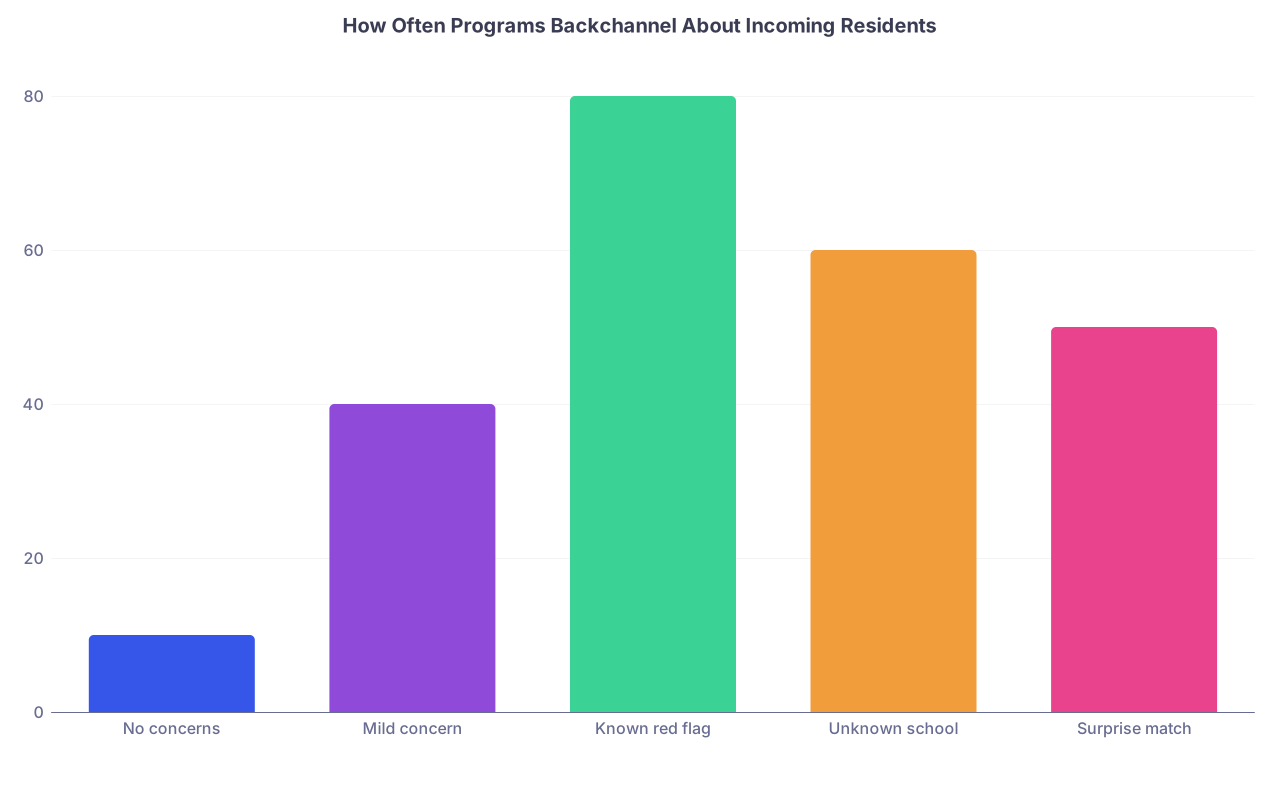
Not every resident. Not every time. But for certain categories:
- Anyone with red flags (failures, professionalism events, leaves of absence)
- Anyone who matched “above” what their application normally would earn
- Anyone from a med school that the program hasn’t had much experience with
- The “surprise match” – either surprisingly high or surprisingly low
That’s where the conversations get interesting.
| Category | Value |
|---|---|
| No concerns | 10 |
| Mild concern | 40 |
| Known red flag | 80 |
| Unknown school | 60 |
| Surprise match | 50 |
Those numbers aren’t from a published paper. That’s from what PDs will tell you in a candid closed-door meeting: they almost always backchannel on any significant concern.
What They Actually Ask Your Med School
Let me be blunt: no one is calling to ask if you are “nice.” They’re trying to answer one question:
Will this person be safe and reliable on my service on July 1?
The specific questions I’ve heard on both sides of the phone:
- “Did they have any professionalism concerns that didn’t make it into the MSPE?”
- “Can they handle a heavy workload, or do we need to watch them more closely at the beginning?”
- “How much support did they need clinically? Independent or hand-held?”
- “Any concern they won’t pass Step 3 on the first try?”
- “Are they likely to complete the program, or are you worried about burnout/dropout?”
Your dean’s office already has mental “profiles” of every student. They don’t usually trash you; that’s not how this works. But they do calibrate expectations. You’ll hear phrases on those calls like:
- “Great with patients, may need structure on time management.”
- “Very bright but sometimes slow with documentation; benefits from clear feedback.”
- “Had an early professionalism hiccup, but really responded well and no issues since.”
That’s code. Everyone on the call speaks fluent code.
Your school is trying to protect you while still being honest enough that their reputation doesn’t suffer. Because if they oversell you and you crash and burn, that program will trust that med school less next cycle.
What Your Program Tells Your Med School
This part almost nobody talks about.
Med schools care deeply about their match stats and their “placement” track record. They want to know:
Did our students perform like we said they would?
PDs, especially at places that take multiple residents from the same school over the years, give quiet feedback. Not in official emails. Usually in side conversations at conferences, text messages, or “hey, quick question” calls.
I’ve heard PDs say things like:
- “Your grads are always clinically solid, but their notes are weak. You all de-emphasizing written work?”
- “We’ve had three residents from your school and all of them struggled with workload at first. Is this a cultural thing?”
- “Your top students are phenomenal; the mid-tier seem to be overscored in the MSPE.”
Where does that go? Right back into how deans counsel future students:
- Which programs are “friendly” to your school
- What those programs “care about”
- How realistic certain students’ aspirations are
This is why some schools suddenly “discourage” students from applying to certain programs after a couple of bad matches. You’ll never get the full story, but I can tell you: it often comes from this backchannel feedback loop.
The Unwritten Red Flag Channels
Now we get to the part people really want to know: what if you had a serious issue in med school?
Here’s the ugly truth: severe red flags do not die with Match Day. They echo.
We’re talking about:
- Repeated exam failures, multiple board failures
- Major professionalism events: cheating, harassment, boundary violations
- Extended LOAs for concerning reasons (especially unaddressed)
- Behavior labeled as “toxic,” “disruptive,” or “unsafe”
If you match despite that, PDs in multiple fields will quietly ping each other:
“Hey, did you interview this student?”
“What did you hear?”
“Were there concerns on your end?”
They’re not breaking NRMP rules at this point. You’ve already matched. They’re assessing risk and planning supervision.
And yes, sometimes they’re asking: did we miss something big?
Your med school is in a bind here. If they underplay a major professionalism issue and you repeat it as an intern, they’re complicit. So the language gets very careful:
- “There was a professionalism concern that was addressed with remediation; we had no further issues after that.”
- “We would recommend close early supervision and frequent feedback; they respond well to structure.”
Is that fair? Not always. But it’s real.
How This Affects You on Day One (Whether You Know It or Not)
People imagine all of this as abstract admin noise. It’s not. It bleeds straight into your first weeks of residency.
You might notice:
- Certain interns get paired with the strongest seniors or most patient attendings
- One intern has their notes reviewed more closely
- Someone gets a slightly lighter first rotation “to ease in”
- A PD mentions, “We’ll do a quick check-in after your first call shifts”
Sometimes that’s random. But often it’s informed by the backchannel.
Your PD may have a mental list of “watch a bit closer early” interns based on:
- Backchannel calls with your dean
- Your MSPE between-the-lines language
- Whisper reputation from a clerkship director they know
Does it mean you’re doomed if you’re on that list? No. I’ve watched plenty of “high concern” interns become rockstars by mid-PGY2. But pretending that list doesn’t exist is naive.
The “Star” Backchannel – Yes, It Works in Your Favor Too
This isn’t just about damage control.
If you were a standout student, your name travels too. Some examples I’ve seen:
- A PD telling a dean: “Your grad X is one of the best interns we’ve ever had. If you have more like them, send them our way.”
- A clerkship director emailing a PD before Match: “If you end up with Y, you just won the lottery.” After Match, that PD will absolutely call back and say, “You were right.”
Why does this matter?
Because when your school sees its “stars” thriving in certain programs, it shapes:
- Where they push future strong applicants to consider
- The “pipeline” they quietly build to those institutions
- How aggressively they advocate for future students with that PD
And for you personally, a strong early performance validated by your dean’s prior praise can land you early opportunities: chief resident consideration, letters for fellowships, early research projects. People like being proven right about their “good feeling” on a trainee.
The Legal and Ethical Line: What They Can’t Say (But Sometimes Hint At)
There are legal boundaries and institutional policies that limit how directly a school or program can trash you. Nobody wants to be sued for defamation.
That’s why the language gets so coded.
Things they usually avoid explicitly saying:
- “This person is dangerous.”
- “You should not have ranked them.”
- “We don’t trust them.”
Instead, PDs and deans lean on euphemisms:
- “They’ll require more support than the average intern.”
- “We had concerns at one point, but I can’t share all the details; just keep a close eye initially.”
- “They did better in structured environments than high-autonomy ones.”
Everyone in those conversations knows exactly what’s being communicated. But there’s plausible deniability if somebody ever reads that email in discovery.
Do some places cross the line and speak more bluntly in private? Yes. Usually on the phone, never in writing. There’s a reason so many of these conversations start with “Do you have a minute to chat, not over email?”
How Different Types of Schools Play This Game
Not every med school works the backchannel the same way. And programs know it.
| School Type | Typical Style | Program Trust Level |
|---|---|---|
| Top-tier research | Polished, protective | High, but cautious |
| Solid state MD | Fairly candid | Generally trusted |
| Newer MD/DO | Very eager, optimistic | Variable |
| Schools with issues | Defensive or vague | Low over time |
I’ve seen it play out like this:
- Well-established state schools often give the most balanced, honest assessments. Programs love them for that.
- Highly brand-conscious top-tier schools sometimes over-buff their students; after a couple of “oversold” residents, PDs adjust downward.
- Newer or lesser-known schools overcompensate by being almost too positive about everyone, which ironically hurts them when residents underperform.
Where does that leave you as a student? You’re partially riding your school’s historical reputation—fair or not.
The Few Times Things Blow Up After Match
You want the real nightmare scenarios? Here they are, and they involve heavy backchannel traffic:
Student fails Step 2 late, after matching, and can’t start on time.
- PD calls dean: “Did you see this coming?”
- Other PDs hear about it at meetings: “We had to scramble to fill a vacancy because of a grad from X.”
- That school’s next crop of borderline test-takers gets more scrutiny.
Serious professionalism issue emerges between Match Day and graduation.
- School has to decide: do we report this to the program? (Yes, if it’s serious. They’re legally and ethically trapped.)
- PD may reconsider whether this person can safely start, or put them on probation from day one.
- That case becomes a story that lives in memory when future apps from that school arrive.
Resident crashes and burns early in PGY1, gets put on remediation or asked to leave.
- There will 100% be detailed back-and-forth between the program and the school: what did we miss, what did you know, how do we handle this.
- That school’s MSPE practices will be quietly questioned.
None of this is theoretical. I’ve watched it unfold, and you can literally see the ripple effects in how PDs talk about that school for years.
What You Can (And Should) Do About All This
You can’t control the dean’s phone calls. But you’re not powerless.
Here’s what actually matters for you:
Your reputation with student affairs is not optional.
The people writing your MSPE and answering those quiet PD calls remember who was respectful, who disappeared, who made their lives harder. They’re human.If you have a past issue, address it head-on before Match.
I’ve heard deans say, “They took full responsibility and really grew from it,” and I’ve heard, “They still externalize blame.” Guess which one gets a softer backchannel description.Once you match, act like your PD already has a partial story—and you’re filling in the rest.
You don’t need to obsess about the backchannel. But assume there’s some expectation—good or bad—and your behavior in the first 3–6 months either confirms or rewrites that narrative.Do not assume silence means no one is talking.
Just because no one mentions your issues to your face doesn’t mean they aren’t aware. The wiser move is to over-deliver on professionalism, punctuality, and reliability early. Make it boringly obvious that you’re solid.

| Step | Description |
|---|---|
| Step 1 | Student Performance in Med School |
| Step 2 | Dean and Clerkship Opinions |
| Step 3 | MSPE and Informal Notes |
| Step 4 | Program Rank List |
| Step 5 | Match Day |
| Step 6 | Backchannel Calls |
| Step 7 | Early Residency Supervision Level |
| Step 8 | Resident Performance PGY1 |
| Step 9 | PD Feedback to School |
That loop exists whether you acknowledge it or not.
What Almost No One Will Tell You Explicitly
Let me give you the three brutally honest truths that PDs and deans talk about among themselves:
Your school’s reputation follows you into every new system you enter.
It shapes how much initial benefit of the doubt you get. Not fair. Very real.A single loud failure from your school can hurt dozens of future students.
When a resident completely implodes, that school’s next applicants often get “we’ll see” treatment for years.The backchannel is strongest at the top and at the extremes.
Huge superstars and major problems get talked about the most. If you’re somewhere in the middle and reasonably professional, you won’t be the center of any secret conspiracy. You’ll just be… a normal intern. Which is exactly what you want.