
The way your program decides your early rotations and call schedule after the Match is not random, not “fair,” and definitely not based only on “educational goals.” It’s a controlled chaos designed around service needs first, everything else second.
Let me walk you through what actually happens in the back room before you ever see your name on a July block.
The Real Timeline: When They Start Deciding Your Life
You think schedules get made after Match Day. That’s cute.
Serious programs start building skeleton schedules in January or February. Before they even know your name.
They already know:
- How many PGY-1s (or categorical vs prelim) they requested
- How many ICU, wards, ED, night float, subspecialty, elective, and ambulatory blocks they must fill
- Exactly how many warm bodies they need on each team every day of the year
Match results just tell them which human faces they’re going to plug into a grid they mostly built months ago.
Here’s the usual sequence:
Winter (Jan–Feb): Chiefs and coordinators build the annual “coverage matrix.” No names. Just numbers: “3 interns on Wards A, 2 on Wards B, 1 in ICU, 1 ED, etc.”
Late Winter (Feb–early Mar): They finalize rotation counts by PGY level. Stuff like: each intern must do 4 wards blocks, 2 ICU, 1 ED, etc. They juggle ACGME rules, clinic requirements, and vacation blocks.
Match Week: As soon as the Match list drops, your program coordinator prints the names, pours coffee, and the plugging-in begins.
Late March–April: They run multiple drafts. Chiefs fight over who goes where, which new grad they want on their favorite service, and which block gets the weaker folks early vs later.
April–May: Call schedules (for at least the first 1–3 months) get built on top of the block schedules. Night float vs traditional call gets superimposed here.
By the time you’re proudly wearing your med school hoodie on Match Day, half your PGY-1 year is already decided in a spreadsheet you will never see.
Who Actually Decides Your Early Rotations
You probably imagine some faceless “committee.” No. It’s usually three people and one overworked admin who actually run your life.
Most programs use a combo of:
Program Coordinator: The real engine. Knows every vacation rule, ACGME detail, which attending hates interns in July, which clinic days can’t move. They keep the master schedule and point out when the chiefs are breaking rules.
Chief Residents: They do most of the heavy lifting. They assign names to blocks, juggle fairness (or something like it), and do 90% of the call distribution.
Program Director (PD): Steps in for strategic moves: which intern gets oncology early, who gets ICU first, where the “risky” resident should not be in July.
Associate PD / Service Directors (sometimes): Chime in if they want specific interns at certain times (research-track folks on specific electives, or “strong residents” on notorious services at the worst times).
Yes, your schedule is hand-built. With politics. And opinions. Not generated by some neutral algorithm.
The Hidden Inputs They Use (That No One Tells You About)
Here’s where the insider stuff starts to matter. Because residents love to think, “They don’t know us yet, so it must be random.”
No. They already think they know you.
They’re using any data they can get:
- Interview Impressions
Those little notes in Thalamus or ERAS rating sheets? They come back.
Phrases like:
- “Very solid clinically, mature, will be fine”
- “Needs more supervision”
- “Strong in critical care interest”
- “Quiet but thoughtful, might be slower early on”
That shapes where you land in July/August.
- Letters of Recommendation
Strong ICU/ED letters? Do not be surprised if you’re one of the first interns to hit those rotations. “Showcase them early.” That’s the line.
A letter saying, “Needs some structure, improved a lot over the year”? That person is not starting solo nights in July. They’ll be insulated a bit early on.
Career Interest (stated on interview or rank day)
Told everyone you love cards? If the cards attending has influence, you may find your early year oddly rich in wards/tele/CCU blocks. Programs like to show their people off early to the subspecialty they want to feed.Where You Trained
Yes, it matters.
- Big academic U.S. MD: they assume you’ve seen high volume and sick patients. You might tolerate an early ICU or heavier call.
- Small community or international school: they may delay ICU or nights to later in the year—or they may throw you in and just pad the schedule around you. Depends on culture.
- Whispers from People They Know
This is the part nobody talks about openly. PDs and attendings call each other.
“Hey, you know this student from your med school?”
“Yeah. Solid. Quiet but dependable.”
Or: “Really bright, but easily overwhelmed.”
That information doesn’t vanish. Someone in scheduling remembers it.
The Real Priorities: Service vs Education vs “Fairness”
Let me be blunt: the “educational goals” language in orientation is mostly branding. The true hierarchy in most programs looks like this:
- Service Needs
Beds must be staffed. ICU must be covered. Night float cannot be empty. Someone has to admit the 2 a.m. train wreck.
The matrix is built to ensure this above everything else.
- Regulatory Compliance
ACGME limits: duty hours, days off, clinic sessions, required rotations. This is the second immovable pillar.
If there’s a conflict between ideal education and ACGME rules, rules win every time.
Recruitment/Showcase Strategy
Strong residents on showpiece rotations when applicants visit. Good people on services run by powerful attendings. It’s strategic.“Fairness” / Resident Morale
This comes in last. Not because the leadership doesn’t care. But because the top three are constraints; fairness is a luxury they try to impose on top of a rigid structure.
You feel that on your schedule. Especially in the first six months.
How They Decide Your First Three Months
Those first blocks matter more than you think—politically, educationally, and emotionally. Chiefs know this. PDs know this.
They’re trying to answer three questions:
- Who can handle a heavy July service?
- Who needs a softer landing?
- What impression do we want each new intern to make?
Patterns I’ve seen in multiple programs:
1. The “Anchor Interns” in July
Every program has 2–4 people they think of as “anchors” before Day 1.
How do you become one?
High Step 2 / COMLEX, strong clinical letters, confident interview, maybe prior clinical work. They trust you—rightly or wrongly.
Those people often get:
- Early wards
- Early ED
- Early subspecialty consults that require independence
Not as a punishment. As a vote of confidence. These are the folks attendings “remember” by name when October comes around for fellowship letters.
2. The “Soft-Landing” Interns
If they sensed:
- Less clinical exposure
- Slightly weaker letters
- More anxiety or insecurity on interview
- Significant life transitions (new baby, major move with partner struggles, etc.)
They’ll try to give you something like:
- Ambulatory/clinic
- Elective (if the program allows it early)
- Lighter ward services with more senior support
Not every program is gentle. But many try. Not out of kindness alone, but because sink-or-swim disasters look bad to the PD and burn out faculty too.
3. Balance Across a Class
They don’t stack “strongest” vs “weakest” all on one block. They think in terms of teams.
You’ll hear things like:
- “We can’t put all the strong interns in July ICU, then have a weak August team.”
- “We need at least one high-functioning intern on each call team early.”
Your early rotation may be less about you personally and more about who else is in your class and how they spread you out.
The Politics Behind Early ICU, Nights, and ED
People obsess over who gets ICU or nights first. Here’s what usually drives those decisions:
Early ICU
Why some get it:
- They look strong; PD wants to test them and impress the ICU attendings.
- They said they’re interested in critical care, pulm, anesthesia, EM, etc.
- They trained at a place with heavy ICU exposure as students.
Why some avoid it:
- Concerns about being overwhelmed too early.
- Didn’t rotate in big ICUs as a student.
- PD fears a safety issue. They won’t say that out loud.
Early ED / Nights
Two things drive this:
- Staffing patterns: ED and night float need bodies every month. Somebody has to go early.
- Perceived resilience: Not just “smart.” Who seems emotionally sturdy, flexible, and not prone to meltdown with circadian chaos?
The quiet, meticulous, slower intern often gets days and structured services first. The adaptable, talkative, “I can handle anything” intern? They get nights sooner than later.
How Call Schedules Get Built On Top of Rotations
Let me pull back the curtain on how call schedules actually get made. Because residents imagine this mystical fairness algorithm. Reality is a lot messier.
Step by step, behind the scenes:
Block Schedule First
They assign each resident to Wards A, Wards B, ICU, ED, clinic, electives, etc. for each block (usually 2–4 week chunks).Call Ownership by Service
Each service has a fixed call expectation:
- Wards team: X long-call days or nights per block
- ICU: maybe no additional call, but Q4 overnights built in
- Night float: all nights, no additional
- Chief’s Call Grid
Chiefs open a blank monthly grid: days across, interns/seniors down. They start plugging in:
- First: immovable nights (night float)
- Second: weekend coverage and long calls
- Third: weekdays
- Constraints Applied
They check:
- Everyone gets required days off (4 in 4 weeks minimum)
- No one exceeds hour rules
- People on lighter rotations (clinic/elective) shoulder more call
- People on heavy services (ICU, night float) get minimal extra call
- Then the Reality: Chief Bias & Memory
This is where the human factor kicks in hard.
If a chief:
- Liked you on interview
- Has heard good things about your work ethic
- Remembers your face and story
You’ll feel their hand on your schedule in subtle ways. Less brutal call pairings. Slightly better weekends. More balanced distribution.
If you were forgettable or rubbed someone wrong:
- You won’t be “punished” outright (most places are not that petty)
- But you’ll get fewer exceptions, less creative problem-solving on your behalf
- When they need to plug holes, your name “fits” the void more often
They won’t write this in any handbook. But I’ve seen it in meeting after meeting.
Vacation: Why Your “Requests” Sometimes Don’t Matter
Residents love to agonize over vacation requests. Reality: your vacation is slotted around service needs, not your cousin’s wedding.
Typical process:
- Programs block out forbidden times: ICU, nights, often ED or key ward months.
- Residents submit requests: top 2–3 preferred months or specific weeks.
- Coordinator overlays those on the skeleton schedule.
Who wins conflicts?
- Intern classes sometimes use seniority (couples, people with kids, big life events). But ultimately the chiefs break ties.
- If you’re going into a competitive fellowship and the PD wants you on a certain service when the big-name attending is on, your “ideal vacation month” might get steamrolled.
They might tell you: “Sorry, we couldn’t accommodate that due to service needs.”
Translation: that month needed your body more than your happiness.
Sample: How Three Different Interns Get Different Starts
Here’s a simplified version of how three interns might be handled very differently based on behind-the-scenes judgments.
| Intern | July Block | August Block | Early Call Exposure |
|---|---|---|---|
| A - Strong, ICU interest | Wards (busy service) | MICU | Early nights, weekend long calls |
| B - Solid, lower confidence | Ambulatory/Clinic | Wards (moderate) | Gradual, fewer early overnights |
| C - Great on interview, unknown clinically | Wards (lighter) | ED | Mixed; some early nights but supervised |
Intern A gets thrown onto a high-volume ward and then the ICU. Not as punishment. As a way to showcase and test them.
Intern B gets ramped up. They’ll probably feel the schedule is “nice.” It was intentional.
Intern C is a wildcard. They’ll get one heavy and one moderate service, early, so the PD can see what they really are.
The Quiet Data They Collect On You From Day One
Your early schedule isn’t one-and-done. Those first months are an audition tape for what the rest of your residency will look like.
Chiefs and faculty pay attention to:
- How fast you pick up notes and workflows
- Whether you hit duty hours or routinely go over
- Your attitude on bad calls
- How much seniors trust you on admissions
- How many times you need to be bailed out clinically
This flows into mid-year scheduling. Yes—your second half of PGY-1, and definitely PGY-2, are shaped by these impressions.
Someone who:
- Handles early ICU smoothly → more responsibility, maybe earlier senior roles, more critical care-heavy rotations.
- Struggles early on → shifted away from high-risk blocks, more supervised settings, fewer “hero” assignments.
No one will sit you down and say:
“We changed your schedule because we’re worried.”
They just move you. Quietly.
How Different Specialties Handle This
Not every field plays the game the same way. Let’s be honest about a few.
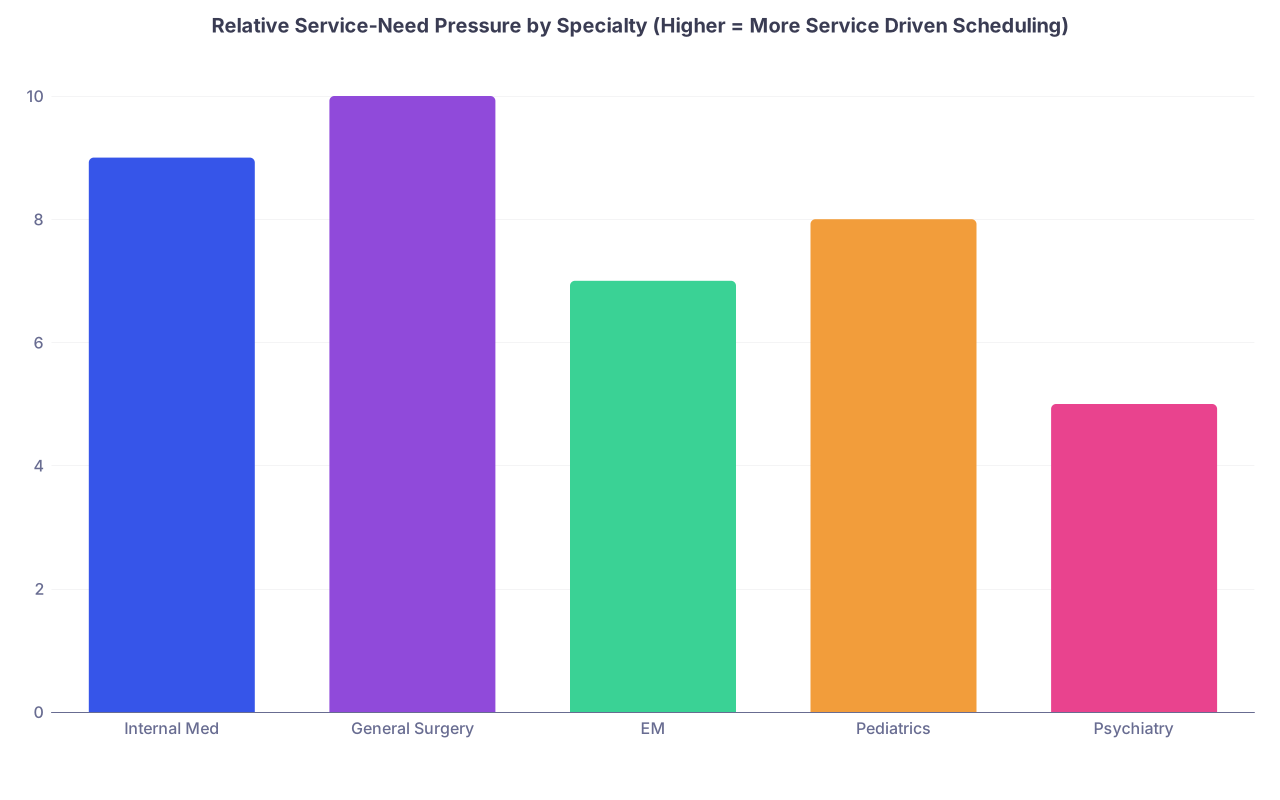
| Category | Value |
|---|---|
| Internal Med | 9 |
| General Surgery | 10 |
| EM | 7 |
| Pediatrics | 8 |
| Psychiatry | 5 |
Internal Medicine: Wards + ICU drive everything. The matrix is complex. Fairness is attempted, but service wins often. Night float distribution is a blood sport.
General Surgery: Block schedules are more rigid. You might be “the transplant intern” or “the trauma intern” for a long stretch. Call follows the service. New interns sometimes get hammered early because the service just always runs hot.
Emergency Medicine: Shifts instead of “call,” but same politics. Who gets the prime day shifts? Who lives on nights? Chiefs and schedulers absolutely care about who performs in early blocks.
Pediatrics: Slightly more protective early on, especially in NICU/PICU. But wards schedules are still driven by census and coverage.
Psychiatry: Often the most humane schedules early on. But call for consults and nights still has to be covered, and stronger residents can end up shouldering heavier early responsibilities.
What You Can Actually Control (Before and After the Match)
You cannot control 80% of this. But that last 20% is significant.
Before Match
How you present on interview.
Programs remember confidence, reliability, and self-awareness. If you come across as “steady,” you’re likely to be trusted with important early blocks.What your letters say.
You asked for “strong letters,” but did you pick people who can vouch for your work ethic under pressure? That matters when chiefs are deciding who can survive early ICU.How you talk about career interests.
If you say, “I really want ICU experience early,” don’t act surprised when they give it to you in July or August.
After Match, Before July
You usually get a chance—sometimes small, sometimes real—to give input.
Some programs send a survey:
- Rank preferences: start with wards vs ambulatory?
- Any major life events?
- Strong preferences to avoid something early?
They will not turn the world upside down for you. But they might:
- Avoid putting you on the heaviest ward in July if you say you’re extremely anxious about clinical ramp-up.
- Try to align an early elective with a major family event.
- Not schedule you on the night of your wedding anniversary if there’s an easy swap.
Polite, clear communication with the coordinator and chiefs helps. Over-demanding, self-centered emails do not.
The Emotional Side: Why the Schedule Feels Personal (But Usually Isn’t)
You’ll open your schedule and feel something: relief, rage, fear, envy. Everyone does.
What you need to remember is this:
- It feels targeted, but most of the time, it isn’t. You’re a piece in a machine that has hundreds of constraints.
- The small parts that are tailored to you usually reflect either confidence in you or concern for your safety, not malice.
- Chiefs are dealing with impossible math: 20+ residents, dozens of services, vacations, ACGME rules, attendings’ quirks, and recruitment optics.
Does bias creep in? Of course.
But the #1 driver is still the simple, brutal fact that the hospital must not fall apart at 3 a.m.
How to Read Your Early Schedule Like an Insider
When you get your PGY-1 schedule, don’t just react emotionally. Read it like leadership does.
Ask yourself:
- Did they give me early heavy blocks? They trust you. You’re on their “anchor” list.
- Did they give you a soft on-ramp, with heavier stuff later? They think you’ll grow into it, or they’re protecting you early on.
- Are you clustered on specific high-profile services? Someone wants you in front of certain attendings.
And if it looks unfair on the surface, zoom out:
- Count total ICU/ wards/ nights across the year, not just July–September.
- Compare casually with co-interns (without turning it into a bitterness-fest).
You’ll often find it’s more balanced over 12 months than it feels in any one block.
The Part That Matters Long-Term
Five years from now, you won’t remember which random Thursday you were on call during July of intern year. You will remember how you handled that first brutal block, how quickly you earned trust, and whether you became the resident chiefs fight to have on their service—not the one they quietly protect from the fire.
Your early schedule is not a referendum on your worth, but it is an opportunity. Programs are watching. Not just who survives, but who steps up.
And the truth is, long after the spreadsheets are deleted, what sticks in people’s minds is not the exact call pattern you got. It’s the story they tell about you when the next schedule is built.