

The biggest myth about SOAP is that “unranked” means “you were a backup nobody wanted.” That’s wrong. And if you just matched through SOAP to a program you never ranked, you need a clear explanation, not sugarcoating.
Here’s what actually happened and what it really means for your career.
1. What “Unranked Program” and SOAP Really Mean
First thing: you didn’t get scammed by the algorithm. The algorithm didn’t suddenly decide to ignore your rank list.
If you matched to a program you didn’t rank, it almost certainly means one of two things:
- You didn’t match in the main NRMP Match on Monday.
- You secured a spot through SOAP (Supplemental Offer and Acceptance Program) between Monday–Thursday of Match Week.
SOAP is not the same as the regular Match. The standard Match uses rank lists. SOAP uses applications + offers, not rank lists.
So when you say “unranked program,” what you really mean is:
- This program was not on your original rank list.
- You applied to it during SOAP.
- They offered you a position.
- You accepted.
The algorithm did exactly what it was supposed to do in the main Match: it tried to match you to the highest program on your list that ranked you. When that didn’t happen, you moved into SOAP. New game. New rules.
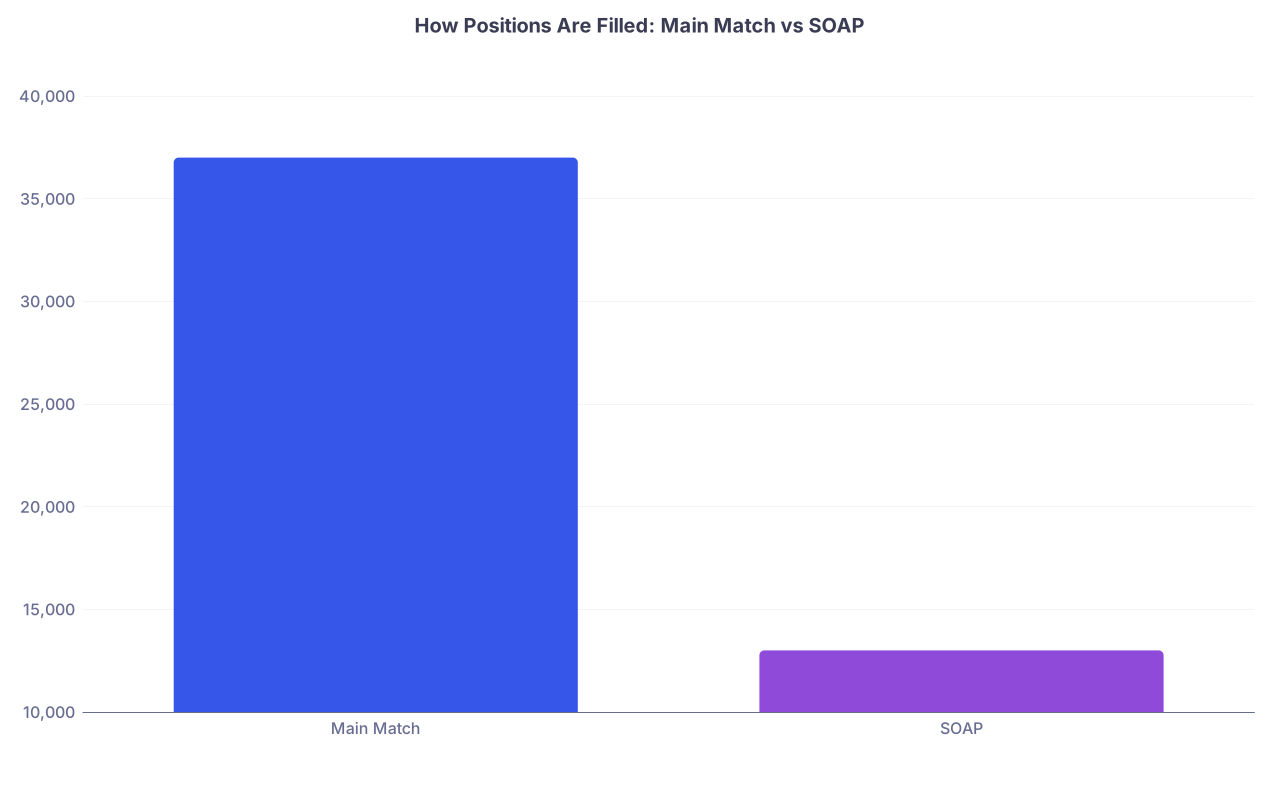
| Category | Value |
|---|---|
| Main Match | 37000 |
| SOAP | 13000 |
(Example scale only, but the point stands: most spots fill in the main Match. SOAP is the second-chance system.)
2. What SOAP Actually Is (And Isn’t)
SOAP feels chaotic when you’re living it. I’ve seen people refreshing their email like it’s a vitals monitor.
Here’s the stripped-down version of SOAP:
- Monday: You learn you’re unmatched or partially matched.
- You get access to a list of unfilled programs.
- You can apply to a limited number (currently 45 max).
- Programs review applications and send offers in rounds (Tuesday–Thursday).
- You either:
- Accept an offer (and you’re done), or
- Decline and wait for the next round.
No rank list. No long-term negotiation. Just: here’s an offer, accept or don’t.
So by definition, any program you get through SOAP is one you didn’t include on your original list, because SOAP programs are, by nature, those that were unfilled after the main Match.
Calling it “unranked” is emotionally accurate. Technically, it’s “not included in your pre-SOAP ROL.”
3. Does Matching Through SOAP Hurt Your Career?
Let me be blunt: for the vast majority of people, matching via SOAP does not destroy your career.
Program directors, future employers, fellowship committees — they don’t see a giant red banner in ERAS that says “SOAP MATCH.” What they see is:
- Where you trained
- What you did during residency
- Your letters
- Your performance
- Your Step scores (for now), research, evaluations, etc.
There are three main realities you’re dealing with:
Stigma (emotional, not structural)
You feel “less than.” You think everyone knows. They don’t. Your classmates are way more focused on their own result than yours. Most people forget by PGY-2 who matched where or how.Program reputation
Some (not all) SOAP programs are:- Less academic
- Less research-focused
- In less desirable locations
- With more service-heavy workloads
That may affect later competitiveness for ultra-competitive fellowships. But it doesn’t disqualify you, it just changes how hard you’ll need to fight.
Internal story you tell yourself
This is the one that actually derails people. The “I only got in through SOAP so I’m not good enough” narrative. I’ve watched residents with SOAP matches absolutely crush their training and outcompete “prestige” grads for jobs and fellowships — because they didn’t let that story dictate their effort.
If you do the following well — show up, learn, get strong letters, take ownership — your SOAP status becomes background noise.
4. How to Evaluate the Program You Just SOAP-Matched Into
You accepted the offer under pressure. Now you’re wondering if you made a mistake. Let’s walk through how to evaluate it practically.
Ask these questions:
Accreditation and stability
Is it ACGME-accredited? Any recent citations or probation? Check ACGME publicly available data and ask current residents directly:- “Have there been any major issues with accreditation or leadership turnover?”
Board pass rates
What are the last 3–5 years of board pass rates? Are they stable, or ugly? Programs with consistent failures are a red flag.Case volume and patient exposure
Are residents actually seeing enough bread-and-butter cases? Or are they glorified scribes? Ask residents:- “Do you feel clinically prepared?”
- “Do seniors leave feeling confident to practice or apply to fellowship?”
Fellowship and job placement
Where do graduates go? Community jobs only? Mix of academic and community? Any fellowships? You don’t need a list of Harvard-only, but you do want evidence that people land where they want.Resident culture
This matters more than you think. Are residents:- Burned out and bitter?
- Quietly supportive but tired (normal)?
- Collegial and proud of their training?
If no one would recommend the program to a friend, that’s a giant warning sign.
Here’s a quick side-by-side view of what to care about:
| Factor | What You Want to See |
|---|---|
| ACGME Status | Full accreditation, no probation |
| Board Pass Rates | Stable, >90% over recent years |
| Case Volume | Adequate, residents feel prepared |
| Graduate Outcomes | Solid jobs, some fellowships |
| Resident Culture | Supportive, not toxic |
If your new program looks acceptable or decent on most of these metrics, you’re not in a bad spot. You’re just not where you fantasized you’d be back in M2.
5. Should You Try Again Next Year Instead?
This is the question people whisper about: “Should I decline SOAP or leave after PGY-1 and reapply?”
Let me be direct: reapplying after SOAP is usually a worse bet than you think.
Here’s what you’re up against if you try to reapply:
- You’ll be labeled as:
- A reapplicant
- Possibly someone who left a contract early
- A “flight risk”
- You’ll need:
- Very strong justification for leaving
- Strong letters from your current program (which you may not get if you bail early)
- And you’ll re-enter an even more competitive cycle, likely with:
- The same or similar scores
- The same transcript
- Now with a question mark about reliability
There are rare exceptions where I’d seriously consider reapplying:
- The program is:
- In serious accreditation trouble
- Historically unsafe or truly malignant
- Closing or losing spots
- You are:
- In a specialty you absolutely cannot see yourself practicing
- Willing to accept a year or more of career delay and real risk of not matching at all
For most people, the smarter path is:
- Commit to the program.
- Become a top resident there.
- Use that strong performance to:
- Get a good job, or
- Leverage into a fellowship that opens doors.
6. How SOAP Affects Fellowships and Future Competitiveness
People love to overdramatize this. “You SOAPed, you’re never getting cardiology/derm/ortho.” Not true. Harder? Often yes. Impossible? No.
Here’s how your path changes:
If you’re in a competitive specialty already (e.g., EM, anesthesia, radiology) via SOAP:
- Your main job is to absolutely excel. Top of class, strong letters, possibly research.
- If your program is smaller or less academic, you might need away rotations or connections for certain fellowships.
If you’re in IM, Peds, FM, Psych, etc. and want a competitive fellowship (cards, GI, heme/onc):
You’ll need:- High in-training exam scores
- Strong clinical reputation
- At least some scholarly work (case reports, QI, small projects)
- Strategic networking (attend local/regional meetings, connect with fellowship directors)
Fellowship directors care far more about:
- How strongly your PD advocates for you
- How you performed clinically
- Any extra work you did (research, QI, teaching)
…than whether your residency slot came via SOAP.
7. What You Should Do in the First 3–6 Months
You’ve matched to a program you didn’t rank. That’s the fact. Here’s how you turn it into a decent or even great outcome.
First 3 months:
Show up as if this was your #1 choice.
No sulking. No “I was supposed to be at X” talk. That spreads fast and poisons your reputation.Identify the power people early.
PD, APDs, chiefs, senior residents who are actually listened to. Show them you’re competent and coachable.Ask for expectations and feedback on day one.
Literally: “What does an excellent intern look like here?” Then align your behavior to match that.Crush the basics.
Notes done early. Calls returned quickly. Follow-through on tasks. Be the intern no one has to chase.
Months 3–6:
Clarify your long-term goal.
General practice? Fellowship? Academic? Community? You don’t need a perfect answer, but you need a direction.Find at least one mentor.
Someone in your specialty who:- Answers emails
- Likes teaching
- Has some track record of helping trainees
Get on at least one small project.
Case report, QI, small retrospective. Doesn’t have to be world-changing. It shows initiative and starts your “extra” column.
Here’s a simple mental flow for you:

| Step | Description |
|---|---|
| Step 1 | Matched via SOAP |
| Step 2 | Commit fully for at least PGY1 |
| Step 3 | Talk to PD and advisors |
| Step 4 | Assess risk and alternatives |
| Step 5 | Identify mentor and goals |
| Step 6 | Excel clinically and seek projects |
| Step 7 | Program safe and accredited |
8. How to Talk About SOAP (Now and Later)
You don’t owe everyone your full life story. But you should know how to handle it when it comes up.
Right now, with classmates/family:
- “I matched through SOAP into [Specialty] at [Program]. I’m grateful to have a spot and I’m going to make the most of it.”
That’s it. You don’t need to justify. You don’t need to overshare your rank list.
Later, in interviews (jobs/fellowship) if someone probes:
- “The initial Match didn’t go my way, and I was fortunate to secure a position through SOAP at [Program]. I used that as motivation to fully commit here — I’ve had strong training, great mentors, and I’m proud of what I’ve done with the opportunity.”
Short. Honest. Focused on what you did after, not the drama of Match Week.
9. Reality Check: What This Does and Doesn’t Change
What it does change:
- Your environment: location, resources, maybe prestige
- How strategic you need to be for ultra-competitive next steps
- Your own ego story about “top program or bust”
What it doesn’t change:
- Your ability to learn medicine
- Your capacity to be a great resident
- Your chance to be a solid attending
- Your responsibility to patients
Plenty of incredible physicians came from community and SOAP-filled programs. You just usually meet them later, in the real world, not on med school Reddit threads.
FAQ: SOAP, Unranked Programs, and Your Future
1. Does anyone actually know I matched through SOAP?
Program staff and you, yes. Future employers and fellowship directors, not automatically. Your NRMP result doesn’t stamp you as “SOAP.” What matters downstream are your evaluations, letters, and performance. If you don’t make it a defining identity, it usually isn’t.
2. Should I feel bad that I didn’t match in the main round?
Feel whatever you feel for a day or two. Then move on. Lots of strong applicants don’t match on the first pass — sometimes because of specialty choice, geography limits, or simple bad luck. The key is what you do now at the program where you did land.
3. Is a SOAP program always lower quality than my ranked programs?
Not always. Some legitimately good programs underfill because of geography, new accreditation, or timing (e.g., new program, misaligned interview season). But many SOAP positions are at places with less name recognition or fewer resources. That doesn’t mean poor training — it means you need to assess more carefully.
4. Can I still get a competitive fellowship if I matched through SOAP?
Yes, but you’ll likely need to be more deliberate. Strong clinical performance + high in-training scores + good letters + some scholarly work can absolutely get you into competitive fellowships, even from a lesser-known or SOAP-filled program. It’s been done many, many times.
5. Can I switch specialties after starting a SOAP position?
Sometimes, but it’s tricky. Internal transfers depend on open spots, willingness of another PD to accept you, and your current PD’s support. Leaving after PGY-1 to reapply is risky and should only be done with very clear advising and a realistic plan. Most people are better off committing and building a strong career from where they are.
6. What’s the smartest thing I can do this week after SOAP matching?
Email or meet your new program director or chief and say something like: “I’m grateful for this opportunity and I want to hit the ground running. What are your expectations for new interns, and what can I start doing now to be as prepared as possible?” Then act on what they tell you.
Open the email or PDF with your SOAP match letter right now. Write down three specific questions you want to ask your new PD or a current resident about the program — and send that email today.


