Should You Take the MCAT Before or After Biochemistry? A Clear Answer
What actually happens to your MCAT score if you take the exam before finishing biochemistry?
Here’s the direct answer:
If you can choose, you should almost always take the MCAT after completing a solid, college-level biochemistry course.
Not “while you’re halfway through.”
Not “I watched some YouTube videos.”
After you’ve taken the full course and done reasonably well.
But there are exceptions. And some people do just fine without a formal biochem class. So let’s sort this out like adults instead of vague Reddit anecdotes.
The Core Truth: How Much Biochem Is Really on the MCAT?
Biochemistry is not “just another topic” on the modern MCAT. It’s baked into the exam.
Here’s the rough reality:
- About 25–35% of the Bio/Biochem section is straight-up biochemistry.
- Biochem shows up indirectly in Chem/Phys passages, too.
- Experimental passages often use enzyme kinetics, signaling pathways, protein structure, and metabolism as the context.
If your biochemistry is weak, you’re not just missing a couple questions. You’re handicapped in an entire section, and you’ll be slower and less confident in others.
So when people ask “Should I take the MCAT before or after biochem?” what they’re really asking is:
“Can I afford to have a major content gap in a core section of the exam and still hit my target score?”
Usually, the answer is no.
When You Should Take the MCAT After Biochemistry
Let me be blunt: for most premeds, waiting until after biochem is the best move, even if it delays your MCAT by a semester.
You should take the MCAT after biochem if:
You’re targeting a competitive score (510+), especially for:
- MD programs
- Highly selective DO programs
- Or if you know your GPA isn’t stellar and the MCAT has to help offset it
You’re not already strong in:
- Metabolism (glycolysis, TCA, oxidative phosphorylation, beta-oxidation)
- Amino acids (structures, properties, categories)
- Enzymes (Km, Vmax, inhibition types, Lineweaver–Burk style logic)
- Protein structure (primary → quaternary, bonds, folding)
- DNA/RNA basics plus replication, transcription, translation, regulation
You’ve never taken:
- Any kind of molecular biology / cell biology class with heavy biochemical focus
- An upper-level biology course that really hammered pathways and enzymes
You’re planning to self-study everything from scratch and feel unsure about it
Is it possible to self-teach biochem? Yes.
Is it pleasant for most people? No.
Is it efficient compared to having taken a semester-long class? Also no.
If you’re early enough in college that you can rearrange your schedule, the cleanest path is:
- Finish:
- General Chemistry I & II
- Intro Biology I & II
- Organic Chemistry I (Org II is helpful but not essential)
- Biochemistry (1 semester course – typical “Biochem I”)
Then take the MCAT the following spring or summer.
When It’s Reasonable to Take the MCAT Before Biochem
Now, let’s not pretend there’s only one path. Sometimes taking the MCAT before biochem is completely reasonable.
You can consider taking the MCAT before biochem if:
You’re forced by timing.
Example: You’re a rising senior, biochem is only offered in the fall, and you need an MCAT score for the upcoming application cycle. Reality wins; you self-study biochem.You have a strong foundation from other courses.
Maybe you’ve taken:- Molecular Biology
- Cell Biology
- Genetics with heavy biochemical content
- A “Biomolecules” or “Intro Biochem” module in another class
In this case, the gap may be smaller than you think.
You’re a non-traditional applicant with:
- Prior graduate-level biology
- Research experience in a biochem-heavy lab (enzymes, proteins, metabolism)
- A previous degree in a related field
You’re a very strong self-learner and:
- You actually follow through with doing 1–2 solid passes through a biochem resource (Kaplan, Princeton, Khan Academy, etc.)
- You drill biochem-heavy practice questions and review them thoroughly
In these situations, taking the MCAT before a formal biochem course isn’t automatically a disaster. But you need a plan.
How Big Is the Advantage of Having Biochem Done?
Let’s talk impact, not theory.
From what I’ve seen in students over the years:
Students who’ve completed biochem:
- Move faster in Bio/Biochem passages
- Recognize pathways instead of “decoding from scratch”
- Make fewer panic guesses when a passage uses enzyme kinetics jargon
Students without biochem:
- Spend more time re-reading the same paragraph
- Feel overwhelmed by figures and experimental design
- Often say things like, “I knew the general idea, but the answer choices all sounded the same”
Here’s a rough comparison:
| Factor | After Biochem | Before Biochem (Self-Study) |
|---|---|---|
| Bio/Biochem comfort | High–Moderate | Moderate–Low |
| Study time needed | Less (review-focused) | More (learn + review) |
| Passage speed | Faster | Slower |
| Risk of big content gaps | Lower | Higher |
| Best for target score | 510+ | 500–510 (or strong self-learner) |
Are those numbers exact? Of course not. But the patterns are real.
The Real Question: Timing vs Score – Which Matters More for You?
Sometimes students ask the wrong question: “Can I survive the MCAT without biochem?”
The better question is:
“What’s the trade-off between waiting for biochem vs taking it earlier?”
Here’s the basic trade:
Wait for biochem:
- Pros: Higher score potential, less stress learning content, smoother studying
- Cons: Delayed MCAT date, possibly a later application cycle
Take it before biochem:
- Pros: Earlier application, keeps you “on schedule” with your original timeline
- Cons: Heavier content load, more self-study, possible lower ceiling for your score
If your GPA is:
- On the lower side (≤ 3.4), and you need a strong MCAT to compensate, I’d prioritize score over timing. Wait for biochem if you can.
- Strong (≥ 3.7), and you’re okay with a solid, not perfect MCAT, then taking it earlier and self-studying biochem may be acceptable.
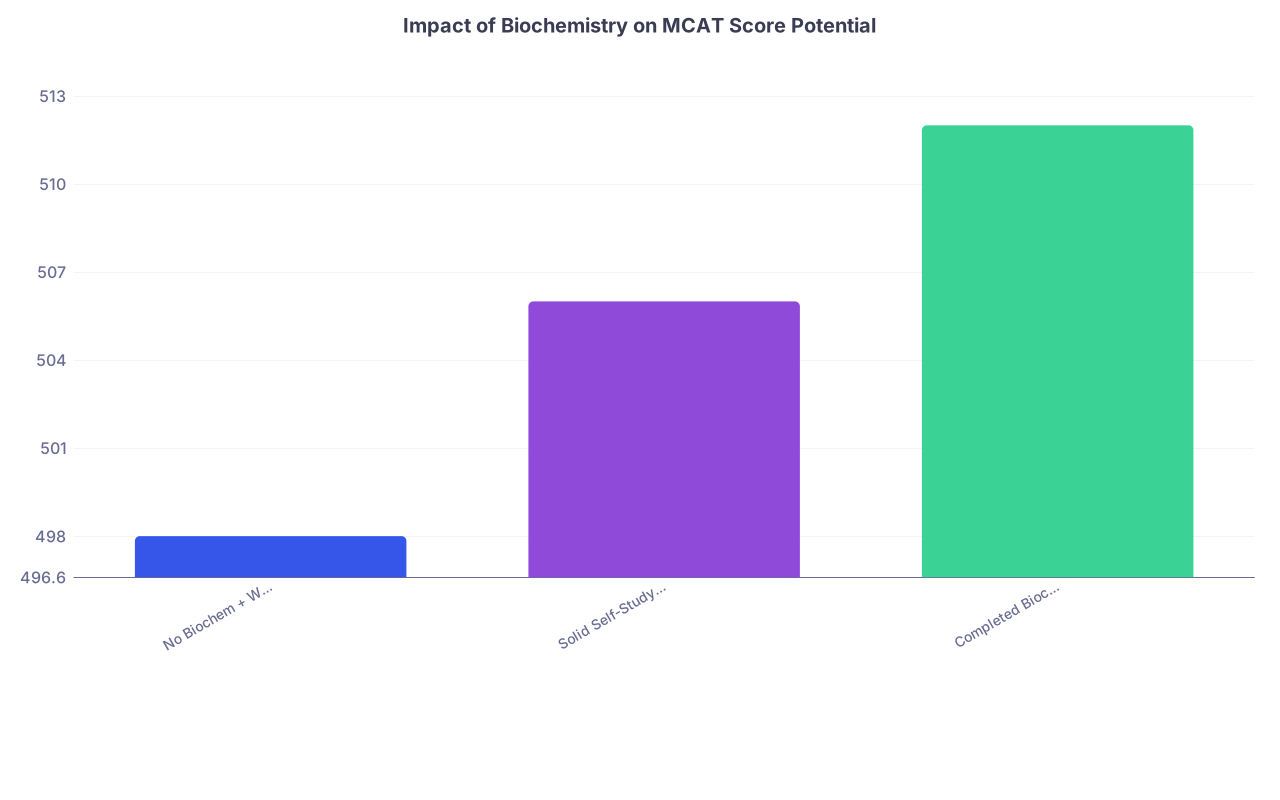
Here’s how that trade-off looks visually:
| Category | Value |
|---|---|
| No Biochem + Weak Self-Study | 498 |
| Solid Self-Study Only | 506 |
| Completed Biochem Course | 512 |
Again, these are illustrative, but the point stands: biochemistry raises your ceiling.
How to Self-Study Biochem If You Can’t Wait
Let’s assume you’ve decided: “I’m taking the MCAT before biochem. No way around it.”
Then you treat biochem like a full-on MCAT subject, not an afterthought.
Core topics to master:
-
- Names, 3-letter, 1-letter codes
- Polar/nonpolar/charged
- Acidic vs basic
- Where they show up in proteins (e.g., active sites, transmembrane regions)
Enzyme basics:
- Active site, substrate, product
- Competitive vs noncompetitive vs uncompetitive inhibition
- Vmax, Km (conceptually, not memorizing equations)
- Cofactors, coenzymes
Protein structure:
- Primary/secondary/tertiary/quaternary
- Disulfide bonds, hydrogen bonds, hydrophobic interactions
Metabolism (high yield, do not skip):
- Glycolysis (inputs, outputs, regulation)
- TCA cycle
- Electron transport chain & oxidative phosphorylation
- Beta-oxidation
- Gluconeogenesis basics
Nucleic acids and expression:
- DNA structure
- Replication, transcription, translation
- Basic regulation ideas
Minimum resource combo I’d use if you’re self-studying:
- One content book (Kaplan, Princeton, or Examkrackers Biochem section)
- Khan Academy Biochemistry videos for reinforcement
- A lot of biochem-heavy practice questions (AAMC Section Bank, UWorld, or similar)
And you don’t cram this in the last 2 weeks. You spread it over 6–10 weeks.
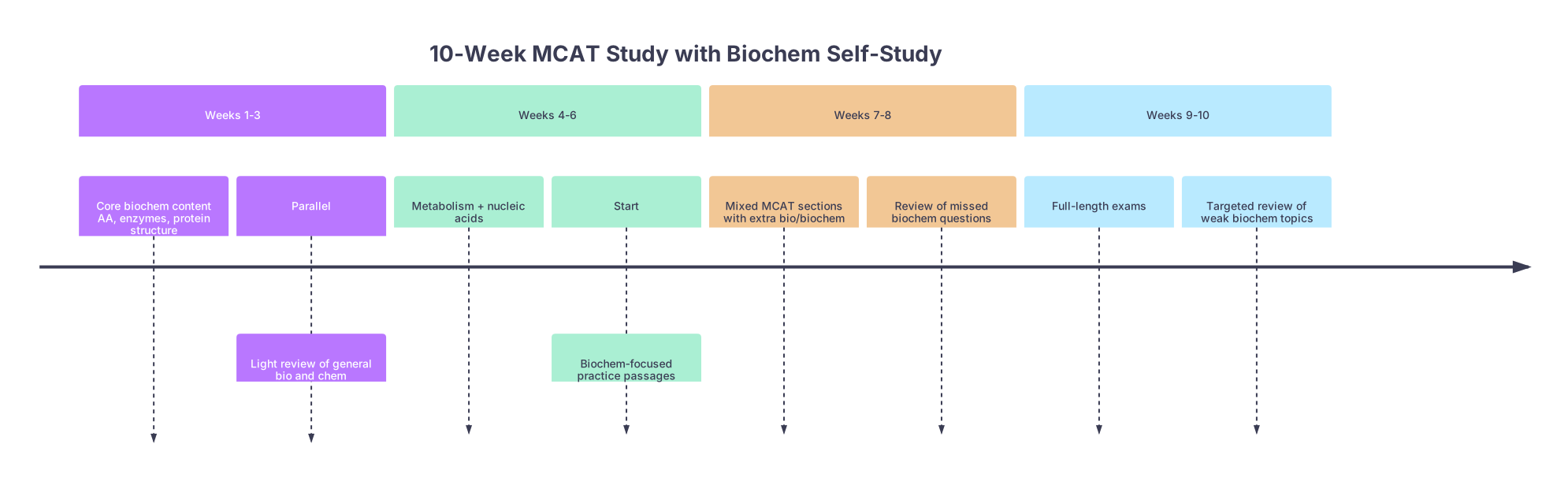
Here’s how I’d build it into a schedule:
| Period | Event |
|---|---|
| Weeks 1-3 - Parallel | Light review of general bio and chem |
| Weeks 4-6 - Start | Biochem-focused practice passages |
If you’re not willing to do that level of work for biochem, then taking the MCAT without the class is a bad idea. Simple as that.
How Admissions Committees See Biochem and the MCAT
Admissions committees are not sitting there saying, “Did they take biochemistry before or after the MCAT?”
They look at:
- Your MCAT section scores
- Your overall GPA and science GPA
- Your course load rigor (which includes biochem)
But here’s the catch: if your Bio/Biochem section is weak and it’s clear you rushed the MCAT without core coursework, it doesn’t look great. Especially if:
- You took the MCAT early
- Scored poorly in Bio/Biochem
- Then took biochem later and improved in class, but the MCAT score is already on file
You’d have to retake, which wastes time and money.
In other words, rushing to take the MCAT before biochem and scoring low often ends up costing you more time than just waiting one semester and doing it right.
Quick Decision Framework: What Should You Do?
Use this as a blunt checklist.
You should WAIT and take the MCAT after biochem if:
- You’re aiming for 510+
- You haven’t taken any biochem-like classes
- You’re not a naturally strong content learner
- You have flexibility in your application timeline
You can CONSIDER taking the MCAT before biochem if:
- You’ve done:
- Gen Chem I & II
- Bio I & II
- Org Chem I (ideally II as well)
- You can’t realistically delay your application a year
- You’re committed to a structured, serious biochem self-study plan
And if your situation is messy and right on the edge (e.g., average GPA, tight timeline, no biochem yet), you need to decide what you care about more:
- Being “on time”
- Or being competitive
Those aren’t always the same thing.
Visual Summary: Course Timing vs MCAT Readiness
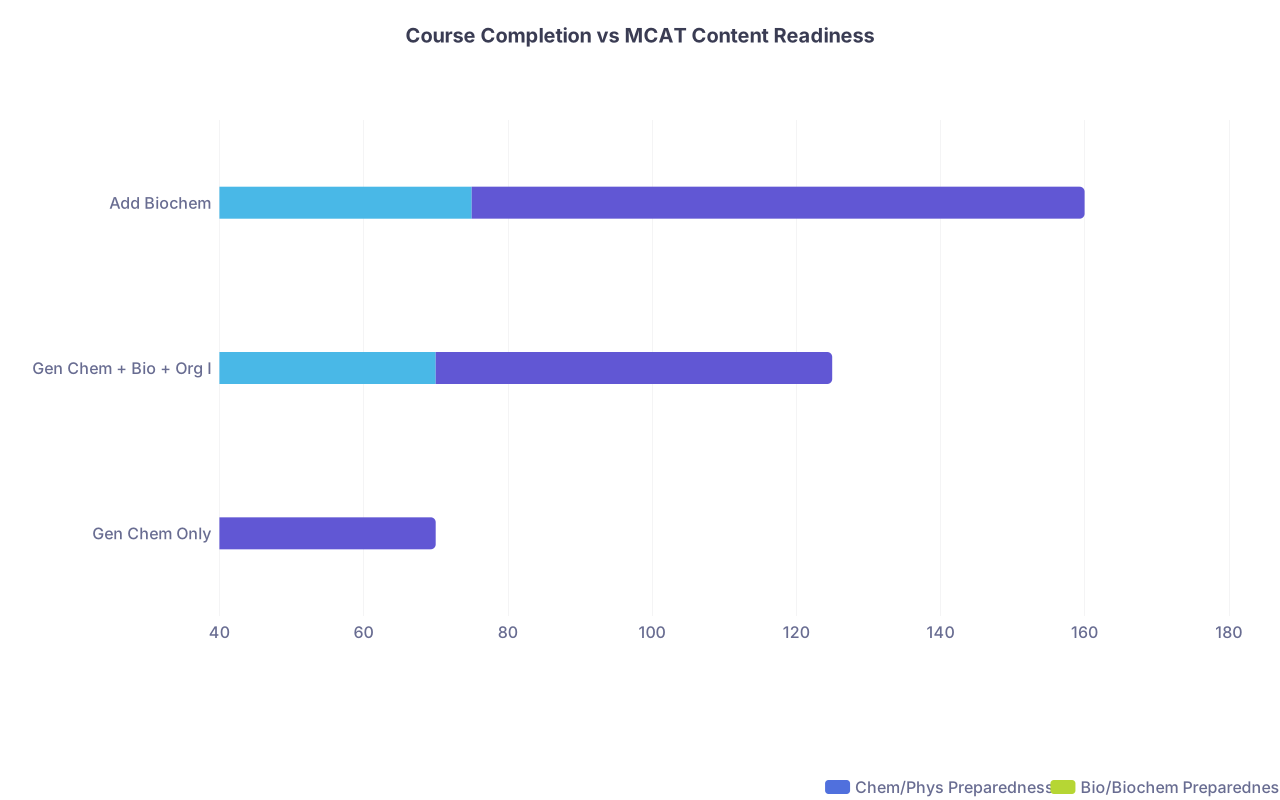
| Category | Chem/Phys Preparedness | Bio/Biochem Preparedness |
|---|---|---|
| Gen Chem Only | 40 | 30 |
| Gen Chem + Bio + Org I | 70 | 55 |
| Add Biochem | 75 | 85 |
Once you add biochem to the stack, your Bio/Biochem preparedness jumps the most. That’s why this one course has an outsized impact.
If You’ve Already Scheduled the MCAT and Haven’t Taken Biochem
Last scenario: test date is on the calendar, biochem isn’t done, and you’re now realizing you might have miscalculated.
Here’s what to do:
Take a full-length practice exam right now (or in the next week).
Look specifically at:
- Bio/Biochem score
- How often you missed enzyme/pathway/protein/experiment questions
If:
- Your score is far below your target (e.g., you want 510, you’re scoring 500)
- And biochemistry is a glaring weakness
Strongly consider postponing.
If:
- You’re close to your target
- Biochem questions are not consistently killing you
Then stay the course, but shift more of your review time to biochem-heavy practice.
Sometimes rescheduling once is smarter than retaking the whole exam later.
FAQs
1. Can I get a 510+ on the MCAT without taking biochemistry?
Yes, it’s possible. But it’s harder, and you’ll need excellent self-study discipline. Most students find that biochem gives them both content and confidence, especially in the Bio/Biochem section. Without it, you’re raising the difficulty of an already hard exam.
2. Is biochemistry more important than organic chemistry for the MCAT?
For the current MCAT, yes. Biochemistry is more central than classic “Org II-style” reaction memorization. You still need organic basics, but biochem is where those principles actually show up in questions. If I had to choose one to complete before the MCAT, I’d pick biochem over Org II every time.
3. Can I rely on Khan Academy alone to learn biochem for the MCAT?
Khan Academy is solid for concept introduction and review, but I wouldn’t use it alone. Pair it with:
- A structured MCAT content book
- Lots of practice questions
Khan is great for “I don’t get this, explain it simply.” It’s not a complete study plan by itself.
4. Does it look bad to medical schools if I take biochemistry after the MCAT?
No. They are not cross-checking the exact sequence of “MCAT vs biochem course.” What matters is your MCAT score and your performance in biochemistry when you do take it. The only time it indirectly “looks bad” is if you obviously rushed the MCAT and scored poorly in bio/biochem.
5. If I’ve taken molecular biology and cell biology, do I still need biochem before the MCAT?
Need? No. Strongly benefit? Probably. If those courses were biochem-heavy and you did well, you may be fine taking the MCAT without a formal biochem class, especially if you reinforce with MCAT-specific biochem review. But if your target score is high and timing allows, biochem still helps anchor and organize all that information.
Key takeaway #1: If you have the choice, take the MCAT after a full biochemistry course. It meaningfully boosts your readiness and score ceiling.
Key takeaway #2: If you cannot wait, you must treat biochemistry as a major self-study project, not a side topic you cram in the last month.