
The fastest way to get filtered out in a med school interview is to answer “Why this school?” with something you could say anywhere.
The Real Job of the “Why This School?” Question
Let me be blunt: most applicants answer this question like tourists reading from a brochure. “Strong research.” “Supportive community.” “Diverse patient population.” Everyone says this. It is white noise to an interviewer.
The actual purpose of “Why this school?” is threefold:
- Test if you did serious homework.
- See if you understand how their curriculum and their mission align with who you are.
- Decide if you are likely to stay, thrive, and represent the school well.
They are not asking: “Convince me we are a good school.”
They are asking: “Convince me that you and we make specific sense together.”
That means you cannot just name-drop a couple of centers and call it a day. You need to show:
- You understand the structure and philosophy of their curriculum.
- You understand what their mission actually looks like on the ground.
- You can connect both of those to your past experiences and future goals.
Let me break this down in a way you can actually use.
Step 1: Dissect the Curriculum Like You Mean It
Most applicants say “I like your early clinical exposure and pass/fail grading.” That tells the interviewer you spent 45 seconds on the website. Every school claims early clinical exposure now. Pass/fail is common.
You need to drill down to curriculum texture, not generic labels.
How to research the curriculum properly
Here is a simple but effective process I’ve seen work:
- Go to the school’s “MD Program” or “Curriculum” page.
- Find the year-by-year overview or block diagram.
- Write down 3–5 structural features that are not universal.
Things to look for:
Curriculum structure
Block vs organ system vs discipline-based
1.5-year pre-clinical vs traditional 2-year
Longitudinal integrated clerkships vs block clerkshipsUnique required elements
Longitudinal primary care experience
Required scholarly project or thesis
Required service-learning course
Required community immersion / rural immersionAssessment and grading
Pure pass/fail vs tiered (Honors/Pass/Fail)
Shelf exam policies, remediation structure
Narrative evaluations, coaching programsLongitudinal threads
Health systems science
Quality improvement / patient safety
Social determinants of health
Leadership / advocacy threads
The question you should be answering is not just “What do they have?”
It is “How is this meaningfully different from other schools?”
Example: Turning curriculum into a sharp answer
Weak version (what most people say):
“I am drawn to your pass/fail curriculum, early clinical exposure, and strong emphasis on research.”
You could put that line in 50 secondaries.
Strong version that actually uses curriculum detail:
“What stands out to me in your curriculum is the 1.5-year pre-clinical phase followed by the required Scholarly Concentration. I am coming from a background where my honors thesis in community nutrition turned into a quality improvement project in a free clinic. The way your curriculum intentionally builds in protected time for a mentored project—after early clerkship exposure—matches how I like to work. I tend to identify problems once I am in real clinical environments and then go deeper. That sequence is much more appealing to me than a 2+2 structure where research feels bolted on.”
Specific, comparative, and clearly tied to personal history. That lands.
Step 2: Translate Mission Statements into Real-World Behavior
Mission statements are usually vague. “Service.” “Leadership.” “Innovation.” The words themselves do not help you. You must translate them into actual behaviors and actual programs on that campus.
How to break down a mission statement
Take a generic mission line:
“We are committed to training physicians who will advance health equity and serve diverse, underserved communities.”
You should ask:
- How do they define “underserved”? Urban? Rural? Indigenous? Immigrant?
- Where in the curriculum is “health equity” structurally embedded?
- What are the specific pipelines, clinics, or programs that operationalize this mission?
Then go hunting:
- Look at the “Office of Diversity and Inclusion” page.
- Look at “Community Engagement,” “Service Learning,” or “Center for Health Equity” pages.
- Look at required or optional “Urban Health,” “Rural Track,” “PRIME,” “Pathway” programs.
- Look at real examples of student groups and longitudinal clinics.
You want at least 2–3 named mission-linked programs you can reference. Not “service opportunities.” Actual names.
Mission in action: Examples you can model
Here is what “mission-specific” sounds like when done well.
Example for a community-focused public school:
“Your stated mission to serve the state’s rural and frontier communities shows up in concrete ways—especially in the Rural Physician Leadership Program and the longitudinal placements in critical-access hospitals. I grew up in a town of 4,000 where the nearest OB was 90 minutes away. For the last two years I have been coordinating telehealth visits for high-risk pregnancies in a similar setting. So I am not just drawn to the idea of rural health as a talking point. I am looking for a school that has built in the infrastructure, like your RPLP and required third-year rural rotations, so I can continue that work in a structured way.”
Example for a research-heavy private school:
“Your mission statement’s emphasis on ‘training physician-investigators who will advance the science of medicine’ is not just abstract. It shows up in the required Discovery Period, the MD with Distinction in Research, and the way most clerkships incorporate quality improvement projects. I have a background doing bench research in immunology that translated into a small clinical pilot on vaccine adherence. I want an environment where moving between lab and clinic is normal, not unusual. The fact that you protect six months for scholarly work and pair students with clinician-scientist mentors makes me confident I would actually be able to grow as a physician-scientist here, not fit research into nights and weekends.”
Do you see the pattern?
Mission phrase → named program → link to specific past experience → forward-looking plan.
Step 3: Build a “Why This School” Evidence Table
If you are serious about this, you will not wing it two hours before the interview. You will have a compact reference for each school that makes specificity easy.
Here is the structure I recommend you build for every school you are interviewing at.
| Category | What the School Offers (Specific) | Your Matching Evidence (Specific) |
|---|---|---|
| Curriculum | 1.5-year pre-clinical + Discovery period | Honors thesis + summer research |
| Mission | Health equity & urban underserved focus | Free clinic work in urban setting |
| Community/Fit | Longitudinal mentoring & small colleges | Respond well to close mentorship |
| Career Support | Formal physician-scientist pathway | Goal: academic IM with research |
For each school, try to fill:
- 2–3 curriculum features
- 2–3 mission/values items
- 1–2 community/culture elements
- 1–2 career pathway supports
If you cannot fill this table for a school, you do not know that school well enough to give a strong answer.
Step 4: Link Curriculum and Mission Directly to Your Story
You are not there to recite their brochure back to them. You are there to argue: “Given who I am, this particular structure and mission will let me do my best work.”
You do that by tying each feature to something specific:
- A past project or sustained activity
- A clear skill set or learning style
- A concrete career direction (even if broad: primary care vs subspecialty, community vs academic)
Framework: The 3-part connection
For each key point, build a 3-part mini-argument:
- School-specific detail
- Your specific experience or trait
- Future-oriented link
For example:
- “Your curriculum’s required longitudinal clinic in an FQHC…”
- “…mirrors the longitudinal diabetes group visits I helped run in my community health center, where continuity over time completely changed follow-up rates.”
- “…I want that same patient continuity built into my training, because my long-term goal is to practice primary care in a safety-net system where relationships over years, not single visits, are the norm.”
Or:
- “Your mission’s focus on immigrant health, operationalized through the Global Health Pathway and the Refugee Health Clinic…”
- “…speaks directly to my last three years volunteering as a medical interpreter and helping my aunt navigate the asylum process.”
- “…My plan is to train in internal medicine and ultimately work at the interface of clinical care and policy for migrant populations. Having those specific pathways and clinics available from M1 would accelerate that trajectory.”
You weave 2–3 of these mini-arguments together and you have a powerful, customized “Why this school?” answer.
Step 5: Structure Your Actual Spoken Answer
You need a structure that is clear, not robotic. If you ramble through 10 features, none of them land. Aim for 3–4 core points, organized.
A reliable skeleton:
- One-line thesis: why this school, in a sentence.
- Curriculum alignment: 1–2 concrete features + your tie-in.
- Mission alignment: 1–2 concrete features + your tie-in.
- Culture/fit: 1–2 points from students, visits, or reputation.
- Close the loop: why these together make this place your top choice for how you want to train.
A worked example
Imagine you are interviewing at a school with:
- 1.5-year pre-clinical → Discovery research period
- Longitudinal primary care experience
- Mission: urban underserved and health equity
- Required Health Systems and Policy thread
A strong, concise answer might sound like this:
“The short version is that your school sits exactly at the intersection of the kind of medicine I currently practice as a volunteer and the kind of physician I hope to become.
From a curriculum standpoint, two things matter most to me. First, the longitudinal primary care clerkship in the FQHC setting. For the last three years, I have worked at a Federally Qualified Health Center running hypertension group visits. The continuity over time is what has made that work meaningful. So the idea that I would have a single clinic home across my pre-clinical years, rather than scattered shadowing, is a much better fit for how I learn and build relationships. Second, the 1.5-year integrated pre-clinical followed by your Discovery period matches my project-driven mindset. I did not really understand my honors thesis on food insecurity until I started applying it in clinic. The chance to get into clerkships early, identify a question, then come back to protected time with a mentor to work on it is exactly the loop I am looking for.
Mission-wise, your explicit focus on urban health and health equity is not abstract to me. I have spent most Saturdays in an inner-city blood pressure clinic where 70 percent of our patients are Black and uninsured. Seeing how your Health Equity and Policy thread is required across all four years—and not just an elective—tells me that the values I care about are baked into how you train physicians, not optional side projects.
Finally, when I talked with current students, what they kept coming back to was the culture of shared advocacy—people organizing around food deserts, lead exposure, and Medicaid access with real faculty support. I want an environment where that kind of systems-focused work is normal. That combination of curriculum structure, equity-focused mission, and activist student body is why this school stands out for me.”
Notice: 3–4 clear pillars. Each with specifics. Each connected to the applicant’s story.
Step 6: Avoid the Lazy, Overused Traps
There are patterns that interviewers hear dozens of times a day. When you use them, you vanish.
Phrases that immediately weaken your answer
- “I love the location.” (Fine as a minor point, never as a main one.)
- “The match list is impressive.”
- “You have great research opportunities.”
- “I have heard the students are very happy.”
- “You are highly ranked.”
- “You have diversity.”
These are not inherently bad ideas. They are just generic and shallow in isolation.
If you are going to say them, make them painful specific:
Not “great research opportunities” → “…the structured summer research program that pairs M1s with NIH-funded mentors in cardiometabolic disease, which directly aligns with my last two years working on a registry for heart failure patients.”
Not “I have heard students are happy” → “…three students independently mentioned that faculty routinely stayed late to help them with OSCE prep and that the formal coaching program actually works, not just on paper. That culture of accessible teaching is what I am looking for.”
The “website regurgitation” problem
Another common failure mode: listing 8 things from the website in a row.
“You have the X Center, the Y Institute, the Z Track, the A Pathway, and many student groups…”
No connective tissue. No personal link. It sounds like a scavenger hunt, not motivation.
Rule of thumb:
For every school feature you mention, give at least one line of “why that matters to you specifically.” If you cannot, cut it.
Step 7: Integrate Curriculum and Mission into Other Interview Questions
“Why this school?” is not only asked when they say those exact words. Several questions are stealth versions of the same test.
Common stealth “Why this school?” variants
- “How did you decide where to apply?”
- “What are you looking for in a medical school?”
- “If you were accepted to multiple schools, how would you choose?”
- “Why do you think you are a good fit here?”
- “What kind of curriculum environment works best for you?”
They are fishing for the same thing: do you know us, and do we make sense for you?
You can reuse your prep here.
Example for “What are you looking for in a medical school?”:
“I have found that I learn best in integrated, system-based curricula with early real patient contact and structured opportunities to pursue a substantial project. That is why schools with a 1.5-year pre-clinical phase and a required research or discovery block rose to the top of my list. I also was specifically drawn to schools where health equity is a required longitudinal thread, not just an elective. Your curriculum and mission aligned with those priorities, which is why I was excited to interview here.”
You are answering the general question while implicitly saying: “And by the way, that is you.”
Step 8: Use Student Voices and Concrete Anecdotes
One of the strongest ways to show authentic interest is to reference specific conversations with students or faculty. Not “I talked to some students.” Actual substance.
Do this the right way:
- Talk to 2–4 current students before your interview.
- Ask them: “What is one thing the website does not capture well about this school?”
- Write down their exact phrases.
Then pull one or two into your answer.
Example:
“When I spoke to a current M2, she told me that the ‘learning societies’ were the reason she did not burn out during her first anatomy block—because she had a built-in group of peers and a dedicated faculty mentor. That kind of structured, small-group support is something I have actively sought out in college, and it matters to me going forward.”
Now your answer does not read like something written from a website. It sounds lived-in.
Step 9: Practice Without Sounding Scripted
You need rehearsal. But memorized blocks sound fake. The solution is to memorize structure and anchor phrases, not exact paragraphs.
Here is how:
- Write out your full ideal answer. Long. Detailed.
- Underline 4–5 anchor phrases or program names you must hit.
- Practice answering out loud without looking, aiming to always hit the anchors, but letting the exact wording float.
You want to reliably hit, for example:
- “Longitudinal primary care clinic”
- “1.5-year pre-clinical plus Discovery period”
- “Health Equity and Policy thread”
- “My work at the FQHC”
The rest can flex so you sound like yourself, not a teleprompter.
Step 10: Differentiate Between Schools that Look Similar
You will apply to multiple schools with “early clinical exposure,” “health equity focus,” and “research opportunities.” If your answers sound identical across them, that is a problem.
The way around this is to identify each school’s sharp edge—the thing that, if you removed it, would make it just another mid-tier med school.
You find that by comparing:
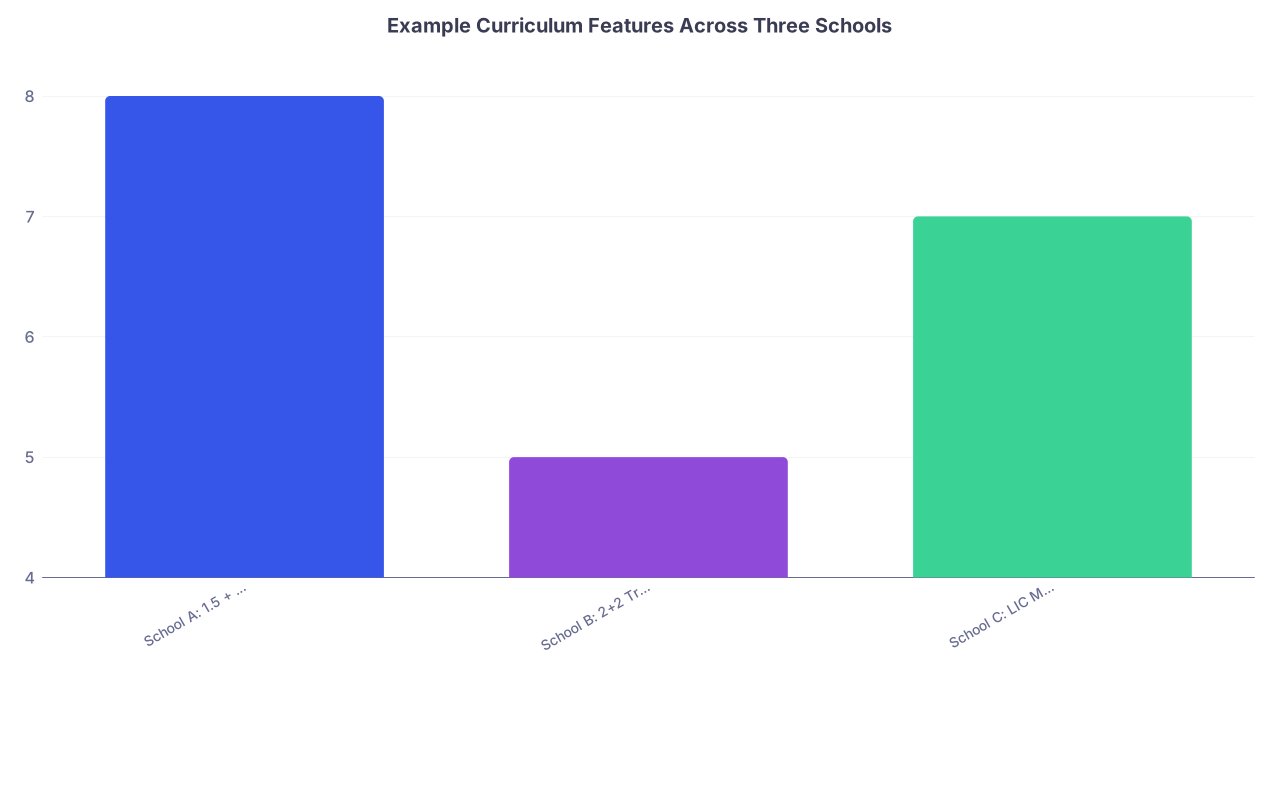
| Category | Value |
|---|---|
| School A: 1.5 + Discovery | 8 |
| School B: 2+2 Traditional | 5 |
| School C: LIC Model | 7 |
(In other words: what each school strongly emphasizes vs just “also has.” Ignore the fake numbers; focus on the idea.)
Examples of distinctive “edges”:
- A true longitudinal integrated clerkship instead of traditional blocks.
- A mandatory community health project graded and tracked over four years.
- An embedded public health degree option with funded tuition.
- A formal rural/urban/indigenous track with guaranteed rotations in those settings.
- A flipped-classroom, team-based learning model for all pre-clinical content.
Pick the real differentiator and frame your answer around that, instead of generic overlap.
A Quick Visual: How to Prep for “Why This School?”
Let me map the process you should be following.

| Step | Description |
|---|---|
| Step 1 | School Website |
| Step 2 | Identify Curriculum Structure |
| Step 3 | Extract Mission & Values |
| Step 4 | Find Named Programs & Pathways |
| Step 5 | Your Experiences & Goals |
| Step 6 | Match to Curriculum Features |
| Step 7 | Match to Mission & Programs |
| Step 8 | Build 3-4 Key Points |
| Step 9 | Practice Spoken Answer |
If you follow that flow for each school, the actual interview question stops being scary. You are just pulling from a system you already built.
How This Looks in a Real Interview Day Context
On interview day, you will not only use this content once. It will bleed into multiple moments:
- Lunch with students: you can ask sharper questions. “How has the required community health project actually been implemented for your class?”
- MMI stations about health policy or ethics: you can reference the school’s health systems thread or community clinics.
- End-of-day ‘Any questions for us?’: you can ask follow-ups that show you already understand their structure.
You can also adapt your “Why this school?” for different formats:
- Traditional 1-on-1: longer, more narrative.
- MMI station with a faculty member asking “Why here?”: compressed to 60–90 seconds, hitting just 2–3 strongest connections.
- Group info session Q&A: a question that hints at your preparation. “You mentioned the new Discovery curriculum; how has that changed the way students balance research with clerkships compared to the old 2+2 model?”
This is how you repeatedly signal: “I am not shopping for any acceptance. I am choosing this training model and this mission.”
Two Brief Examples: Strong vs Weak Answers
To make this painfully clear, here is a side-by-side comparison.

Weak, generic answer
“I really like your pass/fail curriculum and emphasis on work-life balance. The location is also great because it is close to my family, and I have heard that your students match into excellent residencies. I am also excited about your research opportunities and the diverse patient population. All of those factors make this school a great fit for me.”
That could be said anywhere. No interviewer remembers this.
Strong, specific answer
“Your school stands out to me because of how your curriculum and mission line up with the way I already work and the kind of physician I want to become.
Structurally, the most important feature for me is your integrated, 1.5-year pre-clinical curriculum followed by the required Discovery quarter. In my undergraduate work, my best learning came when I was in the clinic first—at the student-run diabetes clinic I helped coordinate—and then went back to the lab to refine our A1c tracking protocol. Your model of getting us into clerkships early, then protecting time to pursue a mentored project once we have real clinical questions, is exactly how I learn best.
That aligns tightly with your mission’s emphasis on health equity in urban communities. My last two years have been spent working with a mobile clinic serving primarily uninsured, Spanish-speaking patients. When I saw that your Health Equity Pathway includes both community organizing training and a longitudinal placement in the Eastside Community Clinic, I recognized the same kind of environment, but with much more robust faculty support and structure.
When I spoke with current students, they described a culture where it is normal to conduct a quality improvement project on hypertension control as part of your internal medicine clerkship and then present it at your annual Health Systems Science Day. That expectation that we will think about systems and equity while we learn medicine is the main reason I feel this school would be the right place for me.”
You see the difference.
Specific. Evidence-backed. Clearly tied to that one school’s curriculum and mission.
Final Thoughts
Three key points and I will stop:
- “Why this school?” is not about flattery; it is about fit. You prove fit through curriculum and mission-level specificity tied tightly to your own history and goals.
- Vague statements (“great research,” “diverse patients,” “supportive community”) are interview filler. Replace them with named programs, structural features, and real anecdotes.
- If you cannot fill a small grid of 3–4 curriculum features and 3–4 mission-driven programs for a school, you are not prepared. Do that work, then build a clean, 3–4 pillar answer you can deliver without sounding scripted.
Do that consistently, and your “Why this school?” answers will finally sound like they belong to someone they would actually want to train.