
Most applicants talk about shadowing in a way that quietly undermines them.
They think it sounds impressive to rattle off, “I shadowed a neurosurgeon at Mass General,” as if the hospital name alone will move the interviewer. It will not. What moves an interviewer is whether you understood anything from that experience about what physicians actually do and who you are in relation to that work.
Let me break this down specifically.
What Interviewers Actually Hear When You Talk About Shadowing
On paper, shadowing looks simple: follow a physician, wear a badge, stay out of the way. In an interview, that same experience can either make you sound like a thoughtful future colleague—or like someone who collected business cards and white coats.
Here is the disconnect.
Premed way of describing shadowing:
“I shadowed three specialties at two major academic centers and accumulated 80 hours.”
Interviewer's translation:
“You stood in a corner, watched a lot, did not process much, and think big names equal value.”
If you describe shadowing like a LinkedIn flex, the message is: “I care about prestige more than understanding the work.” Interviewers have heard these lines thousands of times:
- “I shadowed in the OR at [famous hospital].”
- “I followed the chair of cardiology at [big-name institution].”
- “I spent a summer shadowing in neurosurgery.”
All of that is background noise if it is not linked to insight, tension, or change in how you think.
The core problem:
Most applicants describe shadowing as exposure, not education.
You need to flip that. Stop trying to impress them with who you stood next to. Impress them with what you noticed that 90% of premeds miss.
The Principle: Translate Proximity into Perspective
Shadowing is not a trophy. It is a lens.
The single question you should be answering anytime you mention shadowing:
“What did this teach me about the reality of being a physician—and how did that shape my behavior, decisions, or values?”
If you cannot answer that, you are name-dropping. Even if you never say the name.
A strong shadowing anecdote has three components:
- Specific clinical moment – Something concrete you saw. Not “I shadowed in cardiology.” Instead: a particular patient, conflict, or decision point.
- Internal processing – What you thought, questioned, or struggled with in that moment. Your actual brain, not the Hallmark version.
- Resulting change – How that moment shifted your understanding or future actions.
Weak shadowing answers usually skip (2) and (3) entirely and just repeat (1) with vague adjectives like “inspiring” and “rewarding.”
You want to sound like someone who was mentally working the whole time, not just absorbing vibes.
Let me walk you through how to actually do that.
The Fast Filter: Are You Name-Dropping or Demonstrating Insight?
Take any shadowing anecdote you are planning to use and run it through this quick test.
If your answer hits any of these patterns, it is probably shallow:
- The most specific detail is the hospital or physician name.
- You rely heavily on superlatives: “incredible,” “amazing,” “inspiring,” “life-changing”—with no sensory or concrete backing.
- You focus on what you saw (“I watched a coronary bypass”) but not what you learned or questioned.
- You never mention uncertainty, discomfort, or trade-offs.
What strong looks like:
- The most specific detail is a decision, interaction, or problem.
- You articulate either:
- something that surprised you,
- something that bothered you,
- or something that complicated your previous belief.
- You show movement: “I used to think X, but this showed me Y, so now I do Z differently.”
If we reduce it to a single litmus test:
If I strip out the hospital, the physician’s name, and the specialty, is your story still interesting?
If the answer is no, your story is about prestige, not perspective. Fix it.
Reframing Common Shadowing Scenarios: Before vs After
Let’s go through specific examples, because this is where most people derail.
OR Shadowing
Weak version (classic):
“I shadowed a cardiovascular surgeon at [elite hospital]. I watched several CABG procedures and saw how precise and focused the surgeon had to be. It was inspiring to see how he saved patients’ lives and worked with the team.”
What the interviewer hears:
You stood in the back of the OR, got a little dizzy, and memorized a generic sentence off SDN.
Stronger version:
“I shadowed in cardiac surgery and was honestly more focused on the rhythm of the room than the anatomy. Before incision, the surgeon went around the table and made each person say what they were most worried about in the case. The anesthesiologist mentioned the patient’s tenuous ejection fraction. A nurse flagged that one of the blood products was delayed.
I walked in assuming surgery was a solo performance where the surgeon ‘saves the day.’ Leaving that day, I realized how much the surgeon’s job is actually managing uncertainty and pulling the team into the same mental model. That stuck with me. In my campus EMS work, I started explicitly asking our team before tough calls, ‘What are we most concerned about here?’ It felt awkward the first few times, but it immediately surfaced things I would have missed—like a paramedic worried about scene safety when I was focused only on the patient.”
Same basic setting. Completely different level of thought.
Notice a few things:
- No need to say “[Big Name] Hospital” or “world-renowned surgeon.”
- The insight is translatable (team communication, uncertainty).
- There is evidence of behavioral change (how they now run EMS calls).
Outpatient Clinic Shadowing
Weak:
“I shadowed a primary care doctor at a community clinic serving underserved populations. It was inspiring to see how much patients trusted her and how dedicated she was.”
Interviewer’s internal reaction: Yes, you and 12,000 other applicants.
Stronger:
“I shadowed in a community clinic where most patients were Spanish-speaking and uninsured. One visit stays with me: a man with uncontrolled diabetes who worked two jobs and kept missing appointments. The physician had 15 minutes. She spent 10 of them trying to adjust his insulin and only 5 talking through why he kept missing visits.
Walking out, I thought the visit had gone well—we ‘optimized’ his meds. The physician disagreed. She said, ‘We fixed the numbers on the screen, not the problem he is living.’ She was frustrated with herself, not him.
That reframed how I thought about ‘adherence.’ I stopped mentally categorizing patients as ‘non-compliant’ on my hospital volunteer shifts and started asking myself, ‘What would make this plan impossible for me if I were in their shoes?’ It pushed me to choose a free clinic for my longitudinal volunteering, where social barriers are as front-and-center as the lab values.”
Again, the point is not how many hours or how “underserved” the setting was. It is the clarity of the insight and specific change in perception and behavior.
Specialty Shopping
A lot of students proudly say they shadowed “11 specialties.” It never lands the way they think.
Weak:
“I shadowed across internal medicine, pediatrics, surgery, and emergency medicine, which gave me a broad understanding of the different fields and confirmed that I want to be a doctor.”
That sentence tells me nothing. It might as well not exist.
Better:
“I made myself a rule during shadowing: every time I switched a specialty, I had to write down one moment that made clinicians’ lives harder and was not obvious to patients.
In surgery, it was the hidden hours of documentation and follow-up that residents did long after the case was over. In pediatrics, it was the emotional work of telling a parent no—no antibiotics for a viral illness, no MRI for a minor fall—knowing they were terrified. In EM, it was the reality that some of the most medically complex patients were not remotely ‘emergency’ but had nowhere else to go at 2 a.m.
By the end of that process, I stopped seeing specialties as TV caricatures—‘the cool surgeons,’ ‘the nurturing pediatricians’—and started appreciating the trade-offs different people are willing to make in their careers. That made me more realistic about my own future: I am drawn to longitudinal relationships, but I also know I need variety and acuity, so fields like heme/onc or cards now make more sense to me than they used to.”
This is how you use multiple shadowing experiences: not as a catalog, but as a comparative framework.
Structuring Shadowing Answers in the Interview
You need a mental template so you do not default to listing places and physician names under pressure.
Use this simple 4-part skeleton for any shadowing-based answer:
- Context in one clean sentence
Where you were and in what role. Not the full CV. - Specific moment
The concrete interaction / decision / conflict. - Your internal reaction
Confusion, surprise, discomfort, or shift in thinking. - Downstream effect
How your behavior, choices, or values changed.
Here is that skeleton in action for a common question: “Tell me about a clinical experience that influenced you.”
“During my junior year, I shadowed a hospitalist on a general medicine service at a VA hospital.
One afternoon, we saw a patient with end-stage COPD who kept pulling off his BiPAP and saying he wanted to go home. The team had documented him as ‘non-compliant’ several times. The hospitalist sat down, got eye-level, and spent 20 minutes talking about what ‘home’ meant to him—his wife, his dog, his recliner—and what he was actually afraid of in the hospital.
I was initially frustrated; I was eager to ‘do medicine’ and wanted to see more procedures. But walking out, the physician said: ‘If I do not understand his story, any plan I write is fiction.’ That sentence hit me harder than any physical exam pearl I learned.
Since then, in my work as a hospice volunteer, I have tried to leave space for patients’ stories even when the task list is long. I am still not as patient as that hospitalist was, but that encounter is the standard I measure myself against.”
Notice what is not there: hospital name, physician’s full name, any attempt to prove they were at a shiny place. The substance stands alone.
When (and How) to Use Names Without Sounding Like You Are Flexing
You do not need to scrub all names out of your answers. You just need to deploy them with discipline.
Here is a simple rule:
- If you are using a name to signal prestige, drop it.
- If you are using a name to provide clarity or specificity, keep it short and neutral.
Acceptable uses:
- “A community clinic affiliated with [state university].”
- “A private practice pediatrician in my hometown.”
- “A county hospital that served mostly uninsured patients.”
Marginal but okay:
- “A large academic center like [Hospital X] where I saw the tension between research demands and clinic time.”
Terrible:
- “I shadowed the world-renowned chief of neurosurgery at [Top 5 Hospital], which was an amazing privilege…”
If you must mention a specific place because it is essential to the point (for example, VA system, free clinic with a specific model, rural health center), do it once, briefly, and then move on to what actually matters.
Common Interview Questions Where Shadowing Comes Up—and How to Anchor in Insight
Let us be concrete. These are the exact prompts where students drift into name-dropping. Here is how to anchor differently.
| Common Question | Weak Instinct | Stronger Angle |
|---|---|---|
| Why medicine? | “I shadowed [famous doctor] and saw amazing surgeries.” | One or two shadowing moments that changed how you see the physician’s role and how you behaved differently afterward. |
| What clinical experiences have been most meaningful? | Listing 3-4 settings with hours and roles. | One or two specific encounters, with your internal conflict and a clear takeaway. |
| Tell me about a time you saw a good physician. | “The doctor was so smart and caring.” | Concrete behaviors you want to emulate and an example of you trying to do so in your own sphere. |
| [Tell me about a time you saw something troubling.](https://residencyadvisor.com/resources/med-school-interview-tips/mastering-ethical-dilemmas-a-decision-tree-for-common-mmi-scenarios) | Long rant about “the system” with no self-reflection. | A moment that bothered you plus how you made sense of it, including your limits as a student. |
“Why Medicine?” with Shadowing
Bad:
“When I shadowed at [Top Academic Center], I saw complex surgeries and cutting-edge care, which inspired me to pursue medicine.”
Better:
“I entered college fascinated by biology but unsure if I could handle the emotional weight of medicine. Shadowing clarified that.
In one oncology clinic, I watched a physician tell a patient her cancer had progressed despite months of treatment. I expected the visit to be purely devastating. Instead, there was also planning, small jokes, even a moment where they talked about the patient’s garden.
I walked out struck by how much of medicine is about walking into suffering without flinching and still making room for ordinary life. That same semester, I sought out work at a hospice center, specifically to see whether I could show up consistently in those spaces. I found that those conversations, while draining, were also the ones I felt most present and honest in. That combination of rigorous thinking and human proximity is what pulls me toward medicine rather than a purely lab-based career.”
Note how the shadowing is an inflection point, not the whole argument.
“Tell Me About a Time You Saw Something That Concerned You in Healthcare”
This is where students either get preachy or bland.
Lazy answer:
“During shadowing I saw how overworked doctors were and how broken the system is. It made me want to advocate for change.”
Stronger:
“During shadowing in an ER, I watched a patient with clear signs of opioid use disorder come in for the third time that month with abdominal pain and withdrawal. The resident labeled her as ‘drug seeking’ during rounds and there was an eye roll when she pressed for IV pain meds. No one was overtly cruel, but there was a hardness that made me uncomfortable.
On the way home, I was frustrated both with the system and with myself; I had said nothing and slipped into the same cynicism in my head. My premed brain wanted a clean ‘villain’ in that story, but the more I learned about burnout and resource constraints, the less simple it became.
That experience pushed me to take an addiction medicine elective class and volunteer at a needle exchange, where I had longer, non-acute conversations with people who use drugs. I still do not have a neat answer for how to fix that ER dynamic, but I am much more aware of how easy it is to slide into dehumanizing shorthand under pressure—and I hope to be the kind of physician who resists that.”
Insight is not pretending to have solved systemic problems. Insight is showing that you recognize their complexity and changed your behavior or learning path because of them.
Using Shadowing to Show Maturity, Not Naïveté
A mature applicant uses shadowing to show they understand at least three uncomfortable truths about medicine:
- The work is not glamorous most of the time.
Documenting. Calling insurance. Repeating the same explanation for the 6th time that day. - Physicians are human and imperfect.
They get frustrated. They cut corners under pressure. They miss things. - Real patients do not behave like textbook cases.
They forget meds, lie about smoking, show up late, refuse tests, make choices you personally would never make.
If your shadowing stories quietly acknowledge these realities and still end with you wanting to step into that world, you will sound far more credible.
Here is what that looks like in an answer:
“Shadowing did not make medicine look glamorous. It actually did the opposite. I saw a pediatrician spend 15 minutes on the phone arguing with an insurance company about an inhaler. I saw a surgeon who was clearly exhausted snap at a scrub tech and apologize later. I saw patients walk out against medical advice.
Those moments did not make me doubt the path; they made it feel more honest. They forced me to ask whether I want this as my day-to-day life, not as a fantasy. And after working for two summers as a CNA—long shifts, call bells, bodily fluids—I am more certain that I prefer real, messy human problems to abstract ones on a screen.”
Notice: no hero worship. No pretending everyone in a white coat is a saint. That groundedness is exactly what interviewers are scanning for when you bring up shadowing.
A Quick Exercise to Upgrade Your Shadowing Stories Before Interview Season
If you have shadowed already, do this:
- Take a blank page. Divide it into three columns:
“Moment,” “What surprised/bothered me,” “What I did with it.” - Force yourself to list 5–10 specific moments from shadowing. Not generalities.
- For each, quickly jot:
- what was emotionally or intellectually interesting to you,
- and one way it changed your thinking or behavior (even a small way).
Then, pick the 2–3 that show the most growth or complexity, not the ones at the fanciest places.
Those 2–3 become your go-to interview anchors. You do not need more. Rehearse them using the 4-part structure:
- Context (1 sentence)
- Specific moment (sensory, concrete)
- Internal reaction (not always flattering)
- Downstream effect (behavior, choices, values)
You should be able to deliver each in 60–90 seconds. Anything longer and you will drown the insight in details.
To visualize how much of your shadowing you are actually using, think of it like this:
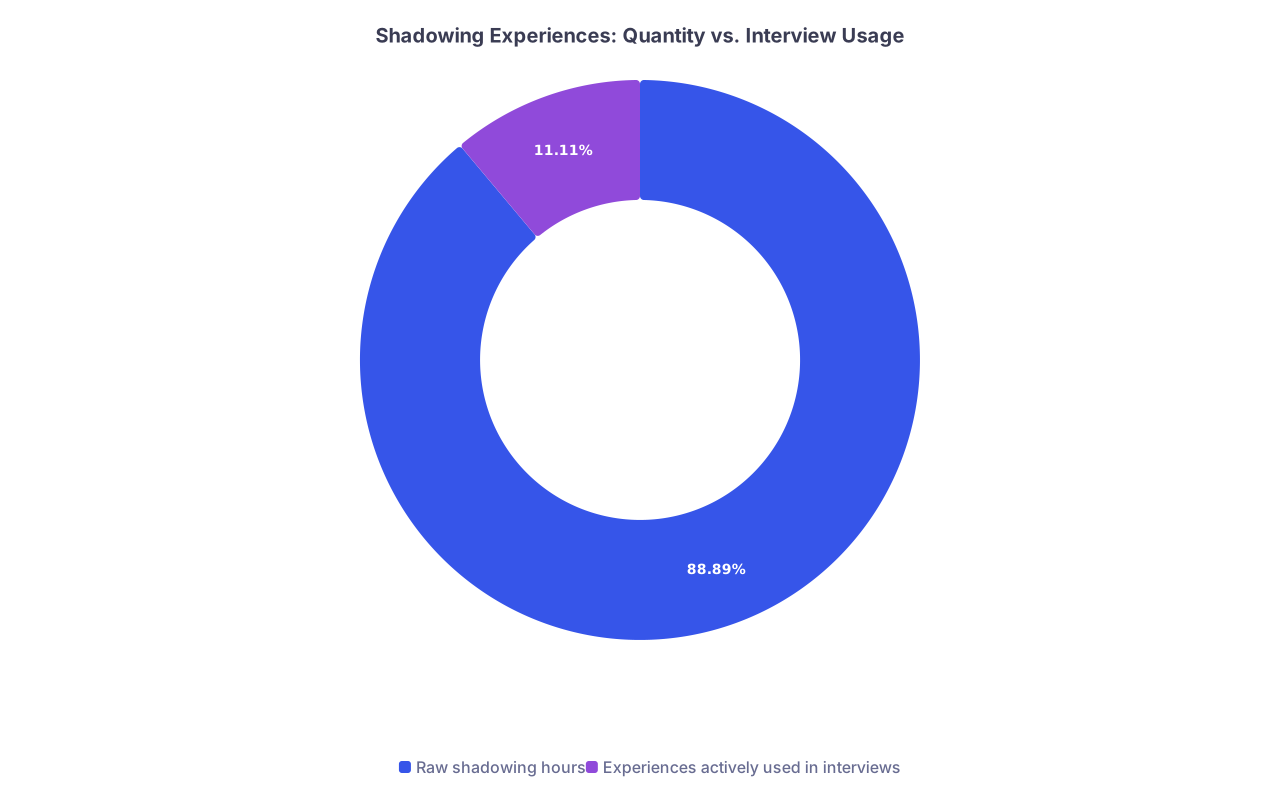
| Category | Value |
|---|---|
| Raw shadowing hours | 80 |
| Experiences actively used in interviews | 10 |
Most of your hours will never be mentioned. That is fine. You are curating the ones that demonstrate who you are, not submitting a time sheet.
How This Plays Differently for Premeds vs. Current Medical Students
You mentioned this is for “PREMED AND MEDICAL SCHOOL PREPARATION,” so let me separate the expectations.
Premed Applicants (MD/DO Interviews)
Interviewers know your clinical access is limited. Shadowing is often your only true window into physician life. For you:
- Shadowing is primarily about showing:
- you understand the real job is messy, not just “helping people,”
- you have seen physicians’ limits and still want the role,
- you started translating observations into your own behavior (volunteering, work, leadership style).
They are not expecting you to have “responsibility” in those settings. They are expecting you to have reflection.
Medical Students (Residency Interviews)
For MS4s applying to residency, pure shadowing is largely irrelevant unless:
- it shaped your specialty choice in a specific, traceable way, or
- it shows long-standing exposure to a field (e.g., military medicine, rural practice).
By then, you should have your own direct patient care stories. If you are still leaning on premed shadowing anecdotes heavily in residency interviews, you will sound underdeveloped.
For preclinical med students interviewing for research positions or scholarships, use shadowing to highlight:
- early understanding of team dynamics,
- how it informed the kind of environments you sought out in med school (safety-net hospitals, academic centers, etc.),
- and any connection to the population or problem you now work with.
Different stage, different purpose. But the same underlying rule: no name-dropping as substitute for thinking.
Putting It All Together
Let me sketch a clean, integrated response using shadowing the right way in a classic question: “Tell me about a clinical experience that confirmed medicine is right for you.”
“I am not sure there was a single confirming moment, but there is one shadowing experience that captured what I want my career to look like.
I was shadowing a family medicine physician at a county clinic. A middle-aged woman came in for ‘back pain.’ On paper, it looked straightforward. But the visit unraveled into something more complicated—her back hurt because she was working double shifts as a home health aide, her blood pressure was uncontrolled, and her adult son had just been arrested.
I expected the physician to focus on the pain and the blood pressure. Instead, he spent a significant part of the visit asking specific, almost checklist-like questions about her support system, finances, and what she was most overwhelmed by. He still adjusted her meds and ordered imaging, but the plan also included a social work referral, a letter for modified duty, and a short follow-up rather than the standard three months.
I walked out realizing that what I found most compelling was not the diagnostic piece—though that was interesting—but the way he used a 20-minute visit as a lever on several parts of her life. It felt like applied problem-solving under constraints, with a human being at the center rather than a puzzle. That experience pushed me away from a purely bench-research path and toward roles where I could work at that interface.
Since then, I have sought environments that look like that clinic: I volunteer at a free clinic that similarly integrates social work, and I joined a research project on primary care access rather than staying in my original wet lab. Those were not random choices; they were a direct extension of what I saw and valued in that family medicine clinic.”
No prestige. No list of institutions. Just specific observation → internal shift → changed behavior.
That is exactly how you want shadowing to function in your interview narrative.
Key Takeaways
- Shadowing only helps you in interviews if you translate proximity into perspective. If your story is not interesting without the hospital name, you are name-dropping, not reflecting.
- Structure every shadowing anecdote around a specific moment, your internal reaction, and a clear downstream effect on your behavior or choices. One or two rich stories beat a catalog of places every time.
- Use shadowing to show maturity about the realities of medicine—its messiness, limits, and trade-offs—while still choosing it with clear eyes. That is what convinces interviewers you belong in this profession, not the number of white coats you stood beside.