
The worst answers about burnout are the ones that sound perfectly “correct.”
You are not being tested on whether you can recite wellness slogans. You are being tested on whether you understand the realities of stress in medicine, have insight into your own limits, and will not melt down (or blow up) in the middle of M2, clerkships, or residency.
Let me break this down specifically.
What Interviewers Are Actually Screening For
When an interviewer asks anything in the neighborhood of “burnout,” “stress,” or “wellness,” they are not trying to trap you into admitting weakness. They are running a very pragmatic risk assessment in their heads:
- Will this person crumble under routine pressure?
- Will this person become a professionalism problem when stressed?
- Will this person require massive hand-holding or remediation?
- Or, on the positive side: Can this person recognize strain early and course-correct?
The mistake most applicants make: they either
a) deny stress exists (“I just manage my time well!”), or
b) trauma-dump their entire mental health history with no clear arc of growth or stability.
Both raise red flags.
Here is what interviewers actually want to hear, implicitly:
- You understand medicine is hard and have already encountered some demanding situations.
- You have concrete, practiced coping strategies that are sustainable and not performative.
- You have insight: you can notice early warning signs in yourself and adjust.
- If you have struggled, you sought appropriate help and are now stable, functional, and self-aware.
They do not want:
- Uncontrolled disclosures of severe, current impairment.
- Vague clichés with zero examples.
- “I never get stressed.” (No one believes that, and if it were true, it would be concerning.)
So your task is to walk a narrow but very manageable line: honest, but bounded; reflective, but not confessional; growth-focused, not pathology-focused.
Common Question Types and What They’re Really Asking
These questions show up everywhere: MMIs, open-file interviews, faculty panels. Different wording, same core themes.

1. “How do you handle stress?” / “How do you maintain wellness?”
Translation:
“Do you have practical, non-delusional strategies to stay stable under pressure?”
Bad answers:
- “I just power through.”
- “I go to the gym and hang out with friends” (with no substance behind it).
- “I do yoga, meditation, journaling, gratitude, and 14 other buzzwords” (sounds like a Pinterest board, not a real life).
Better structure:
- Acknowledge that stress is real and expected.
- Name 2–3 specific, sustainable strategies you actually use.
- Give one concrete example of using them in a demanding period.
- Briefly connect this to how you anticipate using them in medical school.
Example (strong, concise):
“Stress is unavoidable in rigorous environments, so I focus on having routines rather than quick fixes. My non-negotiables are structured planning, regular exercise, and one social anchor each week. During my organic chemistry and MCAT semester, I was taking 18 credits and working part-time. I blocked my week out every Sunday, protected a 45-minute run most days, and had a weekly dinner with two friends where we did not talk about school. When I noticed myself getting irritable or cutting sleep, that was my cue to scale back extra commitments for a week. I expect medical school to be more intense, but the framework is the same: clear planning, movement, and consistent connection with people outside of medicine.”
Notice the tone:
- Realistic about stress.
- Concrete behaviors.
- Shows early warning signs and adjustment.
- No melodrama. No “I don’t get stressed.”
2. “Tell me about a time you felt overwhelmed or burned out.”
Translation:
“Have you ever reached your limits, and if so, did you spiral or adapt?”
You must choose your story carefully. Here is the rule:
- The situation can be genuinely hard,
- But the outcome must clearly be functional and growth-oriented,
- And your current functioning must be excellent and stable.
Good domains to pull from:
- Heavy academic term (but not one that ended in disaster).
- A period of caretaking responsibility plus school.
- A summer of intense research or full-time work plus MCAT.
Dangerous domains (handle with extreme care, if at all):
- Active, recent major mental health crises.
- Stories that show you still do not have boundaries.
- Situations where you behaved unprofessionally under stress.
This is not about hiding illness. It is about not centering your entire interview identity on acute past crises that are not clearly resolved.
Use a tight narrative arc:
- Brief context.
- Specific moment you realized it was unsustainable.
- Concrete actions you took.
- What is different about your approach now.
Example:
“During my sophomore year, I took on far too much at once: a full course load, leadership in two organizations, and weekend shifts. By mid-semester, I was exhausted, missing small details, and dreading commitments I had previously enjoyed. One night, when I double-booked myself for two events and let both groups down, I realized I was not managing things responsibly. I met with my academic advisor the next week, stepped down from one leadership role, and adjusted my work hours. I also started scheduling actual downtime on my calendar. Since then, I have been better at saying no upfront and checking in with myself monthly about my bandwidth. The result has been better grades and more reliable performance in the commitments I keep.”
That answer shows:
- You can hit a wall.
- You notice impact on functioning.
- You take ownership and restructure.
- You have a durable change in behavior, not a one-time fix.
3. “What do you think about burnout in medicine?”
Translation:
“Do you understand the systemic reality without sounding jaded or naive?”
You are being evaluated on:
- Awareness that burnout is widespread and multifactorial.
- Ability to talk about it respectfully and in a solutions-oriented way.
- Not framing yourself as a future victim or a future martyr.
Balanced example:
“Burnout in medicine is real and significant. The physicians I have shadowed talk about documentation burden, time pressure, and feeling pulled between patient care and system demands. I do not think the answer is just telling people to be more ‘resilient.’ Systems changes matter: reasonable workloads, supportive leadership, and efficient workflows. At the same time, individual habits still count. Seeing attendings who protect time for family, exercise, or teaching has shaped how I think about my own future. My hope is to contribute to both—taking care of myself and also engaging in quality-improvement or culture-change efforts where I work.”
This hits three notes:
- Honest about systemic issues.
- Mature, not cynical.
- Clear about personal responsibility for self-care without ignoring structure.
How To Talk About Your Own Mental Health Without Setting Off Alarms
This is the delicate part. Let me be blunt:
You are allowed to have a mental health history and still be an excellent candidate. Many physicians do. Many admissions committee members do.
But interviewers have very little time and partial information. If you present your history poorly, they will fill in the blanks with risk.
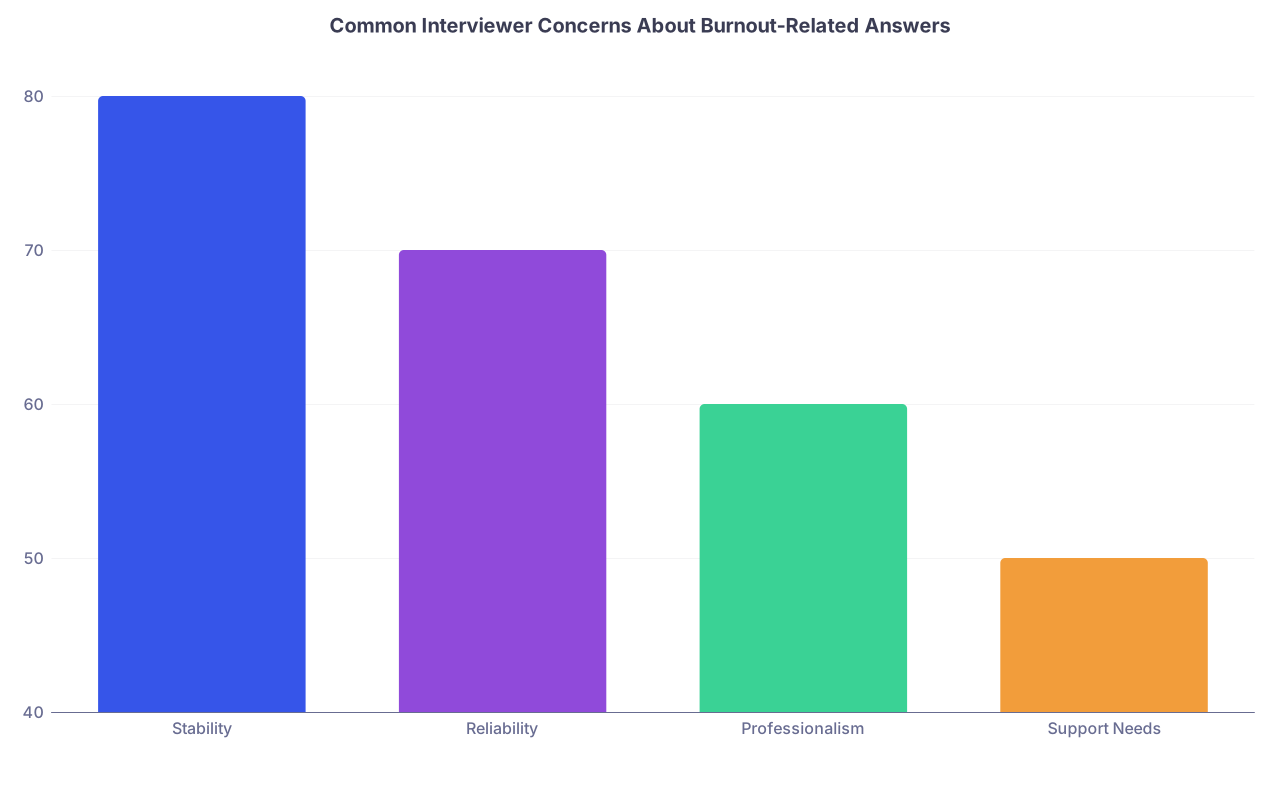
| Category | Value |
|---|---|
| Stability | 80 |
| Reliability | 70 |
| Professionalism | 60 |
| Support Needs | 50 |
When it can help to share
It can strengthen your application if:
- The experience is clearly in the past or well controlled.
- It clearly led to specific, durable growth (boundaries, empathy, insight).
- You can speak about it calmly, succinctly, and without visible distress.
Example (moderately disclosing, controlled):
“Early in college, I struggled with anxiety. I was overcommitted, sleeping poorly, and my performance suffered. I started meeting with a counselor through student health and made concrete changes—fewer extracurriculars, consistent sleep, and regular exercise. Those changes have stuck; over the last two years I have maintained strong academic performance while managing a full but realistic schedule. That experience forced me to develop habits and self-awareness that I expect will be essential in medical training.”
That answer:
- Names the issue without dwelling on symptoms.
- States you sought appropriate help.
- Emphasizes time course and current stability.
- Connects directly to future coping.
When you should not dive into detail
Red flags in how applicants talk:
- Ongoing, uncontrolled impairment: “I still have frequent panic attacks during exams.”
- No treatment, no insight: “I was severely depressed but never told anyone and just pushed through.”
- Identity fully wrapped in illness: “My whole path in medicine is about my trauma.”
That does not mean you hide your truth. It means you decide what is relevant for the interview and what belongs with a therapist, not an adcom.
If you are actively unstable or barely holding it together, your priority is health, not performance in an interview. Step back, get care, and reapply later if needed. That is not weakness. That is precisely the kind of judgment medicine requires.
Language That Raises Red Flags vs Language That Builds Confidence
You can describe almost the same underlying experience in a way that sounds either risky or reassuring. The difference is framing, specificity, and trajectory.
| Topic | Risky Phrasing | Reassuring Phrasing |
|---|---|---|
| Stress level | “I was totally overwhelmed all semester.” | “There was a period where my workload exceeded my limits.” |
| Mental health | “I had a complete breakdown.” | “I realized my coping strategies were not sufficient.” |
| Response to difficulty | “I just pushed through and survived.” | “I restructured my commitments and added support.” |
| Current status | “I still struggle with that a lot.” | “What I learned has shaped routines that work for me now.” |
| Systemic burnout in medicine | “Medicine burns everyone out eventually.” | “There are real challenges, and I want to be part of sustainable solutions.” |
Themes you want in your language:
- Controlled, measured tone.
- Ownership of your choices, not blame.
- Forward-looking, with concrete habits or systems you use.
Themes you want to avoid:
- Catastrophic language.
- Total helplessness or fatalism.
- Vague generalities with no behavior tied to them.
Concrete Answer Templates You Can Adapt
Let me give you some templates. Do not memorize these word for word; that will sound canned. But use the structure.

| Step | Description |
|---|---|
| Step 1 | Question about stress/burnout |
| Step 2 | Choose specific but bounded example |
| Step 3 | Acknowledge reality of stress in medicine |
| Step 4 | Describe context briefly |
| Step 5 | Explain early warning signs |
| Step 6 | Outline concrete actions taken |
| Step 7 | State current stable habits |
| Step 8 | Discuss systemic + individual factors |
| Step 9 | Share how youll apply this in training |
| Step 10 | Personal or general? |
Template 1: “How do you handle stress?”
“Stress is inevitable in [college / research / clinical] environments, so I focus on having consistent systems rather than one-time fixes. For me, that looks like [strategy 1], [strategy 2], and [strategy 3 – usually something social or reflective]. For example, during [specific high-stress period], I [concrete planning / boundary / self-care action]. When I notice [early warning sign], that is my signal to [adjustment you make]. I anticipate that medical school will be more demanding, but the same principles will apply: structured planning, protecting a few key wellness habits, and asking for help early when I need it.”
Template 2: “Tell me about a time you felt burned out or overwhelmed.”
“During [time frame], I took on [set of responsibilities]. At first it felt manageable, but after a few weeks I noticed [specific signs: declining performance, irritability, loss of enjoyment]. One specific moment that stood out was [brief incident]. That was a wake-up call that my approach was not sustainable. I [actions: sought advice, reduced commitments, changed study schedule, added sleep/exercise, saw counselor if relevant]. Since then, I have [ongoing habit or boundary], and in later demanding periods like [later example], I was able to manage the load much more effectively.”
Template 3: “What role should wellness play in medical education?”
“I see wellness as less about pampering and more about sustaining the capacity to learn and care for patients over the long term. From what I have seen in [shadowing / scribing / volunteering], people perform best when they have [examples: reasonable rest, psychological safety, efficient systems]. At the student level, that means building habits around time management, sleep, and having some identity outside of school. At the institutional level, it means thoughtful scheduling, mentoring, and a culture where asking for help early is viewed as responsible, not weak. I want to be part of that culture by [brief personal commitment: modeling boundaries, being a supportive peer, engaging in QI projects].”
Calibrating Disclosure: How Much Is Too Much?
Here is a practical way to think about it. Ask yourself three questions about any story you are considering sharing:
Is this story necessary to convey my point, or just emotionally powerful?
If you can make the same growth point with a less extreme example, use the less extreme one.Can I tell this story in 60–90 seconds, calmly, without feeling activated?
If you feel your throat tighten even in practice, it is probably too raw.Can I clearly articulate how I function now and what changed?
If the arc is still “I am working on it,” that is fine for life but weak for an interview centerpiece.
You are allowed to decline to go deep. If someone pushes you with something like, “Have you ever experienced burnout personally?” you can answer in a controlled way:
“I have certainly had times when I was stretched too thin and had to reassess my approach, like [brief controlled example]. Those experiences have made me more intentional about [habits/boundaries]. I try to address stress early now rather than waiting until it becomes unmanageable.”
Notice: you acknowledge, you do not deny, but you also do not open your full chart.
Practicing Without Sounding Robotic
You cannot improvise good answers to these questions on the fly and expect them to land well. You also cannot script them to death.
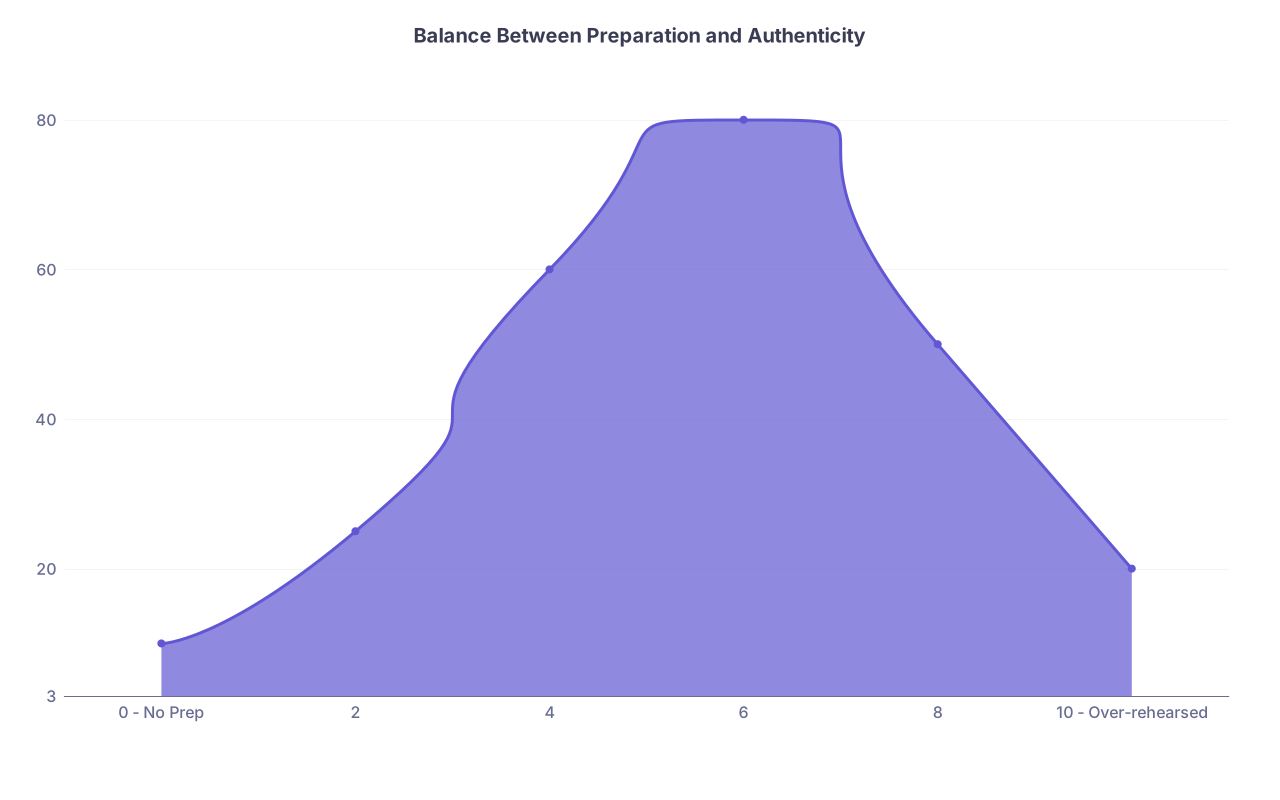
| Category | Value |
|---|---|
| 0 - No Prep | 10 |
| 2 | 25 |
| 4 | 60 |
| 6 | 80 |
| 8 | 50 |
| 10 - Over-rehearsed | 20 |
Target zone: rehearsed structure, natural language.
Practical approach:
Write out your answers in full once.
Not because you will read them, but to clarify your own narrative and avoid rambling.Underline key anchors:
- The context summary (one sentence).
- The warning signs you noticed.
- The 2–3 concrete actions you took.
- The “what I do differently now” line.
Practice aloud with a timer:
- Aim for 60–90 seconds per answer.
- Record yourself once or twice and listen specifically for:
- Cliché overload (“I manage my time well, I stay organized, I work hard…”)
- Over-sharing or wandering.
Get feedback from someone who will be honest:
- Prehealth advisor, mentor, or a peer who is not conflict-avoidant.
- Ask them explicitly: “Does this sound stable and mature, or does anything sound like a red flag?”
Do not rehearse 50 times. You will lose tone. Five to ten thoughtful run-throughs is enough to make your answers coherent and flexible.
The Deeper Mindset Shift: You Are Not Proving Invincibility
The hidden trap in all of this is the belief that you must present yourself as nearly indestructible to be accepted into medicine. That belief, by the way, is exactly how many physicians end up burned out: years of refusing to acknowledge limits, refusing help, and equating self-care with weakness.
What interviewers want is not invincibility. They want durability.
Durability looks like:
- Recognizing when your current pattern is not working.
- Adjusting early.
- Using resources without shame.
- Maintaining professionalism under pressure, not perfection.
If your answers communicate that, you are doing it right.
FAQ (Exactly 5 Questions)
1. Should I ever say the word “burnout” about myself in an interview?
You can, but with precision. Saying “I felt burned out and here is how I responded, and here is how I function now” is far better than dramatic language like “I completely burned out and crashed.” Personally, I prefer framing it as “I realized my approach was not sustainable” or “I was stretched beyond my limits” and then focusing heavily on the changes you made. The more extreme the term, the more carefully you need to show current stability.
2. Is it a mistake to mention seeing a therapist or counselor?
Not inherently. In fact, calmly describing that you sought counseling, implemented strategies, and are now doing well often signals maturity. The red flag is not “I saw a therapist.” The red flag is “I am still in acute crisis” or “I never learned anything from that process.” So if you mention professional help, anchor it with a clear before/after in your functioning and habits.
3. What if I truly have not experienced anything close to burnout yet? Won’t I sound naive?
You do not need to manufacture drama. You can say something like, “I have not experienced what I would call burnout, but I have had periods of significant stress, like [example], where I had to be deliberate about how I managed my time and energy.” Then walk through your concrete strategies and how you monitored your wellbeing. Awareness and preparation matter more than having suffered maximally.
4. How do I talk about systemic problems without sounding negative or anti-medicine?
Be specific and balanced. For instance: “From shadowing and reading, I see that electronic documentation and workload can contribute to burnout. I do not think this diminishes the value of medicine, but it does highlight the need for systems-level changes—more efficient workflows, team-based care, and supportive leadership. At the same time, I know I will have personal responsibility for my own boundaries and habits.” That tone shows realism and commitment, not cynicism.
5. What if I start to get emotional while answering a burnout or wellness question?
A little emotion is human; losing control is what worries interviewers. If you feel yourself getting choked up, pause, take a breath, and it is perfectly acceptable to say, “This is meaningful to me; let me take a second to gather my thoughts.” Then either continue briefly or gently pivot to the growth and present-focused part of your answer. If a topic consistently brings you close to tears in practice, choose a different example for the real interview.
Key point one: You are not trying to prove you never struggle. You are demonstrating that you recognize stress, respond early, and are stable now.
Key point two: Specific, behavior-focused stories with clear growth arcs are trusted. Vague clichés and uncontrolled oversharing are not.
Key point three: If you frame burnout and wellness as long-term professional sustainability, not personal fragility, your answers will land exactly where they should—mature, realistic, and red-flag free.