
You are sitting in a Zoom waiting room for your first MMI circuit.
Station 3 pops up in the schedule: “Ethical Scenario.” Your heart rate jumps a little. You have no idea if they are about to throw you an impaired colleague, a resource allocation nightmare, or a confidentiality trap dressed up as a ‘friend asking for help.’
Here is the problem: most students approach ethical MMIs the same way they cram for biochem. Memorize buzzwords, skim some four-principles ethics, hope the right phrase pops out under pressure.
That does not work.
What does work is having a decision tree in your head. A structured way you attack any ethical scenario in 60–90 seconds of thinking time, and then talk through it clearly for the next 5–8 minutes.
Let me break this down specifically.
The Core Decision Tree: How To Think In Real Time
You need one mental algorithm you can apply to almost anything: cheating, confidentiality, resource allocation, cultural conflict, end-of-life, professionalism.
Use this skeleton. Internalize it so hard you can run it half-asleep.
Step 1 – Clarify the scenario.
What is actually happening? Who is involved? What is your role?
Step 2 – Identify the stakeholders.
Who is affected now and downstream? Include the “hidden” ones (future patients, institution, public trust).
Step 3 – Surface the ethical principles in tension.
Usually some mix of:
- Autonomy
- Beneficence
- Non-maleficence
- Justice
- Professionalism / fidelity / integrity
Do not list all five like a robot. Pick the 2–3 actually in conflict.
Step 4 – Identify your obligations and constraints.
What are you allowed to do? Required to do? Forbidden to do? Think laws, institutional policies, scope of your role (student vs physician vs friend).
Step 5 – Generate options (at least 3).
Not just “do it” vs “do nothing.” Realistic graduated options. Often:
- Handle it quietly / informally.
- Escalate to an appropriate authority.
- Refuse / withdraw / seek guidance.
Step 6 – Analyze harms and benefits for each option.
Short term and long term. To each stakeholder. Explicitly link back to principles.
Step 7 – Decide and justify.
Pick one path. Commit. Explain why it best balances principles and protects patients / public / integrity, even if imperfect.
Step 8 – Add process: communication and reflection.
How you would speak to people respectfully, document, seek supervision, and learn from it.
That is your decision tree. Now, let us plug in common MMI categories and show you exactly how to move through it under time pressure.
Common Scenario Type 1: Cheating, Impairment, and Professional Misconduct
These are the “your friend is doing something bad, what do you do?” stations. They test whether you understand that medicine is a team sport with public trust on the line.
Classic pattern
- A classmate cheats on an exam.
- A resident shows up clinically impaired.
- A colleague falsifies a chart.
- A friend asks you to sign them in when they are not present.
The wrong instinct is binary: “I would protect my friend” vs “I would immediately report them.” Interviewers want to see your reasoning, not a reflex.
Walk through the tree.
Step 1–2: Clarify and stakeholders
You: second-year med student, not in formal leadership.
Stakeholders:
- Patient(s) (even if not directly present yet; future patients matter).
- The impaired/cheating colleague.
- Other students / team members.
- Institution (reputation, accreditation).
- Public trust in the profession.
Step 3: Principles
- Non-maleficence and beneficence → patient safety and quality of care.
- Integrity / professionalism → honesty, fairness, trust.
- Justice → fair evaluation, others disadvantaged by cheating.
- Autonomy is usually secondary here.
Step 4: Obligations
Key conceptual point: Once patient safety is at stake, your duty to patients overrides loyalty to peers.
If it is purely an academic integrity issue (no immediate patients in front of you), you still owe fairness to classmates and honesty to the institution, but you may have more room to start informally.
Step 5–7: Options and justification
Example: Resident appears intoxicated before a shift.
Options:
- Ignore it and hope for the best.
- Confront them privately, suggest they go home.
- Immediately contact the supervising attending or relevant authority (chief resident, program director).
- Both 2 and 3: express concern directly, but also ensure leadership knows.
Analysis:
- Option 1: Violates non-maleficence and beneficence. Unacceptable.
- Option 2: Respects the resident, but may be inadequate for patient safety if they refuse.
- Option 3: Protects patients but can feel confrontational or disloyal. Still ethically strongest.
- Option 4: Often best in real life. Immediate escalation with a compassionate conversation.
You want to say something like:
“Given the potential risk to patients, I would prioritize non-maleficence over personal loyalty. I would quickly and discreetly alert the supervising physician or appropriate authority so that this resident is removed from clinical duties. If safe and appropriate, I would also express concern to the resident directly and frame it in terms of their well-being as well as patient safety. This approach protects patients, respects institutional policies, and still treats my colleague as a person in need of help rather than just a problem.”
For cheating on an exam (no patient harm today but big future implications), your decision tree is the same, but the timeline is slightly less urgent. You can emphasize:
- Talking to the peer first.
- Encouraging self-report.
- If they refuse, escalating, because fairness and professional integrity are non-negotiable.
Common Scenario Type 2: Confidentiality vs Safety
This is the “your friend tells you X, do you keep it private?” station.
Variants:
- Friend confesses suicidal ideation and asks you to promise secrecy.
- Patient is HIV positive and refuses to tell their partner.
- Teen asks for contraception without parental knowledge.
- Peer admits to using illegal drugs regularly.
This category tests whether you understand that confidentiality is not absolute.
Run the tree
Step 1–2: Clarify and stakeholders
- Speaker (friend/patient).
- You (student/future physician).
- Third parties at risk (family, partner, public).
- Institution / legal system (if mandated reporting issues).
Step 3: Principles
- Autonomy and confidentiality (respecting privacy, trust).
- Beneficence (helping the person who disclosed).
- Non-maleficence (preventing harm to them or others).
- Sometimes justice (e.g., if harm is unevenly distributed).
Step 4: Obligations and limits
Core idea:
Confidentiality is strong but not unlimited. Safety overrides absolute secrecy.
Mandated exceptions (varies by region, but you can speak conceptually):
- Imminent risk of serious harm to self or others.
- Certain infectious diseases or public health threats.
- Child or elder abuse reporting.
You do not need to quote specific laws. You need to show you know there are legal & professional boundaries.
Step 5–7: Options
Example: Friend tells you they are suicidal, begs you not to tell anyone.
Options:
- Promise secrecy and just “be there” for them.
- Encourage them strongly to seek help, but if they refuse, respect their choice.
- Encourage them strongly; if they refuse, break confidentiality to protect them (inform a trusted adult, physician, counseling service, emergency services depending on acuity).
Your justified path:
“I would first thank them for trusting me and listen carefully. I would explore how immediate the risk is: do they have a plan, means, timeline. I would make it clear, gently but firmly, that I care too much about them to keep a secret that could cost their life. I would try to involve them in seeking help—offering to call a crisis line together, contact a counselor, or reach out to a trusted family member. If they refuse and I genuinely believe there is a serious and imminent risk, I would break confidentiality and contact appropriate support, because non-maleficence and preservation of life must override a promise of secrecy in this context.”
They are evaluating whether you:
- Take suicide risk seriously.
- Understand limited confidentiality.
- Communicate with empathy, not just policy.
For patient scenarios (HIV refusal to disclose to partner), you say something similar but in the clinical frame: explore reasons, counsel, negotiate, document, involve infectious disease / ethics / legal, and if allowed in your jurisdiction, use public health mechanisms to protect the partner.
Common Scenario Type 3: Resource Allocation and Justice
These are the “only one ventilator, two patients” or “who gets the last liver” stations. They are testing your grasp of fairness, triage, and impersonal decision-making.
Most students fumble here by focusing on who is more “deserving” in a moralistic sense. That is a trap.
The decision tree adapted to triage
Step 1–2: Clarify and stakeholders
- Patients competing for the resource.
- Their families.
- Future patients needing the same resource.
- Healthcare team and institution.
- Society (if this is policy-level).
Step 3: Principles
- Justice (fair distribution).
- Utility (maximizing overall benefit).
- Non-maleficence and beneficence for each patient.
- Respect for persons (avoid discriminatory value judgments).
Step 4: Obligations and constraints
Key point: You do not invent criteria on the fly. You follow or propose transparent, consistent, evidence-based policies that avoid discrimination on irrelevant traits (race, wealth, social status, disability per se).
You can reference typical triage criteria:
- Medical prognosis / likelihood of survival with treatment.
- Duration and intensity of benefit.
- Urgency and severity of illness.
- Sometimes “first come, first served” if all else is equal.
Step 5–7: Options
You are rarely asked to flatly choose patient A vs B. Instead, you should:
- State that you would want pre-established institutional triage protocols, developed with ethics input, not ad-hoc decisions by a single clinician.
- If forced to reason: favor allocation to the person with higher likelihood of survival and greater expected benefit, as long as criteria are clinically relevant and non-discriminatory.
- Emphasize communication with the patient/family not chosen, and continued care and palliation.
Example justification:
“In a resource-scarce situation like competing ventilator needs, I would want to rely on institutional triage guidelines designed ahead of time, which prioritize ethical principles of justice and utility. Typically this means using objective clinical criteria such as likelihood of survival with treatment, severity of illness, and potential duration of benefit. I would avoid value judgments about social worth or non-medical characteristics. If, under those criteria, one patient has a significantly higher chance of meaningful recovery, allocating the ventilator to that patient would maximize benefit while still applying the same framework to all. For the patient who does not receive the ventilator, I would ensure they receive excellent palliative and supportive care, and that the decision is communicated honestly, compassionately, and transparently to their family.”
You do not need to produce a full triage policy. You need to show you understand fairness, consistency, and avoidance of bias.
To make this concrete, here is a simple comparison of allocation criteria:
| Criterion Type | Example |
|---|---|
| Clinically relevant | Likelihood of survival with treatment |
| Clinically relevant | Severity and reversibility of condition |
| Clinically relevant | Expected duration of benefit |
| Problematic / biased | Social status or profession |
| Problematic / biased | Ability to pay out-of-pocket |
Common Scenario Type 4: Cultural or Religious Conflict
These stations look like: “Patient refuses blood transfusion for religious reasons” or “Family insists on continuing aggressive treatment that seems futile” or “Parent wants a treatment you consider harmful.”
They are testing whether you can handle disagreement without arrogance and without abandoning core ethical duties.
Run the tree
Step 1–2: Clarify and stakeholders
- Patient.
- Family and surrogate decision-makers.
- Healthcare team.
- Institution.
- Sometimes broader community.
Step 3: Principles
- Autonomy: patients’ right to make informed decisions.
- Beneficence / non-maleficence: clinician’s duty to recommend evidence-based, safe care.
- Respect for persons and cultural diversity.
- Sometimes justice if resources are at play.
Step 4: Obligations and limits
Crucial nuance:
- Competent adults can refuse treatment, even life-saving, if informed.
- You cannot be forced to provide harmful or non-beneficial treatment.
- For minors, parental authority is significant but not absolute; clinicians and legal systems can override decisions that seriously endanger the child.
Step 5–7: Options
Example: Competent adult Jehovah’s Witness refuses blood transfusion for life-threatening anemia.
- Confirm competence and understanding.
- Explore their values and reasons. Check that they truly understand the risks and alternatives.
- Offer all acceptable alternatives (bloodless surgery techniques, erythropoietin, volume expanders, etc.).
- Involve ethics, chaplaincy, or cultural mediators if helpful.
- If they persist, respect their autonomous refusal, document thoroughly, and continue to treat within their constraints.
Your explanation could sound like this:
“I would first ensure the patient has full decision-making capacity and understands the seriousness of their condition and the potential consequences of refusing a transfusion. I would ask them to explain their understanding back to me. I would then explore their beliefs respectfully, offer all available alternatives that might align with their values, and involve interpreters or chaplaincy if appropriate. If, after this process, a competent adult continues to refuse, I would respect their autonomy while documenting the discussion carefully and providing the best possible care within the constraints they have set.”
For a child where parents refuse a life-saving but low-risk treatment based on beliefs (e.g., insulin for DKA), your decision tree shifts: beneficence toward the child and non-maleficence override parental autonomy. You would:
- Attempt respectful negotiation.
- Involve senior physicians, ethics, social work.
- If necessary, seek legal authority (temporary custody / court order) to treat.
That tension—respect vs duty to protect—is exactly what they want to see you unpack.
Common Scenario Type 5: End-of-Life and “Futile” Treatment
These stations are less common at the premed level, but they show up enough that you should be ready.
They often sound like:
“An ICU patient has minimal chance of recovery. Family insists on ‘doing everything’ including high-burden, low-benefit interventions. What do you do?”
Same tree. Different context.
Walk it through
Step 1–2: Clarify and stakeholders
- Patient (even if not conscious).
- Family / surrogate decision-maker.
- Healthcare team.
- Other patients indirectly affected by resource use.
- Institution.
Step 3: Principles
- Beneficence / non-maleficence: avoid painful, non-beneficial treatment.
- Respect for prior patient wishes (advance directives) and autonomy.
- Justice if resources are very constrained.
- Honesty and transparency.
Step 4: Obligations and constraints
- You are not ethically obligated to provide treatments that are medically futile in the strict sense (no reasonable chance of achieving the intended physiological goal).
- But “futility” is often not purely objective; it is value-laden.
- You owe families clear, compassionate communication, not just “we are not doing this.”
Step 5–7: Options
This is about process, not magical resolution. You describe steps:
- Gather full medical facts and prognostic data.
- Clarify whether the patient has expressed prior wishes (advance directives, previous discussions).
- Arrange a family meeting with the interdisciplinary team.
- Use clear, non-euphemistic language about prognosis. Avoid false hope.
- Explore the family’s understanding, values, fears.
- Propose a plan focused on comfort, dignity, and aligning with patient’s goals.
- Involve palliative care, ethics if there is disagreement.
- If, after extensive discussion, the team believes a requested intervention is non-beneficial and potentially harmful, they may decline to offer it, with institutional support.
You do not need to “solve” the conflict in your answer. You need to show maturity in your process and sensitivity to grief while still grounded in ethics.
The Communication Layer: How You Sound While Using the Tree
Content is one axis. Delivery is the other. Interviewers care about both.
Here is a simple mental checklist for how to talk through your tree.
1. Announce your structure out loud
You are thinking in a decision tree. Say that.
Something like:
“I will start by identifying who is affected, then the main ethical principles at stake, and then I will walk through a few options and explain which I would choose and why.”
You have now told the interviewer: my answer will be organized. Then you prove it.
2. Show you see the gray zone
Avoid cartoon answers: “I would always report immediately” or “I would never break confidentiality.” Real ethics live in gray space.
You want phrasing like:
- “My first step would be to…”
- “Before deciding, I would want to understand…”
- “I see a tension between respecting X and protecting Y…”
And still: you end with a decision. You are not allowed to hide in ambiguity.
3. Be explicit about trade-offs
Interviewers are listening for sentences like:
- “This approach best protects patient safety, even though it may strain my relationship with my colleague.”
- “Respecting this patient’s competent refusal may be emotionally difficult, but autonomy here must override my personal discomfort.”
- “Breaking confidentiality in this case sacrifices some privacy to prevent serious harm, which I think is ethically justified.”
Those sentences are gold in an ethical MMI. They show you understand ethics as balancing, not rule-reciting.
A Visual: Your Internal MMI Ethics Flowchart
To cement this, here’s a simple flow mindset you can picture and run in any station.

| Step | Description |
|---|---|
| Step 1 | Read scenario carefully |
| Step 2 | Identify stakeholders |
| Step 3 | Name key ethical principles |
| Step 4 | Clarify your role & constraints |
| Step 5 | Generate 2-3 realistic options |
| Step 6 | Weigh harms & benefits to each stakeholder |
| Step 7 | Choose option best balancing principles |
| Step 8 | Explain communication steps & reflection |
That is it. Eight nodes. You can run that in under a minute mentally.
How To Practice This So It Actually Sticks
You do not get good at ethical MMIs by reading lists of “top 50 scenarios.” That just gives you recognition, not reasoning.
Use this instead:
1. Case sprints with the same tree every time
Grab any ethical prompt (there are hundreds online). For each:
1 minute: silently run the 8-step tree.
5 minutes: speak your answer out loud, recording yourself.
2 minutes: listen back and ask:
- Did I mention stakeholders?
- Did I name principles clearly?
- Did I give at least 3 options?
- Did I explicitly justify my final choice?
You want to reach the point where those elements appear automatically.
2. Swap category labels; keep the structure
Do one cheating case, one confidentiality case, one resource case, one cultural case. Same internal structure, different surface content. That builds transferability.
3. Use specific phrases that signal maturity
Practice inserting lines like:
- “I would want to seek supervision from a senior colleague or ethics committee, recognizing my own limits as a trainee.”
- “I would document the discussion carefully to protect all parties and to maintain transparency.”
- “I recognize that this is emotionally challenging, and I would aim to communicate with empathy while still upholding my professional obligations.”
Those phrases show you understand how real medicine works: hierarchies, documentation, ethics consults. Interviewers like that.
One More Example, Fully Walked Through
Let me put it all together with a medium-difficult, very realistic MMI scenario, and I will run the tree step by step.
Scenario:
You are a third-year medical student on an internal medicine rotation. A senior resident you admire prescribes a medication dose that seems too high for an elderly patient with kidney disease. The nurse asks you if the dose is correct. The resident is busy and seems stressed. What do you do?
Run the tree.
Stakeholders:
- Patient (risk of harm).
- Resident.
- Nurse.
- You.
- Attending and institution (quality of care, liability).
Principles:
- Non-maleficence (avoid medication harm).
- Beneficence (protect patient health).
- Professionalism and integrity.
- Hierarchy / respect vs duty to speak up.
Role & constraints:
- You are a student. Not the prescriber. Not legally in charge.
- You are still responsible to raise concerns about possible harm.
- There is a nursing colleague also worried.
Options:
- Say nothing and assume the resident knows what they are doing.
- Tell the nurse you are not sure but to follow the order.
- Check the dose yourself (reference, EMR) and, if still concerned, speak discreetly to the resident.
- If resident is unavailable or dismissive and you still believe there is imminent risk, escalate to the attending or another senior clinician.
Analysis:
- Options 1 & 2: fail non-maleficence; you have a reasonable concern and a duty to voice it.
- Option 3: respects hierarchy but challenges potentially harmful order appropriately. Uses evidence (drug reference, guidelines).
- Option 4: ensures patient safety if resident does not respond adequately.
Decision & justification (spoken):
“My primary duty, even as a student, is to patient safety. I would first quickly double-check the dose using available resources—drug reference tools or the hospital’s prescribing system—to see whether it is appropriate for an elderly patient with impaired renal function. If it still appears excessive, I would approach the resident discreetly and respectfully, perhaps saying, ‘I looked up the recommended dose for this medication in renal impairment, and it seems lower than what is ordered—could we review this together?’ This frames it as a shared check rather than a challenge. If I were unable to reach the resident quickly, or if they dismissed the concern without explanation and I remained genuinely worried about harm, I would escalate the concern to the attending physician or another senior team member. That might feel uncomfortable, but non-maleficence and beneficence toward the patient should override my discomfort with hierarchy.”
- Process and reflection:
- Mention that you would appreciate feedback later to understand the dosing decision.
- Note that speaking up is part of being a safe team member.
That is the exact kind of answer that makes an interviewer think, “Yes, I would trust this person on my team.”
Looking Ahead
Right now, you are probably still at the stage where ethical scenarios feel like landmines. Random, unpredictable, each one needing a different trick.
Once you internalize this decision tree, that feeling goes away. The surface details change; your method does not. You stop memorizing answers and start thinking like someone the public can actually trust.
From here, your next step is straightforward: build a small bank of 15–20 diverse ethical cases and run this structure on every single one until you are bored of it. When you hit that point, you are finally ready for live-fire MMI practice with peers or a coach.
And once this framework is automatic, you will find it bleeds into more than just ethics stations. Policy questions. Team conflict. Health advocacy. They all become variants of the same reasoning process.
With that foundation in place, you are in a much better position to walk into the MMI circuit and treat each station as a problem to think through, not a trap to escape. The rest—communication polish, timing, presence—that is the next layer. But that is a story for another day.
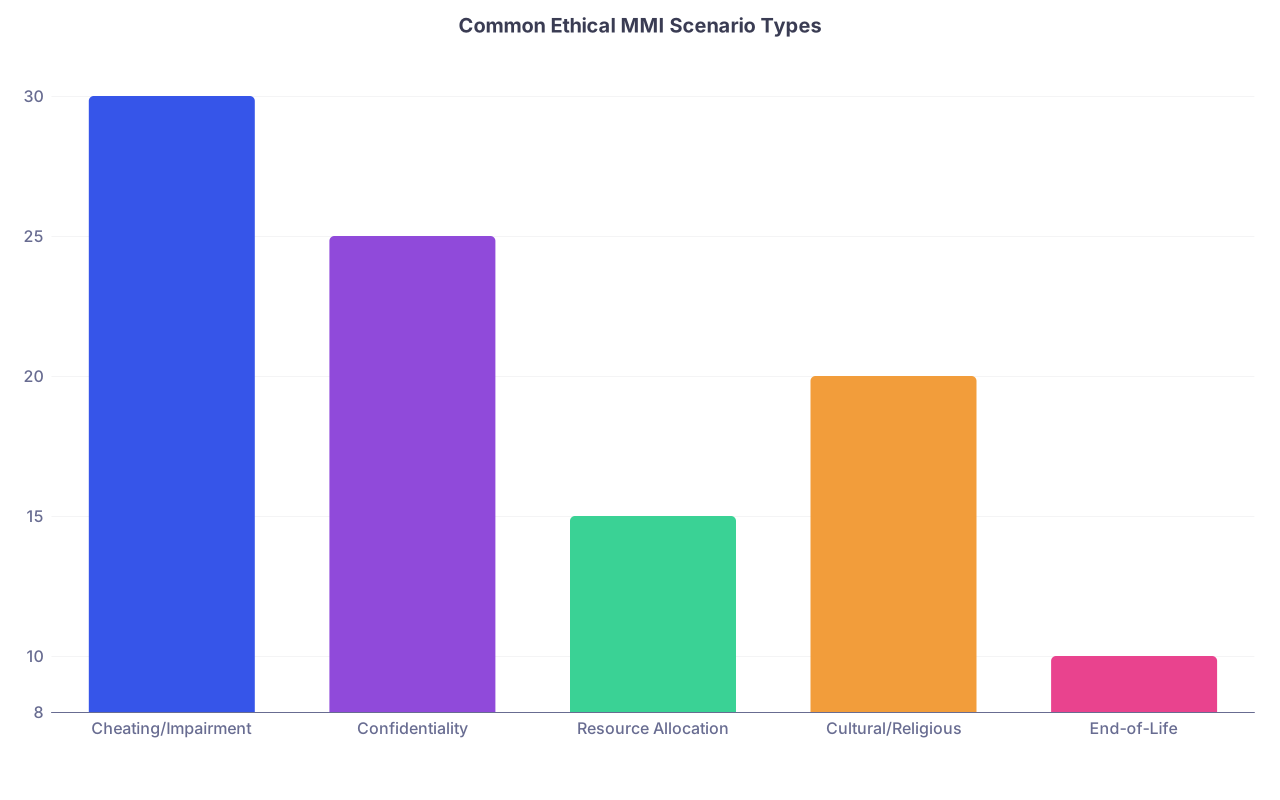
| Category | Value |
|---|---|
| Cheating/Impairment | 30 |
| Confidentiality | 25 |
| Resource Allocation | 15 |
| Cultural/Religious | 20 |
| End-of-Life | 10 |