
You are sitting in a quiet study room on campus. Your first MMI circuit for medical school is in 48 hours. You just pulled up a practice prompt:
“Tell me about a time you had a conflict with a teammate and how you resolved it.”
You start talking. Three minutes later, you realize you are rambling. The story feels scattered. You are not sure you ever actually answered the question. And you know this is exactly the type of complex behavioral question that will decide whether you look polished… or not ready.
This is where the STAR+R method stops being “nice theory” and starts being survival gear.
Let me break this down specifically for premeds and medical students facing MMI, traditional interviews, and later, residency interviews.
What STAR+R Actually Is (And Why You Keep Butchering It)
Most people have heard of STAR:
- Situation
- Task
- Action
- Result
STAR+R adds one more piece:
- Reflection
Not as a vague “what I learned” sentence. As a structured, explicit, high-yield segment that shows growth, self-awareness, and alignment with medicine.
Here is the problem: almost every student I have worked with either:
- Spends 80% of their time in Situation and Task and rushes Action/Result/Reflection, or
- Gives generic reflections that could fit any applicant, any specialty, any year.
You want the opposite. For complex behavioral questions, your power is in:
- Tight context
- Crisp problem definition
- Specific behaviors
- Measurable outcomes
- Targeted reflection that ties directly to being a stronger future physician
Anatomy of STAR+R for Medical Interviews
Let us dissect each component in the medical education context.
S — Situation: Set the Scene Fast
Your goal: give just enough context so the interviewer is oriented within 15–25 seconds.
Bad:
“I was in college and I did a lot of group projects, and there was one time where we had some conflict…”
Better:
“During my junior year, in a 6-person capstone research team, we were preparing a poster for a regional neuroscience conference with a hard submission deadline.”
Three rules for Situation in medical interviews:
- Anchor it in a real, specific environment: course, lab, clinic, volunteering site, job, or leadership role.
- Include stakes: time pressure, patient impact, grade, ethics, professionalism, safety, or interpersonal impact.
- Avoid autobiography. This is not “tell me about yourself.” It is “put me in the room.”
Target length: 2–4 sentences. That is it.
T — Task: Clarify Your Responsibility, Not the Universe’s
Task is where most premeds drift into philosophical territory.
Bad:
“The task was to make sure the group functioned well and everyone was on the same page.”
That is vague and unmeasurable.
Better:
“My responsibility, as the designated project lead, was to coordinate data analysis, integrate everyone’s sections, and submit a coherent poster on time.”
You are answering: What, concretely, were you supposed to accomplish?
For clinical or shadowing stories, Task often involves:
- Ensuring safe, respectful patient care within your role limits
- Communicating clearly with team members or families
- Following protocols while adapting to patient needs
- Upholding professionalism, confidentiality, or ethics
Task should be 1–2 sentences. If it sounds like a mission statement, narrow it.
A — Action: This Is Where Most of Your Words Go
Action is you on the field. It is where your judgment, communication, and problem-solving show up.
In complex behavioral questions (conflict, ethical tension, major change, failure), Action is not just “what I did.” It is:
- What I noticed
- What I decided
- What I said
- How I adapted
For medical interviews, your Action section should surface specific competencies:
- Communication with patients / peers / faculty
- Interprofessional collaboration
- Handling feedback
- Managing time and priorities
- Coping with stress, ambiguity, or failure
- Advocating respectfully (for patients, teammates, yourself)
Example (conflict question):
“First, I met individually with each team member to understand their concerns without assigning blame. I learned that two members felt their data analysis was being ignored. I then scheduled a brief meeting where I summarized what I had heard, acknowledged the tension, and proposed that we revisit the analysis plan together. During the meeting, I used a shared Google Doc to list each person’s contributions and asked the group to decide collaboratively which analyses best answered our research question. I also redistributed tasks so that the timeline was realistic and everyone’s work was visible in the final poster.”
Notice: verbs, sequences, specifics. Action is not “we resolved it.” It is the play-by-play of how.
R — Result: Outcomes, Not Vibes
Interviewers are unimpressed by “It went well” and “Everyone was happy.”
Result must have:
- Something objective (grade, outcome, improvement, changed behavior, feedback)
- Something relational (trust restored, communication improved, patient/family response)
For premed/med school level, you do not need dramatic hero stories. Modest, concrete outcomes are fine:
- “We submitted on time and received an honorable mention at the conference.”
- “The attending later commented that our handoff was among the clearest she had heard that day.”
- “Attendance at the tutoring sessions increased from 3–4 to 10–12 students per week over the semester.”
Be explicit. One or two sentences.
+R — Reflection: The Part That Actually Sells You
If you skip Reflection, you sound like you are reporting an event log. Medical schools and residency programs care about who you are becoming, not just what you did once.
Reflection has to do three things:
- Name a specific lesson or insight.
- Connect it to future behavior.
- Align it with being a better student/physician.
Weak reflection:
“I learned the importance of communication and teamwork.”
Strong reflection:
“This experience taught me that addressing conflict early and directly prevents small frustrations from hardening into resentment. Since then, I have made a habit of summarizing next steps in writing after group meetings, which has reduced misunderstandings on later projects. In a clinical team, I see that same proactive communication as essential for avoiding errors and protecting patient safety.”
See the difference? Concrete, longitudinal, connected to medicine.
Why STAR+R Matters More For Complex Behavioral Questions
Basic behavioral questions (“Tell me about a time you showed leadership”) are easy STAR training wheels.
The real exam is when they twist the question:
- “Tell me about a time you made a mistake that affected someone else.”
- “Describe a situation where you disagreed with a supervisor. What did you do?”
- “Tell me about an ethical dilemma you faced, and how you handled it.”
- “Describe a time when you were overwhelmed and how you responded.”
These are high-risk questions. You can easily:
- Expose poor judgment
- Sound defensive or blame others
- Minimize the impact of your mistake
- Reveal you have not grown
STAR+R keeps you from doing that. It forces you to:
- Own the problem (Task)
- Show mature coping and communication (Action)
- Be honest about impact (Result)
- Demonstrate insight and growth (Reflection)
Mapping STAR+R to Common Medical Interview Themes
Let me show you how to deliberately choose stories and frame them with STAR+R for the types of questions you actually get.
| Theme / Question Type | High-Yield Story Sources |
|---|---|
| Conflict with peer or teammate | Group projects, research lab, premed org, work |
| [Handling a mistake or failure](https://residencyadvisor.com/resources/med-school-interview-tips/how-to-tackle-failure-questions-using-growth-mindset-and-reflection) | Course struggle, exam failure, lab error, job |
| Ethical tension / professionalism | Clinical volunteering, scribing, shadowing, work |
| Working with someone very different | Community service, tutoring, mentoring, team |
| Leadership and initiative | Club officer, new program, quality improvement |
Conflict Example — STAR+R in Action
Prompt: “Tell me about a time you had a conflict with a coworker or teammate.”
S:
“During my second year, I worked as a medical scribe in a busy ED. I shared shifts with another scribe, and we were responsible for alternating patients for documentation during high-volume evening shifts.”
T:
“My responsibility was to ensure accurate, timely notes and to collaborate smoothly so the physicians were never waiting on documentation.”
A:
“Over several weeks, I noticed that my coworker frequently delayed charting, which meant I ended up taking extra patients to keep up. I started feeling resentful and worried that errors might slip through. Rather than complain to the attending, I first asked my coworker to grab coffee before a shift. I explained what I had observed, using ‘I’ statements, and emphasized that I wanted us both to succeed. I asked if there was something making charting difficult. She shared that she was still uncomfortable with the EMR templates and felt embarrassed asking for help. I offered to stay 30 minutes after our next shift to walk through examples together. We created a shared checklist for template sections and shortcuts. I also suggested we agree on a simple system to track who had which patients, so expectations were clear.”
R:
“Over the next month, her charting speed improved noticeably, and our division of patients became much more balanced. An attending later commented that our notes were consistently complete and timely, which reduced the time he spent correcting documentation.”
+R:
“This experience shifted how I view conflict. I had initially framed it as a work ethic issue, but by approaching her directly and listening, I learned it was more about confidence and training. I now try to assume there is a barrier I do not see before attributing problems to motivation. In a clinical team, I plan to use the same approach—address issues early, privately, and with curiosity—because it not only protects working relationships but ultimately supports more reliable patient care.”
Notice something: no one is perfect in this story. You are slightly resentful at first. That humanizes you. The resolution shows growth.
Time Management: Fitting STAR+R Into 2–3 Minutes
In MMIs and traditional interviews, you are not giving TED talks. You usually have 1.5–3 minutes of clean airtime before the interviewer starts probing.
Rough timing blueprint:
- Situation: ~15–25 seconds
- Task: ~10–15 seconds
- Action: ~60–90 seconds
- Result: ~15–25 seconds
- Reflection: ~20–40 seconds
Total: around 2–3 minutes.
If your Situation drags past 30–40 seconds, you are in trouble. You are probably dumping backstory or justifying yourself. Cut.
Building a STAR+R Story Bank (Premed Version)
You should not be inventing STAR+R on the fly in your first real interview.
You need a story bank: 8–12 experiences pre-structured as STAR+R, which you can adapt to different questions.
Categories to cover:
- Leadership
- Conflict / disagreement
- Failure / setback
- Ethical / professionalism challenge
- Working with diversity / cultural humility
- Initiative / starting something new
- Long-term commitment / perseverance
- Clinical or patient-facing insight (if you have it)
Process to build each story:
- List the raw experience in 1 sentence.
- Draft S/T in 4–5 sentences total.
- Write out Action as a bullet sequence first (even though you will not speak in bullets): what you noticed → what you decided → what you said/did → how you adapted.
- Add 1–2 sentences of Result with something objective.
- Write a Reflection that clearly states:
- “This taught me…”
- “Since then, I have…”
- “As a future physician, this matters because…”
Once you have that written, you practice compressing it into a spoken 2–3 minute response.
Handling “Ugly” Stories Using STAR+R
You will be tempted to only choose clean, flattering stories.
That is a mistake.
Schools are not looking for people who have never failed. They want people who fail, own it, and improve. STAR+R gives you a way to safely present:
- Academic struggle
- A major miscommunication
- A professionalism misstep (within reason)
- Overwhelm and burnout moments
The key rule: You must not still be in the middle of the failure. The Result and Reflection need to show a clear arc of learning and change.
Example: academic setback.
S:
“In my first semester of organic chemistry, I underestimated the course and balanced it with a heavy work schedule and leadership role.”
T:
“My responsibility was to master the material and maintain my scholarship, which required staying above a certain GPA.”
A:
“After scoring far below the class average on the first midterm, I met with the professor to review my exam. I realized that my issue was not content gaps but the way I approached problems and time management during tests. I shifted from passive rereading to active problem sets, joined a peer study group, and blocked specific hours for orgo in my calendar while temporarily stepping back from nonessential extracurricular tasks. I also began using the professor’s office hours weekly to check my understanding.”
R:
“By the final exam, my performance improved from the bottom quartile to slightly above the class average. I ended the course with a B+, preserved my scholarship, and felt genuinely more confident with the material.”
+R:
“That experience forced me to confront my limits and adjust before medical school. I learned that asking for help early and strategically adjusting commitments is not a sign of weakness but of responsibility. Since then, I have consistently audited my schedule during heavy periods and sought feedback rather than waiting for a crisis. Entering medical training, I see those habits as essential for preventing burnout and protecting my future patients from the downstream effects of my overcommitment.”
Notice: you do not pretend the B+ is an A+. You frame it as growth. That is credible.
Common Mistakes Premeds Make With STAR+R
Let me be blunt about what I see repeatedly in mock interviews.
1. “We” Stories With No “I”
Overuse of “we” makes it impossible to tell what you personally did.
Fix: Use “we” for context, but switch to “I” when describing key actions.
Bad: “We decided to reorganize the project and we split tasks differently.”
Better: “I suggested we reorganize the project and proposed a new task distribution, then checked with each person to confirm the plan was realistic.”
2. Reflection That Is Just Fluff
If your reflection could be copy-pasted into any other story, it is bad.
Generic: “I learned the importance of time management and communication.”
Specific: “I learned that my impulse to take on extra work instead of confronting issues directly can actually hurt the team. I now pause and ask whether a direct, respectful conversation would be more effective than quietly compensating.”
3. Overdefending Yourself
If your story sounds like a legal defense brief, the interviewer mentally checks out.
Common tells:
- “To be fair…”
- “It was not really my fault because…”
- Long explanations about why you were justified
Fix: Accept responsibility for your part quickly, then move to what you changed.
4. No Emotional Content
I do not mean crying. I mean zero acknowledgment of what you felt or what others felt.
Smarter: “I felt defensive at first, but I forced myself to listen before responding.” One sentence like that shows emotional awareness and self-regulation, which are huge in clinical work.
5. Ending Without Looking Forward
Reflection must explicitly connect to future behavior and to medicine. Otherwise you sound like you learned something and then… filed it away.
Always answer, implicitly or explicitly: “So what does this mean for how I will show up as a medical student or physician?”
Adapting STAR+R Under Pressure (MMI and Curveballs)
MMI stations throw curveballs:
- “Describe a time you faced an ethical dilemma… now, how would you handle it differently if it were a patient instead of a classmate?”
- “Tell me about a time you received critical feedback, and then explain how you would give feedback to a struggling peer.”
The move here is:
- Answer with STAR+R from your own experience.
- In Reflection, bridge to the hypothetical clinical context.
Example bridge line:
- “Translating this to a clinical setting, I recognize that the same instinct to avoid difficult conversations could compromise patient safety, so I deliberately…”
STAR+R is not just past-focused. The Reflection segment lets you pivot fluidly to “how I would behave in the future as a physician.”
Practice Strategy: Turning STAR+R Into Muscle Memory
If you want this to hold under nerves, you need structured practice, not just “thinking about stories in the shower.”
Use this progression:
Write 8–12 STAR+R stories fully.
Summarize each into a one-line title (“ED scribe conflict,” “Orgo failure,” “Ethics in free clinic,” etc.).
Record yourself answering 3–4 behavioral questions in a row, randomly choosing from your story list. No reading.
Rewatch and grade yourself:
- Did I clearly hit S/T/A/R/+R?
- Did I spend too long on context?
- Was my Reflection specific to that story and to medicine?
Get someone to play “interviewer” and deliberately interrupt you mid-story with:
- “What did you learn?”
- “If you faced this again, what would you change?”
- “How did the other person feel?”
If you have STAR+R in your head, you will not get derailed by these.
A Quick Visual: Where Interviewers Care Most
Here is how evaluators subconsciously weight the elements of your answer in complex behavioral questions.
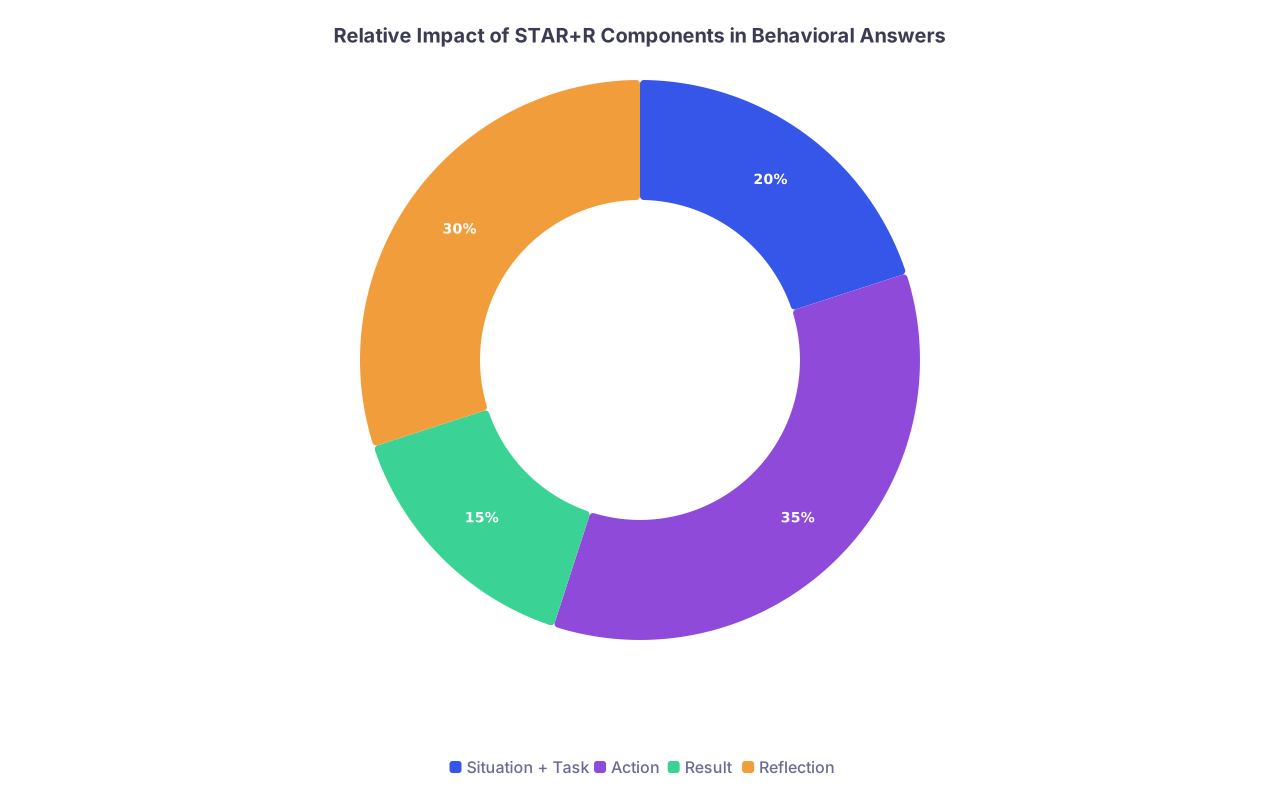
| Category | Value |
|---|---|
| Situation + Task | 20 |
| Action | 35 |
| Result | 15 |
| Reflection | 30 |
The takeaway:
- Context matters, but not that much.
- Action and Reflection are where you differentiate yourself.
Clinical Layer: Translating Premed Stories to “Future Physician” Language
You might worry: “My story is about tutoring or group projects. How is that relevant to medicine?”
That is exactly what Reflection is for.
You explicitly connect the dots:
- Tutoring → patient education and explaining complex information in plain language
- Group conflict → interdisciplinary teams disagreeing on patient management
- Student government budgeting → allocating limited healthcare resources
- Research error → patient safety, double-checking orders, humility in uncertainty
Do not assume the interviewer will make the connection for you. Spell it out efficiently.
Example line:
“Working through that disagreement with my lab partner gave me a small-scale version of what I imagine interdisciplinary disagreements in patient care will be like—high stakes, different perspectives, and the need to advocate for your view while still listening. That is why I focus now on…”
That sort of explicit analogy is underrated. Use it.
Key Takeaways
- STAR+R is not a script; it is a skeleton. Situation and Task are brief. Action and Reflection carry the weight, especially for complex behavioral questions.
- Your Reflection must be specific, forward-looking, and tied directly to how you will function as a medical student and physician. Generic “I learned communication” lines are dead on arrival.
- Build and rehearse a story bank now, during premed and medical school, so that under real interview pressure you are selecting and adapting solid STAR+R stories—not improvising your professional identity on the spot.