
The worst answers in medical school interviews are not the ones with no clinical exposure. They are the ones with clinical exposure and no story.
You are not getting screened out because you “only” shadowed, or because your clinical volunteering was limited. You get screened out when you cannot turn those experiences into coherent, patient-centered narratives that show you actually paid attention.
Let me break this down specifically.
Most premeds walk into interviews with:
- A few scattered shadowing days
- Some volunteer hours in a hospital or clinic
- Maybe one longitudinal experience if they are lucky
And they talk about all of it like a résumé in paragraph form. No arc. No tension. No patient.
You can do much better than that with far less experience than you think you need.
This is an article about how to squeeze maximum narrative value from minimal clinical exposure—and how to build authentic, patient-centered stories that actually work in interviews.
The Brutal Reality: You Are Competing With “Thousand-Hour” People
You might think: “I only have 30 hours of shadowing, how can that possibly compete?”
The truth: interviewers do not remember raw hours. They remember:
- One or two vivid patient stories
- Concrete details that show you were mentally present
- Insights that sound like you learned from real human beings, not from Reddit
I have seen applicants match or beat “1000+ clinical hours” peers because they did three things right:
- They chose specific encounters, not generic settings.
- They framed the story through the patient’s experience, not their own ego.
- They extracted 1–2 sharp insights about what being a physician actually feels like.
So you do not need more exposure first. You need to mine what you already have.
Step 1: Audit Your Actual Clinical Exposure (Without Self-Pity)
Before you can build any story, you need to know what raw material you are working with.
Grab a sheet of paper or a blank document. List every clinical touchpoint you have had. Shadowing, volunteering, scribing, MA work, phone triage, health coaching, anything that involved sick people and healthcare professionals.
Then, under each, list at least 3–5 memories, not tasks. What you actually remember.
Examples:
- “ED shift where older man refused CT until daughter arrived”
- “Clinic day: Spanish-speaking patient, interpreter on iPad, long wait, visibly frustrated”
- “Shadowed surgeon: pre-op consent conversation very different from post-op check-in tone”
Do not write:
- “Took vitals and transported patients”
- “Shadowed in OR and clinic”
- “Volunteered in ED”
Those are job descriptions, not stories.
You are looking for moments with:
- Emotion (fear, relief, frustration, gratitude)
- Conflict or tension (uncertainty, disagreement, time pressure, system barriers)
- A decision or trade-off (treatment options, goals of care, culture/language issues)
Even if you only shadowed for two mornings, you saw something. If you “cannot remember anything specific,” it usually means you watched passively, not that nothing happened. Dig deeper.
To make this more structured, think across settings:
| Setting | # Hours | # Memorable Patients | Role Type |
|---|---|---|---|
| Shadowing | 20 | 3–4 | Observational |
| Volunteering | 40 | 5–6 | Support/Service |
| Scribing/MA | 100 | 8–10 | Direct Support |
| Community Clinic | 25 | 3–4 | Longitudinal |
You may find you have 3–6 usable patient encounters buried in your memory. That is enough. You need maybe 2–3 excellent ones for interview season.
Step 2: Shift the Camera: From “What I Did” to “What the Patient Lived”
Most premeds instinctively narrate from their own perspective:
“I followed the doctor into the room, we saw a patient with heart failure, the doctor explained…”
That is weak. That is observer-centered. You sound like a tourist.
Patient-centered stories flip the lens:
- What was the patient facing?
- What was at stake for them?
- How did the clinician’s choices affect their experience?
Structure it like this:
- Who is the patient? (de-identified, of course)
- What problem were they actually living with?
- What made this encounter hard?
- How did the physician respond—not just medically but interpersonally?
- What did you realize or question about medicine because of this?
Here is a concrete before-and-after.
Weak version:
“During my hospital volunteering, I helped transport a patient to imaging. The patient was nervous, and the nurse reassured him. I realized how important it is to comfort patients and communicate clearly.”
Improved, patient-centered version:
“On one shift I transported an older man down to CT. He kept asking if this meant ‘they found something bad,’ but no one had actually explained why the scan was ordered. By the time we reached radiology he was gripping the rails and asking me whether this could be cancer. I was not allowed to discuss his results, so I just stayed with him and let him talk about his fear of dying before his granddaughter’s wedding.
When his nurse arrived, she paused before wheeling him in, knelt beside the gurney, and walked him step by step through what we knew and did not know yet. It took maybe three minutes, but his whole body language changed. That contrast—his escalating panic, then the visible drop in his shoulders when he finally understood what was happening—made me see how much of medicine is managing uncertainty, not just treating disease.”
Notice:
- 2–3 details make the patient real (older man, wedding, gripping rails).
- The “moment” is his fear and confusion, not your heroic volunteering.
- The physician’s behavior is concrete (kneeling, explanation, 3 minutes), not vague “good communication.”
- Your takeaway is about uncertainty and trust, not “I like helping people.”
That is what “patient-centered story” actually means in interview terms.
Step 3: Use a Real Narrative Skeleton (Not Just “Situation–Task–Action–Result”)
You have probably seen the STAR method and similar frameworks. Most people apply them mechanically, and it shows. For clinical stories, I prefer a slightly different spine:
C-PACT
- Context – Where are we? Who is the patient? What is at stake?
- Problem – What made this encounter challenging (emotionally, ethically, practically)?
- Actions – What did the physician and team actually do? What did you do within your role limits?
- Consequences – What changed? How did the patient respond? What remained unresolved?
- Themes – What did you learn about medicine, physicians, or yourself?
You are not reciting letters aloud in the interview. This is just how you think and practice.
Let’s apply C-PACT to a short shadowing example.
Context:
“Outpatient oncology clinic, follow-up visit with a woman in her 50s, undergoing chemotherapy, came with her adult son.”
Problem:
“Her recent scan showed no improvement. The oncologist had to explain that the current regimen was failing and discuss options that were all, frankly, bad in different ways—more side effects for small benefit, or shifting focus to comfort.”
Actions:
“Before going in, the oncologist reviewed the imaging and then paused outside the door and said quietly, ‘We need to read the room before we read the scan to them.’ In the visit, he first asked about her week and how she had been tolerating the last cycle. When he introduced the scan results, he spoke slowly and left space for silence. He repeatedly asked, ‘Tell me what you are hearing me say,’ to check that they understood. I did not say anything; I just took notes and watched the son’s face closely, because he kept looking at his mother before he asked questions, almost like he was calibrating what he was allowed to ask.”
Consequences:
“They did not actually decide on a new plan that day. The oncologist named that this was a lot to process and scheduled them for a longer visit the next week, encouraging them to think about what mattered most to her—time, energy, being at home, symptom control.”
Themes:
“That one encounter reshaped my notion of what ‘good medicine’ looks like. It was not a clear winning option, and it was not about convincing them to choose one path. It was about protecting their ability to understand, grieve, and then choose. I walked out realizing being a physician means getting comfortable walking with patients through situations where there is no fix, only trade-offs.”
That is how you transform a short shadowing moment into a serious, reflective narrative.
Step 4: Mining Limited Exposure for Maximum Depth
If your total clinical time is thin, you cannot play the “breadth” game. You must play the “depth” game.
You do not say:
- “I have shadowed in multiple specialties and settings…”
You say: - “Across the limited but meaningful exposure I have had, three patient encounters in particular have shaped how I think about medicine.”
Then you go deep on those three.
Here’s how to systematically deepen a single encounter:
A. Reconstruct the Scene
Ask yourself:
- What did the room actually look like?
- Where were people standing or sitting?
- Who spoke first? Loud or soft? rushed or slow?
- What non-verbal cues do you remember?
You will not include all of that in the interview, but reconstruction gives you texture. One or two details are enough to make it real.
B. Ask “What Was Hard About This For The Patient?”
Not for you. For them.
Examples:
- Hard to accept loss of independence (stroke, amputation, new diagnosis of epilepsy).
- Hard to trust the team (prior misdiagnosis, systemic racism, language barrier).
- Hard to face uncertainty (non-diagnostic tests, “watchful waiting”).
Explicitly name this in your story:
“Part of what made this so difficult for her was…”
This is where your empathy shows.
C. Identify One Physician Behavior That Stuck With You
Do not say “the doctor was empathetic” and leave it there.
Ask:
- What did they actually do?
- What specific phrase or gesture did you remember 6 months later?
Examples:
- “She closed the chart on the computer and turned her chair fully toward the patient.”
- “He said, ‘I cannot promise this will fix it, but I can promise I will not disappear.’”
- “Instead of answering immediately, she said, ‘Can you tell me what you are most afraid of?’ first.”
This is where you show you were not just physically present. You were mentally recording how physicians use language and behavior.
D. Connect the Encounter to a Larger Theme
Interviewers want to see you can generalize.
Some recurring themes that play well:
- Uncertainty and limits of medicine
- Shared decision-making vs paternalism
- Cultural humility and language constraints
- The emotional labor of being a physician
- The tension between system pressures and patient-centered care
You pick one theme per story. Do not water it down by listing five lessons. Choose the sharpest one.
Step 5: Adapting Stories To Common Interview Questions
You do not need twenty unique stories. You need 3–5 core patient-centered stories that you can adapt.
Let’s look at how a single oncology encounter might flex.
Question: “Tell me about a meaningful clinical experience.”
- Focus: big-picture lesson about walking with patients through bad options.
- Emphasize: your evolving understanding of what physicians do beyond treatment.
Question: “What does patient-centered care mean to you?”
- Focus: how the oncologist prioritized the patient’s values, not just tumor metrics.
- Emphasize: questions like “What matters most to you?” and delaying decisions to allow processing.
Question: “Have you seen any ethical challenges in healthcare?”
- Focus: tension between continuing toxic treatments vs focusing on comfort.
- Emphasize: how there was no obvious “right” answer, and how you saw the oncologist try to avoid imposing his preferences.
Question: “What do you think will be the hardest part of being a physician?”
- Focus: emotional weight of telling patients bad news repeatedly.
- Emphasize: the cumulative toll, your respect for that burden, and how you are starting to think about coping and boundaries.
Same story. Different lens. That is how strong applicants sound prepared without sounding rehearsed.
Step 6: Fix The Common Premed Storytelling Mistakes
Let me be blunt about the patterns that make interviewers tune out.
Mistake 1: You Are The Protagonist, Not The Patient
Red flag phrasing:
- “I realized I was meant to be a doctor when…”
- “This confirmed my passion for medicine because…”
Fix by shifting:
- “What stayed with me was how the patient…”
- “For her, the hardest part was…”
You can mention how it affected you, but after you have given the patient center stage.
Mistake 2: Purely Positive, Sanitized Stories
If every story ends perfectly and every doctor is a flawless role model, you sound naïve or disingenuous.
You do not need drama for its own sake, but you do need:
- Imperfection
- Trade-offs
- Something that was unsettling or unresolved
Example: “Even though we had a plan by the end of the visit, I walked out feeling uneasy because I still was not sure we had addressed his biggest fear: whether he would be a burden on his family. That gap is something I want to learn how to recognize and fill as a physician.”
That is honest. That reads as maturity.
Mistake 3: Zero Self-Awareness Of Your Role Limits
If your exposure is limited, do not overinflate it.
Bad:
“I helped manage a diabetic patient’s blood sugar by…”
No, you did not. You observed.
Better:
“From my position as a volunteer, I mostly just watched and occasionally helped bring supplies, but being physically in the room while the nurse titrated his insulin and explained the plan showed me…”
You gain credibility by clearly stating your scope.
Mistake 4: Moral Of The Story = “I Like Science And Helping People”
That is baseline. That is wallpaper.
Push your takeaways into more advanced territory:
- “I saw that a lot of the suffering came from not knowing what would happen next, not just from the disease itself.”
- “I realized that good intentions are not enough in a system that makes it hard to spend time with patients.”
- “I was struck by how much work goes into aligning patient values with medical possibilities, especially when families disagree.”
That sounds like someone who has actually watched medicine instead of fantasized about it.
Step 7: Practicing Without Sounding Scripted
Strong stories die in delivery. Especially when you over-rehearse exact sentences.
Here is how to practice properly:
- For each core story, write out a full, detailed version once using C-PACT.
- Underline:
- 1–2 key details (the rails of the gurney, the phrase the doctor used, the son’s face)
- The single theme you want to hit (uncertainty, trust, trade-offs, etc.)
- Then practice telling the story out loud without reading, aiming for 60–90 seconds.
Record yourself. Ask:
- Did I make the patient feel like a person?
- Did I clearly capture what was hard about the situation?
- Did I avoid drowning in adjectives or cliches?
You are not memorizing a monologue; you are anchoring to:
- Character (patient)
- Conflict (what was hard)
- One or two concrete details
- One clean takeaway
If you can hit those four reliably, you will sound natural and consistent even when the wording changes.
Step 8: Handling The “Limited Exposure” Question Head-On
If your hours really are on the low side, someone may poke at it.
“What do you see as the limitations of your current clinical exposure?”
Do not fake it. Do not get defensive. Do not start justifying.
A mature, sharp answer sounds like this:
“My clinical exposure so far has been limited in hours and settings. I have primarily volunteered on a surgical floor and shadowed in outpatient primary care. That means I have not yet seen long-term continuity, end-of-life care across months, or the full workload of a resident.
What I have tried to do, especially knowing my hours are limited, is to pay close attention to the details of the encounters I have seen—how physicians navigate uncertainty, how patients respond when plans change, and how the team communicates in front of the patient versus in the hallway afterward.
I am very aware that my current understanding of medicine is incomplete. What I am hoping for in medical school is the chance to expand that exposure across different settings and take on more responsibility, while bringing the same level of attention and reflection to those experiences.”
You turn a weakness into a demonstration of insight and humility. That plays well.
Step 9: Use Non-Clinical Experiences To Support Clinical Themes (When Needed)
If your clinical stories are thin, you can borrow emotional or ethical “weight” from non-clinical experiences—as long as you connect them honestly.
For example:
- You saw a patient struggle with health literacy in clinic.
- You also tutored adult learners in a GED program who were embarrassed about reading aloud.
You can say:
“Watching patients nod along to complex discharge instructions reminded me of adults I tutored who would say ‘I’m fine’ rather than admit they could not read the passage. That parallel made me realize how easily we can mistake silence for understanding in both education and healthcare.”
Now your limited clinical story feels reinforced by a deeper pattern from your life.
Step 10: A Simple Pre-Interview Story Prep Checklist
Before you walk into any interview, you should be able to answer these, out loud, without much hesitation:
Can you name 3 specific patients (de-identified) and describe:
- Who they were
- What they were going through
- What you learned?
For each, can you say in one sentence what the theme is?
- “This story is about uncertainty.”
- “This story is about cultural barriers.”
- “This story is about the emotional burden on physicians.”
Can you adapt each story to:
- “Meaningful clinical experience”
- “Challenge or ethical dilemma”
- “What patient-centered care means to you”
Can you name two ways your exposure is limited and what you plan to seek out in medical school to grow?
If you cannot hit those four, do not waste time memorizing generic answers. Fix your stories first.
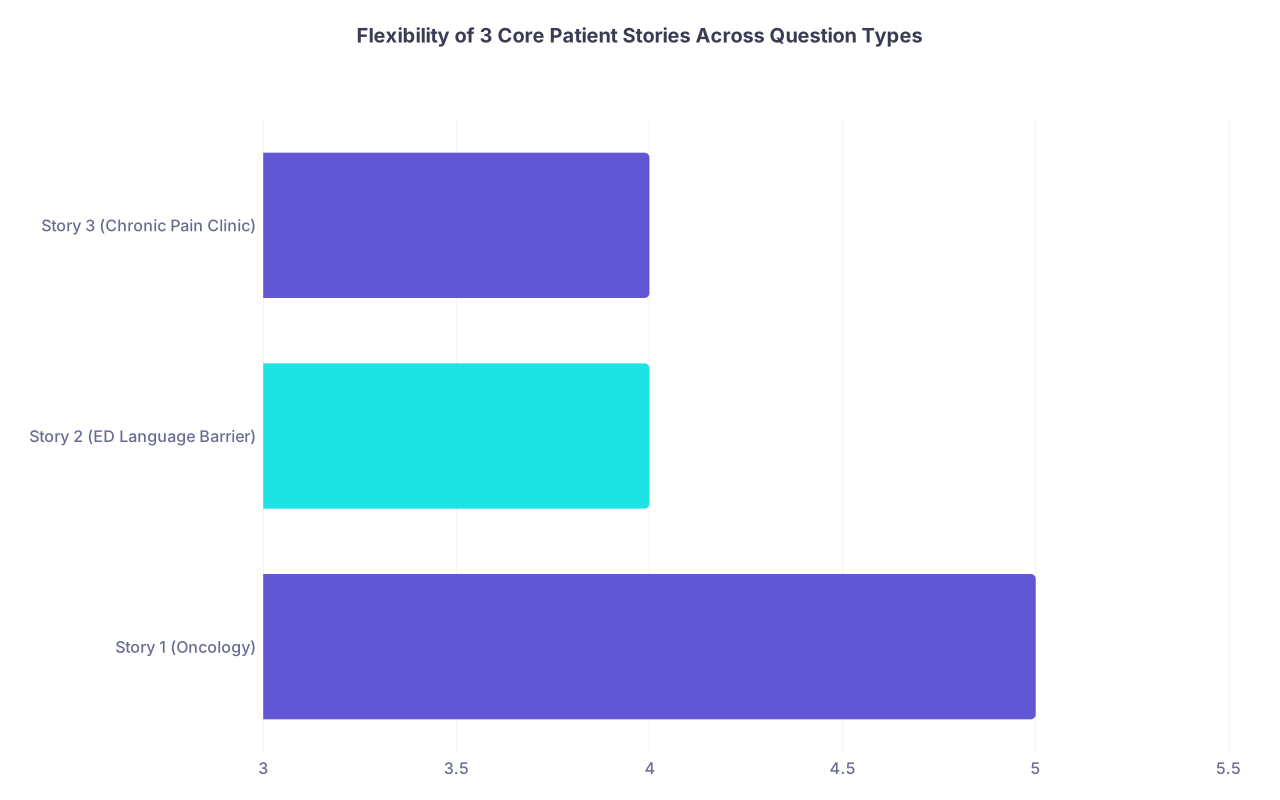
To visualize how a few core stories can map onto many question types:
| Category | Value |
|---|---|
| Story 1 (Oncology) | 5 |
| Story 2 (ED Language Barrier) | 4 |
| Story 3 (Chronic Pain Clinic) | 4 |
Legend (conceptual, not shown on chart):
- 5 = can flex to ~5 major question types
- 4 = can flex to ~4 major question types
The point is simple: a few good stories do a lot of work.
Visualizing How One Encounter Becomes A Story
To make this even more concrete, here is what the transformation process looks like:

| Step | Description |
|---|---|
| Step 1 | Raw Clinical Hours |
| Step 2 | Identify Memorable Patients |
| Step 3 | Reconstruct Scene & Emotions |
| Step 4 | Apply C-PACT Structure |
| Step 5 | Extract Clear Theme |
| Step 6 | Adapt To Common Questions |
| Step 7 | Practice 60-90s Delivery |
You are not inventing drama. You are extracting narrative.
A Quick Example: Building a Story From Very Minimal Exposure
Let me show you how little you actually need.
Scenario: You shadowed a family physician for only 8 hours, one clinic morning.
Memory: A middle-aged man with uncontrolled hypertension.
Raw recollection:
- He keeps missing follow-up appointments
- BP still high
- Doctor mentions job stress
Turned into an interview-ready, patient-centered story:
“During a brief shadowing experience in family medicine, I sat in on a visit with a man in his 40s with persistently uncontrolled blood pressure. On paper he looked non-compliant: missed appointments, not checking his pressures at home, labs overdue.
In the room, the story looked different. When the physician asked what had been getting in the way, he described working two jobs, rotating night shifts, and trying not to lose one of them after taking ‘too many sick days.’ He admitted he sometimes skipped his medication on days he was exhausted because it made him dizzy at work.
Rather than lecturing him, the physician reframed the plan around his reality. They adjusted the timing of his doses, set up a follow-up by phone instead of requiring another in-person visit, and connected him with a social worker to look into more stable employment options.
That brief encounter challenged the simplistic ‘compliant vs non-compliant’ idea I had picked up from textbooks. It showed me how often so-called non-adherence reflects structural barriers and competing priorities, not lack of caring. For me, patient-centered care now means designing treatment plans that can actually fit into a patient’s life, not just their physiology.”
That came from a single visit in one morning of shadowing. If you can do that three times, you are fine.
Two Concrete Practice Exercises You Should Actually Do
Do not just “think about” this. Practice.
Exercise 1: One-Page Story Drill
Pick one patient you remember.
Write:
- 1 paragraph: context and what was at stake for the patient
- 1 paragraph: what made it hard and what the physician/team actually did
- 1 paragraph: what you learned (one theme, not five)
Then condense it into a 60–90 second spoken version. Record, listen, refine.
Exercise 2: Theme Tagging
List every patient or clinical moment you can recall in a column.
Next to each, write one or two word themes:
- “uncertainty”
- “trust”
- “system failure”
- “bias”
- “communication”
Then ask: which 3–4 give you the richest, most interesting themes? Those are your core stories. Drop the rest or keep them as backups.
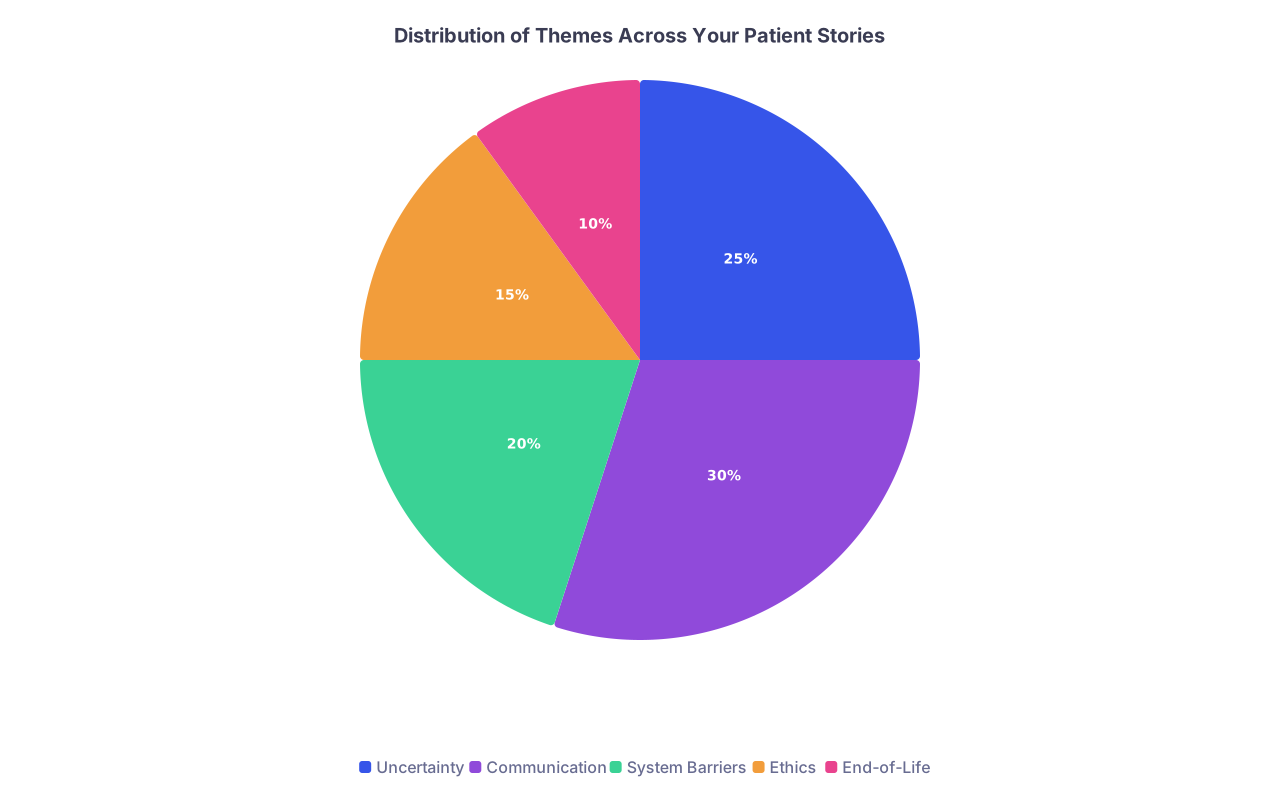
To see how theme coverage might look:
| Category | Value |
|---|---|
| Uncertainty | 25 |
| Communication | 30 |
| System Barriers | 20 |
| Ethics | 15 |
| End-of-Life | 10 |
You want some variety. Not five nearly identical “communication” stories.
How This Plays Out In A Real Interview Day
Picture this.
You are on a virtual MMI or traditional panel. You get a variant of:
“Tell me about a time when you saw patient-centered care done well.”
You do not panic. Because you know:
- Story 1: oncology, theme = uncertainty and values
- Story 2: ED, theme = language and cultural barriers
- Story 3: primary care, theme = system barriers vs “noncompliance”
Quick mental scan: which one best fits “patient-centered”? Probably the hypertension story or the ED language barrier case.
You pick one, run the C-PACT skeleton mentally, and speak. Calmly. Specific, patient-focused, with one clear insight.
They ask a follow-up: “Do you think your clinical experience is sufficient to really understand what being a doctor is like?”
You already have your “limited exposure but high attention and humility” answer loaded, not memorized word-for-word, but conceptually anchored.
Instead of scrambling, you are connecting dots.
Why This Works Even If Your CV Is “Weak”
Admissions committees are not naïve. They know premeds operate under constraints:
- Gatekeeping around hands-on roles
- COVID disruptions
- Geographic and socioeconomic limitations
What they absolutely require, though, is evidence that:
- You have looked closely at real patients.
- You have watched real physicians practicing medicine—not Instagram medicine, not TV.
- You can reflect with nuance, humility, and specificity.
If you can do that with 50 hours, you will beat someone who cannot do it with 500.
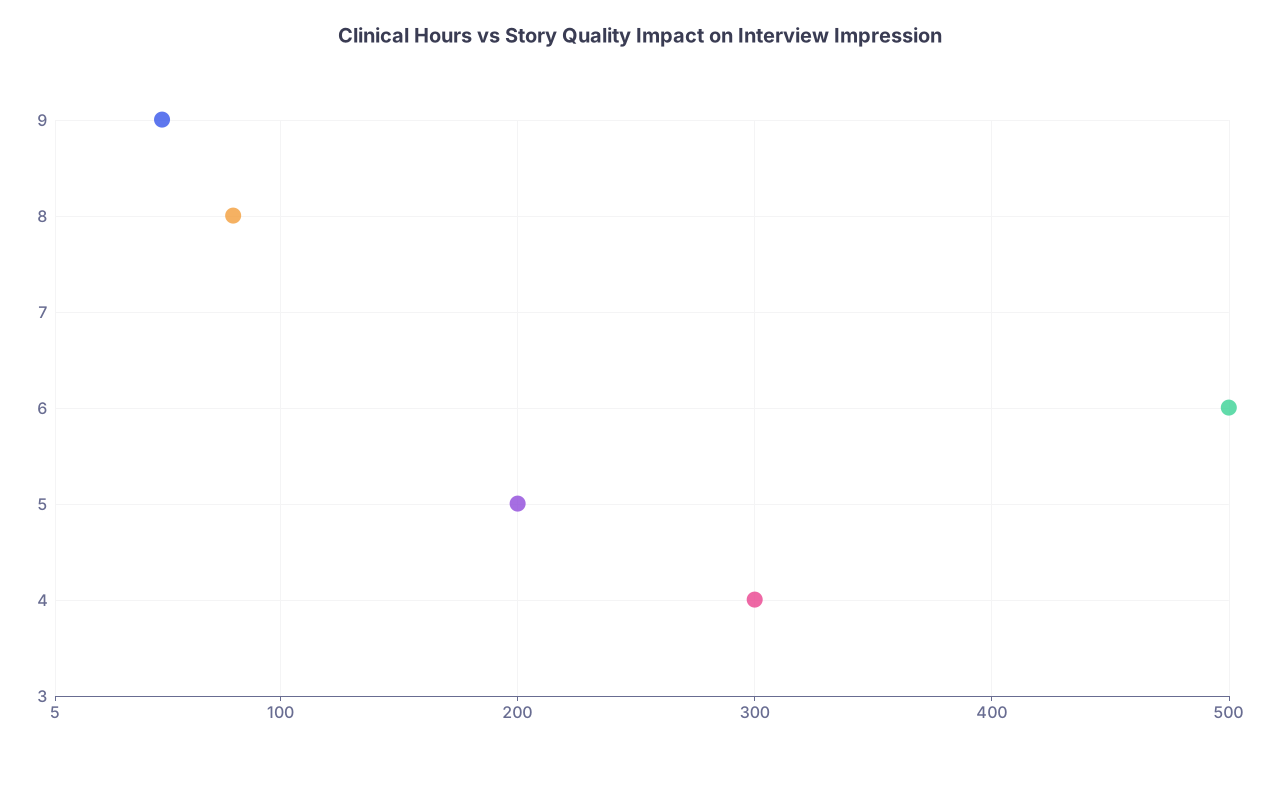
To drive home how “story quality” matters more than raw “hours,” consider this conceptual relationship:
| Category | Value |
|---|---|
| Applicant A | 50,9 |
| Applicant B | 200,5 |
| Applicant C | 500,6 |
| Applicant D | 80,8 |
| Applicant E | 300,4 |
X-axis (conceptually): hours
Y-axis: strength of patient-centered stories (1–10)
Applicants with fewer hours but stronger stories often leave a better impression.
Final Tight Summary
Three points to keep in your head:
- Limited clinical exposure is not your real problem; shallow, self-centered, generic stories are. Fix those first.
- Build 3–5 core patient-centered stories using a clear spine (context, problem, actions, consequences, theme) and focus relentlessly on the patient’s experience.
- Practice adapting those stories across question types and openly acknowledge the limits of your exposure with maturity, not defensiveness.
Do this well, and your “small” experiences will sound big enough.