
(See also: Mastering Ethical Dilemmas for MMI ethics strategies.)
You’re In The Hot Seat: “Tell Me About Health Disparities…”
You are halfway through your MMI circuit. You have already done the awkward role-play with the “angry patient,” survived the ethics station on physician-assisted dying, and now you sit down at a new door. The prompt on the paper:
“Discuss a health disparity affecting patients in the United States and how you, as a future physician, would address it.”
Clock is running. Your pulse ticks up. You have some vague ideas about social determinants, maybe a lecture from your public health class, and a memory of scrolling past a CDC infographic. But you also know a canned, hand-wavy answer will look flat next to someone who can use data and real insight.
This is the gap we are going to close.
You are not just trying to “say the right thing.” You are trying to sound like someone who actually understands disparities, has thought about them, and can connect that to real work you have done or want to do. That requires two things:
- You can use data with precision.
- You can pair that data with genuine, personal insight.
Let me break down how to do that in a way that holds up under scrutiny.
What Interviewers Are Really Testing
When they ask about health disparities, they are not looking for:
- “Social determinants of health are important.”
- “We should treat all patients equally.”
- “We need more access to care.”
Those are slogans, not answers.
Here is what they are actually probing:
- Do you understand that medicine exists inside a social, historical, and economic context?
- Can you talk about inequity without becoming defensive, dismissive, or performative?
- Do you know anything specific? Real numbers, real populations, real mechanisms?
- Can you connect this to your experiences in a way that does not center you as the hero?
- Do you think like someone who will be a useful colleague on diversity, equity, and inclusion (DEI) issues—or a liability?
If you can hit those, you stand out. Most applicants do not.
Step 1: Choose a Concrete Disparity You Actually Understand
The fastest way to tank this question is to pick a huge, vague topic like “racial disparities” and then say nothing specific.
You want a narrow arena where you can:
- Name the disparity clearly.
- Anchor it with at least one relevant statistic.
- Explain why it exists in plain language.
- Offer realistic actions a med student / trainee could take.
Some high-yield options:
- Maternal mortality in Black women.
- Diabetes complications in Native American populations.
- Hypertension and stroke in Black adults.
- Opioid use disorder and access to treatment in rural communities.
- Language barriers and worse outcomes for limited English proficiency (LEP) patients.
- LGBTQ+ youth and mental health / suicide risk.
- Undocumented immigrants and delayed cancer diagnoses.
Do not try to hit all of them. Pick one or two that fit your background or interests and prepare those properly.
Here is a quick comparison so you can see how these differ on “data + story” potential:
| Disparity Topic | Strong Data Availability | Easy to Connect Personal Experience | Complexity to Explain |
|---|---|---|---|
| Black maternal mortality | Very strong | Moderate | Moderate |
| Hypertension in Black adults | Strong | High | Low |
| Rural opioid treatment access | Strong | High (for rural applicants) | Moderate |
| LEP patients & interpretation access | Strong | High (esp. bilingual applicants) | Low |
| LGBTQ+ youth suicide risk | Strong | Variable | Moderate |
Pick one. Own it. Do it well.
Step 2: Learn the Numbers Without Sounding Like a Robot
You do not need a full epidemiology lecture. But you do need 1–3 hard facts. Numbers show seriousness. Vague adjectives do not.
Examples, phrased the way I would want to hear them in an interview:
- “In the U.S., Black women are about 3 times more likely to die from pregnancy-related causes than White women, even after adjusting for income and education.”
- “American Indian and Alaska Native adults have the highest rates of diagnosed diabetes of any racial/ethnic group in the U.S., and also higher rates of preventable complications like amputations.”
- “LGBTQ+ youth are over 4 times more likely to attempt suicide compared to their straight and cisgender peers.”
That level of specificity signals: I have read something beyond a tweet.
You do not need to memorize citations, but you should be able to name credible sources if pressed: CDC, NIH, ACOG, The Trevor Project, etc.
To keep this practical: pick 2–3 stats you can reliably reproduce for your chosen disparity. Write them out. Say them out loud until they sound like you.
Step 3: Understand “Why” Without Getting Lost in Jargon
Interviewers will mentally dock you for two extremes:
- Saying disparities exist “because people do not take care of themselves” (huge red flag).
- Dumping a laundry list: “social determinants, racism, structural barriers, mistrust” with no explanation.
You need a middle path: plain-language mechanisms.
Take Black maternal mortality as an example. A competent breakdown in an interview might sound like this:
“Black women in the U.S. have pregnancy-related mortality rates roughly three times higher than White women. This is not explained solely by income or education. Multiple factors contribute: less access to high-quality prenatal care, hospitals that are under-resourced and predominantly serve Black communities, and bias in how symptoms are taken seriously—like pain or shortness of breath. Chronic stress related to racism also affects baseline health conditions like hypertension, which increases the risk of complications such as preeclampsia.”
Notice what that did:
- Named the disparity and an approximate ratio.
- Listed 3–4 specific mechanisms in normal English.
- Tied one mechanism to a clinical condition (hypertension → preeclampsia).
That is enough. You do not need a dissertation. But you must show that you understand disparities as structural and multifactorial, not as “some people just do not care.”
Step 4: Build a Simple, Reusable Answer Framework
You do not want a script. You want a structure you can flex for any health disparity question. Here is one that works well under pressure:
- Name the disparity + population.
- Give 1–2 key statistics.
- Briefly outline 2–3 drivers (structural + clinical).
- Add one concrete example or vignette.
- End with what you, as a trainee, can do at the micro and meso level.
You can literally think about it as: “What / How big / Why / Story / What I will do.”
Let me give you a full, integrated example using hypertension in Black adults:
“Hypertension is one area where we see clear racial disparities. In the U.S., Black adults develop high blood pressure at younger ages and have higher rates of complications like stroke and kidney disease compared to White adults. Some data suggest that control rates are also lower despite similar or greater contact with the health system.
There are multiple drivers. Neighborhood-level factors like fewer safe spaces to exercise and less access to affordable, healthy food matter. There is also the impact of chronic stress, including experiences of racism, on cardiovascular health. Inside the health system, medication regimens may not be optimized, follow-up is inconsistent, and bias can affect how seriously symptoms are taken or how much time is spent on counseling.
When I volunteered at a free clinic in [city], I remember a middle-aged Black man whose blood pressure was always high when he came in. He missed appointments often, and at first it was easy to think of it as ‘non-compliance.’ But when we actually asked, he told us he worked two jobs, relied on a bus that ran every 45 minutes, and was choosing between paying for his meds and paying rent some months. That reshaped the way I think about adherence.
As a trainee, I see my role at a few levels. At the bedside, that means not labeling patients as ‘non-compliant’ without understanding their context, and using team resources like social work to address barriers. At the team or clinic level, it might mean getting involved in quality improvement projects to improve blood pressure follow-up or home monitoring in high-risk populations. Longer-term, I am interested in working in primary care in a community setting where I can be part of longitudinal relationships that actually move the needle on these disparities.”
That is data + personal insight in action.
Step 5: Use Your Own Experiences Without Turning Yourself Into The Hero
Interviewers are allergic to disparity answers that sound like self-congratulation:
“I volunteered in an underserved clinic and I realized how much people struggle, so now I am passionate about helping them.”
That is shallow. It also centers you, not the patients or issues.
A better approach:
- Show what you misunderstood originally.
- Show how a specific patient / moment corrected you.
- Show what you actually did differently afterwards.
- Do not exaggerate your role; you were a volunteer / student, not a policy maker.
For example:
Weak:
“I worked in a free clinic and learned underserved people have limited access to care. This taught me the importance of health equity.”
Stronger:
“At first, I thought of ‘access to care’ mostly as having or not having insurance. At the student-run clinic, there was a Spanish-speaking patient with uncontrolled diabetes. We technically provided ‘free care,’ but she missed multiple appointments. When one of the interpreters spent more time talking with her, we learned she was working night shifts, could not afford to miss work for morning appointments, and did not fully understand the sliding-scale policy for lab fees.
That experience pushed me to stop equating access with ‘we are open’ and to think about schedule flexibility, language, and trust. Later, I helped our team pilot one evening clinic per month and worked with the interpreter team to rewrite some of our patient instructions in plain Spanish. I was still just a volunteer, but it was the first time I saw how small process changes could actually reduce a barrier for a specific group of patients.”
That is the kind of “personal insight” that feels real.
Step 6: Connect Disparities to Your Future Role Without Overpromising
Med school and residency interviewers have very sensitive radar for grandiose nonsense:
- “I will end healthcare disparities.”
- “I plan to reform the entire health system.”
- “I will create national policy to fix this.”
You are not testifying before Congress; you are applying to training. Your ambitions should be big-picture, but your actions must be believable.
Good lanes to stay in:
- Micro level: How you will talk to and advocate for individual patients.
- Meso level: How you will participate in QI projects, curriculum committees, community outreach through the institution.
- Macro level: Acknowledge interest (policy, research, advocacy), but frame it as “I want to build the skills and then contribute to…”
For example:
“As a student, I will not be redesigning Medicaid, but there are still tangible roles. At the bedside, I can be the person who notices when a family seems confused because of language or health literacy issues, and I can slow the team down to bring in an interpreter or re-explain the plan. At the institutional level, I am interested in joining a student group that works on improving health education materials for patients with low literacy or in multiple languages.
Long-term, I see myself in primary care in a safety-net setting, and I would like to be involved in research or quality projects that track whether we are actually closing gaps—for example, in blood pressure control rates between racial groups in our clinic.”
Notice the phrase “I will not be redesigning Medicaid.” That kind of grounded humility reads as self-awareness, not resignation.
Step 7: Handle Hot-Button Topics Without Melting Down
Some of you are scared of this question because you are worried you will say the “wrong” thing about race, immigration, LGBTQ+ care, or poverty. The fear shows, and you end up giving vague, sanitized nonsense.
Two rules:
- Use accurate, respectful language. “Black” not “blacks,” “people experiencing homelessness” or “unhoused people” rather than “the homeless,” “transgender people” not “transgenders.”
- Name racism and structural bias directly when relevant. Avoid euphemisms that erase reality.
You do not need to sermonize about privilege for 5 minutes. But hiding from the word “racism” in a discussion of Black maternal mortality makes you look clueless.
Example of calm, neutral phrasing:
“Racism operates both at the interpersonal level—how patients are spoken to or believed—and at the structural level—how neighborhoods are funded, where hospitals are built, how policies shape access. Both levels affect health outcomes for marginalized groups.”
If the interviewer pushes on something heated—say, resource allocation, undocumented patients, or implicit bias trainings—take a breath and stay specific:
“I know there is debate about the best ways to address bias, and not every training is equally effective. But it would be hard to argue that bias does not exist in healthcare when we see consistent patterns in who receives pain medication, which complaints are taken seriously, and who is offered certain procedures. I am interested in approaches that actually change behavior and outcomes, not just box-checking.”
That is balanced. You are not waffling, but you are not in activist-slogan mode either.
Step 8: Specific Question Types and How to Handle Them
Interviewers will not always ask, “Tell me about a health disparity.” They will wrap it in different clothing. You should recognize the pattern and adapt.
1. “What do you see as the biggest problem in our healthcare system?”
Trap: ranting about insurance in the abstract.
Better approach: Acknowledge complexity, then pivot to one unresolved disparity.
“I could pick a few, but one that stands out to me is [X disparity]. We have made some progress in [Y], but we still see [data point]. This reflects deeper issues in [access, bias, funding, etc.]. As a future physician, the part I can directly influence is [micro/meso-level actions].”
2. “Tell me about a time you worked with an underserved population.”
Trap: generic service-trip story with “they were so grateful.”
Better: Describe one patient, your specific role, what you misunderstood, and how it changed your behavior.
Tie that directly to a recognized disparity if possible (e.g., diabetes, prenatal care, mental health).
3. MMI scenario: “Design an intervention to reduce [X disparity] in our community.”
Do not try to invent a national policy. Think small and specific: clinic hours, interpreter services, transportation vouchers, community health workers, texting systems for follow-up.
Then:
- Name which population and outcome you are targeting.
- Mention how you would measure success (e.g., “track missed appointment rates before and after,” “monitor control rates,” “survey patient understanding”).
For example:
“If we are talking about missed prenatal visits among low-income patients, one realistic intervention would be to pilot evening and weekend prenatal clinics, paired with text-message reminders in patients’ preferred language. We could track no-show rates by time of day, stratified by insurance status and maybe ZIP code, to see if access improves.”
That level of specificity is rare in MMI answers. It reads as someone who knows how real systems work.
Step 9: Practice Out Loud Until Your Answers Sound Like You
Silent studying does not fix rambling, disorganized answers. The only way to refine this is to speak.
Do this:
- Pick one disparity you are going to “own.”
- Write down:
- One or two stats.
- Three main causes.
- One personal experience that connects to it.
- Two things you can do as a student.
- Record yourself answering:
- “Tell me about a health disparity that concerns you.”
- “What could you do as a medical student to address that?”
- Listen back. Ruthlessly cut filler:
- “I think that, like, it’s kind of important that…”
- “In a sense…”
- “At the end of the day…”
You want clean, declarative sentences:
- “One example is…”
- “We know from data that…”
- “From my experience at…”
- “As a student, my role would be…”
If you want to push yourself, map out a mini-timeline of your growth in understanding disparities and be ready to tell it in 60–90 seconds:
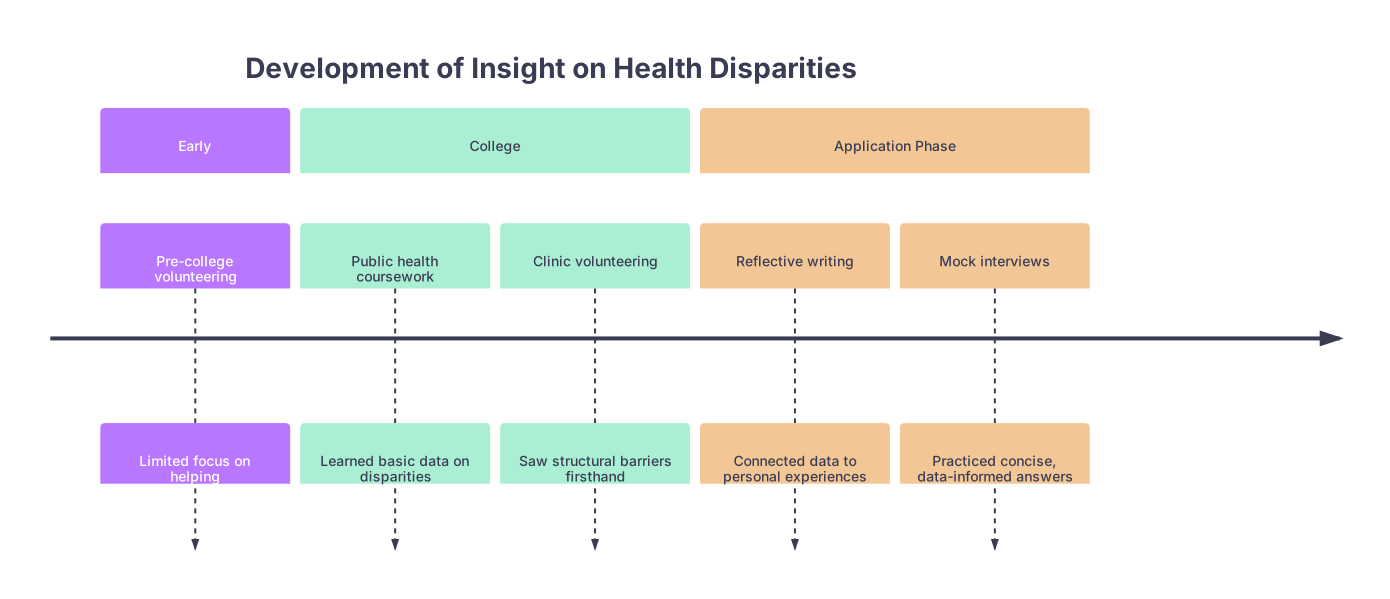
| Period | Event |
|---|---|
| Early - Pre-college volunteering | Limited focus on helping |
| College - Public health coursework | Learned basic data on disparities |
| College - Clinic volunteering | Saw structural barriers firsthand |
| Application Phase - Reflective writing | Connected data to personal experiences |
| Application Phase - Mock interviews | Practiced concise, data-informed answers |
This is the difference between, “I care about disparities” and “Here is how my understanding of disparities has actually matured over time.”
A Quick Visual: Where You Actually Have Influence
To keep your ambitions grounded, it helps to picture where you can realistically move the needle during training:
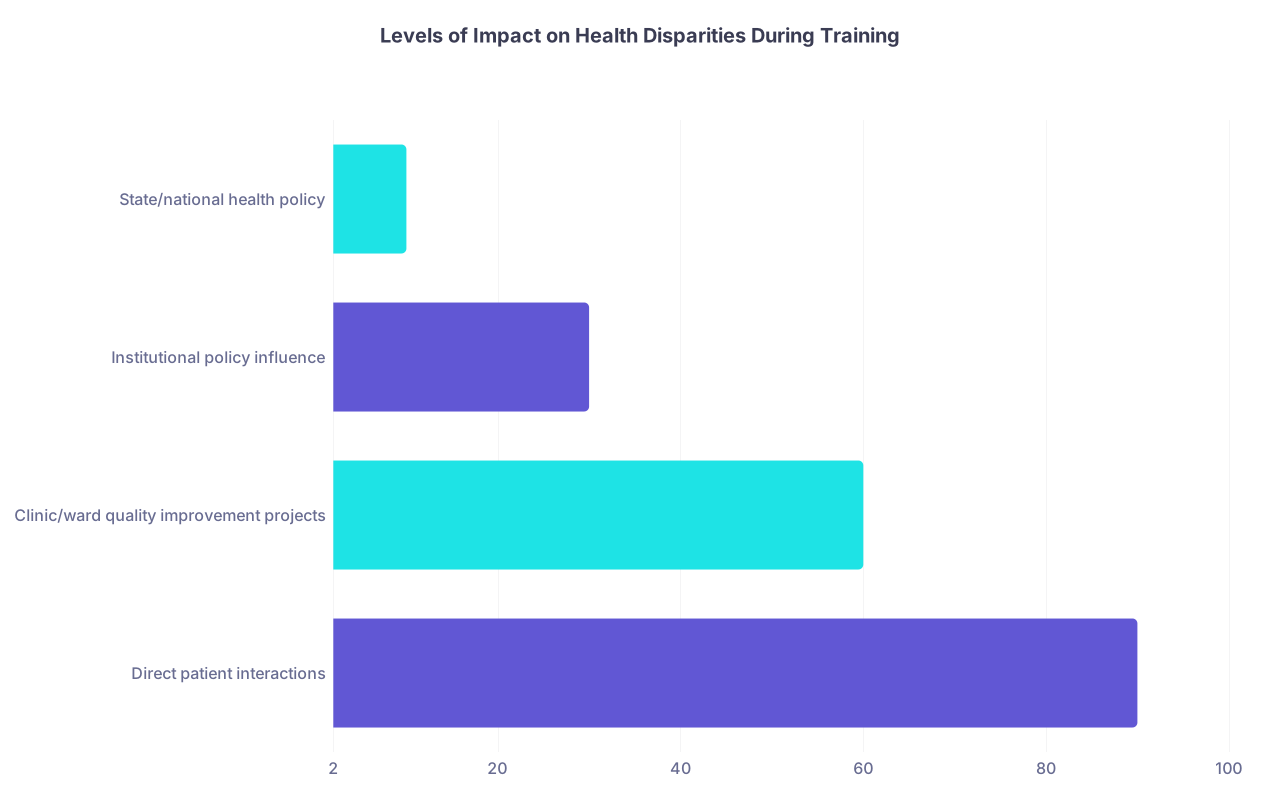
| Category | Value |
|---|---|
| Direct patient interactions | 90 |
| Clinic/ward quality improvement projects | 60 |
| Institutional policy influence | 30 |
| State/national health policy | 10 |
You have a lot of leverage in how you treat patients and how you participate in team-level improvement. You have limited leverage in national policy—do not pretend otherwise in an interview.
Putting It All Together: A Model Answer Template
If you need a final “assembly guide,” here is a template you can mentally plug your content into:
- “One health disparity that stands out to me is [disparity] affecting [population].”
- “We see [specific stat or comparison].”
- “This arises from a mix of [2–3 specific drivers: access, bias, environment, economic factors].”
- “In my experience at [setting], I saw this when [brief story], which challenged my assumption that [old belief] and helped me see [new insight].”
- “As a future physician, I know I cannot fix [the entire system] on my own, but I can [micro actions] and participate in [meso-level projects] that align with reducing this gap.”
- Optional: “Long-term, I hope to [type of practice / research / advocacy] so that I am part of the broader work of closing this disparity.”
Do not memorize these sentences. Memorize the moves. Then make them sound like you.
Key Takeaways
- Pick one or two specific disparities you truly understand, learn a couple of real stats, and be able to explain the “why” in clean, non-jargony language.
- Pair the data with one or two concrete experiences that changed how you think about patients and systems—without turning yourself into the savior.
- Keep your solutions grounded at the level of a trainee: strong bedside advocacy, smart participation in team and clinic-level improvements, and a credible vision for how you plan to keep engaging with health equity over your career.