
The way most applicants answer healthcare policy questions is lazy, vague, and forgettable. That is why structured reasoning stands out so sharply.
You are not being tested on whether you can recite the ACA or explain MACRA reimbursement formulas from memory. You are being tested on whether you can think clearly about complex trade‑offs, bring order to a messy problem, and communicate like someone other people would trust in a crisis. That is what separates the nervous pre‑med from the future chief resident.
Let me break this down very specifically.
1. Why Policy Questions Exist (And What They Really Test)
Interviewers do not ask, “What changes would you make to the U.S. healthcare system?” because they expect you to redesign CMS on the spot. They ask for three reasons:
- To see whether you can structure ambiguity.
- To see whether you understand that healthcare = policy + people + money, not just pathophysiology.
- To see whether you can disagree or criticize constructively without sounding reckless or naive.
A few examples you will actually see:
- “What are your thoughts on universal healthcare in the United States?”
- “How should we handle rising healthcare costs?”
- “Do physicians have a role in healthcare policy?”
- “What are the pros and cons of telemedicine expansion after COVID?”
- “Should non-physician providers have independent practice authority?”
Students who bomb these questions make the same predictable moves:
- They answer with slogans. “I think healthcare is a human right and we should ensure access for all.” That is not wrong. It is just shallow and generic.
- They dodge specifics. “It is complicated, there are a lot of factors.” Then they list three vague “factors” and stall.
- They soapbox. They rant about Big Pharma, insurance companies, or “the system” with zero nuance. Interviewers tune out immediately.
- They show no structure. They jump from cost to ethics to their grandmother’s experience to “we need prevention” with no logical flow.
What impresses faculty is different:
- You narrow the question to something answerable.
- You define your terms.
- You lay out 2–3 clear axes (e.g., access, cost, quality) and reason through them.
- You acknowledge trade‑offs and uncertainty without collapsing into mush.
- You land the plane with a specific, modest proposal or stance.
That is structured reasoning.
2. The Core Framework: A–B–C–D for Policy Questions
You do not need ten frameworks. You need one you can apply under pressure. Here is the one I teach students, and I have watched it rescue people in MMI rooms and traditional interviews repeatedly.
A–B–C–D:
- A – Ask and clarify the question
- B – Break the problem into 2–3 dimensions
- C – Consider pros, cons, and trade‑offs
- D – Decide and defend a position
This is not theory. Let me show you how it actually sounds aloud.
A – Ask and clarify
If the question is broad or vaguely worded, you buy yourself 5–10 seconds and sharpen the target.
Examples:
- “That is a big question. To make sure I understand, are you mainly interested in access to insurance coverage, or also changes to how we deliver care?”
- “When you say ‘universal healthcare’, do you mean a single‑payer system, or more broadly the idea that everyone should have access to basic services?”
- “For this question on rising costs, would you like me to focus on the patient-level perspective, or the system-level drivers, like pricing and regulation?”
If they clarify, great. If they say “Either is fine,” then you pick one and state your scope: “I will focus first on system-level drivers, then briefly relate that to patients.”
You have already done something 80% of applicants do not: you refused to answer a vague question vaguely.
B – Break into dimensions
You need a default set of “axes” for policy thinking so you are not inventing structure from scratch each time. The most useful triad in healthcare is:
- Access – Who can get care? Where, how fast, and with what financial barriers?
- Cost – To the system (macro) and to the individual (out‑of‑pocket).
- Quality – Outcomes, safety, patient experience.
You can also occasionally swap in:
But if you freeze, start with access–cost–quality. It works for almost everything.
Example transition:
- “I will think about this in terms of access, cost, and quality, since any major policy change affects all three.”
Now you have a skeleton.
C – Consider pros, cons, trade‑offs
For each dimension, do three things:
- Name the effect
- Give a concrete example or mechanism
- Flag the trade‑off
Stay short. Two sentences per dimension is fine.
Example: universal healthcare question.
Access: “Universal coverage would likely improve access by reducing the number of uninsured and underinsured patients. For instance, preventive visits and chronic disease management could become more routine for low‑income populations. The trade‑off is that access on paper does not guarantee timely appointments if workforce and infrastructure are not scaled.”
Cost: “At the system level, depending on the design, we might reduce administrative waste—right now the U.S. spends far more on billing and insurance overhead than other high‑income countries. However, there could be higher taxes or reallocation of funds, and short‑term disruption as hospitals and insurers adjust to new reimbursement models.”
Quality: “Quality could improve if coverage allows earlier and more consistent care, especially for chronic diseases. But there is a risk of ‘crowding’—if demand increases faster than capacity, wait times and perceived quality might suffer unless we invest in primary care, telemedicine, and team‑based models.”
That is structured, balanced, and specific without demanding perfect policy knowledge.
D – Decide and defend
You must land on a position. Waffling for three minutes and then saying, “So it is complicated” is a weak ending.
You do not need a radical position. You need a clear one, connected to the structure you just built.
Continuing the same example:
- “Overall, I support moving toward universal coverage in the U.S., mainly because the current system leaves too many people uninsured or underinsured despite high spending. I would prioritize models that expand coverage while simplifying administration and deliberately invest in workforce and primary care so that increased access does not erode quality. As a future physician, I see my role as both caring for individuals and lending my voice to policies that reduce preventable barriers to care.”
You answered the question. You showed value awareness, trade‑off awareness, and professional identity. That is what they want.
3. Filling the Content Gap: Minimum Policy Literacy You Actually Need
You are not in a policy PhD. But you cannot be totally blank either. Here is the minimum “content spine” that lets your structured reasoning sit on something solid.
The three “pillars” of U.S. coverage
You should be able to say, in normal language:
- Medicare – Federal program, mainly for people 65+ and certain disabilities. Big payer.
- Medicaid – Joint federal–state program for low‑income individuals and certain groups (pregnant women, children, disabled, etc.). Expanded under the Affordable Care Act in some states.
- Employer & individual insurance – Most under‑65 people get private insurance through employers; others buy on exchanges or go uninsured.
And then one sentence on the Affordable Care Act (ACA):
- “The ACA expanded coverage primarily by Medicaid expansion and creating subsidized insurance marketplaces, while also adding protections like prohibiting denial of coverage for pre‑existing conditions.”
That much alone already puts you above many applicants.
Core tensions to understand
You want a mental “map” of recurring fault lines. These appear in almost every policy question, just in different costumes.
Access vs cost containment
- Expanding coverage and benefits usually increases short‑term costs unless offset by savings elsewhere.
- Cost‑saving measures can create access barriers if poorly designed (e.g., narrow networks, high deductibles).
Individual autonomy vs public health
- Vaccine mandates
- Masking, quarantine
- Sugar taxes, smoking bans
The pattern: balancing personal freedom against protecting others and system capacity.
Centralization vs local control
- Federal standards vs state flexibility (Medicaid, scope of practice).
- Large integrated systems vs small independent practices.
Physician authority vs team‑based care
- Scope-of-practice debates.
- Advanced practice providers (NPs, PAs) in primary care, anesthesia, etc.
You do not need to know every detail. You do need to know that every real policy lever comes with a price tag somewhere else.
4. Applying the Framework to Common Question Types
Let us walk through realistic question types and map the structure onto them.
Type 1: “Should X policy exist?” (e.g., universal healthcare, vaccine mandates)
Example: “Do you think healthcare is a right? Should the U.S. have universal healthcare?”
Use A–B–C–D directly:
- A – Clarify: “By ‘universal healthcare,’ I will assume you mean that everyone has access to at least a basic set of essential health services, regardless of income.”
- B – Break: “I will think through this in terms of access, cost, and equity.”
- C – Consider:
- Access: Much better coverage, fewer uninsured, earlier care.
- Cost: Higher public spending; potential administrative savings; need for tax or budget trade‑offs.
- Equity: More fairness; fewer care gaps by income, race, geography.
- D – Decide: “Yes, I support moving toward universal coverage, with careful attention to financing and implementation to maintain quality and innovation.”
You do not need a 20‑minute dissertation. Two to three well-structured minutes is more than enough.
Type 2: “How would you fix rising healthcare costs?”
This is where unstructured people ramble about “prevention” and “eating healthy” and “we spend the most and get the least.” Interviewers have heard that 200 times.
You structure it.
A – Clarify: “When we talk about healthcare costs, are you most interested in system-level spending or what patients pay out of pocket?” If they say “both,” say: “I will start at the system level and then connect it to patients.”
B – Break:
Think in terms of:- Prices (what we pay for services, drugs, devices)
- Utilization (how much care we deliver)
- Administrative overhead
C – Consider:
Briefly hit each:- Prices: “We pay higher prices for many services and drugs than other high‑income countries, partly because of fragmented purchasing power and limited price negotiation.”
- Utilization: “Some care is clearly beneficial, but there is also overuse—unnecessary imaging or procedures driven by incentives and culture.”
- Admin: “We spend a lot on billing and insurance operations because every payer has different rules and contracts.”
Then propose 1–2 levers:
- “Potential approaches include increasing price transparency, empowering large payers (including the government) to negotiate drug prices, and shifting payment from pure fee‑for‑service toward models that reward outcomes rather than volume.”
D – Decide and defend:
“If I had to pick one priority, I would focus on payment reform that aligns incentives toward high‑value care—because that indirectly influences both utilization and some elements of pricing. As a future physician, that would mean being engaged in value‑based care initiatives, quality improvement, and thoughtful ordering practices rather than reflexively doing ‘more’ just because it is billable.”
Now you sound like someone who understands the levers, not someone parroting buzzwords.
5. Handling Ethical–Policy Hybrids with Structure
MMI stations love ugly hybrids: ethics + policy + emotion.
Example station:
“You are a physician in a resource-limited clinic. New guidelines recommend an expensive cancer drug that adds a modest survival benefit for some patients. Your hospital is under financial strain, and administration is considering restricting access to this drug. What do you think?”
If you try to “feel” your way through this without structure, you will wander. Instead, shift to a three‑part ethical frame:
- Stakeholders
- Principles
- Practical approach
Step 1: Identify stakeholders
Out loud, briefly:
- “The key stakeholders here are the patients who might benefit from the drug, other patients whose care could be indirectly affected by financial strain, the hospital as an institution responsible for stewardship, and the clinicians caught in the middle.”
Simply naming them shows systemic awareness.
Step 2: Name competing principles
You do not need a bioethics dictionary. Basic ones are enough:
- Beneficence (helping patients)
- Non-maleficence (avoiding harm)
- Justice (fair resource allocation)
- Autonomy (respecting informed choices)
Example:
- “There is a tension between beneficence—wanting to offer the drug to patients who might benefit—and justice—using limited resources in a way that does not destabilize care for others.”
Step 3: Suggest a principled process
This is where you bring in policy thinking:
- “I would support a transparent, evidence‑based policy developed through a multidisciplinary committee that reviews the drug’s benefits, costs, and which patient groups benefit most. That could mean restricting it to patients most likely to gain meaningful benefit, while communicating clearly with patients about the rationale and advocating for broader systemic solutions, like better reimbursement or inclusion in coverage formularies.”
Notice: you are not promising magic. You are articulating process, fairness, and communication. That is exactly how real hospitals behave when they are doing it halfway right.
6. Talking About Physician Involvement in Policy Without Sounding Fake
You will almost certainly get a version of:
“Should physicians be involved in healthcare policy?” or “What role do you see yourself playing in advocacy?”
Weak answer: “Yes, they should be involved, because they understand patient care. I hope to advocate for my patients.”
Structured answer:
Acknowledge reality and tension.
“Physicians have limited time and are under a lot of pressure clinically, so not every physician is going to be deeply engaged in national policy. But…”Name levels of involvement.
Think micro → meso → macro.- Micro: advocating for individual patients (prior authorizations, social resources).
- Meso: participating in hospital committees, guideline development, local health initiatives.
- Macro: engaging with professional societies, testifying, writing op‑eds, working with legislators.
Commit to a realistic level.
“I believe at minimum, physicians should be involved at the micro and meso levels—speaking up about policies that affect patient care in their institutions and communities, and contributing data and stories that policymakers often lack. Some physicians will also choose to engage at the national level, and their clinical experience is crucial to grounding policy in reality.”
Then tie it to yourself:
- “Personally, I am interested in [primary care/psychiatry/etc.], so I could see myself working with local public health departments or professional societies on issues like mental health access and reimbursement for collaborative care.”
Specific. Realistic. Grounded.
7. Practice Drills: How to Train Your Policy Brain
You do not fix this in one night by reading Wikipedia on the ACA. You get better by repeated, timed, out‑loud practice using the same structure. Otherwise you will revert to rambling under stress.
Here is a concrete drill that takes 20–25 minutes a day for a week.
Step 1: Build a tiny policy “one‑pager” (you, not me)
Make a single sheet (physical or digital) where you write, in your own words:
- 1–2 sentences each on Medicare, Medicaid, private insurance, ACA.
- The access–cost–quality triad.
- The four ethical principles (beneficence, non‑maleficence, autonomy, justice).
- 3–4 example policy levers: payment reform, coverage expansion, price negotiation, telehealth expansion.
You glance at this before practice sessions to refresh vocabulary.
Step 2: Timed question reps (solo or with a friend)
Pick a question (you can write them on slips of paper or pull from online lists). For each:
- 30 seconds: silently structure using A–B–C–D.
- 2–3 minutes: answer out loud, recording yourself (voice memo is fine).
After 3–4 questions, listen to one recording, not all. Ask:
- Did I clarify the question?
- Did I name 2–3 dimensions, or did I just ramble?
- Did I mention trade‑offs?
- Did I clearly state my position at the end?
Pattern you are aiming for:
- 10–15 seconds: clarify and frame
- 60–90 seconds: structured reasoning
- 20–30 seconds: clear stance and reflection as a future physician
Step 3: Add one “anchor fact” per topic
You do not need data dumps. But a single concrete reference makes you look grounded, not theoretical.
For example:
- Healthcare costs: “The U.S. spends a higher percentage of GDP on healthcare than other high‑income countries, but our outcomes are not consistently better.”
- Insurance coverage: “The ACA reduced the uninsured rate significantly, though some states did not expand Medicaid, leaving coverage gaps.”
- Rural access: “Many rural counties have shortages of primary care physicians and even a single hospital closure can drastically change access.”
You do not need precise percentages. Approximate but accurate statements are fine.
8. Common Traps and How to Avoid Them
Let me be blunt about mistakes that will sink you, even if your structure is okay.
Trap 1: Ideological ranting
If you sound like a Twitter thread, you are done. Avoid:
- Demonizing entire groups: “Insurance companies are evil,” “Politicians do not care about patients.”
- Loaded, partisan language: “Big government takeover,” “Corporate greed is destroying everything” as your only frame.
You can criticize strongly, but anchor in specifics:
- Better: “Our fragmented, multi-payer system creates misaligned incentives and high administrative burden. I think that is harmful. I would favor policies that simplify and align incentives toward patient outcomes.”
Sharp. Not a rant.
Trap 2: Over‑promising simplicity
“No problem. We just need universal healthcare and prevention.” That makes you sound naive.
Instead, explicitly recognize complexity:
- “There are no perfect solutions; every policy path creates winners and losers. The goal is to choose trade‑offs that are transparent, ethically defensible, and evidence‑informed.”
That sounds like someone who has actually read or seen how policies play out.
Trap 3: Hiding behind “I’m just a student”
“I’m not an expert, so I cannot say.” That is not humility. It is avoidance.
Better move:
- “I am not a policy expert, but based on what I know and what I have seen in [clinic/volunteering experience], here is how I think about it…” Then A–B–C–D as usual.
You own your level of knowledge without ducking the question.
9. A Quick Visual: Where Structured Reasoning Fits in Interview Performance
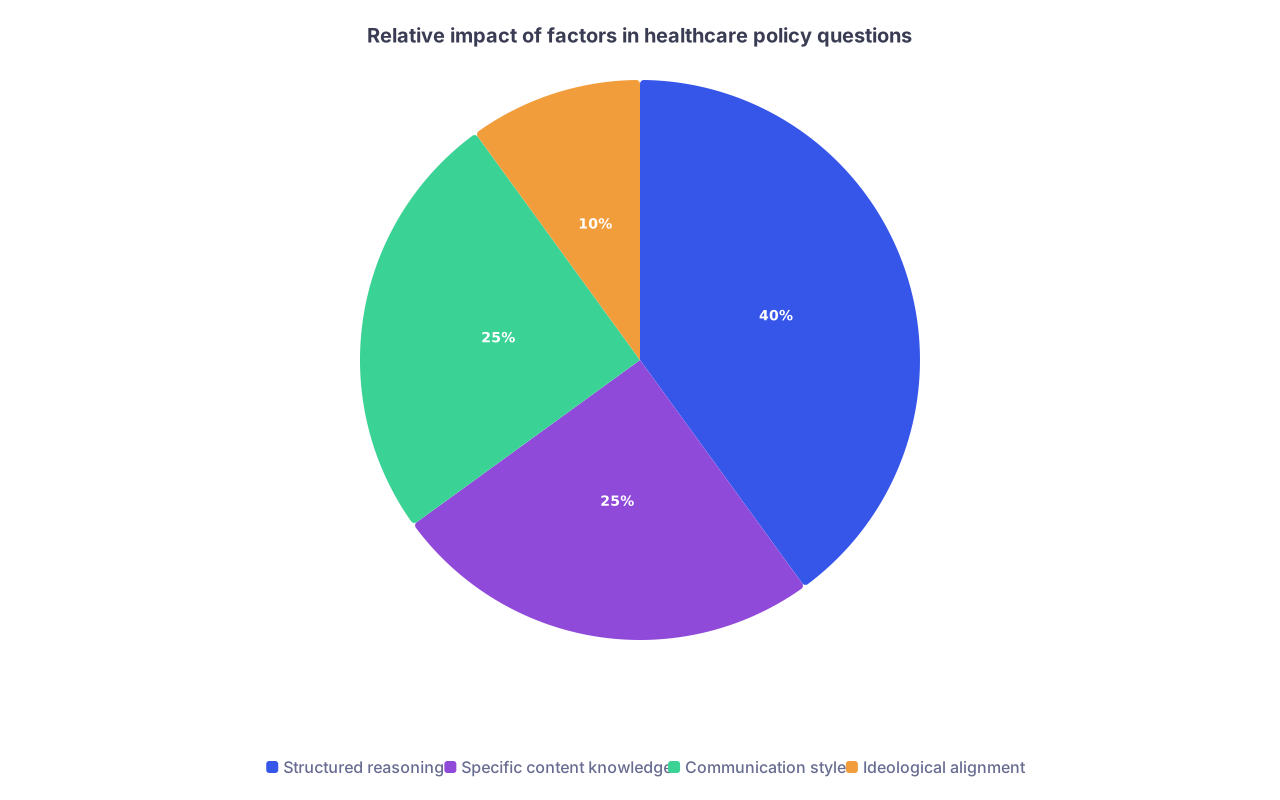
| Category | Value |
|---|---|
| Structured reasoning | 40 |
| Specific content knowledge | 25 |
| Communication style | 25 |
| Ideological alignment | 10 |
The interviewer is not doing a pop quiz. They are primarily watching:
- How you organize your thoughts (structure)
- Whether you know enough basics to avoid nonsense (content)
- How you sound and carry yourself (communication)
- And only slightly, where you land politically—as long as you are reasonable and respectful
10. Putting It All Together: Two Complete Sample Answers
I want you to see what a full, live answer sounds like at the right length.
Sample 1: “What are your thoughts on expanding telemedicine after the COVID‑19 pandemic?”
Clarify and frame:
“Telemedicine expanded very quickly during COVID, and now we are deciding how much of that to keep. I will think about this in terms of access, quality, and cost, and then give you my overall view.”
Access:
“Telemedicine clearly improved access for some patients—especially those in rural areas, those with mobility limitations, or those balancing work and caregiving. For example, in primary care clinics where I volunteered, no‑show rates dropped for some groups when video visits became available. On the other hand, it can worsen disparities for patients without reliable internet, private space, or digital literacy.”
Quality:
“For certain visit types—medication follow‑ups, mental health visits, reviewing lab results—quality can be comparable or even better, because it is more convenient and patients are more likely to attend. But for issues that require a full physical exam or procedures, telemedicine is not a substitute. There is also the risk of fragmented care if patients use ‘telehealth mills’ that do not coordinate with their primary providers.”
Cost:
“From a system perspective, telemedicine might reduce some costs by preventing unnecessary ER visits or allowing efficient chronic disease management. It could also shift some overhead. But if reimbursement is not designed carefully, it could drive overuse—extra visits for minor issues that might otherwise be handled with advice lines or self‑care.”
Decision and stance:
“Overall, I think telemedicine should remain an integrated part of care, not an add‑on or a separate track. I would support payment and regulatory policies that encourage its use for appropriate visit types, require integration with patients’ existing records when possible, and explicitly address digital access inequities—like investing in broadband in underserved areas and offering low‑tech options such as phone visits when needed. As a future physician, I see telemedicine as one tool among many, and my responsibility would be to use it when it serves the patient best, while recognizing where in‑person care is essential.”
That is just over two minutes spoken slowly. Clear structure, trade‑offs, stance.
Sample 2: “Do you think non-physician providers, like nurse practitioners, should have independent practice authority?”
You will see this, especially in primary care–heavy regions.
Clarify:
“When we talk about independent practice authority, I will assume we mean NPs practicing without mandatory physician oversight in primary care settings.”
Break into dimensions:
“I think about this in terms of access, quality and safety, and team dynamics.”
Access:
“In many regions, especially rural areas, there are significant primary care shortages. Allowing NPs to practice independently can increase access where no physicians are available or willing to practice. There are already examples of rural clinics that would simply not exist without NP-led care.”
Quality and safety:
“Studies on quality of care by NPs versus physicians in primary care show broadly comparable outcomes for many routine conditions when NPs are practicing within their training. However, the training pathways are different—medical school and residency versus advanced nursing programs—and that matters for complex, undifferentiated presentations. My concern is not with NPs as clinicians, but with ensuring that scope of practice matches training and that there are systems for consultation and referral for complex cases.”
Team dynamics:
“I strongly believe in team‑based care. Framing this as a turf war misses the point. In high‑functioning practices, NPs, PAs, physicians, nurses, and others work together with clear roles, mutual respect, and good communication. Policy decisions that create independent practice should still encourage integrated teams rather than siloed solo practice where any clinician is left unsupported.”
Position:
“Overall, I support appropriately structured independent practice for NPs, particularly in underserved areas, as long as it is paired with robust training standards, clear guidelines for collaboration and referral, and ongoing outcome monitoring. As a future physician, my role is not to protect a monopoly but to ensure patient safety and to be a good teammate. I would want to work in systems that use all clinicians to the top of their training while preserving access to physician expertise for complex care.”
That answer shows respect for colleagues and attention to training differences, without sounding protectionist or naive.
11. Final Tightening Before Interview Day
The week before your interview, do three things:
- Rehearse 5–7 common policy questions out loud with the A–B–C–D structure until the scaffolding becomes automatic.
- Scan a reputable news source’s health section (e.g., Kaiser Health News, NYT health, STAT) for 10–15 minutes every other day. You want to recognize current terms like “drug price negotiation,” “Medicaid redeterminations,” “telehealth waivers.”
- Decide your personal “north stars.”
Two or three values that you will keep returning to, such as:- Reducing preventable suffering
- Fairness in access
- Maintaining trust in the physician–patient relationship
Those values will keep your answers coherent across different questions, even when the specifics change.
Key Takeaways
- Policy questions are not pop quizzes; they are tests of structured reasoning. Use A–B–C–D: Ask/clarify, Break into dimensions, Consider trade‑offs, Decide and defend.
- A small amount of real content—basic knowledge of Medicare/Medicaid/ACA, the access–cost–quality triad, and core ethical principles—combined with specific examples puts you ahead of most applicants.
- Practice out loud, under time pressure, with real questions. If you can structure messy healthcare issues calmly and clearly, interviewers will remember you as someone who already thinks like a physician, not just a test‑taker.