

The unspoken rule that you “shouldn’t ask about Step scores or match rates” in interviews is nonsense. You absolutely can. You just have to do it the right way.
If you’re interviewing for medical school or thinking ahead to residency, you’re not just asking, “Will you take me?” You’re asking, “If I give you 4+ years of my life, what do I get back?” Step performance, match rates, and residency outcomes are a huge part of that. Pretending otherwise is either naive or dishonest.
Let’s go straight at the question you actually care about.
Short answer: Yes, you can ask. But how you ask is everything.
You can ask about:
- USMLE Step 1 and Step 2 outcomes
- Match rates (overall and specialty-specific)
- Where grads go for residency and in what specialties
Those are completely legitimate questions. Faculty and admins talk about them constantly behind closed doors. You’re not “out of line” for wanting to know.
Where people screw this up is tone and framing.
Two versions of the same idea:
Bad: “What are your Step scores and match rates?”
Sounds demanding, transactional, and a little immature.Good: “How does your program support students in preparing for Step exams, and what have outcomes looked like over the past few years?”
Sounds thoughtful, focused on process, and gives them room to answer honestly.
Same topic. Very different impression.
The real reason programs get weird about these questions
Programs don’t dislike the content of the question. They dislike what it sometimes reveals:
- Applicants who care only about prestige or metrics
- People who sound like they view med school as a Step factory
- A vibe of “what can I extract from you?” instead of “how do we fit?”
So your job is to show you care about:
- Education quality, not just bragging rights
- Support systems, not just cut scores
- Fit and outcomes, not just name-brand matches
Ask about outcomes, but connect them to training, mentorship, advising, and student support.
How to ask about Step scores without sounding obsessed
Don’t ask for a spreadsheet. Ask about the ecosystem.
Here’s how to do it well.
Phrases that work
Use questions like these. Steal them word-for-word if you want.
“How does your curriculum prepare students for Step 1 and Step 2 now that Step 1 is pass/fail? What support do students get during dedicated study time?”
“Roughly how do your students tend to perform on Step 2 compared to the national average? Are there formal prep resources or courses built into the program?”
“If a student is struggling with foundational sciences or practice exams, what structures are in place to help them get back on track before the exam?”
These do three things at once:
- Signal you understand the current landscape (Step 1 P/F, Step 2 more important)
- Show you’re thinking about support, not just numbers
- Give them a chance to share outcomes if they’re strong (and they usually will)
If you want something more direct but still polished:
- “Can you share a general sense of your Step 2 performance trends over the last few years and what you attribute that to?”
That’s as direct as you can be and still sound like a grown-up.
What not to ask (or at least not like this)
Avoid:
- “What’s your average Step 2 score?” (too transactional)
- “What percentage of your students fail Step?” (harsh framing)
- “Are your scores better than [Big Name School]?” (looks childish)
If you’re really concerned about low Step performance (for a newer school, for example), try:
- “For students who don’t pass on the first attempt, how does the school support them, and how do they typically do on a retake?”
That gets you the real answer without sounding like you’re trying to catch them.
Asking about match rates without being “that applicant”
Match data can be heavily spun. Every school loves to say, “We match well.” That doesn’t mean much.
You’re trying to find out:
- Do most grads actually match?
- Do people get into competitive specialties from here?
- Are they matching into good programs, or just anywhere that’ll take them?
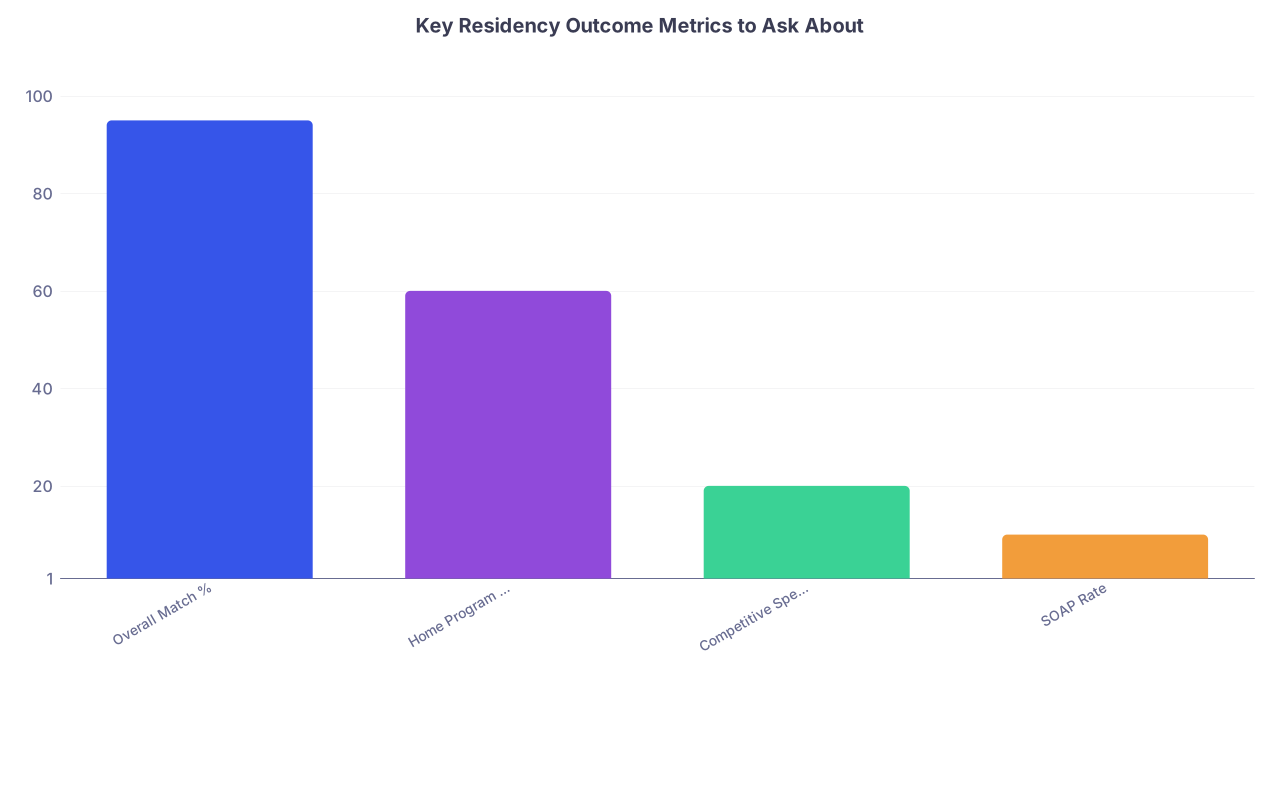
| Category | Value |
|---|---|
| Overall Match % | 95 |
| Home Program Matches | 60 |
| Competitive Specialty Matches | 20 |
| SOAP Rate | 10 |
Smart ways to ask about match outcomes
Use language that focuses on patterns and support, not just the headline number.
Examples:
“Can you walk me through how your students have matched over the last few years—both overall and into more competitive specialties?”
“For students aiming for fields like dermatology, ortho, or plastics, what has their success looked like? And what does the school do to support them?”
“Do you have advising or mentorship structures that help students build a realistic but strong match strategy?”
This shows you’re thinking about your future but you’re not just chasing a name-brand specialty.
Reading between the lines
If they dodge specifics with:
- “Our students do very well!” and nothing else, that’s a soft yellow flag.
- “We don’t have exact numbers offhand,” but they’re clearly a mature, established school? They just don’t want to say. Another yellow flag.
- “We publish an annual match list; I’d really encourage you to look at it”—good sign, as long as that list is actually available and detailed.
You don’t need a perfect number. You want:
- Honest approximate match percentage
- Breadth of specialties
- Evidence that students who really go for something have a path to get there with support
How to ask specifically about residency outcomes
This is where you can get very practical, especially if you already have an interest area.
You should absolutely ask:
- Where graduates go
- How many match at academic vs community programs
- How strong their home residency connections are
| Question You Ask | What It Tells You |
|---|---|
| “Where do most grads match geographically?” | How portable the degree is |
| “How many match into your own affiliated residencies?” | Strength of home programs |
| “Do students match into academic centers?” | Research/academic reputation |
| “Any recent matches in [specialty]?” | Track record in your interest area |
Concrete questions that don’t sound awkward
Try:
“Where do most of your graduates tend to go for residency—more local, regional, or spread across the country?”
“How strong are your connections to your own residency programs? Do many students match into your affiliated IM/surgery/peds/etc programs?”
“If a student wants to leave the region for residency, do you see that happening often, or do grads tend to stay local?”
“Are there particular specialties or programs your graduates match into year after year?”
If you’re already leaning toward a field (even tentatively):
- “I’m currently very interested in [specialty, e.g., internal medicine with an eye toward cards]. Have recent grads matched into strong IM programs or fellowships from here?”
That’s a totally fair thing to care about.
When you’re a premed asking about residency at a med school interview
You’re in the “Premed and Medical School Preparation” phase. You’re allowed to think long-term. Just don’t sound so fixated on derm at age 20 that you come off as inflexible.
Good balance:
- “I know my interests may evolve, but I’m curious how your graduates do in the match both for primary care and for more competitive specialties.”
That shows:
- Self-awareness (you know you might change your mind)
- Maturity (you understand primary care matters too)
- Ambition (you’re thinking beyond MS1 anatomy)
Programs actually like when premeds ask informed questions about match and residency—as long as it’s not the only thing you talk about.
How direct is “too direct”?
Let me draw the line for you.
Reasonable:
- “Roughly what’s your overall match rate over the past few years, and what does the school do when students don’t initially match?”
Too blunt (or just clumsy):
- “How many people fail to match?” (sounds harsh, accusatory)
Better version:
- “For students who enter SOAP or don’t match the first time, what kind of support do they receive, and how do their outcomes look long-term?”
You’re still getting the exact same information. You just sound like someone they’d want as a colleague instead of someone interrogating them.
What if the interviewer looks annoyed when you ask?
Sometimes you’ll get a weird look. That’s not your problem.
Things to remember:
- Some individual faculty honestly don’t know the numbers
- Some are uncomfortable with anything that feels “metrics-focused”
- Some are stuck in the old culture of “don’t ask, just be grateful”
If that happens, pivot:
- “I’m less interested in the exact numbers and more in how the school supports students to reach their goals—whether that’s a competitive specialty or a strong primary care program. Could you speak to that piece?”
That reframes it instantly. Most interviewers can handle that.
A clean, reusable script you can bring to every interview
If you want something you can basically read off your notes without sounding robotic, here’s a tight 3-question set that covers Step, match, and residency outcomes without overdoing it:
“How does your curriculum and advising structure support students in preparing for Step 1 and Step 2, and how have your outcomes compared to national averages in recent years?”
“Could you share a general picture of your match outcomes—both overall and in terms of students matching into competitive specialties if they choose to pursue them?”
“Where do graduates tend to go for residency—do they mostly stay local, match into your own affiliated programs, or spread out to programs across the country?”
If you ask those three, you’ve covered the essentials. Anything else is bonus.
Visual: How these questions fit into the overall interview

| Step | Description |
|---|---|
| Step 1 | Start Interview Day |
| Step 2 | Small Talk & Background |
| Step 3 | Curriculum / Culture Questions |
| Step 4 | Ask About Step & Support |
| Step 5 | Ask About Match Outcomes |
| Step 6 | Ask About Residency Destinations |
| Step 7 | Follow-up on Interests |
| Step 8 | Thank Interviewer & Close |
Don’t lead with “What are your match rates?” five minutes in. Warm up with curriculum, culture, and support, then layer in outcome questions once there’s some rapport.
Bottom line: You’re not shallow for caring about outcomes
Here’s the truth hardly anyone says out loud: if a school or program can’t have an adult, honest conversation about Step scores and match outcomes, you should be cautious about spending years of your life there.
You’re allowed to:
- Care where graduates end up
- Ask about Step performance and support
- Care whether people match into the fields and places you want
Just do it with:
- Good framing
- Focus on support and process
- Some basic emotional intelligence
That’s not being difficult. That’s being smart.
FAQ (exactly 7 questions)
1. Will I look “red flaggy” if I ask about Step scores as a premed?
No, not if you do it well. You look like a red flag when you sound obsessed with numbers or prestige and ignore everything else. If you ask about Step in the context of support, curriculum, and long-term training, you come across as thoughtful and mature.
2. Can I ask for exact average Step or match numbers?
You can, but I wouldn’t lead with “What’s your average Step 2 score?” That’s very transactional. Better: ask how their students generally perform relative to national averages and what they attribute their outcomes to. If they volunteer numbers, great. If not, you still get the important part: whether there’s a real system behind the results.
3. Is it okay to ask about match results in competitive specialties like derm, ortho, or neurosurgery?
Yes. Just don’t make it sound like your life will be over if you’re not a neurosurgeon. “Have students from here successfully matched into fields like derm or ortho, and what helped them get there?” is fine. Saying “I must match derm here—what are my chances?” sounds rigid and naive.
4. What if the school doesn’t publish a match list or any Step data?
For an established school, that’s a red flag. Newer schools may still be building a track record, which is different. In either case, ask how they track outcomes internally and what their first few match cycles or Step cohorts have looked like. If all you get is vague positivity with no substance, be cautious.
5. Can I ask residents about these things on a residency interview?
You should. Residents are often more honest than faculty. Ask them directly: “How did people do on boards here, and how supported did you feel?” and “Have your co-residents been able to match into good fellowships?” They know the real story.
6. Is it bad to ask multiple outcome-related questions in one interview?
One question each about Step, match, and residency destinations is fine—especially if you spread them across different interviewers. If every single question you ask is about metrics, you’ll look one-dimensional. Mix in questions about teaching, wellness, culture, and day-to-day life.
7. What if I genuinely don’t care about prestige and just want to be a good doctor—should I still ask about outcomes?
Yes. Outcomes aren’t only about prestige. A school with poor Step support and weak match advising can leave you stressed, in limbo, or scrambling through SOAP. Asking about outcomes is really asking, “Will you set me up for a stable, sustainable career?” That matters whether you want orthopedics or outpatient pediatrics.
Key points:
- You can and should ask about Step scores, match rates, and residency outcomes—just frame it around support and training, not bragging rights.
- Focus your questions on how the school or program helps students succeed, and ask for a general sense of outcomes rather than grilling them for exact numbers.
- If a program can’t or won’t talk meaningfully about outcomes, that’s your sign—not that you asked the wrong question, but that you might be looking at the wrong place.


