

The worst way to talk about a career change to medicine is to sound like you’re still deciding. You cannot walk into an interview and “explore” medicine. You have to talk like you’ve already crossed the bridge and burned it behind you.
You’re not just selling that you want to be a doctor. You’re selling that you’ve shut the door on your old path and you’re not quietly looking over your shoulder.
Here’s how you actually do that in an interview, step by step.
1. Understand What Makes Committees Nervous About Career Changers
Let me be blunt: admissions committees and residency PDs are not automatically impressed that you’re “nontraditional.” They have specific worries. If you do not address these directly, they’ll fill in the blanks themselves.
The three big fears:
- You’re not fully committed and might change again when it gets hard.
- You’re running away from something (burnout, boredom, failure) rather than running toward medicine.
- You don’t understand how hard and unglamorous medicine actually is.
If your answers sound like:
- “I realized recently that I might want something more meaningful.”
- “I’m still exploring how my skills might fit in healthcare.”
- “I think medicine could be a good next step.”
You’ve already lost ground.
You must project:
- Finality about leaving your prior career.
- Specificity about why medicine, not just “helping people.”
- Evidence that you’ve tested this choice in the real world and stayed.
So as you prepare, every story, every explanation should be doing at least one of those three things.
2. Build a Clear, Firm Narrative: Past → Pivot → Proof
Career changers get into trouble because they talk like this:
“I was in consulting for several years, then I started volunteering, and I liked it, so I decided to apply to medical school.”
That sounds like a hobby that got out of hand, not a life decision.
You need a tight, chronological story with inflection points—specific moments and experiences that made you move. Think in three parts:
- Who you were before
- The turning point and decision
- The proof that the decision stuck
Let’s break each one.
2.1 Who You Were Before (Without Apologizing For It)
Do not trash your old career. Do not sound like you wasted your 20s.
Bad version:
“I was in finance for eight years but I never really liked it, it felt empty.”
Better version:
“I spent eight years in investment banking, primarily working with healthcare companies. I liked the analytical rigor, the responsibility, and working in teams under pressure. But over time, I realized I was always most energized by the rare chances I had to interact directly with the people affected by those decisions—patients, families, clinicians.”
Notice a few things:
- You sound competent, not lost.
- You acknowledge real strengths you’re bringing forward.
- You start to hint at the mismatch without sounding bitter.
Your script for this part should be 2–4 sentences. Short. Controlled. Confident. You’re not giving them your entire resume.
2.2 The Turning Point (Pin It To Specific Moments)
Vague “I wanted to help people more” is death. Everyone wants that. It’s lazy.
You need concrete triggers. Real scenes. Something like:
“During COVID, I was the project manager for setting up telehealth for our hospital clients. I kept hearing physicians improvise solutions to reach patients who had no tech literacy, no broadband, no family support. I realized I wanted to be in that room, solving those problems directly, not just managing the contracts around them.”
“My younger sister’s leukemia treatment meant I spent over 200 hours in the hospital with her across a year. I watched the same pediatric oncologist come in at 6 am and 8 pm, day after day, and still somehow remember the tiniest details about my sister’s fears. That was the first time I thought, seriously: I want that job. Not something ‘patient-facing,’ that job.”
Do you see the difference? You are anchoring the shift to specific images and experiences, not vague “realizations.”
Your turning point segment should answer:
- What exactly changed?
- When did it start?
- What did you do immediately after that wasn’t just thinking?
2.3 The Proof (How You Turned Idea → Commitment)
This is where most people fall apart. They talk about “thinking a lot” and “reading about medicine.” Decision-makers don’t care what you thought. They care what you did.
This section is where you eliminate uncertainty.
You want a quick sequence of actions that show you didn’t just wake up and apply:
- Took formal coursework (post-bacc, DIY post-bacc, community college sciences).
- Shadowed physicians across different areas (primary care, hospital, maybe surgery).
- Took on sustained clinical exposure (scribe, MA, EMT, hospital volunteer, hospice).
- Had honest conversations with physicians about burnout, debt, lifestyle.
And then you say, explicitly, that these experiences confirmed your decision.
Example answer to “Why medicine after [previous career]?”:
“Three years ago, I started seriously questioning whether I wanted to stay in software engineering long-term. Around that time, my father had a prolonged ICU stay, and I saw firsthand how much difference a single attentive physician could make to a confused, frightened family. Instead of impulsively quitting, I set a rule for myself: give it a year of real testing.
I enrolled in evening post-bacc classes while working full time, started volunteering on a hospital medicine floor every Saturday, and shadowed two internists and an ER physician for a total of about 100 hours. I also had some pretty blunt conversations with them about burnout and the parts they disliked. After that year, the picture was actually clearer, not fuzzier. I was more certain, not less. That’s when I decided to move to medicine and committed to the MCAT and full-time preparation.”
That last sentence matters: more certain, not less. You are explicitly pushing back against the “maybe they’re still exploring” worry.
3. Phrases That Make You Sound Uncertain (And What To Say Instead)
You need to clean these out of your interview vocabulary. They signal doubt, hesitation, or lack of commitment.
Here’s the translation table you should memorize:
| Weak / Uncertain Phrase | Strong / Committed Alternative |
|---|---|
| "I think medicine might be a good fit." | "I chose to pursue medicine because..." |
| "I'm still exploring how this will work." | "[I’ve already structured my life around this path by…](https://residencyadvisor.com/resources/med-school-interview-tips/how-committees-actually-use-your-interview-to-break-application-ties)" |
| "I want more meaningful work." | "I want responsibility for patients’ outcomes and long-term relationships with them." |
| "I wasn’t happy in my old career." | "My previous career taught me X and Y, but it couldn’t give me Z, which I’ve found in medicine." |
| "I hope I’ll be able to manage the training." | "I’ve already handled [specific demanding experience], which is part of why I’m confident I can handle the training." |
If you catch yourself starting an answer with “I think” or “I hope” or “I feel like maybe,” stop. Restart the sentence with “I decided,” “I chose,” or “I learned.”
You’re not on trial for arrogance. You are on trial for ambivalence.
4. Answering the Big Career-Change Questions Directly
You’re going to get some version of the same 5–6 questions. If you walk in with clear frameworks and pre-built skeletons, you won’t ramble or sound like you’re explaining it for the first time.
4.1 “Why Medicine, And Why Now?”
Structure it like this:
- One sentence about your prior career context.
- One to two sentences about specific experiences that made medicine compelling.
- One to three sentences about actions you took to test this.
- One closing sentence that affirms certainty.
Example:
“I spent seven years as a high school biology teacher and department chair. I loved teaching and mentoring, but over time I found myself drawn to the medical aspects of my students’ lives—navigating chronic illnesses, mental health crises, injuries. After working closely with our school nurse and helping several families coordinate care, I realized I wanted to be the person responsible for diagnosing and treating, not just advocating from the sidelines.
So I took evening science refreshers, shadowed a pediatrician and a family medicine doctor for six months, and started working part-time as a medical assistant in a community clinic. The longer I did this, the more comfortable I became in clinical spaces and the more clear it became that this is where I want to spend the rest of my career.”
Notice: you’re not “discovering” medicine in the interview chair. You’ve already done it.
4.2 “Why Leave a Stable Career For Medicine?”
This is code for: Are you naive? Do you understand what you're trading?
Your answer must show:
- You understand the costs: time, debt, lifestyle, training length.
- You are not romanticizing the work.
- You have rationally compared staying vs. changing.
Example:
“I had a stable trajectory in law—partner track, good compensation, predictable timeline. I didn’t walk away lightly. I spent two years overlapping legal work with clinical exposure and conversations with physicians about their day-to-day realities: overnight call, documentation burden, burnout risk, salary vs. loans.
In the end, I realized the bigger risk for me wasn’t the debt or the training time; it was spending another 30 years doing work that didn’t align with the responsibilities I actually wanted—direct responsibility for patients’ health, long-term problem-solving with families, and work that challenges me emotionally and intellectually every single day. I went in with my eyes open. I still chose medicine.”
That “eyes open” idea is exactly what they need to hear.
4.3 “How Do You Know You Won’t Change Your Mind Again?”
This one stings. But it’s fair. They’re about to invest hundreds of thousands of dollars in you.
You answer this with pattern and testing.
Bad answer:
“I just feel in my gut this is right.”
Better answer:
“In my twenties, I actually did switch jobs a few times trying to find the right fit. That’s exactly why I didn’t let myself apply to medical school until I had done three things: completed a full year of post-bacc science while working, logged over 300 hours of in-person clinical experience including nights and weekends, and had multiple conversations with physicians about what made them consider quitting. Each of those steps made the picture more realistic.
The difference between earlier changes and this one is that this decision was made under stress, over time, and with full visibility into the tradeoffs. That’s what gives me confidence it will hold.”
You are acknowledging their concern head-on and dismantling it with evidence.
5. Use Your Age and Background As Assets, Not Apologies
You are not a defective 21-year-old. You are a 28-, 32-, 40-year-old bringing real skills. Stop acting like your previous career is this weird detour you have to explain away.
The trick is to pull specific, clinical-relevant strengths, not generic “transferable skills” fluff.
Examples that actually resonate:
- Former engineer: systems thinking, comfort with complex information, debugging mindset for diagnosis.
- Former teacher: explaining hard concepts at different levels, managing group dynamics, reading the room.
- Former business/management: team coordination, conflict resolution, talking to stressed people about money and risk.
- Former military: working under extreme pressure, following protocols but adapting when needed, chain-of-command communication.
You should be able to fill in this sentence clearly:
“In my previous career, I got very good at ________, which will help me as a physician when I’m ________.”
For instance:
“In my previous career as a social worker, I got very good at having uncomfortable conversations with families about safety and capacity. That will help me as a physician when I’m discussing treatment adherence, substance use, or end-of-life decisions in a way that’s honest but not alienating.”
That’s how you sound like someone who knows exactly what they’re bringing, not someone trying to justify a mistake.
6. The Delivery: How You Talk Matters As Much As What You Say
Content is only half of this. The rest is tone, body language, and structure. Indecision leaks out in how you speak.
6.1 Tight, Structured Answers
If you ramble, you sound like you’re thinking it through in real time.
Practice answering the big career-change questions with a visible skeleton in your head:
- “There are really three reasons I moved from engineering to medicine…”
- “I usually explain my career change in two parts: what pushed me away from law, and what pulled me toward medicine.”
- “I can think of two experiences that really made this decision stick.”
That kind of scaffolding makes you sound like someone who’s told this story before—because you have.
6.2 Calm, Not Defensive
Avoid overcompensating. If you sound like you’re trying to convince them you’re not uncertain, you’ll sound… uncertain.
Things to avoid:
- Overemphasizing: “I’m 100% sure,” “I’ve never been more certain of anything,” repeated. Once is enough.
- Taking the question personally: “I know I’m older, but that doesn’t mean…” in a defensive tone.
- Trash-talking your old field or colleagues to prove you’re “over it.”
You’re aiming for: steady, matter-of-fact, grounded. Like you’re describing a house you already bought, not one you’re still haggling over.
6.3 Practice Out Loud Until It’s Boring
Record yourself answering:
- “Why medicine after X career?”
- “Why now?”
- “How do you know you won’t change paths again?”
- “What did you learn from your prior career that will help you as a doctor?”
Listen for:
- Excess “I think” / “maybe” / “kind of.”
- Rambling past 2 minutes.
- Emotional spikes—sounding angry at your old career, choked up, or overly dramatic.
Then cut. Tighten. Replace weak phrases with stronger ones. Do it until your story feels almost too simple. That’s about right.
7. Quick Reality Check: Are You Actually Ready To Talk Like This?
Some people sound uncertain because they are uncertain. If you’re reading this and thinking, “I don’t know if I can honestly say I’m fully committed,” then your problem isn’t interview strategy. It’s that you rushed the decision.
Here’s a harsh but fair litmus test:
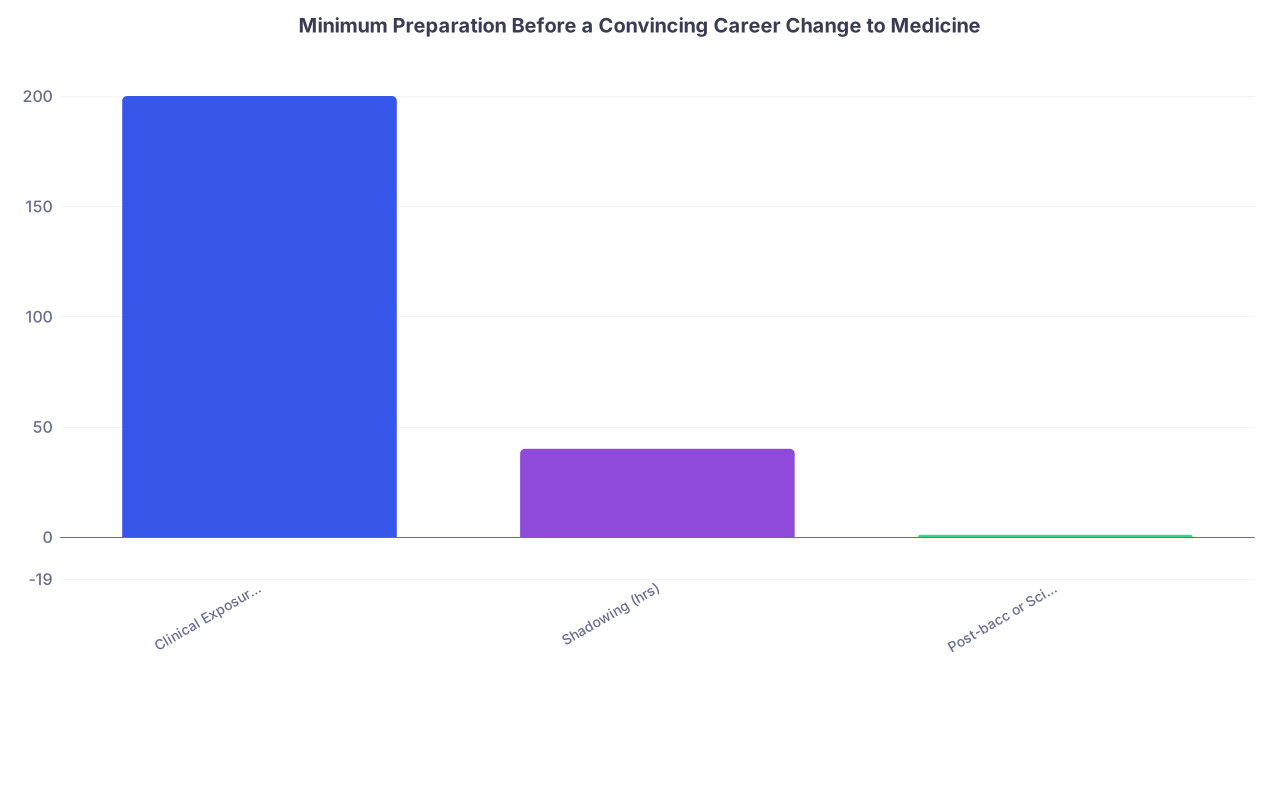
| Category | Value |
|---|---|
| Clinical Exposure (hrs) | 200 |
| Shadowing (hrs) | 40 |
| Post-bacc or Sciences (yrs) | 1 |
If you’ve done:
- Less than ~150–200 hours of real, in-person clinical work,
- Less than ~30–40 hours of shadowing across at least two specialties,
- Zero structured science coursework as an adult,
you’re going to have a harder time sounding convincingly committed. Because you don’t have enough data. You’re trying to promise a 10+ year path based on a handful of afternoons.
If that’s you, the fix isn’t fancy language. It’s more experience—before the interview cycle, not during.
8. Putting It All Together: A Sample Composite Answer
Imagine you’re a 33-year-old former software engineer interviewing at a mid-tier medical school. You get:
“So you had a solid career in tech. Why walk away from that and pursue medicine now?”
Notice how this answer hits every element we’ve talked about:
“I spent almost a decade as a software engineer, most recently leading a small team at a digital health startup. I enjoyed building products and solving technical problems, but over time I realized the part of my job I cared about most wasn’t the code—it was the rare times I actually sat with clinicians and patients to see how our tools were affecting their care.
Three years ago, during a pilot at a safety-net clinic, I watched a primary care physician spend an extra 20 minutes with a patient trying to work through housing instability, depression, and diabetes, all in one visit. I remember thinking very clearly: the person who’s really moving the needle here isn’t our app, it’s her. That was the first time I seriously considered medicine.
I didn’t trust a single moment, so I gave myself two years to test the idea. I kept working full-time while completing a formal post-bacc program at night, started volunteering on a hospital medicine floor every Saturday, and later took a part-time job as a medical scribe in the ED. I also made a point of asking every physician I shadowed about the hardest parts of their job and times they had doubted staying in medicine.
By the end of those two years, I wasn’t running away from tech; I was running toward work where I’d be directly responsible for patients’ health and decisions, not just the tools they use. That process under stress, over time, is what makes me confident that medicine is the right long-term path for me.”
That’s how you address a career change without sounding uncertain. Clear arc, concrete experiences, deliberate testing, stated commitment.

| Step | Description |
|---|---|
| Step 1 | Established Career |
| Step 2 | Specific Clinical Exposure |
| Step 3 | Serious Consideration of Medicine |
| Step 4 | Intentional Testing Period |
| Step 5 | Get More Experience or Stay in Current Field |
| Step 6 | Commit to Prereqs & MCAT |
| Step 7 | Apply to Medical School |
| Step 8 | More or Less Certain? |
9. Bottom Line
Three things you need to remember:
- You’re not “exploring” medicine in the interview. You’re presenting a decision that’s already been tested under stress and time.
- Strip out weak, uncertain language and replace it with clear, concrete, past-tense actions and firm choices.
- Use your prior career as proof of maturity and transferable strengths—not as something you have to apologize for or overexplain.
If you do those three things consistently, you stop sounding like someone hoping medicine will fix their life and start sounding like someone who already chose medicine and is now asking for the training to do it well.


