

Last fall, a second-year med student sat in my office right after an away rotation interview. She’d been asked, “Will you need any special accommodations?” and froze. She mumbled something vague, left the room feeling ashamed, and spent the flight home replaying her answer instead of thinking about the cases she’d seen. The problem wasn’t her disability. It was that no one had ever taught her how to talk about it professionally.
If you’re reading this, you’re probably bracing for the same thing. You have a diagnosis, or you use accommodations, or you’re just worried someone will cross a legal line in an interview and you won’t know how to respond. Let’s fix that now.
First, know the rules (and where interviewers cross them)
You do not have to be a legal expert. But you do need a working understanding of what’s off-limits and what’s fair game.
For U.S.-based programs (med school or premed programs like SMPs/post-baccs), here’s the basic reality:
- They cannot legally ask you if you have a disability, your diagnosis, past medical history, or details about treatment.
- They can ask if you’re able to perform the essential functions of the program/job, with or without reasonable accommodations.
- You do not have to disclose a disability or diagnosis during the interview. Ever.
- You can choose to disclose if:
- It’s part of your story and you’ve already included it in your application, or
- You need to discuss feasibility/safety (for example, mobility issues and certain surgical subspecialties).
The problem is real life is messier than the law.
I’ve seen people get questions like:
- “Do you have any health issues that might affect your performance?”
- “Will you be okay with the long hours given your… situation?”
- “What’s going on with the extra time you mentioned?”
- “I noticed a gap in your education—was that medical?”
These are all problematic in different ways. But you’re not going to stop an interviewer mid-sentence and give them an ADA lecture. You need practical scripts that protect you and keep the interview on track.
We’ll walk through what to say, exactly, in a range of situations.
Decide your disclosure strategy before interviews start
Don’t walk into interview season still undecided about what you’re willing to share. That’s how people overshare or freeze.
There are three broad strategies. Pick one for each of these buckets:
- Premed (post-bacc, SMP, pipeline programs)
- Medical school
- Later (away rotations, residency)
You can change approaches as you move along the pipeline.
Strategy A: No disclosure at interview
You keep your health and disability info private. If you need accommodations, you handle that after acceptance with the disability office, not with admissions or faculty.
This works well if:
- You already use regular accommodations like extra time, quiet room, flexible deadlines, and they won’t change the fundamental program structure.
- Your condition is stable, well-managed, and doesn’t significantly affect patient safety.
- You’d rather avoid bias, which, yes, still very much exists.
Key mindset:
You are not “hiding” anything. You’re using the system as it’s designed: admissions evaluates qualifications, disability services evaluates accommodations.
Strategy B: Limited functional disclosure, no diagnosis
You talk about how you work, not what you have.
You might say things like:
- “I perform at my best when I can use X strategy.”
- “I’ve used test-taking accommodations in the past, arranged through my institution’s disability office.”
- “I’ve shown I can meet all requirements with these supports in place.”
You do not name the diagnosis unless you choose to.
This is often a strong approach if:
- You’ve written about your disability in your personal statement or secondaries already.
- Your file already mentions “approved accommodations.”
- You anticipate questions about gaps/LOAs but don’t want to invite armchair psychiatry from interviewers.
Strategy C: Open disability narrative
You use your disability story as part of your motivation and resilience narrative. You might talk explicitly about chronic illness, psychiatric diagnoses, ADHD, visual/hearing impairments, mobility limitations, etc.
This can be powerful if:
- You’ve already framed it in your application materials in a strengths-focused way.
- You’re very practiced at talking about it without oversharing or sounding like you’re asking for pity.
- You are ready for the fact some programs will silently hold it against you. (Yes, they shouldn’t. Yes, some still will.)
You don’t need to pick one strategy for your whole life. But you do need to decide which one you’re using for this application phase, at these programs.
Scripts for common problematic interview questions
Let’s get concrete. Here’s what you’re likely to see and how to respond.
1. “Do you have any disabilities we should know about?”
Legally? Bad question. But it shows up.
If you’re NOT disclosing:
“Nothing that affects my ability to meet the essential requirements of the program. If I ever needed any support in the future, I’d work with the appropriate institutional office, as I’ve done successfully before.”
If you ARE disclosing functionally (not diagnosis):
“I do not have any limitations that prevent me from meeting the essential requirements of the program. I have, in the past, used approved academic accommodations for standardized tests, and with that structure in place I’ve consistently met expectations and performed well.”
If you ARE openly disclosing and it’s in your application:
“As I shared in my application, I have a chronic health condition that’s well managed. With standard accommodations coordinated through disability services, I’ve been able to fully meet all academic and clinical expectations.”
Then you stop. Let them ask follow-ups if they dare.
2. “Will you need special accommodations?”
First, normalize the concept. Don’t act like they just uncovered a crime.
If you don’t want to get into it in an interview:
“At this stage I don’t have anything specific to request from the program. If I ever did, I’d follow your standard process and work through your disability/accommodations office rather than the admissions side.”
If you’re open to saying you use them but not getting granular:
“In past academic settings, I’ve worked with disability services to arrange exam accommodations, and that’s allowed me to perform at my best. If I matriculate, I’d plan to follow your institution’s process for that, separate from the admissions process.”
If accommodations are obvious (e.g., mobility aid, hearing aid, service dog):
“I use some established accommodations, like [briefly name visible aid], and I’ve been very successful in prior clinical settings with those in place. I’m happy to work with your disability office to ensure everything aligns with your policies.”
You’re not asking permission. You’re signaling: “I know how this works. I’m not a problem; I’m a professional.”
3. “I noticed a gap/LOA in your education—what happened?”
This one comes up constantly. You need a clean, short, practiced story.
Three-part structure:
- General cause (“health issue,” “family situation,” “medical leave”)
- Action taken (treatment, support, recovery, planning)
- Outcome (return to full function and strong performance)
Example if you’re not naming the diagnosis:
“During that period I took a medical leave to address a health issue. I used that time to work closely with my care team, got appropriately treated, and returned when I was fully ready to perform. Since returning, I’ve [point to consistent grades, MCAT, research, Step scores, etc.].”
If you’re more open:
“I took a leave related to severe depression. I got intensive treatment, including therapy and medication adjustments, and I returned with a much better support system. Since then I’ve consistently handled full-time coursework and clinical responsibilities, as you can see from my transcript and evaluations.”
The key is you end on competence and stability, not on struggle.
4. “Can you handle the demands of medical training / night shifts / long hours?”
They ask this of everyone. It hits different if you’ve disclosed something.
You respond like any other candidate, with a subtle nod to your experience:
“I’ve already managed rigorous academic and clinical demands, including [specifics: 60–80 hour weeks on a service, full course loads, research plus classes]. I’m realistic about the intensity, and I’ve built good systems—time management, support, and self-care—that have helped me sustain performance.”
If they push with “given your condition…” (ugly but happens):
“I understand the concern. Since [treatment/recovery/adjustment], I’ve demonstrated that I can handle full clinical loads and call schedules, as you can see from my recent rotations and evaluations. I would not be applying if I did not believe I could safely meet the demands of training.”
You’re drawing a clear line: past challenge, current stability, objective evidence.
How to prepare: practical steps before you walk into the room
You cannot improvise this stuff under stress. You’ll either over-explain, get defensive, or shut down. So you rehearse.
1. Write your “disability/accommodations” paragraph
Literally write it out. One paragraph, 3–5 sentences, built with these pieces:
- One sentence about whether you use accommodations now or have in the past.
- One sentence about working with disability services (shows you understand the process).
- One or two sentences about demonstrated performance with supports in place.
- One sentence about future process: “If I attend here, I’ll work through your disability office.”
Then practice until it sounds like normal speech, not a legal statement.
2. Decide your “floor and ceiling” of disclosure
Floor = minimum you are willing to say if pushed.
Ceiling = maximum detail you’ll allow yourself to share.
Example:
- Floor: “I had a health issue that required leave; it has been treated and I’ve returned to full function.”
- Ceiling: “Depression, partial hospitalization, now stable for 3 years with therapy and medication, transcripts show excellent performance since.”
You pick your comfort range ahead of time so you don’t get dragged into oversharing because an interviewer is awkwardly curious.
3. Practice reframing back to your strengths
You do not let the conversation camp on your disability. You pivot.
Examples of pivot phrases:
- “…and with that in place, my performance has been [concrete example].”
- “…which actually helped me develop [specific skills: empathy, time management, self-awareness] that I bring to patient care.”
- “…and since then I’ve [objective outcome: strong MCAT/Step, clerkship honors, leadership roles].”
Practice with another human. Have them throw semi-inappropriate questions at you so you can practice staying calm and pivoting.
Managing real-time awkwardness and illegal questions
Sometimes the interviewer clearly doesn’t know what they’re allowed to ask. Sometimes they know and don’t care. Either way, standing up and walking out is not your best move.
Here’s how to handle it strategically.
Scenario: Directly illegal question
Example: “So, what exactly is your diagnosis?”
Your goals:
- Protect your privacy.
- Avoid looking hostile.
- Get back to your qualifications.
Response template:
“I tend to keep specific medical details private, but I’m very comfortable sharing that I’ve been fully cleared to participate in all required activities and I’ve consistently met performance expectations with the standard supports available. I’m happy to talk more about how I work and how I’ve been successful in similar environments.”
That’s you drawing a boundary and handing them a safer topic.
Scenario: Vibe is “we’re worried you’ll be a problem”
You’ll feel it. The extra concern, the repeated questions.
Tight answer:
“I understand why programs are careful about whether applicants can manage the demands. What I can tell you is that my recent track record—[grades, hours, responsibilities]—shows I’ve been able to sustain high performance in demanding environments. I would not be in this process if I weren’t confident about that.”
Let the data speak. Don’t start promising heroics or saying things like “I’ll push through no matter what” (that just sounds unsafe and naïve).
Timing: when to bring up accommodations if you don’t tell them at interview
A lot of premeds and early med students get stuck here: “If I don’t say anything now, is it too late later?”
Short answer: No. Most of the time, the correct timing is after acceptance, before or early in the program, through the disability office.
Typical sequence:

| Step | Description |
|---|---|
| Step 1 | Interview Season |
| Step 2 | Admissions Evaluates File Only |
| Step 3 | Limited or Full Narrative in Interview |
| Step 4 | Acceptance Offer |
| Step 5 | Contact Disability Office |
| Step 6 | Submit Documentation |
| Step 7 | Accommodation Plan Set |
| Step 8 | Disclose? |
If you’re applying to medical school:
- You interview
- You (hopefully) get accepted
- Once you know where you’re going to matriculate:
- You reach out to their disability office
- You provide documentation
- You set up classroom/testing accommodations
- Clinical accommodations get negotiated later as needed
If you’re already in medical school heading into clinical rotations:
- You can revisit accommodations before clerkships or sub-internships begin
- You do not owe every attending your medical story; you coordinate at the institutional level
How this plays out differently for premed vs. med students
Let’s separate your worlds a bit.
| Aspect | Premed (Post-bacc/SMP/UG) | Medical School Applicant |
|---|---|---|
| Typical focus | Academic readiness | Clinical & [professional readiness](https://residencyadvisor.com/resources/med-school-interview-tips/how-interviewers-decide-if-youre-professional-enough-in-10-minutes) |
| Common accommodations | Testing, notes, attendance | Testing, clinical logistics |
| Who you tell (ideally) | Disability office post-acceptance | Disability office post-acceptance |
| Best default strategy | Minimal or functional disclosure | Functional, selective narrative |
As a premed
Your main job is convincing them you can succeed academically and transition eventually to the rigors of medical training.
- If your GPA shows a “before and after” around treatment/accommodations, you can leverage that:
“Once I got appropriate support, you can see the change in my academic performance.” - If your disability is why you’re going into medicine, you might choose to share more.
- You still do not need to list DSM codes or lab values for anyone.
As a medical school applicant
Now the concern shifts more to:
- Can you survive the preclinical grind?
- Can you perform safely around patients?
- Can you handle a clerkship schedule?
So you highlight:
- Strong performance in upper-level science classes
- Any clinical or caregiving work with demanding schedules
- Evidence you can already behave like a quasi-healthcare professional
You talk less about “this hurt me” and more about “this shaped how I practice and what I pay attention to as a future physician.”
A quick word on mental health disclosures
This is the landmine. Anxiety, depression, bipolar disorder, ADHD, PTSD—these are all common, and still heavily stigmatized.
My blunt opinion:
If you currently have stable depression/anxiety/ADHD that’s well-treated and you’re functioning at a high level, you are usually better off using a functional disclosure (Strategy B) than a blunt diagnostic label (Strategy C), unless:
- You’ve already written explicitly about it in your primary/secondaries, and
- You’re very polished in explaining the arc: symptoms → treatment → growth → stability → performance.
If you do say it out loud, you must immediately anchor it in:
- Treatment adherence
- Support system
- Concrete evidence of stability (years without leave, good evaluations, etc.)
What you never say:
“I had a nervous breakdown.”
“I burned out completely.”
“I’m still kind of struggling, but I’ll be fine.”
Even if those feel emotionally honest, they sound to an interviewer like, “Risk of future leave and remediation.”
How to mentally reset if an interview goes badly around this
Sometimes you prep, you script, and still something goes sideways. The interviewer is inappropriate. You stumble. You walk out feeling exposed.
Do this after:
- Write down exactly what was asked and what you said. While it’s fresh. This makes it less likely to twist into something worse in your memory and gives you data for whether you need to report it later.
- Evaluate: was this one person, or did the program show a pattern of red flags? If multiple people pushed the same line, that’s useful data about their culture.
- Adjust your script. If you heard yourself oversharing, simplify. If you froze, tighten your key lines and practice a firm-but-neutral boundary phrase like, “I prefer to keep the specific diagnosis private, but…”
- Don’t let one bad interaction make you change your entire career plan. I’ve watched excellent candidates get rattled by one terrible interviewer and then withdraw from specialties or schools they’d be great in. Don’t give them that power.
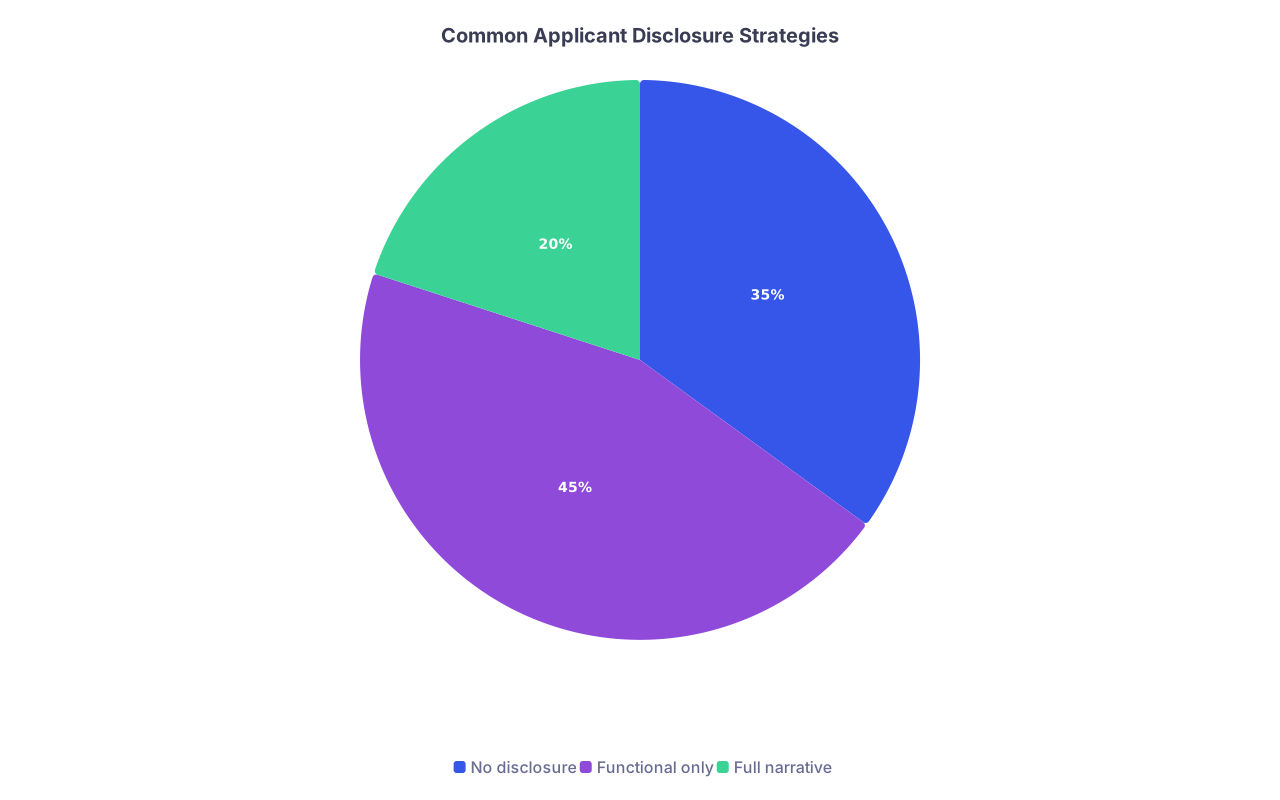
| Category | Value |
|---|---|
| No disclosure | 35 |
| Functional only | 45 |
| Full narrative | 20 |
Quick reality check: yes, bias exists – plan around it
I won’t sugarcoat it. Some people will see “disability,” especially psychiatric disability, and mentally put you in a risk box. Others will quietly admire your resilience. You don’t control which one you get.
What you do control:
- How tight and professional your story is.
- Whether you lean on data (performance) instead of emotion.
- Whether you pick environments that actually support you.
Sometimes your best move is exactly this: say less in the interview, get in, then work with disability services to get exactly what you need.
That’s not being sneaky. That’s using the structure that’s supposed to exist to protect you.

FAQs
1. Do I ever have to disclose a disability during interviews?
No. You never must disclose a disability or specific diagnosis during an interview. Programs are allowed to ask about your ability to meet essential requirements (“Can you meet the physical demands of the curriculum with or without accommodations?”), but you can answer that without naming a condition. The one caveat: if a condition makes it truly unsafe or impossible to perform core tasks even with accommodations, then ethically you should not be entering that training path in the first place.
2. What if I need significant clinical accommodations (e.g., mobility, hearing)?
Then you should think more carefully about timing. If the accommodation is obvious (wheelchair, cane, hearing aids, interpreter), you’re effectively “disclosing” by walking in. In those cases, you can use a calm, practiced line: “I use [X support] and have successfully completed [Y clinical experiences] with it. I work closely with disability services to make sure everything is safe and within policy.” You still don’t have to spell out the diagnosis. For very substantial accommodations (like needing modified call schedules), it can be wise to talk with the disability office before you commit to a school to make sure they can realistically support you.
3. How do I handle disability-related questions in multiple-mini interviews (MMIs)?
MMIs are fast and weird. You don’t have time for a long narrative. If an MMI station touches on disability or accommodations personally, keep it compressed: one sentence acknowledging it, one sentence about using proper channels, one linking back to your strengths. For example: “Yes, I’ve used testing accommodations arranged through disability services, and with those in place I’ve consistently met or exceeded expectations in challenging environments.” Then move straight into the actual scenario or ethical question. Don’t let the personal angle eat your whole 7 minutes.
4. Could not disclosing hurt me later if something goes wrong in training?
What matters later isn’t whether you told an interviewer; it’s whether you worked with the proper institutional channels once you were a student or trainee. If you struggled and never sought accommodations or support, that can complicate remediation conversations: programs may ask why you didn’t engage resources sooner. But “I chose not to share my diagnosis in my admissions interview” is not a problem. The important part is that once you’re in, you document your needs through disability services if you require accommodations, rather than trying to improvise unofficial workarounds with individual faculty.
Key takeaways:
- You control how much you disclose; focus on functional ability and performance, not diagnostic labels.
- Prepare and rehearse tight, professional scripts for gaps, accommodations, and “can you handle it?” questions.
- Use the system as intended: interviews for qualifications, disability services for accommodations—most detailed conversations should happen after you’re accepted, not in the interview chair.


