

It’s May 20th. Your MCAT is done, your primary’s almost ready, and for the first time in a year you have… hours. Actual free hours.
You’re in that weird limbo: too early for interviews, too late to overhaul your GPA, and you’re staring at your calendar wondering if these “gap months” are going to matter or just dissolve into Netflix and part‑time work.
They’re going to matter. Because four to eight months from now, an interviewer is going to lean back, look at your application, and say:
“So, tell me about a time you led a team.”
Or: “What have you been doing with your time recently?”
At that point, you either have sharp, lived, recent stories. Or you’re fumbling back to some half‑remembered thing from sophomore year.
This is where you build those stories. Month by month, week by week.
Big Picture: What These Gap Months Are Actually For
At this point, you should stop thinking “I need more activities” and start thinking “I need better stories.”
Interview committees are not impressed by raw activity count. They care about:
Concrete examples of:
- Leadership
- Resilience
- Teamwork and conflict management
- Ethical thinking
- Commitment to service
Recent engagement:
- “What have you been doing in the last 6–12 months?”
- “How do you spend your time when you’re not being graded?”
Your off‑season strategy is simple:
- Choose 2–3 focused roles over many scattered “one‑off” experiences.
- Stay in them long enough to have:
- A problem you faced
- An action you took
- A result you can measure or describe
- Keep a running log so you do not forget the details.
Everything below is built around that.
6–9 Months Before Interviews: Set the Stage
Let’s anchor some time. For most traditional applicants:
- Primaries submit: June
- Secondaries: July–August
- Interview season: September–February
So we’re talking about roughly March–August as your “gap months” (shift earlier or later if you’re on a non‑traditional schedule).
At this point, you should:
Decide your primary identity for this season
- “I’m a medical assistant working 30 hours a week”
- “I’m a full‑time researcher with a side of community outreach”
- “I’m a scribe plus consistent clinic volunteer”
Commit to depth, not noise
- 2–3 main things you can talk about at length
- Not 7 tiny, forgettable bullet points
| Type | Example Profile |
|---|---|
| Strong | 25 hr/wk MA + 4 hr/wk free clinic + 1 ongoing project |
| Decent | 15 hr/wk scribing + 5 hr/wk crisis hotline |
| Weak | 6 different one-day events + random shadowing sessions |
| Risky | “Just studying and relaxing” with no structured activity |
Step 1: Pick Your Story Engines (Month 0–1)
You need story engines: roles that naturally generate meaningful situations.
At this point, you should lock in:
One patient-facing or community-facing role
- Scribing
- MA / CNA / EMT
- Free clinic volunteer
- Hospice volunteering
- Crisis hotline
One responsibility or leadership role
- Shift lead at a clinic or non-profit
- Coordinator for volunteers
- Project lead for research or quality improvement
- Organizer of a recurring program (tutoring, health fair, mentorship)
Optional: One “personal growth” or non-medical role
- Teaching/tutoring
- Coaching
- Long-term job (restaurant, retail) with real responsibility
- Intensive course (languages, statistics, CS, etc.)
If you’re late to this: stop looking for “the perfect activity” and grab something that actually puts you in the arena with real people and real problems.
At this point you should be:
- Sending 5–10 emails a week asking about:
- Open volunteer shifts at clinics and hospitals
- Research assistant roles
- Community orgs needing consistent help (not just event day bodies)
- Willing to start lower on the ladder if there’s a path to more responsibility within 2–3 months.
3–6 Months Before Interviews: Build the Raw Material
Now you’re in it. You have roles. You’re clocking hours. This is where almost everyone zones out and just “shows up.”
You’re going to do something different: collect story material.
At this point (month-by-month), here’s what you should be doing.
Month 1: Start the Story Log
Week 1–2:
Create a simple log system:
- One Google Doc, Notion page, or physical notebook
- Sections: “Leadership,” “Teamwork,” “Conflict,” “Failure,” “Ethics,” “Resilience,” “Why medicine”
After each shift or weekly:
- Write 3–5 bullet points:
- What did I actually do?
- Did anything fail, go sideways, or feel uncomfortable?
- Did I make a decision, not just follow orders?
- Write 3–5 bullet points:
Example log entry (this is what a good one looks like):
“Free clinic, 5/22 – Intake chaos, short one volunteer. I noticed lines forming and the med assistant was getting flustered. I suggested we separate Spanish-speaking patients into a different queue since I and another volunteer are fluent. Cleared backlog in 25 minutes. MA later told me she appreciated that someone stepped up without being asked. Good for ‘taking initiative under pressure’ story.”
Notice: concrete, specific, and tagged in your head for potential “teamwork/initiative” use.
Week 3–4:
- Identify early story seeds:
- 1 time you messed up or almost did
- 1 time you advocated for a patient or peer
- 1 time you disagreed with someone in authority (even internally)
You do not need perfect hero stories. Vulnerable ones are more believable and useful.
Month 2: Intentionally Create Situations
You cannot just wait for “interesting things” to happen. You need to step into responsibility.
At this point, you should:
Ask for one slightly bigger task in each role:
- “Can I help orient new volunteers?”
- “Can I take ownership of tracking X for the next month?”
- “I noticed we’re always running behind on intake—can I try a different check-in flow next week?”
Look for:
- A small process that’s broken
- A recurring frustration your team complains about
- A gap in communication (“No one ever tells night shift what happened in the day”)
Then:
- Propose a tiny, specific change.
- Try it for 1–2 weeks.
- Track what happens.
That’s your future “Tell me about a time you improved a system” story.
Month 3: Sharpen One Signature Story in Each Category
By now, if you’re paying attention, you should have:
- At least:
- 2–3 leadership moments
- 2–3 teamwork/conflict moments
- 2–3 setbacks/failures
- 2–3 meaningful patient/community interactions
At this point, you should pick one from each major category and start sharpening it using something like STAR (Situation, Task, Action, Result) or whatever structure works for you.
Example categories to lock in:
- Leadership
- Teamwork / working with difficult people
- Ethical dilemma / gray zone
- Major failure / setback
- Stress / resilience / burnout moment
- Why medicine (recent, not just “when I was 10…”)
Do not fully script them. But write these out in bullet form so the bones are clear.
Weekly Rhythm: How to Use Each Week Before Interviews
Zooming in now. Between now and interview season, your weeks should follow a simple rhythm.
At this point in an average week, you should:
Early Week (Mon–Wed): Do Things Worth Talking About
- Prioritize your highest-yield roles earlier in the week (when you have more energy).
- During shifts/volunteering:
- Look for:
- A time something doesn’t go to plan
- A time you have to read someone’s emotions and act
- A time you disagree internally but have to stay professional
- Look for:
That’s usually the spine of a good story: tension + decision + outcome.
Late Week (Thu–Sun): Process and Capture
Set a recurring 20–30 minute block.
You should:
Add 3–5 bullet points to your log:
- What surprised me this week?
- When did I feel frustrated or proud?
- Did anyone give me feedback—positive or negative?
Tag each bullet in your mind:
- (L) leadership
- (T) teamwork
- (F) failure
- (E) ethics
- (R) resilience
You’re not writing an autobiography. You’re just making your future self’s life much easier when you’re staring at 30 secondary prompts and later 20 interview questions.
1–3 Months Before Interviews: Turn Raw Experiences into Interview-Ready Stories
Now timelines compress. If your primary’s in and secondaries are going out, you’re getting closer to interview season.
At this point, you should:
- Keep all your core activities going
- Start deliberately practicing talking about them
Month 4–5: Map Experiences to Common Interview Questions
Take your log. Grab a blank sheet.
Draw columns:
- Leadership
- Teamwork
- Conflict / difficult person
- Mistake / failure
- Stress / resilience
- Ethical tension
- Working with diverse populations
- Why this school / why medicine (recent)
Under each column, list 2–3 experiences from the last 6–12 months.
Then ask:
- Where are the gaps?
- No recent ethical situation? Look harder—often it’s subtle (privacy, language barriers, respecting autonomy).
- No resilience story? Think about schedule overload, MCAT prep, family stuff, or a tough semester.
If you truly have gaps, you still have time. Target them for the next 4–6 weeks:
Want a resilience story?
- Take on a tough schedule for a short period: MCAT work + shifts + family obligations.
- The story is not “I suffered”; it’s “I restructured, set boundaries, and kept commitments.”
Want an ethical story?
- Pay attention in clinical roles:
- Consent
- Witnessing dismissive behavior
- Language access problems
- Privacy issues in crowded clinics
- Pay attention in clinical roles:
Month 5–6: Practice Out Loud
You cannot do this all in your head. You will sound robotic or scattered.
At this point, you should:
Choose 5–7 “anchor stories”:
- 2 leadership/teamwork
- 2 resilience/failure
- 2 patient/community moments
- 1 “this is why I’m still choosing medicine” from the last year
Practice them out loud weekly:
- Record on your phone, 2–3 minutes per story
- No script, only 3–4 bullet prompts
- Listen back once and fix:
- Rambling detail
- Missing “what I learned”
- Lack of concrete action (“I helped” vs. “I did X, Y, Z”)
You’re not memorizing paragraphs. You’re tightening the arc: setup → what you did → what changed → what you took away.
The Last 4–8 Weeks: Closing the Loop Right Before Interviews
As you get closer to actual interview invitations, your strategy shifts slightly.
At this point, you should:
- Keep at least one substantive activity going up to and through interview season
- Be ready for the “What are you doing this year?” question with a clean answer
Month 6+: Presenting Your Gap Months Coherently
Build a narrative that passes the “Does this sound like a real adult?” test.
Example of a coherent summary:
“Since submitting my primary, I’ve been working about 25 hours a week as a medical assistant in a community health clinic, where I help with rooming patients and sometimes translating for our Spanish-speaking patients. I also volunteer one evening a week at a free clinic where I coordinate intake for the walk-in patients. Outside of clinical work, I tutor high school students in math twice a week. Altogether it’s given me a better sense of how medicine intersects with language, transportation, and school systems.”
That answer says: structured, purposeful, human.
What you want to avoid:
“I’ve mostly been waiting to hear back and working a little and spending time with family.”
True maybe. But thin. You can do better.
Specific Scenarios: If You’re in One of These Spots
Let me be direct about a few common situations I see.
If You’re Still in Undergrad (Premed, Rising Applicant)
At this point (late junior/senior year), you should:
- Lock in something that continues past graduation:
- Research role you can stay in over the summer
- Clinic volunteering that transitions to a larger role when you have more time
- Part-time job in healthcare that can expand hours
Interviewers love hearing:
“I started this my senior year and have stayed with it for the last 8 months.”
Shows commitment, not “I did it for the checkbox and left.”
If You Just Graduated and Are in a Full Gap Year
You have the most runway and the least excuse to say “I didn’t have time.”
At this point (early/mid gap year), you should:
- Treat this like a real year of professional development:
- 30–40 hours/week of work/volunteering/research
- A clear answer to: “Why did you take a gap year, and what have you done with it?”
Weak answer:
“I wasn’t ready to apply, so I’m just working and thinking.”
Strong answer:
“I chose to take a gap year to deepen my clinical experience and confirm that I’m ready for the demands of medicine. I’ve been working full time as a scribe in an ED and volunteering on weekends at a crisis hotline. It’s changed how I think about communication under stress and made me more confident that I want to work with acute care patients.”
If You Feel Like You “Wasted” the First Few Months
I see this every cycle: people wake up in August and panic.
If you’re in that boat:
- Stop beating yourself up; it’s unproductive.
- Compress the same strategy into fewer months.
At this point, you should:
Immediately secure:
- One high-contact, high-responsibility role (scribing, MA, EMT, crisis line)
- One weekly consistent volunteer role
Be explicit in interviews:
- “I realized mid-summer that my schedule was too unstructured, so I…”
- Then you describe concretely how you fixed it.
That “I corrected course” story itself becomes a resilience/maturity example.
A Simple Visual of Your Off-Season Plan
Here’s a quick high-level view.
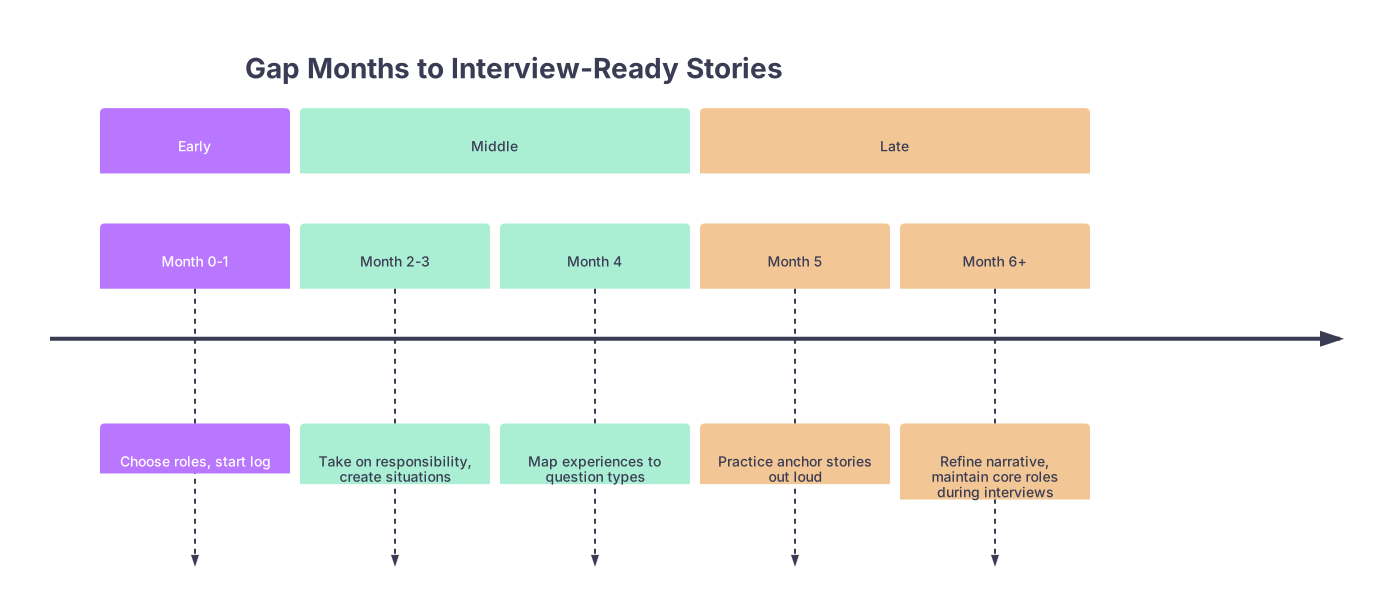
| Period | Event |
|---|---|
| Early - Month 0-1 | Choose roles, start log |
| Middle - Month 2-3 | Take on responsibility, create situations |
| Middle - Month 4 | Map experiences to question types |
| Late - Month 5 | Practice anchor stories out loud |
| Late - Month 6+ | Refine narrative, maintain core roles during interviews |
And how your time might roughly split across roles:
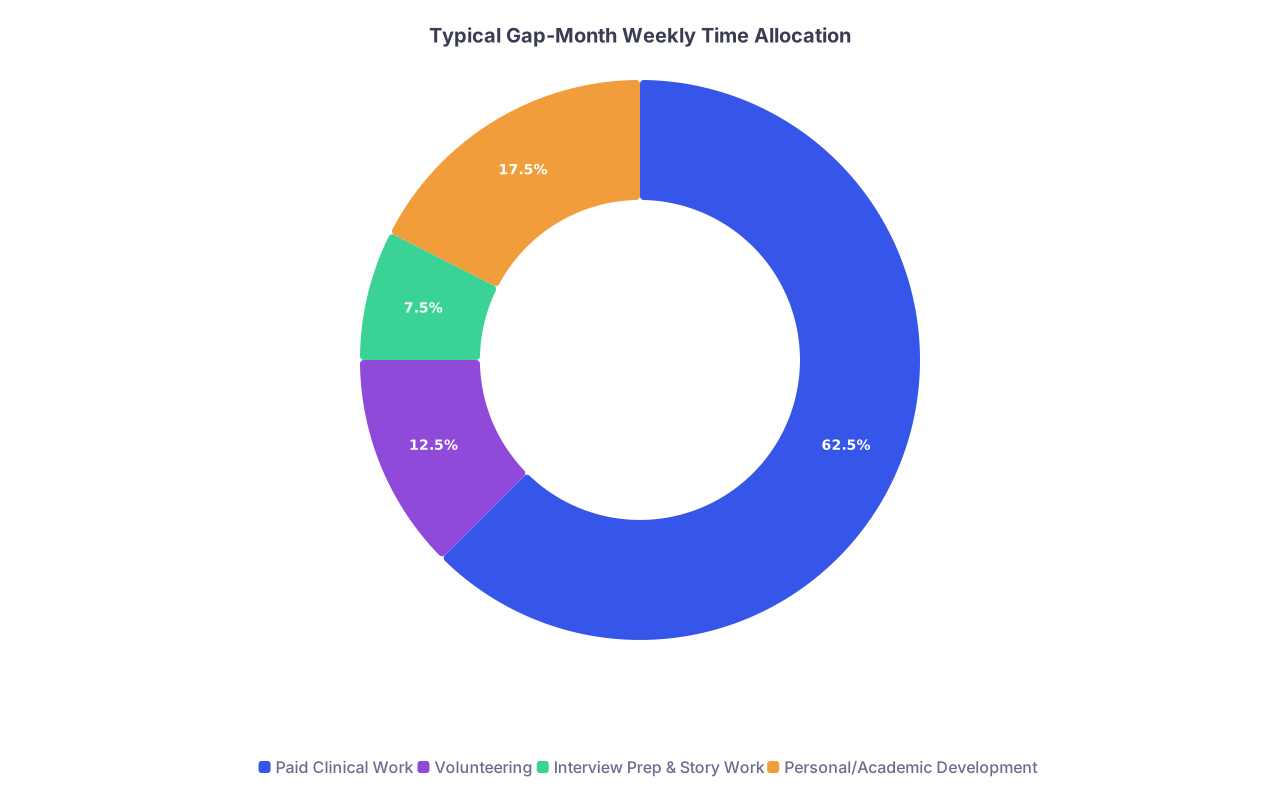
| Category | Value |
|---|---|
| Paid Clinical Work | 25 |
| Volunteering | 5 |
| Interview Prep & Story Work | 3 |
| Personal/Academic Development | 7 |
Final Checklists: What You Should Have by Interview Season
By the time interviews start, you should be able to say “yes” to most of this.
Experience Checklist
You should have:
- 1–2 sustained clinical roles (≥6 months, or ongoing at time of interview)
- 1 role where you clearly stepped into responsibility or leadership
- 1–2 experiences outside of pure medicine that show you’re a normal human with interests and growth
Story Checklist
You should have at least:
- 2 leadership/teamwork stories
- 2 resilience/failure stories
- 2 meaningful patient or community encounter stories
- 1 story from the last 12 months that answers “Why medicine, now?”
- 1 example of improving a process or solving a system-level problem
Process Checklist
You should be:
- Logging weekly — even if it’s just a few bullets
- Practicing stories out loud, not just in your head
- Ready to answer:
- “What have you been doing this year?”
- “How have your recent experiences confirmed or challenged your desire to be a physician?”
Bottom Line
- Gap months are where you create the recent, specific, lived stories that make interviews easy instead of excruciating.
- At every point in the year, you should be either doing something story-worthy or capturing and refining the stories you already have.
- Depth beats noise: a few sustained, responsibility-heavy roles will carry you much farther than a dozen scattered, forgettable lines on your CV.


