

The worst way to handle an interview question you don’t know is to fake it.
The best way is to show you can think, stay calm, and be honest under pressure. That’s what interviewers are actually testing.
Let me walk you through exactly what to say, what not to say, and how to practice this before you walk into a medical school or premed interview.
The Real Test Behind “I Don’t Know” Questions
In premed and medical school interviews, tough or unfamiliar questions aren’t accidents. They’re stress tests.
Interviewers are watching for:
- Do you panic or shut down?
- Do you BS your way through?
- Can you admit uncertainty without collapsing?
- Can you reason through an unfamiliar problem?
- Do you stay professional when you’re uncomfortable?
They know you don’t know everything. You’re not a resident. You’re not supposed to know the exact ethics policy at their hospital or the molecular mechanism of some niche pathway.
But if you’re going into medicine, you will constantly face situations where you don’t know the answer yet. How you respond now is a preview of how you’ll act with real patients later.
So let’s build a script and a mindset that actually impress them when you’re stuck.
The Core Script: What To Say When You Don’t Know
You need a simple, repeatable structure you can fall back on under stress.
Here’s a 4-step framework that works for almost every “I don’t know” situation:
- Pause and breathe (1–2 seconds)
- Acknowledge what you don’t know (honestly)
- Show how you’d think or find out
- Connect back to your values or experience
Let’s turn that into specific phrases you can actually use.
Scenario 1: Knowledge-based question you truly don’t know
Example:
“What are the main arguments against single-payer healthcare in the U.S.?”
You’re blank.
A strong response:
“I’ll be honest, I don’t think I can list all of the major arguments accurately. I know some supporters focus on equity and access, and opponents often raise concerns about cost, government control, and wait times. I’m sure there are economic and policy nuances I’m missing.
If I were on a team discussing this, I’d want to read primary sources from both sides and look at data from countries with single-payer systems. I don’t want to oversimplify something that complex, but at a high level, I’m very interested in systems that increase access while staying financially sustainable.”
What this does:
- Admits limits
- Shows you have a partial framework
- Shows how you’d learn properly
- Keeps you in the conversation instead of tapping out
Scenario 2: Hypothetical or ethical scenario you’re unsure about
Example:
“What would you do if your attending ordered something you believed was wrong for the patient?”
You’re not sure what the ‘textbook’ answer is.
You don’t say “I don’t know.” You work the problem out loud:
“That’s a tough situation. As a student I’m very aware I have limited experience, so I’d start by double-checking the chart and making sure I understood the case correctly.
If I still felt concerned, I’d approach the attending privately and ask them to walk me through their reasoning, framing it as wanting to learn rather than accusing them. Something like, ‘I noticed X in the chart and was wondering how that fits with Y order.’
If I still believed there was a real risk to the patient and I wasn’t being heard, I’d follow the institution’s escalation process—possibly talking to a senior resident or a nurse who knows the system well. My priority would be patient safety, but I’d also want to show respect and humility because I know I could easily be missing something.”
You didn’t “know” the answer. You thought like a future clinician. That’s the whole point.
Exact Phrases You Can Steal (And What to Avoid)
Here’s the practical language you should have ready.
Good ways to say “I don’t know”
Mix and match these:
- “I don’t know the complete answer, but here’s how I’d start thinking about it…”
- “That’s not something I’ve studied in depth, but my current understanding is…”
- “I’m not completely sure, and I don’t want to misstate something. Here’s what I do know…”
- “I don’t know the exact statistic, but I know the general trend is…”
- “I haven’t encountered that specific situation, but based on my experience with X, I’d approach it by…”
These keep the conversation going. You’re not bailing out; you’re pivoting into reasoning.
Bad ways to respond (red flags)
Avoid these like the plague:
- “Uh… I don’t know.” (and then silence)
- “I’ve never thought about that.” (and nothing else)
- Making up facts, numbers, or policies
- Overconfident nonsense: “Well obviously the solution is…”
- Rambling for 3 minutes trying to hide the fact you don’t know
Interviewers can tell when you’re faking. Faculty especially. I’ve watched them write “BS-ing” on evaluation sheets.
A Simple Decision Guide: What To Do in the Moment
Use this mental flow when you get a tough question.

| Step | Description |
|---|---|
| Step 1 | Hear Question |
| Step 2 | Ask for clarification |
| Step 3 | Answer directly |
| Step 4 | Think aloud using structure |
| Step 5 | Acknowledge limit & show how youd learn |
| Step 6 | Connect to values/experience |
| Step 7 | Understand it? |
| Step 8 | Know solid answer? |
| Step 9 | Can you reason it out? |
If you’re:
Confused about what they’re asking → Ask them to clarify
“Just to make sure I understand, are you asking more about X or Y?”Pretty sure you know it → Give a clear, concise answer, then stop.
Not sure but can logically reason → Think aloud, structured, not rambling.
Totally out of your depth (e.g., obscure policy, hyper-specific fact) →
Own the gap, then show how you’d learn.
Medical/Science Questions: Handling Partial Knowledge
Med school and premed interviews sometimes throw in lightly technical or policy-ish questions to see how you handle content.
Common situations:
- Health policy: “What do you think about Medicare for All?”
- Public health: “How would you address vaccine hesitancy?”
- Science basics: “Can you briefly explain how mRNA vaccines work?”
You don’t need PhD-level answers. You need:
- Rough conceptual understanding
- No pretending beyond your level
- Responsible language: no absolutist confidence on things you’re shaky on
Example:
“I can give a high-level explanation, but I wouldn’t call myself an expert. My understanding is that mRNA vaccines deliver a piece of genetic code that tells your cells to produce a harmless part of the virus, usually a surface protein. Your immune system then learns to recognize that protein so it can respond faster if you see the real virus.
I’m sure I’m skipping a lot of molecular detail, but that’s the basic picture I have.”
That’s plenty. They’re not grading you like Step 1.
Behavioral Questions You Can’t “Prepare For”
Some questions you legitimately can’t pre-load an answer to:
- “Tell me about a time you failed.”
- “What’s a decision you regret?”
- “Describe a conflict where you were the problem.”
If you blank, don’t say “I don’t know, I’ve never failed.” That’s either delusional or dishonest.
Instead, use a quick recovery move:
“I’m trying to pick an example that really reflects how I’ve grown. One situation that comes to mind is…”
Then go into one story using a basic structure:
- Situation
- What you did
- What went wrong / what you learned
- How you act differently now
The pause is fine. Interviewers don’t mind a few seconds of silence if what comes next is thoughtful.
How To Practice This Before Your Interview
You can absolutely train this skill. And you should.
Here’s a simple practice plan:
| Day | Practice Focus |
|---|---|
| Mon | 10 random ethical/hypothetical questions aloud |
| Wed | 10 policy/current events questions aloud |
| Fri | 10 personal/behavioral questions aloud |
| Sat | 30–45 min full mock interview with a friend |
And then:
Record yourself (phone video is fine).
Watch for:- Long awkward silences
- Rambling
- Saying “uh” or “like” every other word
- Obvious BS
Force 3 “I don’t know” moments per mock.
Have your partner deliberately ask:- An obscure policy question
- A technical science question slightly above your level
- A weird hypothetical scenario
Your job: use the framework, not perfection.
Train your one-liners.
Literally practice saying:- “I don’t know the full answer, but here’s how I’d approach it…”
- “I’m not completely sure; this isn’t a topic I’ve gone deep into yet, but my current understanding is…”
The goal isn’t to avoid “I don’t know.” The goal is to say it well.
How Interviewers Actually Think About This
I’ve sat in debriefs where faculty compared notes. Here’s the kind of feedback they give:
- “She didn’t know that policy answer, but she was very transparent and thoughtful. I trust her.”
- “He tried to fake his way through that ethics question. That worries me.”
- “He said he wasn’t sure and then reasoned through it. That’s what I want to see in a trainee.”
- “She froze and just said ‘I don’t know’ and stopped. Couldn’t recover.”
Notice something: they don’t punish not knowing. They punish:
- Dishonesty
- Overconfidence
- Collapse under mild pressure
You’re not being interviewed for how many trivia facts you can store. You’re being evaluated on maturity, humility, and thinking.
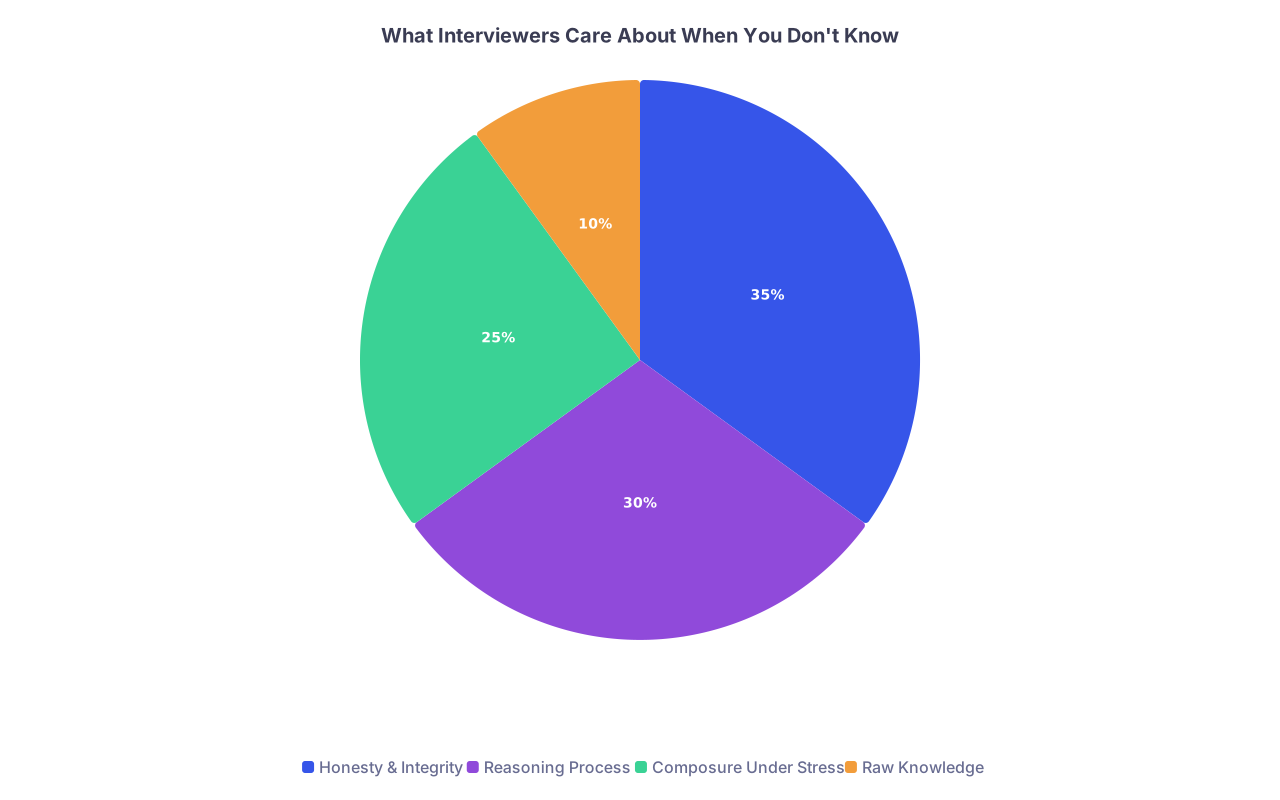
| Category | Value |
|---|---|
| Honesty & Integrity | 35 |
| Reasoning Process | 30 |
| Composure Under Stress | 25 |
| Raw Knowledge | 10 |
Raw knowledge is last. The rest is about how you handle not knowing.
Special Situations: What About MMI and Group Scenarios?
In an MMI station
MMI (Multiple Mini Interview) scenarios are built to be awkward and unfamiliar. The same rules apply, but faster.
If you’re stuck:
“I haven’t encountered this exact situation before, so I’ll talk through how I’d approach it. First, I’d want to understand X… Then I’d consider Y… The main values I’d be weighing are…”
You get points for structure and values-based reasoning, not memorized answers.
In a group or collaborative station
If someone else knows more than you, great. Don’t compete. Show you can be a good teammate:
“I’m not familiar with that specific guideline, but your explanation makes sense. Based on that, maybe we should consider…”
You don’t lose points for not being the smartest person in the room. You do lose points for ego.

What Not Knowing Never Means
It does not mean:
- You’re unqualified
- You “blew” the interview
- You’re not smart enough for medicine
Every strong candidate will have at least one question they stumble on. The difference is how they handle it.
If you walk out thinking, “I completely guessed my way through that ethics question,” then yeah, that’s a problem.
If you walk out thinking, “I was honest, I thought it through, I stayed calm,” that’s a win—even if you didn’t land some perfect polished answer.
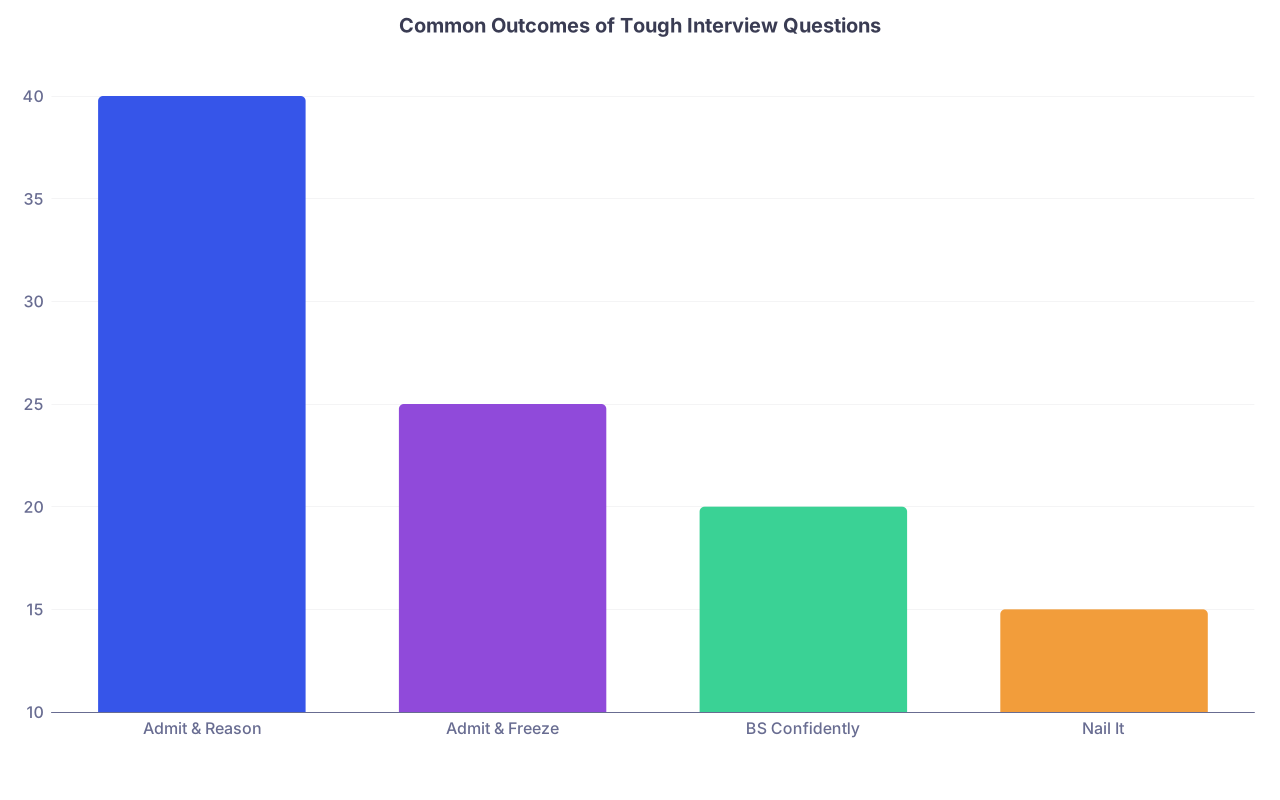
| Category | Value |
|---|---|
| Admit & Reason | 40 |
| Admit & Freeze | 25 |
| BS Confidently | 20 |
| Nail It | 15 |
Most people are in the “admit & freeze” or “BS” categories. You want to live in “admit & reason.”
Quick Reference: Your On-the-Spot Checklist
When you get a question you don’t know, mentally run through:
- Breathe once. Don’t rush. Half a second is fine.
- Clarify if needed. “Are you asking more about X or Y?”
- Decide: Do I know this, partly know it, or really not know?
- If partial:
“Here’s what I understand… I don’t know X, but I’d approach it by…” - If really not:
“I don’t know the answer to that. Here’s how I’d go about finding it, and here’s why it matters to me…”
That’s it. That’s the playbook.

FAQ: Handling “I Don’t Know” in Interviews
Will saying “I don’t know” ruin my medical school interview?
No. Saying “I don’t know” poorly might. If you flatly say “I don’t know” and stop talking, it looks like you shut down. If you say some version of “I don’t know the full answer, but here’s how I’d think about it or find out,” most interviewers will actually like that. They’d rather have a humble, thoughtful applicant than a smooth bullshitter.How long can I pause before answering without it being weird?
A couple of seconds is completely fine. Three to five seconds feels longer in your head than it does in real life. If you need time, you can buy it gracefully: “That’s a great question; let me think about how to answer it clearly.” Then pause, think, and respond. Just don’t sit in total silence with a panicked stare.What if I misunderstand the question?
Clarify. That’s not a weakness; it’s maturity. “Just to make sure I understand, are you asking about X or more about Y?” This actually scores you points because it shows you don’t jump in blindly. In real medicine, clarifying is safer than guessing. Same logic here.Is it better to take a risk and guess, or admit I don’t know?
For factual/technical questions: admit when you’re not sure, then make it clear if you’re speculating. “I’m not certain, but if I had to guess based on what I know about A and B, I’d say…” That shows both humility and reasoning. What you don’t want is confident nonsense. Interviewers hate that.How do I stop myself from rambling when I’m unsure?
Use a structure and force yourself to stop. For ethical or hypothetical questions, aim for: context → options → what you’d do → why. If you feel yourself spiraling, end with: “That’s how I’d approach it, even though I know there are other reasonable perspectives.” Then. Stop talking.Can I circle back and change an answer later in the interview?
Yes, and it can make you look better. “I’ve been thinking about your earlier question about X—I’d like to add something I didn’t articulate well at the time.” That shows reflection, not indecision. In medicine, revising your thinking with more reflection or data is a strength, not a flaw.How should I practice handling questions I don’t know?
Do real mock interviews where your partner’s goal is to stump you a few times. Record them. Each time you get stuck, rewind and script a better response using: acknowledge limit → think aloud → show how you’d learn. Run that same question again until it feels natural. You’re training a reflex.
Open a blank document and write three stock phrases you’ll use the next time you don’t know an answer. Then say them out loud five times each. You want those lines ready in your muscle memory before you walk into your interview.


