

The biggest ethical failures in your first year as an attending rarely come from “bad intent.” They come from bad scheduling.
You think ethics is about big dramatic dilemmas. In practice, it is about when you rounded, what you documented, which review you skipped because clinic was packed, and whose email you ignored. That is where risk lives your first year.
I am going to walk you through your entire first attending year, anchored around one theme: how to deliberately schedule risk and ethics reviews so you do not drift into trouble by accident. Month by month, then zooming into key weeks and recurring checkpoints.
Big Picture: Your First-Year Ethics & Risk Calendar
At this stage, you should stop thinking of “ethics” as sporadic consults and start treating it like a standing part of your clinical calendar—same level as M&M, tumor board, or QI.
Here is the year in one view:
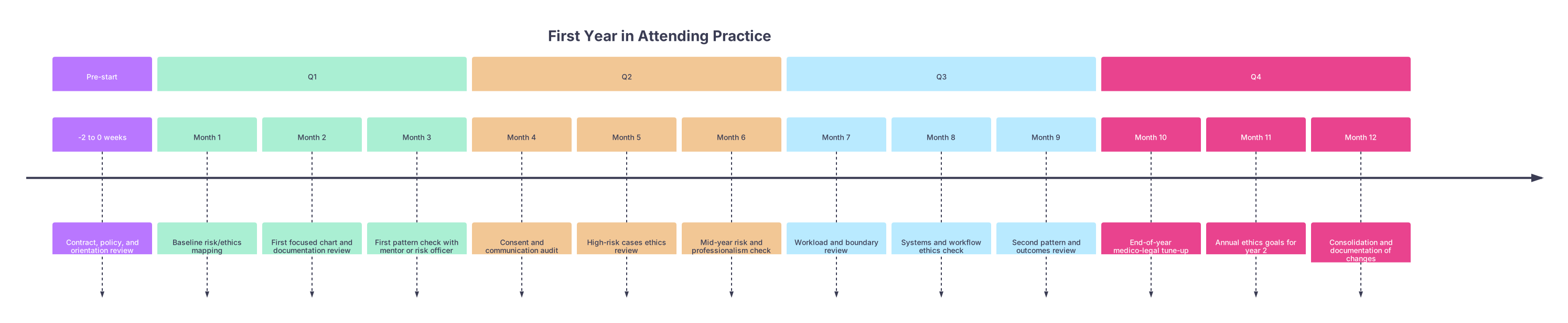
| Period | Event |
|---|---|
| Pre-start - -2 to 0 weeks | Contract, policy, and orientation review |
| Q1 - Month 1 | Baseline risk/ethics mapping |
| Q1 - Month 2 | First focused chart and documentation review |
| Q1 - Month 3 | First pattern check with mentor or risk officer |
| Q2 - Month 4 | Consent and communication audit |
| Q2 - Month 5 | High-risk cases ethics review |
| Q2 - Month 6 | Mid-year risk and professionalism check |
| Q3 - Month 7 | Workload and boundary review |
| Q3 - Month 8 | Systems and workflow ethics check |
| Q3 - Month 9 | Second pattern and outcomes review |
| Q4 - Month 10 | End-of-year medico-legal tune-up |
| Q4 - Month 11 | Annual ethics goals for year 2 |
| Q4 - Month 12 | Consolidation and documentation of changes |
You will not see this timeline in any official handbook. But this is what separates attendings who “somehow avoid complaints” from those who eventually get pulled into performance reviews or legal messes.
Two Weeks Before Start: Stop Reading Reddit, Start Reading Policies
At this point, you should:
- Accept that your vulnerability is highest in your first 6–12 months.
- Front-load your understanding of institutional rules and risk hot spots.
Week -2 to Week 0: Contract, Policies, and Baseline Risk
Set aside two 2-hour blocks before day one. Calendar them. Treat them like a procedure.
Review your contract and scope
- Clinical FTE, call expectations, supervision ratios.
- Any clauses about:
- Documentation standards.
- Use of mid-levels/APPs.
- Telemedicine practices.
- Note anything vague. Bring 3–5 specific questions to your division chief or practice leader.
Pull core policy documents At minimum:
- Informed consent policy.
- Documentation and late entry policy.
- Professionalism and disruptive behavior policy.
- Social media and electronic communication policy.
- Conflict of interest policy.
- Incident reporting / event reporting instructions.
Create a one-page summary (literally one page) of:
- What must always be documented.
- Time limits (addenda, critical results calls, discharge summaries).
- Who you call for:
- Ethics consults.
- Risk management.
- Legal / general counsel.
Map your personal high-risk zones Use your own practice type. For example:
- Hospitalist: end-of-life decisions, code status, capacity assessments, discharges against medical advice.
- Surgery: informed consent, wrong-site risk, post-op handoffs, resident delegation.
- Outpatient IM/FM: chronic opioid management, disability paperwork, test result follow-up.
- Emergency medicine: AMA discharges, boarding, triage decisions, implicit bias in disposition.
Write down your top 5 scenarios where you felt exposed as a senior resident or fellow. Those are your first-year traps.
| Specialty | Top Risk Area | Key Ethics Theme |
|---|---|---|
| Hospitalist | Code status discussions | Autonomy, communication |
| Surgery | Informed consent | Capacity, disclosure |
| EM | AMA discharges | Autonomy, nonmaleficence |
| Outpatient IM | Opioid prescribing | Harm reduction, justice |
| ICU | Withdrawing life support | Surrogates, futility |
- Schedule your recurring ethics/risk blocks
Before day one:
- Put a 30-minute review block every 2 weeks on your calendar. Non-negotiable.
- Put one 60–90 minute quarterly deep-dive per quarter.
- Add contact info (ethics, risk, legal) to your phone favorites.
If you do not pre-schedule this, you will never “find time” later. The system will not gift you that time.
Months 1–3: Survival Mode, With Guardrails
You are overloaded. Learning workflows, names, local politics. This is where ethical shortcuts sneak in: copying forward, vague notes, rushed consents, undocumented phone calls.
At this point, you should focus on preventing obvious, preventable risk.
Month 1: Baseline Mapping and Micro-Habits
Week 1–2: Shadow your own workflows
Use one clinical day as a “meta” day. While you work, keep a pocket note:
When did you:
- Make a judgment call on capacity?
- Modify a care plan based on family insistence?
- Defer a tough conversation because you were behind?
- Ask a trainee to do something borderline unsupervised?
End of day: highlight anything that felt:
- Rushed.
- Poorly documented.
- Ambiguous if later scrutinized in court or at a board meeting.
Week 3: 30-minute solo review block
Sit with 10–15 of your own charts from the first 2 weeks.
Check for:
- Clear documentation of:
- Capacity when decisions were complex.
- Code status / goals-of-care after any major change.
- Risks/benefits/alternatives in complicated consents.
- Evidence of “I was thoughtful,” not “I was perfect.”
You are not hunting for malpractice here. You are looking for patterns of sloppiness.
Week 4: Identify your first 3 “non-negotiable” habits
Examples:
- “Every high-risk discharge: a brief telephone summary documented.”
- “Every end-of-life decision: at least one dedicated goals-of-care note.”
- “No narcotic dose escalation without a documented risk-benefit discussion.”
Put those into a simple checklist you glance at weekly.
Month 2: Documentation and Communication Risk Check
By now, little shortcuts are becoming routine. Worse, you may have picked up bad departmental norms.
Your biweekly 30-minute block this month should target:
10 recent complex notes
- Did you:
- Name the actual decision maker? (patient vs surrogate vs “consensus among siblings”).
- Document conflicts or disagreements, or did you pretend consensus?
- Clarify what was explained in lay terms?
- Did you:
Review 2–3 “oh that was messy” cases
- The challenging family.
- The angry patient.
- The “I should call risk but I did not” situation.
For each:
- What would an external reviewer see?
- Is there a late addendum needed? (Follow your institution’s late-entry rules—never backdate.)
Micro-fix: Standardize 1–2 smart phrases or templates
- Goals-of-care conversation.
- High-risk consent.
- AMA/discharge against advice.
Do not over-template. Over-templating is its own risk. But a couple of high-quality phrases used consistently can save you.
Month 3: First Pattern Review With a Trusted Senior or Risk Officer
At this point, you should stop operating in isolation. Lone-wolf attendings get burned.
Schedule a 30–45 minute meeting this month with:
- A senior attending you trust, or
- Departmental quality/risk liaison.
Send them 3 anonymized cases beforehand:
- One where you felt proud of an ethically complex decision.
- One where you felt uneasy.
- One routine but high-risk (e.g., major surgery, ICU withdrawal of care, opioid taper).
Ask bluntly:
- “What would a plaintiff’s attorney attack here?”
- “What would our risk office have wanted documented differently?”
- “If this went to an M&M, what would be the main critique?”
This is your first real “risk rehearsal.” Do it early, before you are defensive and entrenched.
Months 4–6: From Reactive to Proactive Ethics
By now, you are not drowning every single shift. You have enough bandwidth to start proactive audits.
At this point, you should upgrade from “avoiding disaster” to “building a defensible, ethical practice.”
Month 4: Consent and Capacity Audit
Dedicate your quarterly 60–90 minute block to one domain: consent and capacity.
Pull 10–15 consecutive cases requiring higher-risk consent
- Surgeries, invasive procedures, high-risk medication changes, blood refusal, etc.
Check each for:
- Documentation of:
- Risks, benefits, alternatives (not just “R/B/A discussed” — at least one or two specific items).
- Patient questions addressed.
- If surrogate decision maker involved, why (capacity evaluation, language barrier, etc).
- Documentation of:
Identify common failures, such as:
- “Consent note says discussed complications, but I clearly did not mention X.”
- “I wrote ‘patient understands’ with zero evidence.”
Build a 2–3 line consent structure you always include:
- 1 line: Specific key risks.
- 1 line: Alternatives (including no treatment).
- 1 line: Patient/surrogate expressed understanding and preference.
Month 5: High-Risk Case Ethics Debrief
By now, you have had at least one case that kept you up at night.
Use one biweekly 30-minute block for a structured debrief:
- Write a brief narrative of the case (no chart open yet).
- Then read your documentation and orders.
- Compare your memory vs what the record shows.
Ask:
- Would a neutral reviewer understand:
- The ethical tension you were facing?
- The options you considered and rejected?
- Why you chose the option you did?
If not, you are under-documenting your actual ethical thinking. Fix that going forward.
Month 6: Mid-Year Risk and Professionalism Check
At this point, you should know how you are perceived by:
- Nursing.
- Trainees.
- Other attendings.
Why does this matter for ethics and law? Because professionalism complaints and “difficult to work with” reputations are the gateway to scrutiny. Once people are primed to see you as a problem, every borderline case looks worse.
Concrete steps:
Ask your nurse manager or charge nurse directly
- “Anything in how I communicate or round that causes friction or confusion?”
- “Have there been concerns raised about my availability or responsiveness?”
Ask your program’s chief resident or APP lead
- “Where do you see newer attendings get into trouble here?”
- “Anything you have noticed in how I give feedback, staff, or delegate?”
Block 30 minutes to reflect and adjust:
- Late starts.
- Angry notes.
- Snide EHR comments about consultants. These all show up later when a chart is pulled for review.
Months 7–9: Guarding Against Burnout-Driven Ethical Drift
The mid-year slump is real. Fatigue, disillusionment, and “this is how it is” thinking show up.
This is when good people start cutting ethical corners out of sheer exhaustion.
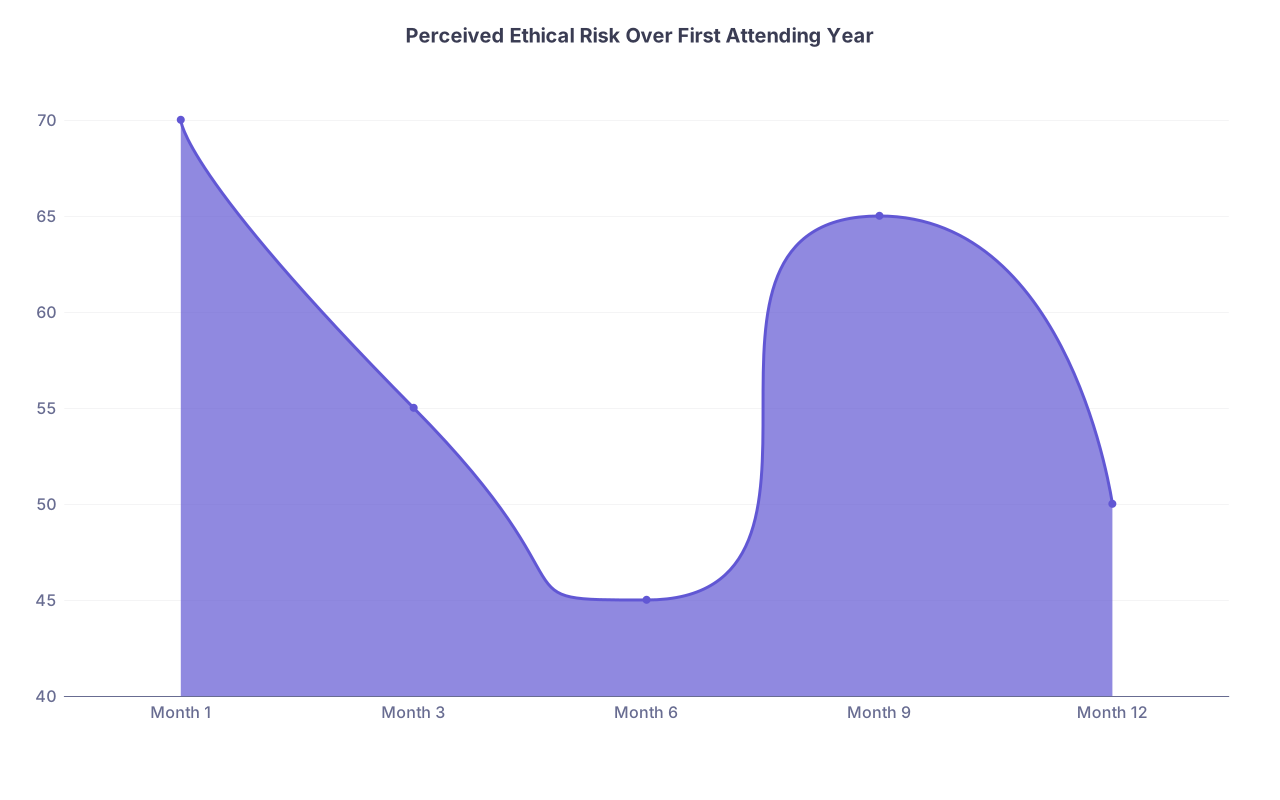
| Category | Value |
|---|---|
| Month 1 | 70 |
| Month 3 | 55 |
| Month 6 | 45 |
| Month 9 | 65 |
| Month 12 | 50 |
(Interpretation: perceived risk drops as you get comfortable, then spikes again with burnout and complex cases, then settles as systems improve.)
Month 7: Workload and Boundary Review
Your quarterly deep-dive this quarter should ask: Is my schedule itself ethical?
Examine:
- Average patient load.
- After-hours inbox time per week.
- Delayed documentation volume.
Identify red flags:
- Signing notes 3–5 days late routinely.
- Consistently finishing documentation after midnight.
- Regularly seeing “just one more” patient at the end of clinic.
Decide on 1–2 boundary changes:
- Hard stop times.
- Protected admin block that you actually protect.
- Delegation to APPs or nurses where appropriate.
Ethically, chronic overwork leads directly to:
- More diagnostic error.
- Poorer communication.
- Sloppier documentation. That is not “just a wellness problem.” It is a risk management problem.
Month 8: Systems and Workflow Ethics Check
At this point, you should realize: most ethical failures are system failures with your name on the chart.
Use a 60–90 minute block to review:
Test result follow-up workflows
- How do you ensure no critical labs or imaging are lost or delayed?
- Do you have a personal process (daily notification review, flagged inbox)?
Handoff processes
- Are your sign-outs superficial?
- Are high-risk issues clearly flagged (suicidality, unstable vitals, tenuous discharges)?
Delegation
- Are you clear on what residents/APPs can and cannot do?
- Is your name attached to orders you never actually reviewed?
Where you find gaps, schedule one small, concrete fix:
- A standard phrase for “test result pending – needs follow up.”
- A simple checklist for ICU to floor transfers.
- A rule for yourself: “No sign-out without updated problem list and active issues.”
Month 9: Second Pattern and Outcomes Review
Time for another pattern check, but now with a data flavor.
If you have access to basic metrics, review:
- Readmission rates (for relevant services).
- Complaint rates (formal or via patient relations).
- Incident reports naming you.
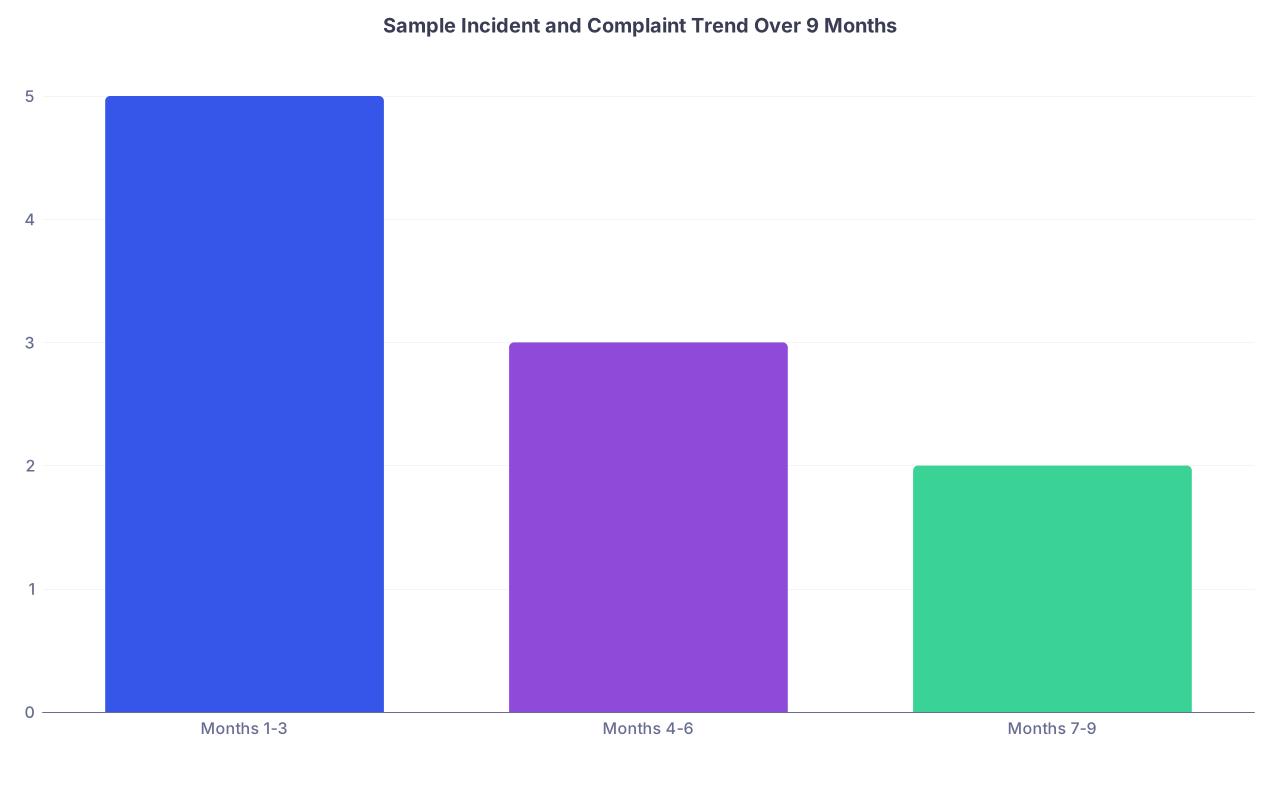
| Category | Value |
|---|---|
| Months 1-3 | 5 |
| Months 4-6 | 3 |
| Months 7-9 | 2 |
If you cannot get formal data, use proxies:
- How many times did someone say “we might need to file a safety report” on your patients?
- How many times did you think “I really hope this patient does not complain”?
Pick one case per 3-month block and do a short, written self-review:
- What happened?
- What did I do well?
- What would I concretely change next time?
Discuss at least one of these with your trusted senior or risk liaison again.
Months 10–12: Tightening, Planning, and Teaching
By your final quarter, you are no longer “new.” You are forming habits that will stick for a decade.
At this point, you should shift from personal survival to structured, sustainable ethics practice.
Month 10: Medico-Legal Tune-Up
Use a focused 60–90 minute session to align with your institution’s risk leadership.
Agenda:
Ask risk management:
- “What are the top 3 types of cases generating claims or near-claims this year?”
- “What documentation gaps do you see repeatedly?”
- “Are there any recent policy changes I should know?”
Review one anonymized lawsuit or claim summary (many institutions have these). Ask yourself:
- Could I have made the same decisions?
- Would my documentation look any different?
- Where in my schedule would I have found time to do it better?
This is also a good time to:
- Check your malpractice coverage details again.
- Make sure you know exactly what to do in the first 24 hours if a bad outcome happens:
- Who to call.
- What to say (and not say) in the chart.
- How to avoid self-incriminating language while staying honest.
Month 11: Ethics Goals for Year 2
Now you are planning forward, not just reacting.
Use your biweekly block this month to define 3 concrete ethics/risk goals for year 2, such as:
- Implementing a reliable test follow-up system in your clinic.
- Leading a short case-based discussion on consent for your team.
- Reducing documentation delays from average 72 hours to 24.
Each goal should have:
- A specific behavior change.
- A check-in point (quarterly).
- Someone who knows you are working on it (so you are accountable).
Month 12: Consolidation and Documentation of Changes
Finish the year with a personal ethics and risk portfolio. Nothing fancy. One or two pages.
Include:
- 3–5 high-risk cases and what you learned.
- The top system changes you made for safety or ethics.
- The micro-habits you now consider non-negotiable.
- The next-year goals.
This is not for a CV. This is for you. And when you hit a serious event (you will, if you stay in practice long enough), this document reminds you that you are not starting from zero.
Recurring Weekly and Monthly Checklists
To keep this practical, here is what your routine should look like.
Weekly (15–30 Minutes)
At a fixed time each week (Friday afternoon, Monday morning—does not matter as long as it is consistent):
Scan:
- Any unresolved inbox items > 72 hours old.
- Any unsigned notes older than 48 hours.
- Any “problem cases” you are emotionally still thinking about.
Ask:
- Did I avoid a tough conversation this week?
- Did I mis-communicate with a colleague or nurse in a way that could be perceived as unprofessional?
- Is there a patient or family I need to circle back to?
Act:
- Make 1–2 follow-up calls.
- Write 1 clarifying addendum.
- Send 1 apology or clarification message to a colleague if needed.
Monthly (30–60 Minutes)
Review:
- 5–10 randomly selected charts with moderate to high complexity.
- Any new institutional ethics/risk memos.
Check for:
- Clear capacity and consent documentation.
- Reasonable test follow-up.
- Succinct but explicit reasoning behind major decisions.
Adjust:
- One template, one habit, or one boundary each month.

When Something Goes Really Wrong (Because Eventually It Will)
You will have:
- An unanticipated death.
- A catastrophic complication.
- A furious family.
- A regulatory complaint.
Your preparation is in how you respond, not whether you prevented every bad outcome.
At that point, you should:
Call:
- Your chain of command.
- Risk management.
- Ethics or palliative if there is ongoing conflict.
Chart:
- Fact-based, non-defensive, chronologic notes.
- No speculation on fault.
- No blame statements about colleagues.
Schedule:
- A 30–60 minute personal debrief within 72 hours.
- A follow-up with your mentor or trusted senior within 1–2 weeks.
The worst mistakes after an event are:
- Emotional, late-night charting.
- Email venting about colleagues.
- Avoidance of follow-up conversations with families or staff.
Build your instinct now: slow down, call the right people, document cleanly. You have been practicing all year for that moment.

Final Takeaways
- Ethics and risk management in your first attending year are not abstract ideals; they are scheduled habits. If it is not on your calendar, it will not happen.
- Small, recurring reviews of documentation, consent, communication, and workflow do more to protect you—and your patients—than any single ethics course.
- The goal is not to be perfect; it is to be defensible, transparent, and consistently improving. Your schedule is the backbone of that work.


