The fastest way to ruin a rotation is a bad roast.
A sharp, poorly judged “joke” in front of the whole team will stick in people’s heads far longer than all your 4 a.m. prerounds. So if you’re going to do an end-of-rotation roast, you plan it like you’d plan a procedure: stepwise, time-based, and with clear “do not cut here” lines.
Here’s how to build a funny, memorable, safe send-off—week by week, then day by day—so you don’t end your month in HR’s office.
2–3 Weeks Before: Decide If a Roast Is Even a Good Idea
At this point you should be asking one question: Is this team roastable?
Some teams love humor. Some are hanging on by a thread. Your first job is triage.
Checklist (2–3 weeks out):
Gauge the culture:
- Has the attending joked about themselves? (“I haven’t read a full article since residency.”)
- Do residents roast each other already, lightheartedly?
- Has anyone made it clear that they hate public attention?
Identify red flags where you skip the roast or keep it microscopic:
- Rotation has had a recent major adverse event, death, or lawsuit.
- There’s serious tension between services (e.g., surgery vs anesthesia trench warfare).
- Someone on the team has been the target of bullying or harassment.
- The attending is clearly humorless or excessively formal.
Pick a format scale:
- Micro-roast (private, 2–3 lines, inside your thank-you speech).
- Team roast (5–7 minutes with slides in team room).
- Big roast (10–15 minutes at formal end-of-block conference—this is high-risk; honestly, I rarely recommend it for students).
Here’s the rule: if you’re not at least 80% sure the attending will genuinely laugh, downgrade the scale by one notch.
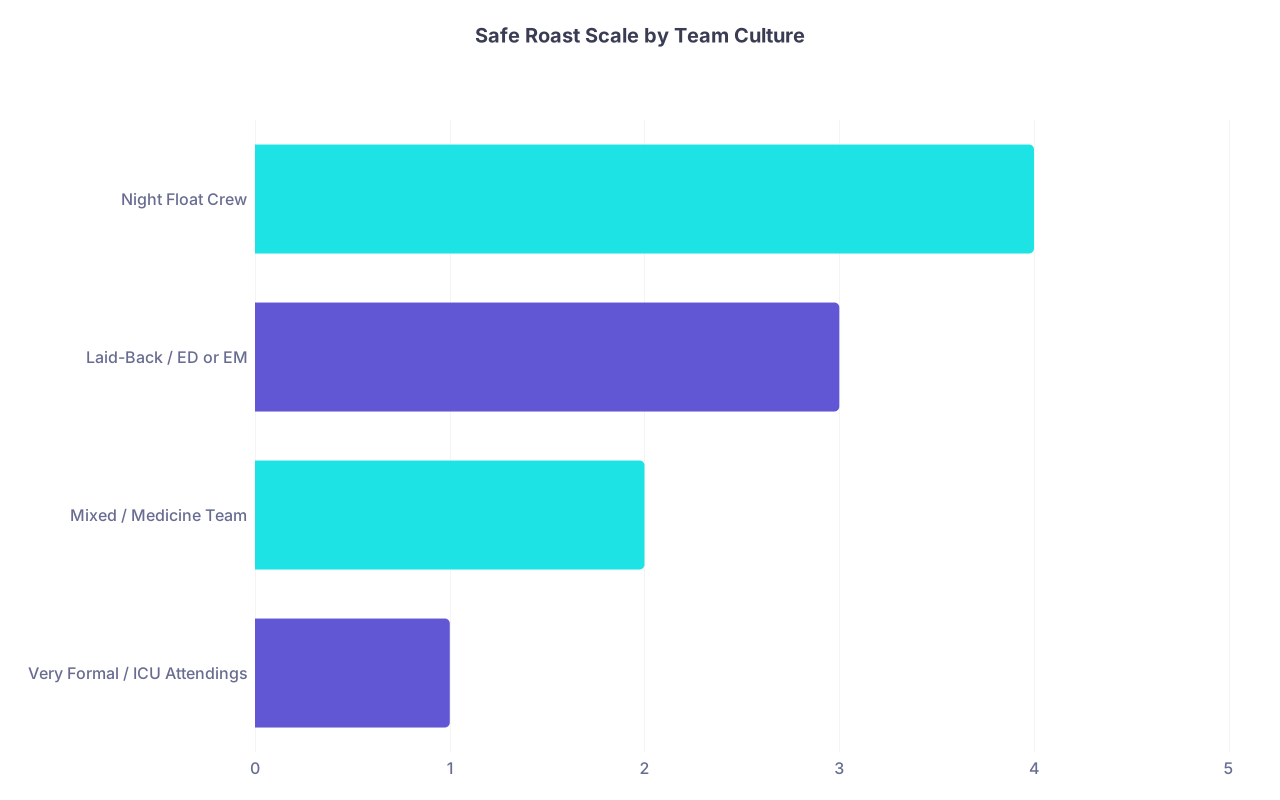
| Category | Value |
|---|---|
| Very Formal / ICU Attendings | 1 |
| Mixed / Medicine Team | 2 |
| Laid-Back / ED or EM | 3 |
| Night Float Crew | 4 |
(1 = almost no roast, 4 = you can safely be funnier and a bit edgier. But still smart.)
10–14 Days Before: Build Your “Safe Targets” List
At this point you should be collecting raw material. Quietly. Systematically.
Step 1: Decide Your Target Priorities
Order of who you can roast, from safest to riskiest:
- Yourself
- Universal systems (EMR, pager, consult culture, hospital food)
- The rotation stereotypes (surgery early mornings, medicine note length)
- Residents you KNOW are comfortable and self-deprecating
- Attendings who clearly enjoy being teased lightly
- Anyone with a power imbalance downward (the absolute riskiest; usually skip)
You should never start with #4–6. Warm the room with yourself and the system first.
Step 2: Start a “Bits” List
Keep a note on your phone. Every time something repeatable and harmless happens, jot it down. You’re not writing jokes yet. You’re collecting patterns.
Examples of good “bits”:
- “Dr. K’s daily question: ‘So… what’s the plan?’ even after you just read the plan.”
- “Every page from radiology starts with ‘So… interesting finding…’ at 3 a.m.”
- “Intern says, ‘This will be quick’ right before a 45-minute discharge.”
Bad “bits” you delete immediately:
- Anything involving a specific patient or identifiable case.
- Anything about weight, appearance, race, accent, religion, disability, personal health.
- Anything that touches evaluations, remediation, or known personal stressors (fertility, divorce, illness, visa status, etc.).
If you catch yourself thinking, “This is hilarious but might be too much,” it is too much. Put it in the “never say out loud” category.
7–10 Days Before: Choose a Structure, Not Just Random Jokes
At this point you should pick a format so your roast feels intentional, not like you’re free-associating in front of the department.
Solid, safe structures:
“Awards Ceremony” Format
- “Most Likely to…” style mini-awards.
- Works well for teams with several residents and students.
- Easy to keep kind and short.
“Guidebook to Surviving This Rotation”
- Slide or speech broken into tips: “Rule #1: Never say you’re caught up on notes.”
- Lets you give everyone a nod without singling people out harshly.
“Day in the Life of This Team”
- Walk through a typical day with exaggerated but kind observations.
- Example: “06:00 – Med student arrives. 06:01 – Med student regrets life choices.”
“Future of Medicine” Angle (fits your category perfectly)
- How this team would behave in 2050.
- “In 2050, Dr. S will still be asking for a paper signout because ‘EPIC is just a fad.’”
- Jokes about AI scribes, robot consults, and future EMR logins.
Pick one main structure. You can sprinkle standalone jokes inside it, but the frame keeps you from rambling.

5–7 Days Before: Write the First Draft (and Install Safety Rails)
At this point you should write the thing. Then immediately make it safer.
Step 1: Write Fast, Then Cut
Give yourself 30–45 minutes. Write all the jokes, even the ones you know are too spicy. Get it out. Then go back with three filters:
Punching up rule
- You can tease attendings and senior residents more than juniors and staff.
- You can absolutely roast the EMR, the pager, the call room, hospital construction noise.
- You rarely, if ever, roast people with less power than you. That includes nurses, techs, admin staff, junior students.
Would I say this if it were recorded and emailed to GME?
- If the answer isn’t an immediate “yes,” cut it. They actually do sometimes record these.
Replace personal with universal
- Instead of: “Dr. X never responds to pages.”
- Use: “You know you’re on this service when your new ringtone is ‘Call back 6N stat.’”
Step 2: Apply the “3 Categories of Safe Humor”
Run every joke through this:
Category A: Self-Roast
- “I finally learned the difference between STAT and ‘I’ll get to it by noon’—from our consult notes.”
- 100% safe. Do more of this than you think.
Category B: Harmless Exaggeration of Truth
- “If you print Dr. M’s notes double-sided, you still need two binders.”
- Based on real patterns, but kind and absurd enough not to sting.
Category C: Aspirational/Future Humor
- Fits “future of medicine” theme nicely:
- “In 10 years, AI will pre-chart, place orders, and still somehow wait for Dr. L to say, ‘OK to place.’”
If a joke doesn’t clearly fit A, B, or C—delete it. Do not try to “soften” a bad joke. Just cut.
3–5 Days Before: Quiet Test Run With a Trusted Person
At this point you should pressure-test the material.
Pick one of the following (not five people, or you’ll get paralyzed):
- A co-student who knows the team.
- A resident who is known to have good judgment and not start drama.
- A friend on another service who’s blunt and not afraid to say “nope.”
Tell them plainly:
“I’m doing a 5–7 minute end-of-rotation roast. I want it to be safe and still funny. Can I read it and you flag anything mean, weird, or career-ending?”
Things they should flag:
- Anything that feels like calling someone lazy, dishonest, or incompetent.
- Any joke that relies on identity (gender, race, accent, age, etc.).
- Any story that’s too close to a specific patient (even anonymized).
If they hesitate, even a little, when you ask “Is this OK to say out loud?”—cut that line.
2 Days Before: Logistics and Timeboxing
At this point you should lock down when and where this roast is happening.
Step 1: Clear It With the Right Person
Light, respectful ask:
- “I was thinking of doing a short, lighthearted end-of-rotation roast/thank-you at sign-out on Friday—totally clean and mostly making fun of myself and the EMR. Is that OK with you?”
If the attending/resident says:
- “Please, that would be fun” → green light.
- “Hmm, maybe just something quick” → keep it under 3 minutes and kill half your jokes.
- “I’m not a fan of roasts” → you pivot: make it a sincere thank-you with 1–2 small, very mild jokes.
Step 2: Decide on Props/Slides
Ask yourself:
Do you really need slides?
- If yes, keep them minimal:
- No screenshots of real charts.
- No photos of staff without explicit permission.
- No memes that could be interpreted as discriminatory or mocking patients.
- 6–8 slides is plenty for a 5–7 minute roast.
- If yes, keep them minimal:
Any physical “awards”?
- Post-it “trophies”: “King of Deferred Consults”
- Printout certificates with silly but kind titles.
You’re not staging a Netflix special. Simple beats chaotic every time.
| Format | Time Needed | Risk Level | Best For |
|---|---|---|---|
| 1–2 minute micro-roast | 1–2 min | Very Low | Serious teams, new students |
| 5–7 minute slide roast | 5–7 min | Moderate | Established, friendly services |
| 10–15 minute big roast | 10–15 min | High | Retreats, retreats, not routine |
Day Before: Final Edit and Delivery Practice
At this point you should sound like you know what you’re doing, even if you don’t feel like it.
Step 1: Read It Out Loud, Alone
You’re looking for:
- Length:
- Aim for:
- 3–5 minutes as a student on a normal service.
- 5–7 minutes max if you were specifically asked to anchor a send-off.
- Aim for:
- Clunky transitions:
- If you trip on a line twice, rewrite it simpler.
- Accidental cruelty:
- Jokes that sounded mild in your head sometimes land harsh out loud.
Step 2: Insert Softening Lines Where Needed
If a joke gently pokes someone, pair it with a clear compliment.
Example:
- “Dr. H’s coffee intake is directly proportional to the number of consults, and somehow her notes still read like UpToDate chapters.”
Or:
- “I’ve never seen someone ask so many ‘one quick questions’ on rounds—and I learned more from those questions than from any lecture.”
You’re allowed to tease. You’re not allowed to leave people feeling exposed.
Day Of: Timeline Hour-by-Hour
Now we go zoomed-in. At this point you should treat the day like a mini-procedure.
Morning (Pre-rounds / Early)
- Reconfirm timing with senior/resident:
- “Still OK if I do that short thank-you/roast at the end of rounds today?”
- Print or download slides to a USB/desktop if you’re using them.
- Do one quick silent run-through in your head walking between patients.
1–2 Hours Before the Roast
Check the room mood:
- If someone is clearly in tears, the team just got blasted by a consultant, or a major adverse event just occurred, you shrink or entirely skip the roast.
- You can always say: “Hey, feels like not the right moment for a big roast. I’ll just do a quick thank-you.”
Pick your opening line:
- Self-roast is safest:
- “I promise this will be shorter than my SOAP notes.”
- “Don’t worry, this is the only time I’ll present without being interrupted.”
- Self-roast is safest:
During the Roast: Moment-to-Moment Rules
At this point you should follow three live rules:
Start with yourself and the system
- First 30–60 seconds: jokes about you, call, EMR, the hospital.
- This signals, “I’m not here to punch down.”
Watch the faces, not your notes
- If a joke gets silence or a weird look, you move on immediately. Do NOT double down.
- If laughter is muted but smiles are there, keep going but lean even safer.
End with genuine gratitude
- Last 30–60 seconds:
- Thank the attending for something specific they taught you.
- Thank the residents for what they modeled.
- Hit one line that acknowledges the reality: this job is hard, and you respect them.
- Last 30–60 seconds:
Example landing:
“All jokes aside, this has been one of the best teams I’ve worked with. You taught me how to think, not just what to write. Thank you for letting me be part of the chaos.”
You want people leaving thinking, “That was funny—and they really appreciated us.”
1–2 Hours After: Debrief and Damage Control (If Needed)
At this point you should quickly reality-check how it landed.
Quick self-check:
- Does anything feel “off” when you replay it?
- Did you notice anyone visibly uncomfortable?
Ask a trusted resident:
- “Was that okay? Anything land weird?”
- If they say, “It was great,” accept it and move on.
- If they say, “Maybe that one joke about X was borderline,” you do not defend it.
If something clearly misfired:
- Find the person privately:
- “Hey, I wanted to check in. That joke about ___ was meant to be light, but I’m worried it might have come off wrong. I’m sorry if it did.”
- Keep it short, sincere, and non-defensive.
How NOT to Get Yourself Reported: Hard Lines You Never Cross
You should memorize this part. This is the “do not cut here” zone.
Never roast:
A person’s:
- Race, ethnicity, nationality
- Gender, sexual orientation, pronouns
- Religion or lack thereof
- Body shape/size, appearance, clothing, voice, accent
- Age, pregnancy, fertility, family status
- Disability, mental health, or medical conditions
Specific clinical events:
- Bad outcomes, codes, near-misses, malpractice worries
- Specific “that one patient” everyone remembers
Professional power dynamics:
- “Lazy” nurse jokes
- “Resident never does any work” jokes
- “This attending is never around” jokes
If you hear these kinds of jokes from others, that’s not permission. That’s a live demonstration of what not to do. Remember: they might get away with it. You probably won’t.
Future-Proofing: Making It About “Future of Medicine” Instead of People
Since you’re explicitly in the “future of medicine” lane, lean into that. It’s safer and often funnier.
Angle the roast like this:
“Updates from the future of this rotation:”
- “In 2035, EPIC will finally load your patient list before your coffee gets cold.”
- “AI will be doing all the pre-charting, but Dr. R will still want to hear your assessment from scratch.”
- “Consults will arrive by drone: still ‘urgent,’ still seen 8 hours later.”
“Predictions for the team in 10–20 years:”
- “Our intern will be the program director who says, ‘Back in my day, we had to pre-round without AI scribes.’”
- “Our senior will be the attending still telling their team, ‘No one leaves until all notes are done.’ Some traditions never die.”
You’re not just being funny; you’re showing you see how medicine is changing and you can laugh at it without being cruel.
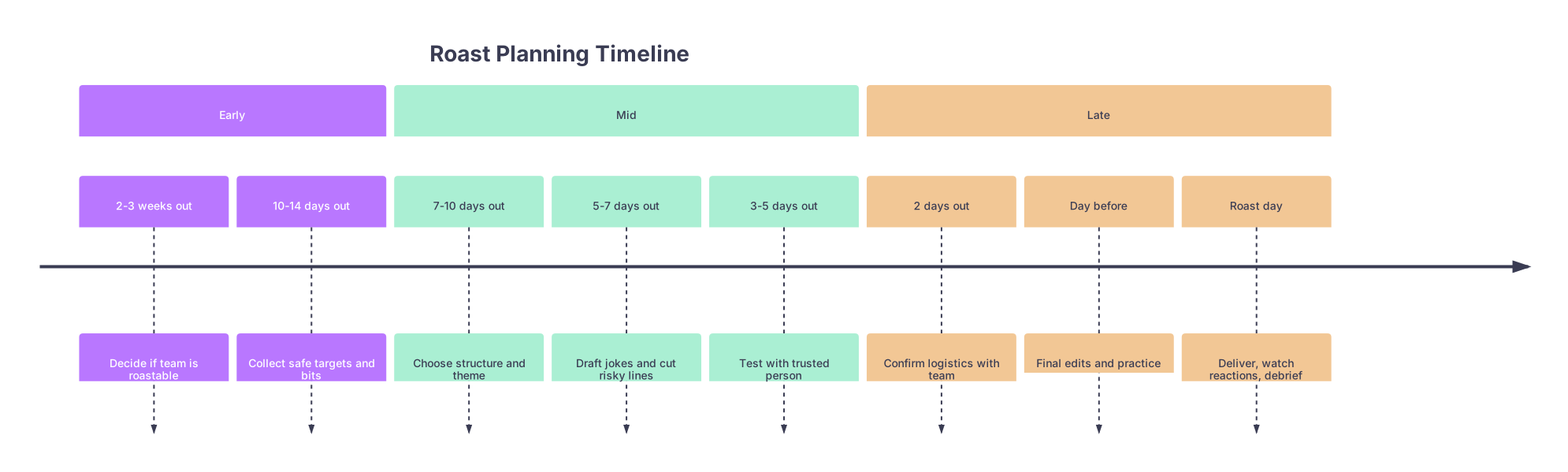
| Period | Event |
|---|---|
| Early - 2-3 weeks out | Decide if team is roastable |
| Early - 10-14 days out | Collect safe targets and bits |
| Mid - 7-10 days out | Choose structure and theme |
| Mid - 5-7 days out | Draft jokes and cut risky lines |
| Mid - 3-5 days out | Test with trusted person |
| Late - 2 days out | Confirm logistics with team |
| Late - Day before | Final edits and practice |
| Late - Roast day | Deliver, watch reactions, debrief |
Core Principles to Remember
- Plan it like a procedure. Timeline, checks, and clear “do not touch” zones. Last-minute, winged roasts are how people get reported.
- Punch up, not down—and mostly at yourself and the system. EMR, pagers, future AI overlords, your own clumsy intern energy—those are fair game. People’s identities and vulnerabilities are not.
- End in gratitude, not in a “sick burn.” The only thing you want lingering after your roast is, “They were funny, and they were grateful to be here.”