
Most interns think humor is what keeps them sane. They are wrong. The right humor, at the right time, is what keeps the whole system from cracking.
There is a difference. Chiefs know it. PGY‑1s usually do not.
You are not just “getting funnier” between PGY‑1 and PGY‑3. You are learning strategic humor:
- When to use it to defuse a disaster.
- When to keep your mouth shut.
- How to protect your team with a joke.
- How to signal to attendings, nurses, and consultants that you understand what is happening…without saying it outright.
Let’s walk this the way your training actually feels: year by year, then month by month. At each point: what you are doing, what usually goes wrong, and what flavor of humor you should be quietly building.
PGY‑1: Survival Mode (Months 1–12)
At this point you think you are being funny if people laugh. That is not the job.
You are learning:
- What not to say.
- Who laughs at what.
- Where the invisible lines are.
Months 1–3: Keep Your Jokes on Mute
First quarter of intern year, your priorities:
Do not be the Intern With Bad Judgment.
You know the one:- Jokes about “circling the drain” on rounds.
- Laughing about a code in front of family.
- Sarcastic comments about nurses in a crowded workroom.
People remember this. And they will not trust you.
Your humor toolkit right now should be:
- Self‑deprecation: “I opened the wrong chart three times before I found our patient.”
- Situational absurdity (aimed at systems, not people): “We have three EMRs, none of which talk to each other, but please document ‘efficiently.’”
- Mild observational jokes that do not punch down: “The pager clearly feeds off my REM cycles.”
Where you test material safely:
- With your co‑interns in a closed call room at 3 a.m.
- In a private chat, not the whole‑team WhatsApp.
- With trusted upper levels who have already teased you kindly.
If you are wondering “is this too dark?” the answer as a PGY‑1 is yes. Save it. Watch what PGY‑3s say in the same situation instead.
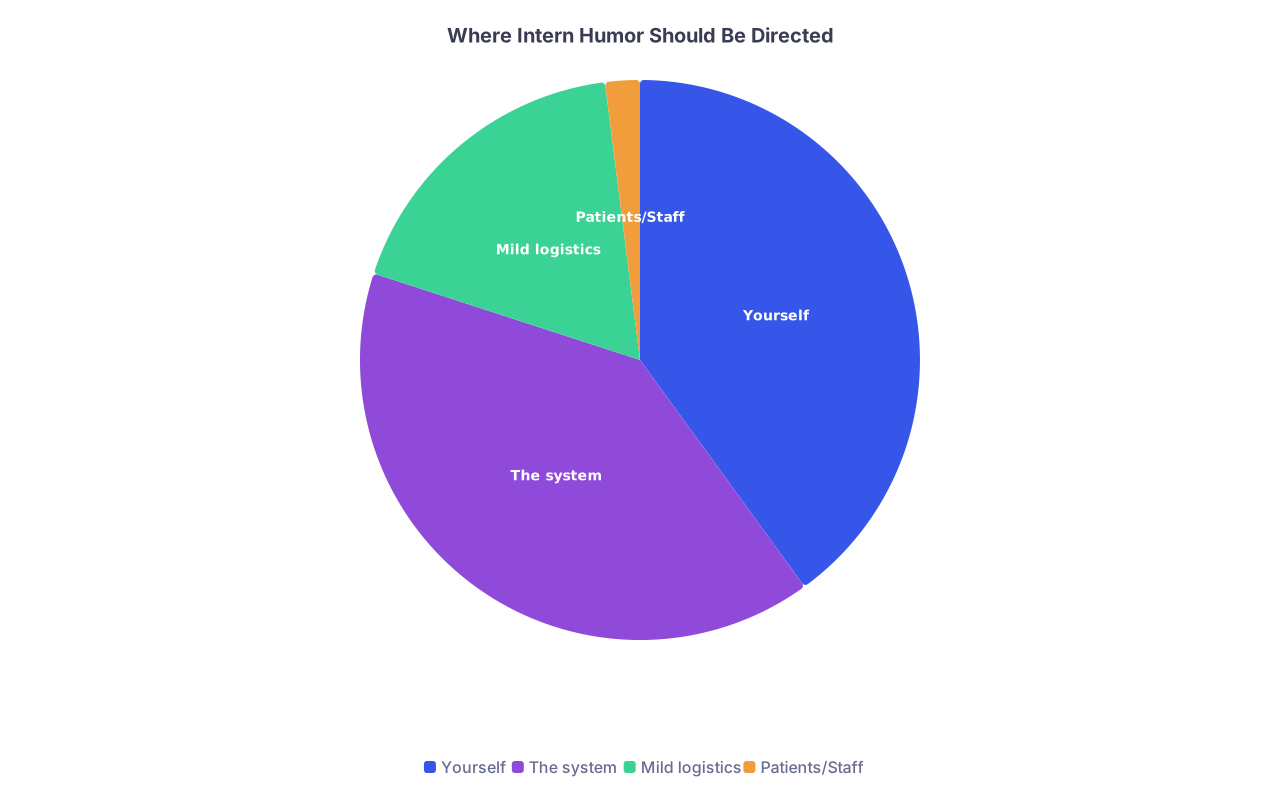
| Category | Value |
|---|---|
| Yourself | 40 |
| The system | 40 |
| Mild logistics | 18 |
| Patients/Staff | 2 |
Months 4–6: Learning the Room
By now, you roughly know:
- Which attending secretly enjoys deadpan sarcasm.
- Which attending will write you up for the same comment.
- Which nurse rolls with gallows humor and which one shuts down.
At this point you should:
Start noticing who uses humor effectively:
- The senior who cracks one non‑mean joke at sign‑out that resets the room’s stress.
- The fellow who disarms an angry consultant with a single self‑mocking line.
- The attending who turns a brutal teaching moment into a laugh and a lesson.
Practice containment:
- No “open mic” in the hallway.
- No jokes on rounds that the patient might overhear through thin curtains.
- No writing “funny” comments in the chart. Ever.
You are building a mental map:
- This situation = okay to lighten.
- This person = absolutely no dark humor.
- This nurse = yes to eye‑roll about admin, no to jokes about surgery.
Months 7–12: Early Strategic Humor (Still Low‑Risk)
Second half of intern year, you have some credibility. You can use humor in tiny strategic doses.
At this point you should:
Use humor to normalize vulnerability.
Example: New med student apologizes for a bad presentation. You say, “My first H&P was so long I’m pretty sure it violated hospital storage policy.”
Result: They relax. They learn. You look human, not terrifying.Decompress your team without minimizing patients.
End of a rough shift:- “We survived. Barely. Someone call IT and ask how to unplug a hospital.”
- “I measure my productivity in how many coffee cups I’ve generated.”
You are not joking about the patient who coded. You are joking about you in the machine.
Start reading micro‑seconds of silence.
When a joke almost lands, and the room goes quiet for half a beat? Log it. You just found an edge. Do not step over it again.

PGY‑2: Management Mode (Months 13–24)
Now the stakes change. You start owning decisions. You carry more of the team’s emotional weight. Humor becomes a leadership tool.
Used right, it buys you:
- Trust
- Time
- Psychological safety
Used wrong, it buys you:
- Complaints
- Damaged credibility
- A reputation that will follow you into fellowship
Months 13–16: Humor as Tension Valve
As an early PGY‑2, your day looks like:
- Constant pages.
- Cross‑cover decisions.
- You + overwhelmed intern + terrified student.
At this point you should:
Use humor at the right layer of the stack:
- Upward (to attendings): very controlled, mostly self‑deprecating, never at patient expense.
- Sideways (to co‑residents and nurses): can be bolder, but still respectful.
- Downward (to interns/students): protective, never mocking.
Typical scenarios:
Intern makes a harmless mistake.
Wrong lab ordered. No harm done.
Bad response: “Nice, trying to bankrupt the hospital?”
Strategic humor response: “Perfect, now that we know how we do not order it, we will never forget the right one.”You laugh with them, not at them. And you still correct the mistake.
Team is fried at 4 p.m. pre‑sign‑out.
You say: “Okay, two more notes and then we all stare at the wall for 5 minutes in complete silence. That’s the wellness curriculum.”
People chuckle. Shoulders drop. Work continues.
Do a quick “humor pre‑check” mentally:
- Is someone grieving a bad outcome today?
- Is anyone clearly on the verge of tears?
- Did we just have a code / complaint / family confrontation?
If yes, tone it way down. Soft, warm remarks only. No bite.
Months 17–20: Humor as Boundary and Shield
Mid‑PGY‑2 you start learning that humor can set limits with abrasive people.
Example:
Orthopedics yells on the phone: “Why did you consult us so late?”
Instead of apologizing for existing, you calmly say, “I promise we did not wait for the full moon, just for the CT to upload.” Said with a smile in your voice, not sarcasm.
Message: I am not your punching bag, but I am also not picking a fight.
At this point you should:
Use light irony to:
- Push back on unreasonable demands.
- Call out system failures without starting a war.
- Protect your intern from direct fire.
Never aim your sharpest lines at the lowest‑power person in the room.
If you are going to be cutting, it better be upward at the system, not downward at the nurse or student.Start noticing when silence is stronger than a joke.
Some situations:- Family crying at bedside.
- A bad error just discovered.
- A colleague clearly shaken after a complaint.
In those spaces, humor is not strategic. It is selfish.
| Level | Safe Primary Target | Avoid Completely |
|---|---|---|
| PGY-1 | Yourself | Patients, staff |
| Early PGY-2 | Yourself, system | Specific colleagues |
| Late PGY-2 | System, process | Individual errors in front of group |
| PGY-3/Chief | System, culture | Vulnerable team members |
Months 21–24: Pre‑Chief Rehearsal
Late PGY‑2 you start functioning like a junior chief on some rotations.
This is where you practice structured, predictable humor:
- The same opening line at morning huddle.
- A recurring sign‑out bit that signals “we are almost done.”
- A running joke the team owns together (“Code Brown count for the week,” “Pager horror stories leaderboard”).
Purpose:
- Predictability. People know you are not volatile.
- Ritual. Humor becomes a small anchor in chaotic days.
- Identity. The team starts seeing itself as an “us” instead of a set of isolated zombies.
At this point, you should be asking yourself:
What type of humor actually calms people vs. what just amuses me?
PGY‑3 / Chief: Humor as Strategy, Not Entertainment
By PGY‑3, especially if you are a chief, your words carry weight. Your jokes are never “just jokes” again. They signal:
- What is acceptable.
- Who belongs.
- How seriously you take problems.
If that sounds heavy, it is. But this is where it actually gets powerful.
Months 25–28: Setting Culture with Micro‑Jokes
Early chief months, you run:
- Orientation
- Morning report
- Some teaching conferences
- WhatsApp/Signal groups
At this point you should:
Use humor to telegraph values.
Example: Orientation slide on duty hours:
“You cannot learn if you are unconscious. Please go home.”
Everyone laughs. Message is clear: we mean it about going home.Example: When someone apologizes for asking a question:
“Good. If no one is confused, that means I am talking to the wrong group.”
You reward questioning. Out loud.Build safe running jokes:
- About scheduling: “If you find a perfect schedule, report it to research. It is a new organism.”
- About the EMR: “Epic has crashed, so we are now using our backup system: vibes and Post‑it notes.”
Notice: you are not mocking individuals. You are mocking bureaucracy and tech.
Watch the residents’ faces more than your own punchline.
If the interns smile but the PGY‑2s look tense, you are missing something. Ask later.
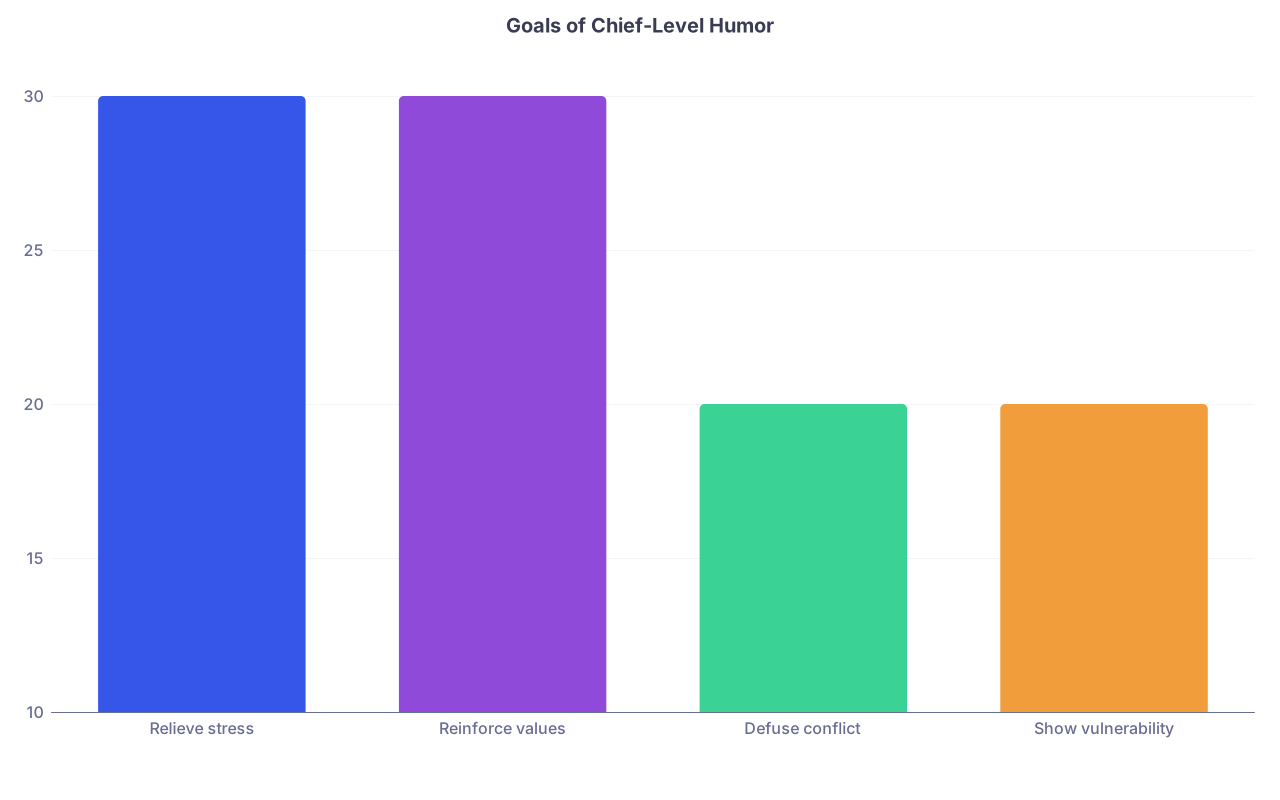
| Category | Value |
|---|---|
| Relieve stress | 30 |
| Reinforce values | 30 |
| Defuse conflict | 20 |
| Show vulnerability | 20 |
Months 29–32: Crisis Command – Humor at the Edge
This is where “strategic” really shows. You use humor to:
- Defuse near‑explosions.
- Re‑center a flooded room.
- Let people breathe just enough to keep functioning.
Common scenarios:
The post‑night float debrief from hell.
Night team had three codes, one death, thirty pages an hour. The room feels like lead.Strategic chief move:
- Start by naming the reality seriously.
- Then one small, human joke.
“Okay. That was brutal. You all carried more in one night than many people see in a month. Let us triage this debrief, because none of us are at our cleverest right now—even me, and I had coffee.”
People chuckle. Shoulders unclench just enough to talk.
Inter‑service conflict in front of learners.
Surgeon snaps during sign‑out about “medicine dumping patients.”
You respond lightly, with spine:“If I could dump these patients anywhere, it would be to a beach resort with intensivists. But they are stuck with us and we are grateful you are here.”
Everyone hears it: we are not taking abuse, but we are also not escalating.Resident self‑loathing spiral.
Resident: “I am a terrible doctor.”
Chief: “Terrible doctors do not stay up worrying they are terrible. They sleep great. You are tired, not terrible.”That line is half joke, half truth. It usually lands.
At this point you should be able to toggle:
- 0% humor → 10% humor → back to 0% in under 5 minutes without seeming erratic.
Months 33–36: Legacy Jokes (What Outlives You)
Final chief months: residents start quoting you back to yourself. That is the sign you have crossed into “strategic” territory.
You will notice:
- Your one‑liners showing up on sign‑out templates.
- Your stock phrases (“We will figure it out. We always do.”) being used by new seniors.
- Your silly recurrent bits (e.g., “Friday afternoon consult tax”) becoming residency folklore.
At this point you should:
Curate what you want to outlive you:
- Jokes that punch up at systems.
- Jokes that normalize seeking help.
- Jokes that de‑romanticize martyrdom.
Example tradition:
- “Wellness pager”: an old dead pager that gets passed around with a rule—whoever holds it must go home on time that day. Everyone laughs, but they also enforce it.
Retire humor that does not age well:
- Anything that relies on stereotyping certain specialties.
- Anything that shames people for needing time off.
- Anything that makes therapy or mental health care the punchline.
Teach the next class explicitly:
- Tell incoming seniors: “Your humor teaches as much as your chalk talk.”
- Call out good uses: “You handled that conflict with a perfect one‑liner. Keep that.”

Week‑by‑Week and Day‑by‑Day: How to Actually Build Strategic Humor
Let us get practical. Here is how you can deliberately train this, instead of hoping it appears magically in PGY‑3.
Weekly Practice (Any Year)
Each week, do this:
- Log three moments where humor helped.
- Briefly write: Situation → What was said → Why it worked.
- Log one moment where a joke landed badly.
- No self‑flagellation. Just: Who, where, topic, what you learned.
- Steal one line from someone better at this.
- That attending who defused a family: grab their phrasing.
- That nurse who shut down a rude consultant with a gentle joke: copy the structure.
Over months, this becomes a mental arsenal that you can pull from under stress.
Daily Micro‑Checklist (Intern Up Through Chief)
Morning:
- Ask: “Who on my team is carrying something heavy from yesterday?”
→ Plan: less sharp humor, more warmth.
During the day:
- Before a joke in mixed company (attendings, nurses, learners, families in earshot), run a 3‑second scan:
- Target: system, self, or vulnerable person?
- Timing: before or after a serious decision?
- Place: hallway, room, workroom?
If two out of three feel wrong, save it.
Night:
- Recall one moment you chose not to joke.
That is part of strategic humor. Restraint counts.
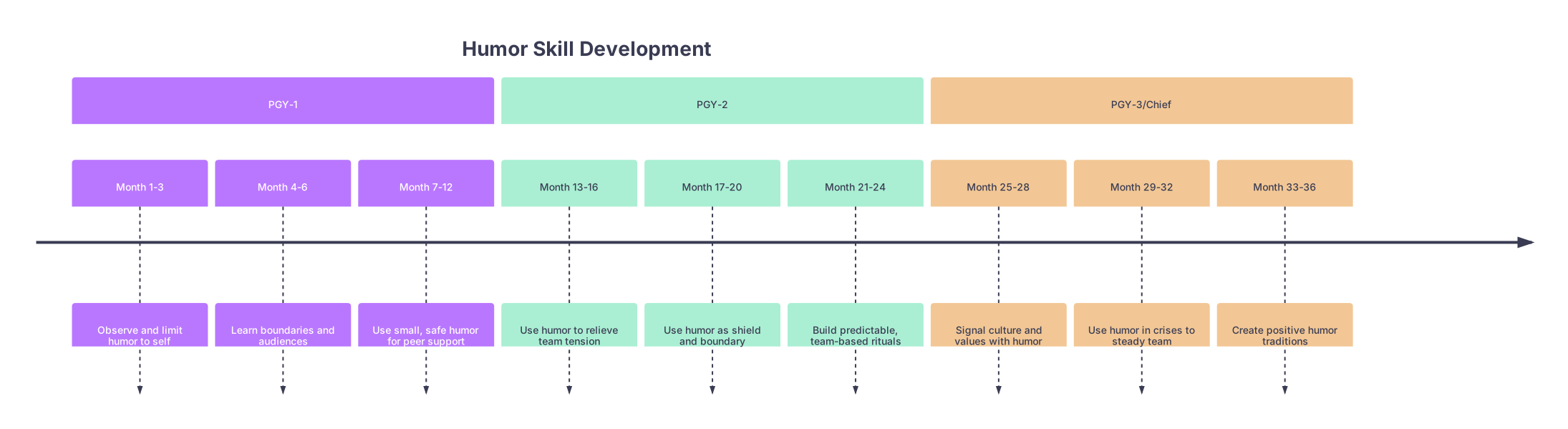
| Period | Event |
|---|---|
| PGY-1 - Month 1-3 | Observe and limit humor to self |
| PGY-1 - Month 4-6 | Learn boundaries and audiences |
| PGY-1 - Month 7-12 | Use small, safe humor for peer support |
| PGY-2 - Month 13-16 | Use humor to relieve team tension |
| PGY-2 - Month 17-20 | Use humor as shield and boundary |
| PGY-2 - Month 21-24 | Build predictable, team-based rituals |
| PGY-3/Chief - Month 25-28 | Signal culture and values with humor |
| PGY-3/Chief - Month 29-32 | Use humor in crises to steady team |
| PGY-3/Chief - Month 33-36 | Create positive humor traditions |
The Future: Why Strategic Humor Actually Matters in Medicine
You will hear a lot of lip service about “resilience” and “wellness.” Most of it is shallow. But here is something that is not:
Teams with healthy, well‑aimed humor:
- Decompress faster after codes.
- Admit errors more easily.
- Support each other more consistently.
And chiefs who control their humor:
- Prevent small conflicts from becoming program‑level problems.
- Model how to be serious about medicine without being serious about themselves.
- Quietly protect their people from the worst edges of the system.
The future of medicine is not more pizza parties or more “mindfulness modules.” It is residents and chiefs who understand the psychology of their teams well enough to know:
- When silence heals.
- When validation heals.
- And when a single, well‑timed joke keeps everyone from falling apart.
Today, before your next shift, write down one line you have heard a good senior or chief use that calmed the room—and commit to trying it once this week when the moment feels right.