
The blunt truth: most funny stories do more damage than good in personal statements and interviews.
You’re not auditioning for “Funniest Person in the Hospital.” You’re auditioning to be trusted with sick people at 3 a.m. Funny can work—but usually only in small, controlled doses and with a very specific purpose.
Let me walk you through when humor helps, when it absolutely does not, and exactly how to handle “funny stories” so you don’t tank otherwise strong applications.
Step 1: Understand What Committees Really Want
Adcoms and program directors are not sitting around saying, “I hope the next applicant is hilarious.” They’re asking three things:
- Can I trust this person with patients and colleagues?
- Are they self-aware, reflective, and mature?
- Will they be miserable (or make others miserable) at 2 a.m. on call?
Comedy is optional. Professionalism is not.
When your story is “funny,” what they’re really evaluating is:
- Your judgment: Do you know where the line is?
- Your priorities: Is the joke more important to you than the patient or the moment?
- Your insight: Did you actually learn anything, or just get a good story?
If your funny story doesn’t clearly pass those tests, keep it out.
Step 2: The Golden Rule – Humor Is a Spice, Not the Main Course
Here’s the core rule I’ve seen work:
You can use humor as seasoning. You should almost never use a funny story as the central plot.
Good:
- A quick, lightly humorous detail to show humanity or humility.
- A self-deprecating one-liner that leads into serious insight.
- A small moment that shows warmth and human connection.
Bad:
- “The time we all cracked up in the OR” as the main story.
- Extended descriptions of pranks, jokes, or anything at a patient’s expense.
- Stories that focus more on the punchline than what you learned or how you grew.
If the “funny” part feels like the highlight, not the setup for something deeper, that’s a problem.
Step 3: When Humor Belongs in a Personal Statement
You can absolutely have a moment that makes a reader smile. The key is: it has to serve your narrative, not steal it.
Good use cases:
Humor to show humility.
Example:
“Halfway through my first standardized patient encounter, my ‘patient’ gently pointed out I’d introduced myself three times and still not asked why she came in. I realized I was more focused on the checklist than the human being in front of me.”That’s mildly funny. It’s also vulnerable, reflective, and clearly about your growth.
Humor to humanize a heavy story.
You’re talking about a serious experience and add one small, grounded human moment:- A patient joking about hospital food.
- A kid putting a stethoscope on your forehead instead of your chest. These moments make you relatable—but the focus should stay on empathy and care.
Humor as a hook, immediately turned serious.
You start with:
“I did not plan to spend my Saturday afternoon covered in glitter in a pediatric oncology unit.”
Then you pivot quickly: this leads into a story about long-term relationships with chronically ill kids and what that taught you about presence, not the joke of the glitter.
Where it goes wrong:
- You write in a “comedian voice” instead of a professional, reflective voice.
- You tell a story you’d normally save for your friends, not your future boss.
- You sound more interested in being clever than honest.
If your primary goal is to “stand out” by being funny, you’re already heading off course.
Step 4: When Humor Belongs in Interviews
Interviews are slightly different. There’s tone, facial expression, and real-time feedback. You can read the room.
Here’s the real rule: You’re not trying to be funny. You’re trying to be personable.
Use humor in interviews when:
- It’s reactive, not forced.
The interviewer jokes about the weather and you respond with a light, short comment. Fine. - It’s self-deprecating and safe.
Not “I’m a chronic procrastinator, haha,” but:
“On my first day in the ED, I was definitely the slowest note writer in the room. By the end of the month, I’d shaved those notes from 40 minutes to 15.” - It breaks tension, then moves on.
One quick line, then substance.
Do not:
- Launch into a full “funny story” unless asked something very specific that clearly calls for it.
- Use humor to dodge a hard question (“What’s a failure you’ve had?” “Well, once I burned pasta…”).
- Make jokes about patients, colleagues, other specialties, or institutions. Ever.
If they say, “Tell me about a memorable patient,” and your brain goes to the funniest case… pick another one. Lead with meaning, not humor.
Step 5: Stories You Should Absolutely Never Make Funny
Some topics are radioactive for humor in applications. If your “funny story” lives in one of these areas, keep it out:
- Patient suffering or death – no joking, period.
- Serious mistakes or near misses – reflection only, no levity.
- Cultural, religious, or language misunderstandings – these can easily read as mocking.
- Anything involving bodily fluids as the main joke – yes, medicine is messy. No, you don’t need to be the 500th applicant to talk about poop.
- Anything that makes staff or colleagues look incompetent – reflects poorly on you.
If an adcom can even wonder whether you’re laughing at a patient, senior, or system in a disrespectful way, you’ve already lost points.
Step 6: Test Your Story With This Filter
Use this filter for any “funny” story you’re tempted to include.
Ask yourself:
- If I remove the funny part, does the story still work as a strong, meaningful story?
- If not, it’s a bad story for this context.
- Is the butt of the joke me, or someone in a position of power (lightly), not a patient or vulnerable person?
- Does the story show a clear growth arc?
“I was clueless → I learned something → I changed my behavior.” - Would this story make sense if read aloud in a faculty meeting, with that patient’s family accidentally in the room?
If you’d sweat, don’t use it. - If this story was summarized in one line on your dean’s letter—would you be okay with that?
If any of these are shaky, cut it.
Step 7: Concrete Examples – Good vs Problematic
Let’s get specific.
Example 1: Mild, Effective Humor (Personal Statement)
“I walked into the room with my stethoscope backwards. My attending quietly rotated it for me and kept talking to the patient as if nothing had happened. On rounds later, she told me, ‘Everyone starts somewhere. What matters is how you listen, not how you wear the equipment.’
That moment stuck. I started focusing less on performing “doctor” and more on actually being present with patients.”
Why this works:
- The humor is small, human, and at your expense.
- The focus is on mentorship and growth.
- No one is disrespected.
Example 2: Bad Humor (Interview Story)
“So there was this patient who kept pressing the call light every five minutes. The nurses were joking that he must be bored. At one point he said…”
Stop right there. This already sounds dismissive. Even if the ending is benign, you’ve started by framing a patient as annoying. Many interviewers will tune out or judge you right there.
Example 3: Humor That Walks the Line (Use With Caution)
“In the pre-op area, the anesthesiologist introduced himself as ‘your bartender for the day.’ The patient laughed, and I saw how that brief joke defused her visible tension. I did not fully appreciate before then how a small bit of appropriate humor can build trust in a vulnerable moment.”
That can work:
- You’re not the one joking; you’re observing.
- The focus is on patient anxiety and rapport.
- You don’t dwell on the joke.
But you still want to be careful how you frame it. Any hint that you think surgery is casual entertainment = bad.
Step 8: Specialty-Specific Considerations
Some fields tolerate a bit more levity; some absolutely don’t.
| Specialty | Relative Tolerance for Light Humor |
|---|---|
| Pediatrics | Higher |
| Family Med | Higher |
| EM | Moderate |
| Internal Med | Moderate |
| Surgery | Lower |
| Anesthesiology | Moderate |
This doesn’t mean “pediatrics = stand-up routine.” It means your mild, patient-centered humor might land more easily there than, say, a very old-school surgical department interview.
But the baseline rule doesn’t change: insight first, humor second.
Step 9: How to Salvage a Story That’s Also Funny
Sometimes the best learning story you have just happens to be funny. Fine. Here’s how to control it:
- Tell it straight first when you draft it. No jokes. Just what happened and what you learned.
- Add back one light, observational detail if it truly helps the reader understand the moment.
- Strip out anything that sounds like a punchline.
- Make sure your last sentence is serious, reflective, and future-facing. That’s the note you want them to remember.
Step 10: Quick Red-Flag Checklist
You’re on thin ice if:
- You’re proud of how “funny” the story is.
- You’re tempted to use sarcasm or irony.
- You’ve told this story at parties as your “wild med school story.”
- A non-medical friend thinks it’s funnier than meaningful.
- You honestly can’t tell if it’s appropriate in a formal setting.
When in doubt? Cut it. There are hundreds of other ways to show that you’re human, likable, and self-aware without gambling on your sense of humor landing correctly with a tired PD reading your file at midnight.
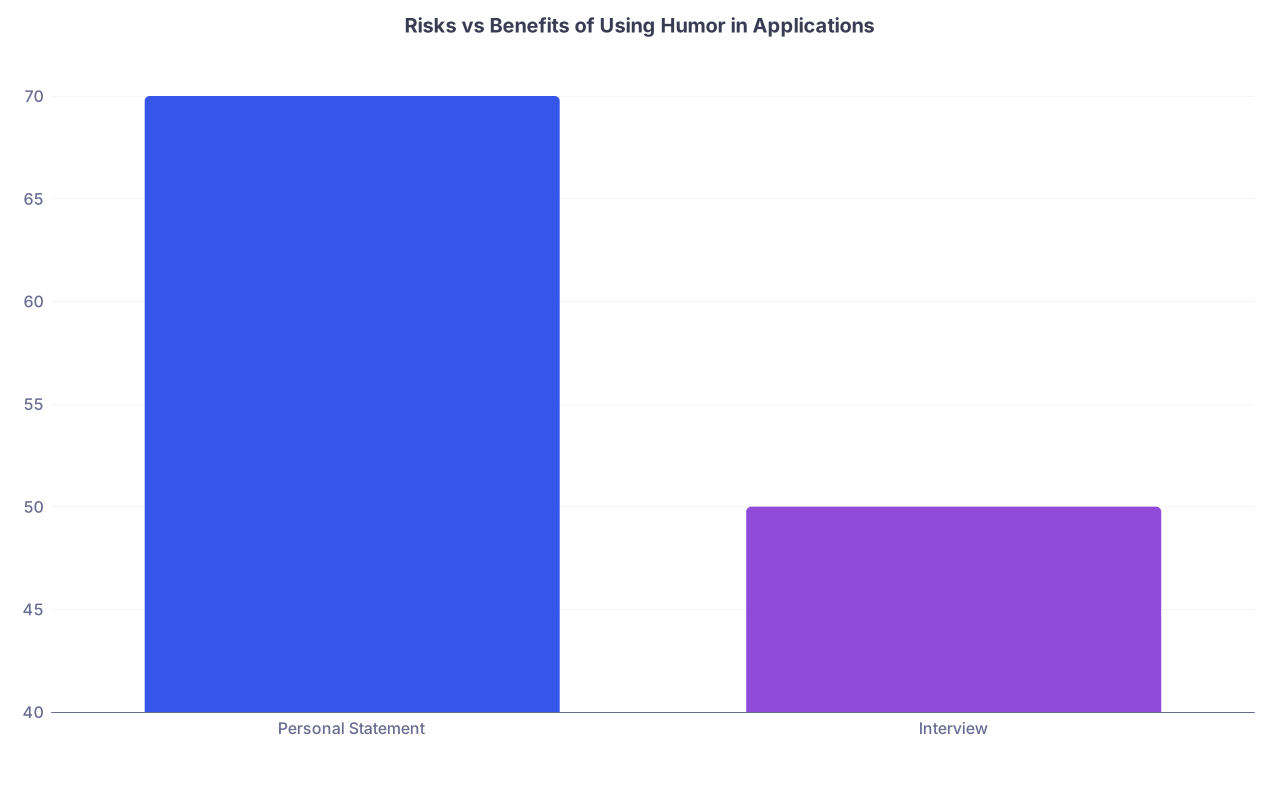
| Category | Value |
|---|---|
| Personal Statement | 70 |
| Interview | 50 |
(Think of those values as “risk level out of 100” if you rely on humor heavily.)

| Step | Description |
|---|---|
| Step 1 | Have funny story |
| Step 2 | Do not use it |
| Step 3 | Use lightly, keep focus on growth |
| Step 4 | Story still strong without humor |
| Step 5 | Is patient butt of joke |
| Step 6 | Shows growth and insight |
| Step 7 | Comfortable if patient family heard it |

FAQ: Funny Stories in Personal Statements and Interviews
1. Is it ever okay to open my personal statement with a funny story?
Usually not. Open with something engaging, sure—but not a pure joke. If your opening is quirky, it should immediately turn toward substance within one or two sentences. If the first reaction you’re aiming for is laughter instead of curiosity or respect, rethink it.
2. Can I mention that I use humor with patients (e.g., pediatrics)?
Yes, but make the point about connection, not about how funny you are. For example: “I’ve found that gentle, age-appropriate humor can help anxious children relax enough to explain what they’re feeling.” Then give one specific, simple example. Keep it focused on the patient benefit.
3. What if the interviewer clearly has a great sense of humor and is joking a lot?
You can mirror lightly, but do not match intensity. Smile, give short, appropriate responses, maybe one brief joke if it feels natural—but stay anchored in professionalism. Remember: you’re being evaluated; they’re not. Many faculty toggle between joking and dead serious very fast.
4. Are self-deprecating stories safe?
Safer, but not automatically safe. “I was so lazy I almost failed,” is not helpful. “I underestimated how much I needed to practice presentations and bombed my first one; here’s how I fixed that” can be good. You want to show vulnerability plus growth, not irresponsibility.
5. If I’m genuinely funny, won’t I stand out in a good way?
Maybe. But the bar to “funny in your head” vs “funny and appropriate to a stressed attending reading 80 essays” is high. Most people overestimate their comedic skill and underestimate the risk. You’re better off standing out for clarity, insight, and grounded self-awareness—those always land, regardless of the reader’s sense of humor.
Key takeaways:
- Do not center your personal statement or interview answers on funny stories; let humor be a tiny accent, if at all.
- Stories must still work as serious, growth-oriented narratives with the humor removed.
- When uncertain, leave the joke out. In medicine, professionalism beats cleverness every time.