

It’s July 2nd of your first fellowship year.
You just finished orientation, you barely know the call schedule, and yet a senior attending has already said the magic, dangerous words:
“You should really design a trial around that. Make it your project.”
This is where people get hurt. Not physically. Career-wise.
Run an investigator-initiated trial (IIT) too early and you drown in IRB revisions and data chaos, with nothing publishable by graduation. Start too late and you run out of time before the first patient is even consented.
Let’s walk the real timeline. Month by month. What you should be doing, and equally important, what you should not be doing yet.
Big Picture: The Fellowship IIT Timeline
For a 2–3 year fellowship, your first real IIT usually needs:
- ~6 months from idea → IRB approval (longer at slow institutions)
- ~3–6 months from IRB approval → first enrolled patient
- ~12–18 months enrollment (depending on scope)
- ~3–6 months follow-up and analysis
So no, this isn’t something you slap together as a PGY-6 in March.
Here’s the macro view for a 3-year fellowship:
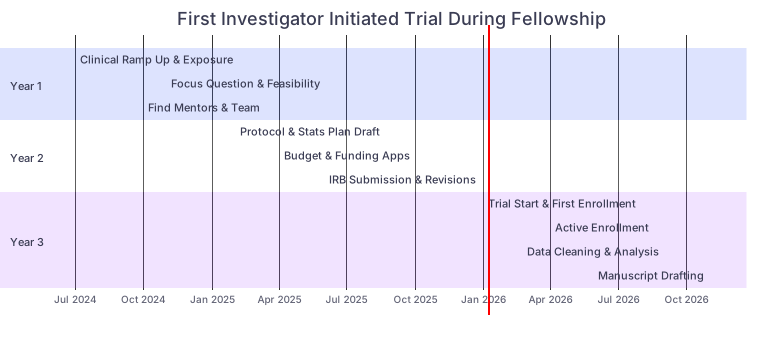
| Task | Details |
|---|---|
| Year 1: Clinical Ramp Up & Exposure | a1, 2024-07, 4m |
| Year 1: Focus Question & Feasibility | a2, 2024-11, 3m |
| Year 1: Find Mentors & Team | a3, 2024-10, 4m |
| Year 2: Protocol & Stats Plan Draft | b1, 2025-02, 4m |
| Year 2: Budget & Funding Apps | b2, 2025-04, 4m |
| Year 2: IRB Submission & Revisions | b3, 2025-06, 6m |
| Year 3: Trial Start & First Enrollment | c1, 2026-01, 3m |
| Year 3: Active Enrollment | c2, 2026-04, 10m |
| Year 3: Data Cleaning & Analysis | c3, 2026-09, 4m |
| Year 3: Manuscript Drafting | c4, 2026-11, 3m |
If you’re in a 2-year fellowship, compress this. Brutally. And be more conservative with scope.
Year 1: You Are Not Doing a Trial Yet (But You Are Laying the Trap)
Months 1–3 (July–September, Year 1): Clinical First, Trial Later
At this point you should:
- Learn the service. Cold.
- Understand standard workflows: admissions, orders, consent, discharge, EMR quirks.
- Start noticing patterns: recurring gaps in care, frequent borderline decisions.
What you should not be doing yet:
- Writing a full protocol.
- Emailing the IRB about some grand multi-center RCT.
- Promising your PD that you will “finish a trial in fellowship” with no idea of logistics.
Use these months to collect seeds, not to plant acres.
Concrete moves:
- Keep a running, messy list in a notes app:
- “Steroids started at wildly different doses for X.”
- “Patients on Y never get Z follow-up.”
- “No structured way to de-escalate this drug.”
- Ask attending-level questions:
- “What’s one thing in our management of [disease] that bugs you or seems totally untested?”
You’re building a sense of what’s actually study-able in your environment.
Months 4–6 (October–December, Year 1): Narrow the Problem, Not the P-Value
At this point you should be:
- Moving from “some interesting ideas” → one or two high-yield questions.
- Starting to distinguish:
- Descriptive/retrospective projects (good warmup)
- Feasibility pilots
- True IITs (prospective, intervention or structured protocol)
For your first IIT in fellowship, you want:
- Small to moderate sample size.
- Single-center (maybe 2 at most).
- Simple outcomes (preferably things already collected in the EMR).
- Minimal long-term follow-up.
Use this period to evaluate feasibility ruthlessly:
| Question | Green Flag Answer |
|---|---|
| Patients per month with disease? | ≥ 5–10 |
| Key outcome in EMR already? | Yes |
| Extra visits required? | 0–1 per patient |
| Consent possible on busy days? | Yes, in < 15 minutes |
| Need external funding? | No or small intramural only |
If you can’t answer these yet, you’re not ready to design the trial.
Months 7–9 (January–March, Year 1): Find Your Mentors and Your Statistician… Early
At this point you should:
Lock in 2–3 mentors:
- 1 content expert (knows the disease/procedure cold)
- 1 methods/clinical research mentor (ideally runs trials already)
- Optional: 1 ethicist or QI guru if your question is borderline or practice-changing
Meet a biostatistician:
- Not for a final power calculation yet.
- For sanity checks: “Is this even a trial question?” “Is this outcome realistic?”
Red flag sign: you’re designing alone. That’s how you waste a year.
Targeted questions to ask mentors:
- “What’s the smallest, cleanest trial that would still move this field?”
- “What barriers have killed similar projects here?”
- “If I only have 18 months of real runway, what would you slice out?”
Schedule one meeting a month for 3–4 months. Your idea should get sharper every time.
Months 10–12 (April–June, Year 1): Pilot in Your Head (and Maybe in Reality)
Now you pressure test the idea.
At this point you should:
Do a 1–2 week “shadow pilot”:
- For every eligible patient you see, pretend they’re in your trial.
- Note down: would they have been eligible? would they have agreed? when would you have consented them? where would you document?
Map the operational flow step-by-step:

| Step | Description |
|---|---|
| Step 1 | Patient identified |
| Step 2 | Not eligible |
| Step 3 | Approach for consent |
| Step 4 | Consent signed |
| Step 5 | Baseline data in REDCap |
| Step 6 | Intervention or protocol start |
| Step 7 | Follow up visits/data pulls |
| Step 8 | Primary outcome reached |
| Step 9 | Data entry check |
| Step 10 | Lock record |
| Step 11 | Meets criteria |
If any step looks like “Fellow does this manually while cross-covering 20 patients on call,” stop. Redesign.
You should end Year 1 with:
- One clear primary question.
- A simple design type (e.g., randomized pilot, stepped-wedge, single-arm feasibility).
- Mentor buy-in that “Yes, this is realistic for fellowship.”
Still no full protocol. Not yet.
Year 2: This Is When You Actually Build the Trial
If Year 1 was scouting the terrain, Year 2 is pouring the concrete.
Months 13–15 (July–September, Year 2): Draft the Skeleton Protocol
At this point you should:
Block off real, protected time for writing. Not “between pages.” Actual blocks.
Build a bare-bones protocol outline:
- Background and rationale (2–3 tight paragraphs)
- Objectives (primary + no more than 2 key secondary)
- Study design (RCT, pilot, before-after, etc.)
- Inclusion/exclusion criteria
- Interventions and comparators
- Outcomes and how/when they’re measured
- Sample size (even if provisional)
- Data collection and management
- Safety monitoring, adverse events, stopping rules
- Ethical considerations and consent
This is not grant-level prose. This is a working document so your team can poke holes in it.
Ethics piece starts here, not at the IRB portal:
- If your intervention changes standard care:
- Is there true equipoise, or are you secretly convinced one arm is better?
- Are trainees at risk of learning worse practices?
- If your trial relies on “pragmatic” consent:
- Are patients actually understanding what’s experimental?
I’ve seen fellows underestimate how hard it is to explain “this is part of a study” in a 5-minute hallway interaction. Plan for that.
Months 16–18 (October–December, Year 2): Stats Plan, Budget, and Data Systems
At this point you should move from “idea with shape” → “project with structure.”
Statistics
- Meet again with your statistician with:
- Estimated eligible patients/month
- Expected effect size (based on prior data, not vibes)
- Get:
- Realistic sample-size estimate (you may not power for hard outcomes; that’s fine for a first IIT)
- Clear primary analysis plan
- Pre-specified handling of missing data
- Meet again with your statistician with:
Budget and funding
- List every cost, even if small:
- REDCap or database build (often free internally, but check)
- Coordinator time
- Lab tests not clinically indicated
- Patient incentives, parking, etc.
- Decide funding route:
- Department pilot grant
- Foundation/society grants (e.g., AHA, ASCO Young Investigator, subspecialty societies)
- Institutional CTSI pilot awards
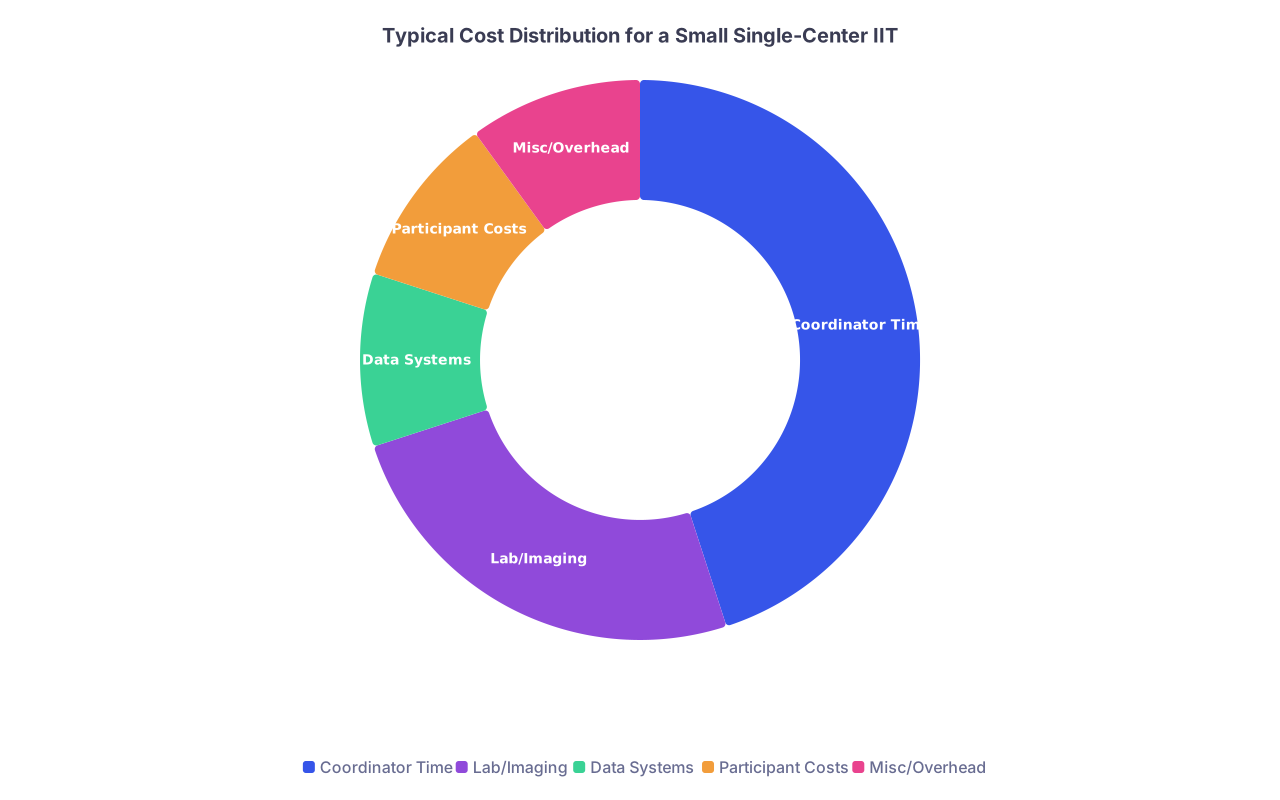
Typical Cost Distribution for a Small Single-Center IIT Category Value Coordinator Time 45 Lab/Imaging 25 Data Systems 10 Participant Costs 10 Misc/Overhead 10 For your first IIT, I’d strongly favor $5k–$50k scale internal/foundation money over chasing a giant federal grant you’ll never have time to execute.
- List every cost, even if small:
Data system
- Decide now:
- REDCap?
- Custom EMR pulls?
- Paper forms keyed in later (usually a bad idea)?
- Design your case report forms (CRFs) to match how data is entered in real life.
- Do a 1–2 patient mock entry and see where it breaks.
- Decide now:
Months 19–21 (January–March, Year 2): IRB Time (The Grind Phase)
At this point you should:
- Convert your protocol into:
- IRB application
- Consent forms
- Recruitment materials
- Data protection plan
Common mistakes I see fellows make:
- Under-describing risks (“minimal risk” slapped on everything).
- Overpromising benefit.
- Hand-waving data security (“stored on a password-protected computer” and nothing more).
- No plan for what happens when you graduate (who owns the data, who closes the study).
Ethically, you need to be clear on:
- Vulnerable populations (limited literacy, limited English, low health literacy).
- Therapeutic misconception (patients thinking research = guaranteed better care).
- Your dual role:
- Are you both treating clinician and PI?
- How will you reduce implicit pressure on patients to say yes?
This is where the PERSONAL DEVELOPMENT AND MEDICAL ETHICS piece is not theoretical. You’re deciding what kind of investigator you’re going to be.
Plan on:
- 4–8 weeks from submission → first IRB feedback.
- 1–3 rounds of revisions.
- Surprise requests (data safety monitor, DSMB, extra consent steps).
Do not submit the IRB in April of your final year and expect to enroll anyone.
Months 22–24 (April–June, Year 2): Pre-Launch: Build the Machine Before You Turn It On
At this point you should have conditional or full IRB approval pending minor fixes.
Now you:
Finalize:
- CRFs
- Data dictionary
- SOPs for screening, consent, data entry, and follow-up
Train:
- Other fellows who’ll be around when you’re off
- Nurses/clinic staff who might identify patients
- Study coordinators (if you’re lucky enough to have one)
Do a dry run:
- Take 2–3 pretend patients (or retrospective cases).
- Walk through the entire process as if it were a real enrollment.
- Time it. Where do things jam?
This is also where you get honest about bandwidth:
- On call? You’re not enrolling.
- In the ICU? You probably can’t consent stable ward patients the same day.
You need backup. Either another fellow, a coordinator, or a very engaged attending.
Year 3: Launch, Maintain, and Actually Get Something Out of It
Months 25–27 (July–September, Year 3): Trial Launch and First Patients
At this point you should:
- Enroll your first real participants.
- Keep a tight screening log:
- Everyone eligible
- Everyone approached
- Who declined and why
Early indicators you’re in trouble:
- You expected 8 eligible patients/month; you’re seeing 3.
- Consent takes 30–40 minutes instead of 10–15.
- Staff are clearly annoyed or confused by your protocol steps.
If that’s happening, you have two choices:
Minor mid-course corrections (IRB-approved amendments):
- Simplify data collection
- Relax a non-critical exclusion
- Clarify confusing consent language
Or admit this will be a feasibility or pilot study, not a fully powered efficacy trial. That’s not failure. That’s reality—and publishable if you’re honest about it.
Months 28–32 (October–February, Year 3): Enrollment Push and Data Discipline
This is the grind.
At this point you should:
- Have enrollment become a reflex:
- Morning list review has a line: “Trial-eligible?” for each new patient.
- Be doing real-time data cleaning:
- Don’t leave all queries and missing values for after graduation.
- Start a running analysis notebook:
- Unexpected patterns
- Operational issues
- Ethical/clinical tensions you notice
The ethical muscles get tested here:
- Are you subtly steering patients toward enrollment?
- Are you tempted to “nudge” borderline-eligible patients into the trial to hit numbers?
- Are you honoring the right to withdraw without penalty?
Nobody’s watching your every move. This is where character shows.
Also: start drafting introduction and methods of the manuscript now. You know the design; that part rarely changes.
Months 33–36 (March–June, Year 3): Close the Loop Before You Walk Out
If your fellowship ends in June, don’t pretend you’ll keep running the trial from a new attending position 1,000 miles away. That almost never works for your first IIT.
At this point you should:
Freeze new enrollment at a pre-defined date (discussed with mentors and IRB).
Focus on:
- Completing follow-up for enrolled patients
- Cleaning and locking the dataset
- Running primary analyses with your statistician
Clarify ownership and stewardship:
- Who is PI after you leave?
- Who handles long-term queries or audits?
- How will you stay involved in publications?
This is also the moment for ethical closure:
- Plan how to:
- Share aggregate results with participants (if feasible).
- Make any beneficial protocol elements accessible outside the study, if they clearly help.
Then you write. Hard.
Timeline for the final stretch:
- 4–6 weeks: finalize analysis and tables.
- 4–8 weeks: complete manuscript draft.
- 2–4 weeks: mentor revisions and submission.
If you leave fellowship with:
- One well-run pilot or feasibility IIT.
- Clean data.
- A submitted or nearly-submitted manuscript.
You’re ahead of most.
If Your Fellowship Is Only 2 Years
You have less runway. Be more aggressive with timing and more conservative with scale.
Compressed version:
- Months 1–3: Identify question and mentors.
- Months 4–6: Skeleton protocol + feasibility shadow pilot.
- Months 7–9: Stats + funding + IRB submission.
- Months 10–12: IRB revisions + build data systems.
- Year 2: Enrollment, follow-up, analysis as above—just with a smaller, clearly “pilot” design.
If your program has no meaningful research infrastructure, consider whether a full IIT is truly the best move, or if a strong prospective observational study will give you more return without crushing you.
What You Should Be Doing Right Now (Wherever You Are in Training)
If you’re a med student / resident thinking ahead:
- Start watching how trials run at your hospital.
- Ask to attend a research team meeting or DSMB meeting.
- Learn basic research ethics (CIOMS, Belmont, your institution’s training).
If you’re starting fellowship in 3–6 months:
- Look up:
- Who in your department runs trials?
- Does your institution have a CTSI or research core?
- Email 1–2 potential mentors before you arrive to set up early meetings.
- Look up:
If you’re mid–Year 1 right now:
- Pick one problem area to follow closely for 2–3 months.
- Start a note titled “Possible Fellowship Trial” and jot specifics after each relevant case.
If you’re early Year 2 and have no protocol yet:
- Scale down. Aim for a simple feasibility trial, single-arm pilot, or pragmatic RCT with very modest scope.
- Block off weekly writing time. Non-negotiable.
Core Takeaways
- Your first investigator-initiated trial is a 2–3 year arc, not a side project; start conceptual work in early Year 1, not late Year 2.
- Feasibility and ethics matter more than cleverness—small, clean, and honest beats ambitious, messy, and underpowered every time.
- Build the infrastructure (mentors, stats, data systems, IRB) before flipping the “enroll” switch, or you’ll spend your fellowship firefighting instead of learning how to be a real investigator.


