The biggest mistake medical students make about clinical trials is timing. They wait until they “have more time later.” Later never comes.
If you want real exposure to cutting-edge clinical trials, you need a year-by-year plan from M1–M4. Not vague intentions. Actual checkpoints.
Below is the timeline I wish more students followed.
Big-Picture Timeline: How Your Role Should Evolve
At this point you should understand the arc:
| Year | Primary Role | Main Goals |
|---|---|---|
| M1 | Observer / Assistant | Learn basics, ethics, Good Clinical Practice (GCP) |
| M2 | Structured Assistant | Take on defined tasks, build reliability, maybe co-author |
| M3 | Embedded Clinician-in-Training | Observe trials on clerkships, link trial work to specialty choices |
| M4 | Semi-Independent Contributor | Capstone projects, sub-I involvement, manuscripts/abstracts |
And in visual form:
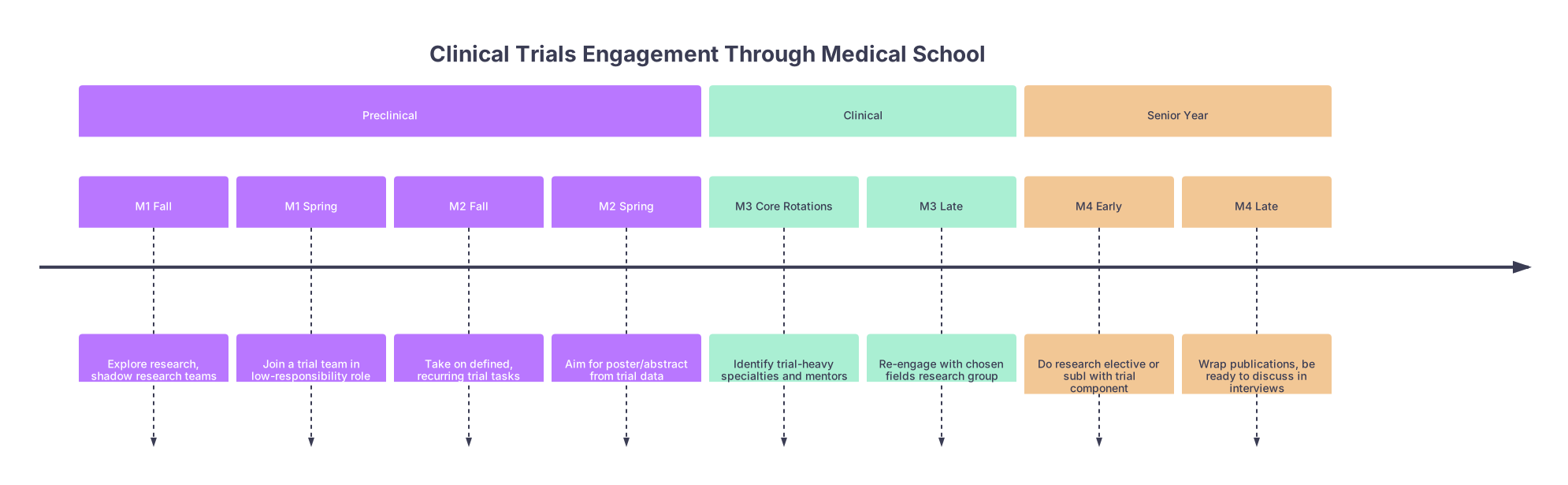
| Period | Event |
|---|---|
| Preclinical - M1 Fall | Explore research, shadow research teams |
| Preclinical - M1 Spring | Join a trial team in low-responsibility role |
| Preclinical - M2 Fall | Take on defined, recurring trial tasks |
| Preclinical - M2 Spring | Aim for poster/abstract from trial data |
| Clinical - M3 Core Rotations | Identify trial-heavy specialties and mentors |
| Clinical - M3 Late | Re-engage with chosen fields research group |
| Senior Year - M4 Early | Do research elective or subI with trial component |
| Senior Year - M4 Late | Wrap publications, be ready to discuss in interviews |
Now, let us walk through this chronologically, M1 to M4, with concrete “by this point you should” milestones.
M1: Lay the Groundwork Without Getting Crushed
During M1, you are not the hero of the trial. You are barely on the cast list. That is correct. You are building credibility, not first-authorship.
M1 Fall (August–December): Learn the Landscape
At this point you should:
- Protect your GPA and adjustment to school first.
- Spend 1–2 hours per week scouting, not committing.
August–September
You should:
Identify active trial hubs at your institution
- Clinical and Translational Science Center (CTSA) / research office.
- Cancer center, cardiology research unit, neurology/stroke center, ICU research group.
- Ask: “Which departments here are running a lot of phase II/III trials?”
Attend 2–3 research or grand rounds specifically mentioning trials
- Look for phrases like “phase II,” “first-in-human,” “randomized controlled trial.”
- After the talk, introduce yourself with one clean line:
- “I am an M1 interested in learning how clinical trials actually run. Could I shadow your team or your coordinator sometime?”
Complete basic research compliance modules
- CITI Program (Human Subjects).
- HIPAA training.
- If offered, start GCP (Good Clinical Practice) – this is your entry ticket.
October–November
Now you should:
- Narrow to one or two specialties that seem interesting and trial-heavy:
- Oncology, cardiology, neurology, critical care, infectious disease, sometimes orthopedics.
- Ask explicitly for observational opportunities:
- Shadow a research nurse or coordinator during:
- Informed consent discussions.
- Screening visit.
- Follow-up visit with protocol-specific assessments.
- Shadow a research nurse or coordinator during:
Your goal here is not productivity. It is vocabulary and pattern recognition.
You should understand, by the end of M1 fall:
- The difference between industry-sponsored vs investigator-initiated trials.
- Basic trial phases (I–IV) and what “first-in-human” actually looks like.
- How consent for trials feels in real time, not just in ethics lectures.
December
Before winter break, you should:
- Decide whether you want a structured trial role in M1 spring.
- Ask one or two investigators:
- “Do you have any trial-related tasks suitable for a first-year student with limited time next semester?”
If the answer is a vague “we’ll see,” that usually means “no.” Move on. Time is limited.
M1 Spring (January–May): Minimal But Real Responsibilities
At this point you should be doing something repeatable, not just floating around.
January–February
Aim for a 2–4 hour per week commitment. More than that and you will regret it when exams hit.
Concrete roles that are appropriate:
- Screening EHR lists for obvious inclusion/exclusion flags (supervised).
- Helping with data entry for already collected data (never inventing or altering).
- Preparing patient packets: surveys, study diaries, follow-up schedules.
- Literature summaries tied to the trial (background sections, citations).
Bad ideas at this stage:
- Being responsible for “making sure consent is done correctly.” You are not ready.
- Unsupervised data abstraction for primary outcomes.
- Being on three different projects “just to see what sticks.” That is how nothing sticks.
March–April
By mid-spring, you should:
- Know the full protocol summary for at least one trial.
- Be able to explain, in two minutes:
- The trial’s question.
- Inclusion/exclusion criteria basics.
- Primary endpoint.
- Rough visit schedule.
You should also:
- Finish GCP training if you have not already. Many serious teams will not let you touch anything without it.
If things are going well, ask:
- “Are there any conference abstracts or retrospective analyses connected to this trial that I could help with for the summer?”
May (End of M1): Decision Point for Your First Summer
You have three reasonable summer options related to trials:
- Full-time clinical research assistant with a trial-heavy PI
- Formal summer research program that plugs you into an ongoing study
- A basic science or non-trial project if clinical research is not clicking
By this point, you should have:
- One clear PI or research coordinator who knows your name and work ethic.
- A tentative summer plan by late April, finalized by mid-May.
M2: Turn “Helper” into “Contributor”
M2 is where students differentiate themselves. Some stay at vague involvement. The smart ones become reliably useful to a trial team.
M2 Summer Before (June–August after M1): Trial-Focused Summer
During your first summer, if you chose trials, you should:
- Work 30–40 hours/week on 1–2 trials, max.
- Aim for:
- Concrete deliverables: a poster, a dataset for analysis, a draft section of a manuscript.
- A working understanding of how data get from patient visit to database to analysis.
Good summer tasks:
- Patient follow-up calls for retention (with scripts, under supervision).
- Detailed chart abstraction for secondary endpoints.
- Building REDCap forms or cleaning datasets.
- Helping build screening logs and recruitment tracking dashboards.
By the end of summer, you should:
- Have your name on at least one planned abstract (“submit by” date identified).
- Obtain strong letters from a PI or research director who has actually seen you work.
M2 Fall (August–December): Tighten Focus as Boards Loom
Now the trap: overcommitting while studying for Step 1/Level 1.
At this point you should:
- Drop to 2–3 hours/week of research during heavy exam or board blocks.
- Keep only one active clinical trials role unless you are superhuman.
Your goals:
- Maintain continuity with your trial group.
- Move existing projects toward completion, not start new ones.
Concrete checkpoints:
- September: Know exact abstract deadlines for your specialty conferences (e.g., ASCO, ACC, AAN).
- October–November: Draft or co-draft at least one abstract based on trial data you helped collect or manage.
- December: Decide if this group is your long-term home base for M3/M4 research.
Ethics and professionalism test here:
If your study team is pressuring you to cut corners (“Just mark these as completed, we know they were done”) you need to:
- Recognize this as a red flag.
- Document your discomfort.
- Escalate quietly to someone you trust (faculty mentor, research integrity office).
Compromising on data integrity in M2 will follow you. People talk.
M2 Spring (January–May): Transition to Clinical Relevance
Your exams are coming. Do not pretend they are not.
At this point you should:
- Protect serious board prep time.
- Let your PI know exact blackout periods where you cannot contribute (e.g., 6–8 weeks pre-exam).
Realistic commitments:
- Finalizing manuscripts, abstracts, or posters previously started.
- Occasional evening or weekend data checks if truly necessary.
By the time you sit for Step 1/Level 1, you should be able to say:
- “I have been consistently involved in [specialty] clinical trials for ~1–2 years.”
- “I have contributed to [X posters / abstracts / manuscripts] and understand how trials function from design to data.”
That is exactly the kind of story that differentiates you later in residency applications.
M3: Use Clerkships to See Trials in the Wild
M3 is not the year to add five new research projects. It is the year to embed trial thinking into your clinical work.
Early M3 (First 3–4 Rotations)
At this point you should:
- Observe how often clinical trial options are discussed with patients.
- Note which rotations actually have real-time, active trials:
- Oncology clinic offering phase II–III drug trials.
- Stroke team recruiting for thrombectomy timing studies.
- ICU teams running sepsis or ARDS trials.
During each rotation, aim for:
- 1–2 conversations with attendings:
- “Are there ongoing clinical trials in this unit that students can ethically and appropriately observe or assist with?”
- 1 re-connection email to your preclinical research PI:
- Share your new clinical perspective and ask how to stay involved without compromising rotation performance.
Ethics in M3 become less theoretical:
You should be paying attention to:
- When trials are not offered because “this patient will not be compliant” (often code for bias).
- Whether consent conversations:
- Are rushed.
- Are translated poorly.
- Overpromise therapeutic benefit.
Log these mentally. They become strong material for personal statements and ethics discussions later.
Mid–Late M3 (After You Have a Specialty Shortlist)
By this point, you should:
- Have 2–3 top specialties in mind.
- Identify for each:
- One or two attendings or fellows with a strong trial portfolio.
- Key ongoing trials in that department.
Your goals in late M3:
- Re-engage with your earlier research home base or switch intentionally:
- If you are moving from oncology interest to EM, for instance, you should not awkwardly drift; you should have a clear rationale.
- Ask for M4 research electives or sub-Is that include trial components:
- “Is there an option to structure a 4-week elective focused on clinical trials in [specialty]? I want to see high-level trial operations from the clinical side.”
You should NOT:
- Start three brand-new trials with no chance of reaching a tangible output before residency applications.
- Agree to “We just need someone to help collect a little data” without a defined scope and end point.
M4: Convert Experience into Impact and Interview Currency
M4 is not the time to “start getting involved” in trials. That is late. M4 is about consolidation, output, and narrative.
Early M4 (June–September): Capstone and Sub-Is
At this point you should:
- Have at least one clinical research mentor in your chosen specialty.
- Plan to do 1–2 months of focused research or trial-heavy electives if your school allows.
Good M4 structures:
Research Elective in [Specialty] Trials
- 4 weeks embedded with the research office or PI.
- Goals:
- Co-author a manuscript.
- Lead data cleaning for final analysis.
- Participate in protocol modifications or DSMB preparation (even as observer).
Sub-I on a Trial-Rich Service
- Example: Hematology/Oncology, CTICU, transplant.
- You are now seeing:
- Which of your patients qualify for ongoing trials.
- How trial enrollment interacts with standard of care.
Ethics and professionalism now:
You should be able to discuss:
- A real case where trial participation created a tension between:
- Patient autonomy.
- Physician equipoise.
- Institutional or sponsor pressures.
Residency interviewers smell fluff. They know the difference between “I helped with some research” and “I saw how financial incentives and vulnerability intersect in a phase I trial.”
Mid–Late M4 (October–March): Interviews and Match Season
By this stage you should stop taking on new, long-horizon projects.
Your focus:
- Finish in-progress manuscripts or at least push them to submission.
- Prepare to talk through trials clinically and ethically in your interviews.
Concrete prep:
- Have 2–3 specific trials you can name and explain:
- One you worked on directly.
- One practice-changing trial in your chosen specialty (e.g., DAPA-HF, KEYNOTE trials, etc.).
- Be able to answer:
- “What did you actually do on this trial?”
- “What did you learn about patient consent or vulnerability?”
- “Would you do anything differently now?”
Use your trial work to show:
- Longitudinal commitment.
- Respect for data integrity.
- Maturity about uncertainty and risk.
When Not to Get Involved (Yes, There Are Wrong Times)
A timeline is not only about green lights. It is also about strategic “no.”
You should delay or downshift trial involvement when:
- You are remediating a course or on the edge academically.
- You are within 6–8 weeks of Step 1/Level 1 or Step 2/Level 2 and not scoring where you need to be.
- The trial team:
- Pressures you to gloss over missing data.
- Wants you to “just sign off” on something you did not witness.
- Treats consent as a box-checking exercise.
You can always say:
- “I need to focus on my core training for the next few months, but I would like to stay in touch for future opportunities.”
That is mature. And safer.
Quick Ethical Guardrails by Year
To keep it very clear:
| Year | You Should Be Allowed To | You Should Not Be Asked To |
|---|---|---|
| M1 | Observe consent, help with low-risk data tasks | Obtain consent alone, alter clinical data |
| M2 | Do supervised chart abstraction, help draft sections | Decide eligibility alone, fudge missing data |
| M3 | Discuss trial options with team, raise ethics questions | Steer patients toward trials against their preference |
| M4 | Co-lead projects, present at meetings, mentor juniors | Take responsibility for regulatory compliance or safety decisions |
And visually, the slope of your involvement:
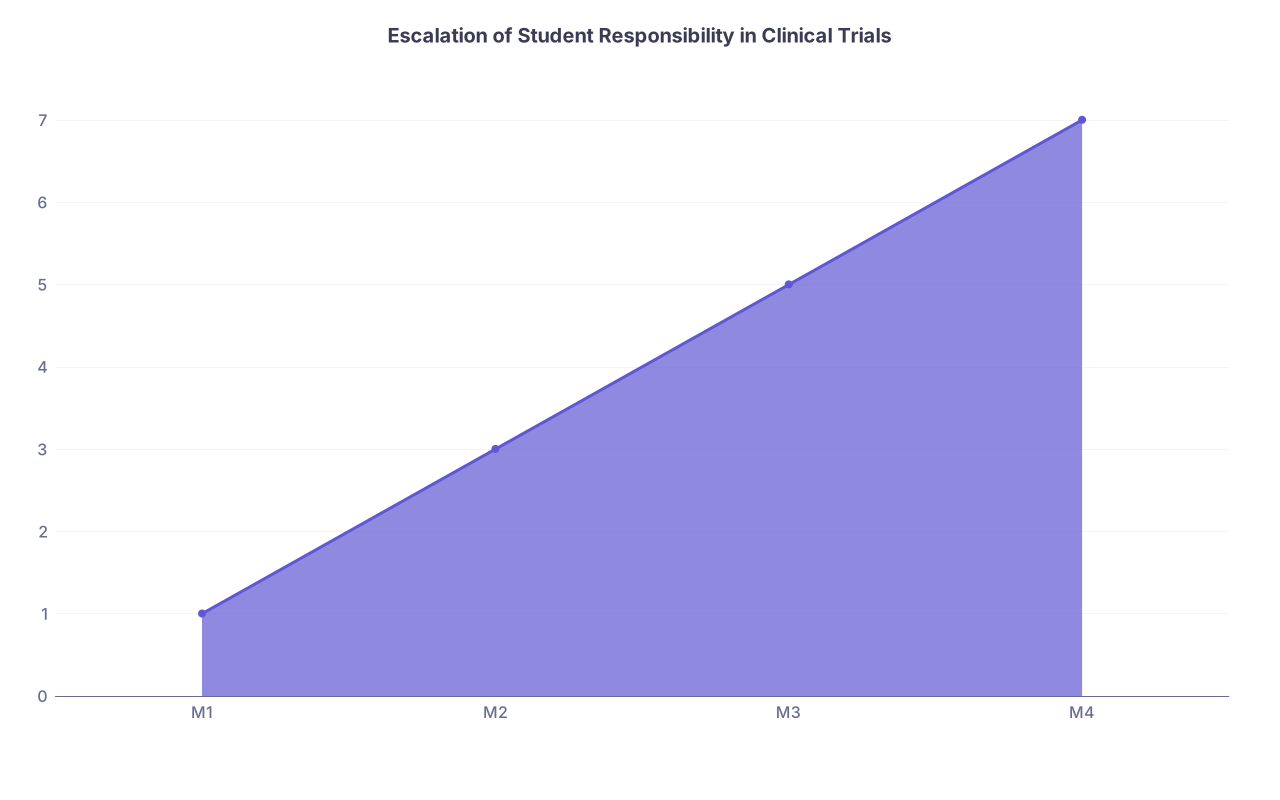
| Category | Value |
|---|---|
| M1 | 1 |
| M2 | 3 |
| M3 | 5 |
| M4 | 7 |
Final Takeaways
- Start light and early in M1–M2 with observation and tightly defined tasks; protect your exams and integrity first.
- Use M3 to align trial work with specialty choice, then leverage M4 for capstone outputs and interview stories.
- At every stage, if involvement in clinical trials starts to compromise your ethics, grades, or sanity, step back. The right timing is not “as much as possible,” it is “enough to learn deeply without losing the rest of your training.”