
It’s July 1st. You’ve just started residency, badge still stiff, passwords barely working, and someone on rounds casually mentions the hospital’s “innovation hub” and the AI sepsis alert team. You feel that little jolt: I want in on that—but right now you’re just trying not to get locked out of the EMR.
This is where most people stall. They tell themselves they’ll “get involved later” when things calm down. They never do. Three years go by, and the innovation teams are full of the same five people who started early and stuck around.
You’re not doing that.
Here’s your residency roadmap—year by year, then quarter by quarter—so by graduation you’re not just “interested in innovation.” You’re the resident people call when they need a clinician who understands product, ethics, and real-world care.
Big-Picture Timeline: R1 to Graduation
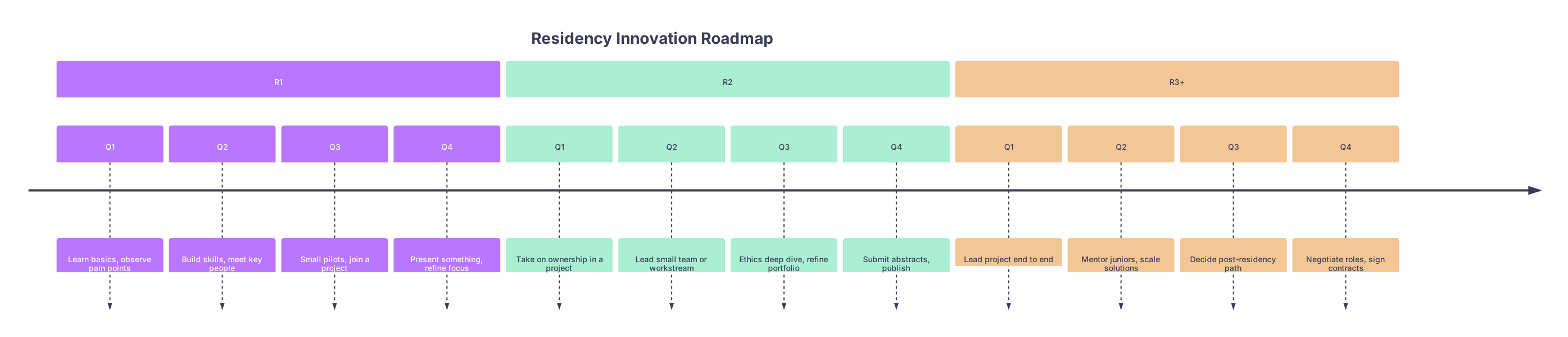
| Period | Event |
|---|---|
| R1 - Q1 | Learn basics, observe pain points |
| R1 - Q2 | Build skills, meet key people |
| R1 - Q3 | Small pilots, join a project |
| R1 - Q4 | Present something, refine focus |
| R2 - Q1 | Take on ownership in a project |
| R2 - Q2 | Lead small team or workstream |
| R2 - Q3 | Ethics deep dive, refine portfolio |
| R2 - Q4 | Submit abstracts, publish |
| R3+ - Q1 | Lead project end to end |
| R3+ - Q2 | Mentor juniors, scale solutions |
| R3+ - Q3 | Decide post-residency path |
| R3+ - Q4 | Negotiate roles, sign contracts |
At each stage, you’ll work on three parallel tracks:
- Clinical credibility (you do not get taken seriously without this).
- Innovation skills (design, data, product, quality improvement).
- Ethics and professionalism (so you’re not “the tech bro with an MD”).
Let’s walk it chronologically.
PGY-1: Survive, Observe, Build a Foundation
PGY-1, Quarter 1 (Months 1–3): Just Look. Hard.
At this point you should mostly watch and write things down. Your job is not to “fix the EMR” in July. Your job is to become the most observant person on the floor.
This quarter, your focus:
- Become clinically safe and reliable.
- Start noticing systems problems worth solving.
- Quietly identify who actually runs innovation where you are.
Monthly breakdown
Month 1
- Keep a “friction log” on your phone (HIPAA-safe, no PHI):
- Every time something wastes >10 minutes or clearly harms care, add a 1–2 line note.
- Tag it: [workflow], [communication], [EHR], [patient experience], [equity].
- Ask each senior or attending one pointed question:
- “If you could fix one system issue here, what would it be?”
- Find the innovation-ish entities:
- Clinical informatics team.
- Quality improvement office.
- Any “innovation hub,” “digital health office,” or “AI task force.”
Month 2
- Pick one friction theme to watch deliberately. Example:
- Delays in discharges.
- Lost consults.
- Unsafe handoffs.
- Join at least one recurring meeting as an observer:
- QI committee, sepsis committee, EHR optimization workgroup.
- Sit in the back, listen, take notes on language and priorities.
Month 3
- Schedule 2–3 short coffees (15–20 min) with:
- A clinical informatics lead.
- A QI nurse or project manager.
- A faculty member who publishes on health systems or digital tools.
- Ask bluntly:
- “How do residents typically get involved in innovation projects here?”
- “What projects are active right now that actually go somewhere?”
Do not propose your big app idea yet. You do not know the system well enough, and it shows when interns do this.
PGY-1, Quarter 2 (Months 4–6): Learn the Tools, Not Just the Ideas
Now that you can mostly keep patients alive and your pager stops inducing panic, at this point you should invest in skill acquisition. Not theory. Skills.

Pick one or two tracks from this table and commit:
| Track | Goal by End of PGY-1 |
|---|---|
| Quality Improvement | Design and run a basic PDSA cycle |
| Clinical Informatics | Understand EHR build/change workflow |
| Data & Analytics | Clean and plot simple datasets |
| Design & UX | Build low-fidelity workflows/mockups |
| Ethics & Policy | Articulate risks of bias and harm |
Month 4
- Complete one short, focused course (online is fine):
- QI: IHI Open School modules.
- Data: Intro to R or Python basics, or Excel for analytics.
- Ethics: A solid course on AI in healthcare ethics and bias.
- Start a tiny “practice project”:
- Example: Pull 10–20 de-identified discharge summaries and manually track:
- Time from “ready for discharge” note to actual discharge.
- Common delays.
- This is not research. It’s you learning to quantify pain.
- Example: Pull 10–20 de-identified discharge summaries and manually track:
Month 5
- Attend one hospital or department QI / innovation pitch / M&M where systems changes are discussed.
- Afterward, email one presenter:
- “I’m a PGY-1 with a strong interest in innovation and QI. Could I shadow or help on a small part of your project to learn the process?”
- Keep your friction log updated and now start grouping items into potential project “buckets.”
Month 6
- Choose one ethics topic to read deeply on:
- Algorithmic bias in clinical AI.
- Patient consent and data reuse.
- Conflicts of interest with industry partnerships.
- Write a 1-page reflection for yourself:
- “Where could innovation at our institution most easily cross ethical lines?”
You’ll use this later. Program directors like residents who can say “this is cool, but where are the guardrails?”
PGY-1, Quarter 3 (Months 7–9): Join a Real Project (Even a Tiny Slice)
At this point you should attach yourself to an existing project like Velcro. Not leading. Not “co-founder.” Learning.
Month 7
- From your coffees and meetings, pick one active project to pursue:
- Maybe it’s a new discharge summary template.
- Or a pilot of a predictive readmission model.
- Or a digital check-in tool in clinic.
- Email the project lead (short and direct):
- Who you are.
- One sentence on your interest.
- One specific way you can help that doesn’t require trust yet:
- “Happy to do grunt work: chart reviews, assembling run charts, testing workflows in the EHR sandbox.”
Month 8
- Show up consistently:
- Join meetings.
- Deliver what you promise on time.
- Ask them to walk you through:
- Their aims statement.
- Their metrics for success.
- Where ethics or equity issues have come up.
Month 9
- Identify one small branch you could own:
- Designing a resident-facing quick reference.
- Running a 2-week PDSA of a modified template on one team.
- Creating a one-page ethics impact checklist for the project.
- Propose it, with clear scope:
- “I’d like to test X on our team for 2 weeks and track A and B outcomes. Minimal build, no new IT requests.”
PGY-1, Quarter 4 (Months 10–12): Have Something to Show
By the end of intern year, you should have:
- One small completed cycle or pilot.
- One very rough “innovation CV line.”
- A clearer sense of which types of teams you like (data-heavy, UX, workflow, policy).
Month 10
- Finish your small project cycle:
- Pre & post metric.
- Simple run chart or bar graph.
- Brief reflection: what worked, what failed.
Month 11
- Present once:
- At morning report, resident conference, or QI meeting.
- 10 minutes is enough.
- Emphasize process and ethics considerations, not just outcome.
- Ask for feedback from someone blunt, not just nice.
Month 12
- Update your CV:
- “Resident lead, pilot evaluation of revised discharge workflow with equity lens.”
- Block 1–2 hours to map PGY-2:
- Decide: Am I more drawn to:
- Systems and workflow?
- Data and models?
- Digital tools and UX?
- Ethics and policy?
- Decide: Am I more drawn to:
You’re now allowed to start calling yourself “involved in innovation” without it being complete fluff.
PGY-2: Step Into Ownership and Ethics Leadership
Now you’re no longer the intern fetching coffee (metaphorically). At this point you should take responsibility for outcomes, not just tasks.
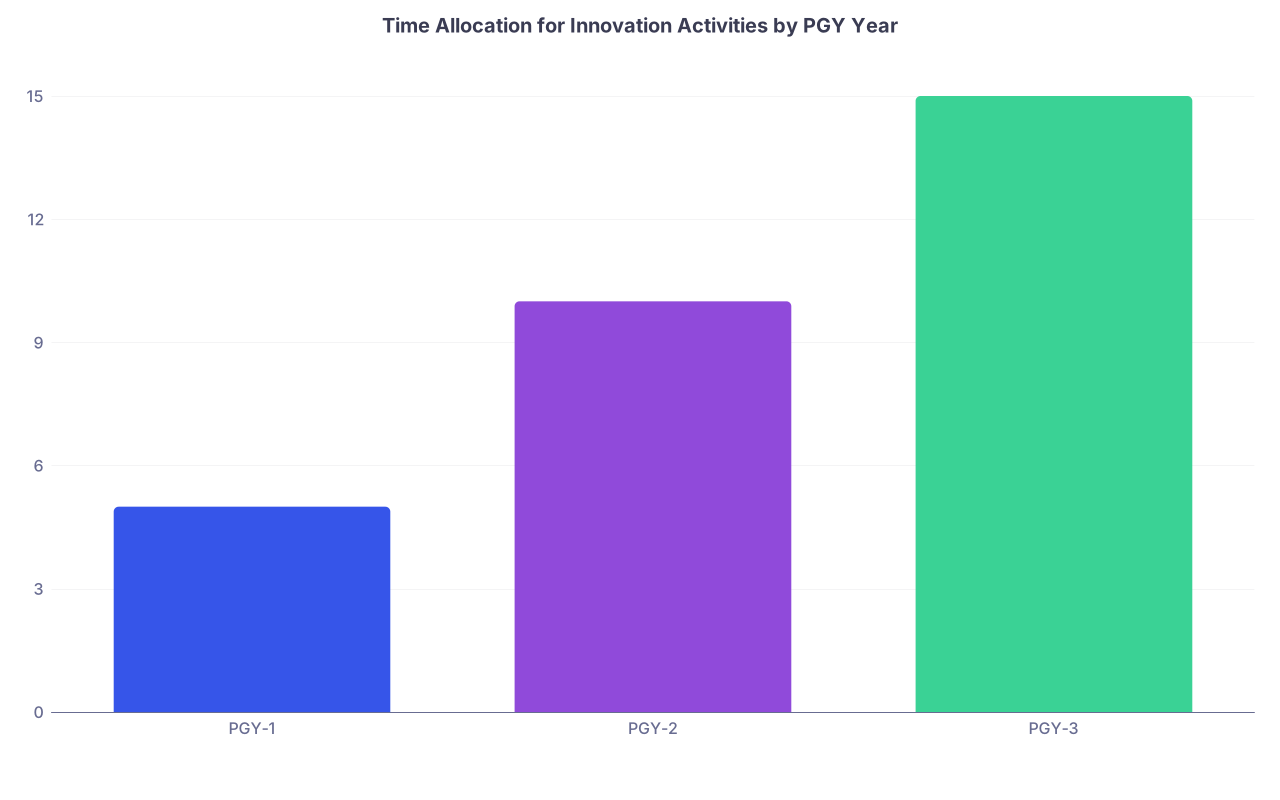
| Category | Value |
|---|---|
| PGY-1 | 5 |
| PGY-2 | 10 |
| PGY-3 | 15 |
(Those numbers are percent of your total work time, roughly. Yes, even 5–15% consistently is enough if it’s focused.)
PGY-2, Quarter 1 (Months 13–15): Own a Workstream
Month 13
- Negotiate with your program leadership:
- A small but formalized “innovation/QI focus.”
- Maybe that’s counting your project time as your QI requirement.
- Clarify expectations:
- Number of meetings/month.
- Time protected from random extra clinic add-ons (or at least some respect for your project time).
Month 14–15
- With your chosen project lead:
- Define a clear sub-aim you own. Examples:
- “Reduce missed post-discharge calls from 40% to 20% on one ward in 3 months.”
- “Evaluate for demographic performance differences in the new risk score.”
- Draft (or co-draft) an ethics and equity section of the project plan:
- Who could be harmed by this?
- Are some groups more likely to be misclassified?
- What’s the rollback plan if things look bad?
- Define a clear sub-aim you own. Examples:
PGY-2, Quarter 2 (Months 16–18): Lead People, Not Just Charts
At this point you should experiment with leadership. Tiny teams count.

Month 16
- Run one recurring mini-huddle:
- Weekly or biweekly, 15 minutes.
- Agenda:
- 3 minutes: metric updates.
- 7 minutes: what’s not working.
- 5 minutes: next small test.
- Practice concise communication. No rambling, no academic monologues.
Month 17
- Pull in a PGY-1 or medical student:
- Give them a well-bounded, low-risk task:
- “Collect feedback from 5 nurses using this new order set.”
- “Draft a 1-page summary of external literature on similar tools.”
- You’re practicing being a multiplier, not a hero.
- Give them a well-bounded, low-risk task:
Month 18
- Start thinking about dissemination:
- Which meeting or journal is realistic?
- What data do you need to collect now so your paper/poster won’t be trash later?
PGY-2, Quarter 3 (Months 19–21): Double Down on Ethics & Impact
Most innovation teams underweight ethics. This is where you differentiate yourself.
Month 19
- Pick a real project decision and push the ethics discussion:
- “How are we monitoring for bias by race/sex/language?”
- “What’s the process if staff feel this tool is harming care?”
- “Is patient consent needed here, or at least strong transparency?”
- Volunteer to build:
- A simple impact and risk checklist used before changing workflows.
- A communication script to explain the change to patients or staff.
Month 20
- Do a focused lit review on your project’s domain:
- 10–15 key papers.
- Summarize 3–4 major ethical pitfalls that keep coming up.
- Share a 1-page summary with your team:
- Concise.
- Practical implications, not fluff.
Month 21
- Draft your first abstract or short manuscript:
- Do not chase NEJM. Aim for:
- Society conferences (SGIM, SHM, AMIA, etc.).
- Specialty QI or digital health meetings.
- Co-authors: get them aligned early.
- Do not chase NEJM. Aim for:
PGY-2, Quarter 4 (Months 22–24): Build a Recognizable Identity
By now, people should start saying, “Talk to them, they’re our innovation person.”
| Domain | Concrete Milestone |
|---|---|
| Clinical | Trusted senior on core rotations |
| Project | Owns a defined sub-aim with metrics |
| Ethics | Leads at least one ethical review step |
| Output | Submitted 1–2 abstracts/manuscripts |
Months 22–23
- Present externally at least once:
- Even a small regional or virtual meeting counts.
- Refine your story:
- 2–3 sentences on:
- What problems you work on.
- How you think about ethics and equity.
- What type of teams you want to join post-residency.
- 2–3 sentences on:
Month 24
- Have explicit career conversations:
- With your PD, mentors, and innovation leads:
- “In 2–3 years, I see myself on X type of innovation team with Y focus.”
- “What roles exist here or elsewhere that match that?”
- With your PD, mentors, and innovation leads:
- Identify 3–5 potential next-step roles:
- Clinical informatics fellowship.
- QI fellowship.
- Industry clinical scientist role.
- Hybrid academic-innovation position.
PGY-3 (and PGY-4 if applicable): Lead and Position Yourself for Post-Residency
At this point you should stop thinking like “a resident helping a project” and start acting like “a physician who owns outcomes.”
PGY-3, Quarter 1 (Months 25–27): Run One Project End-to-End
Month 25
- Choose your “flagship” project:
- The one that will define your narrative.
- Needs:
- Clear problem.
- Real stakeholders.
- Measurable outcome.
Month 26–27
- Map out:
- Stakeholders (clinicians, nurses, IT, patients, compliance).
- Timeline (from idea to sustained implementation).
- Ethics checkpoints (data review for bias, patient communication, rollback plans).
Use something like this to keep yourself honest:
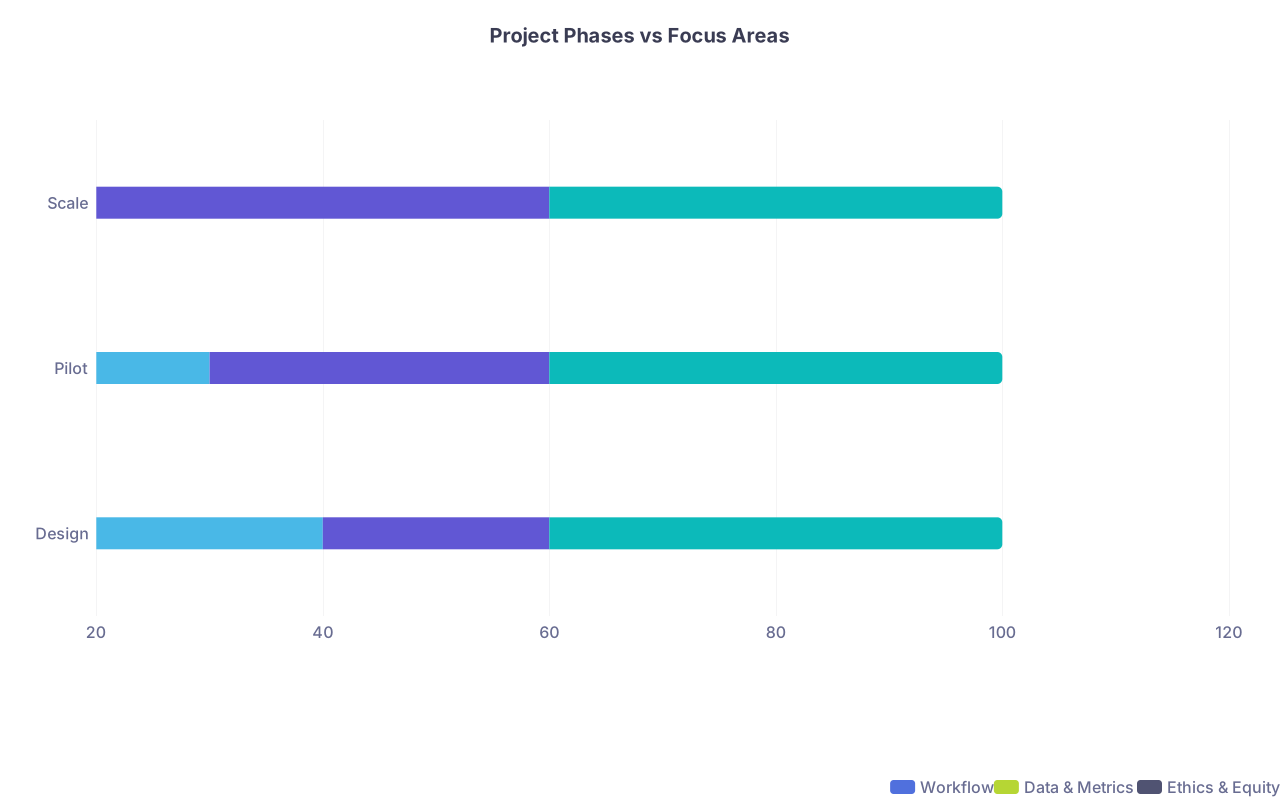
| Category | Workflow | Data & Metrics | Ethics & Equity |
|---|---|---|---|
| Design | 40 | 20 | 40 |
| Pilot | 30 | 30 | 40 |
| Scale | 20 | 40 | 40 |
Translation: ethics isn’t a one-time checkbox in the design phase. It’s present throughout.
PGY-3, Quarter 2 (Months 28–30): Mentor and Multiply

Month 28
- Recruit and mentor at least one junior resident and one student into your flagship project.
- Give them clear roles and credit:
- Data collection.
- User feedback interviews.
- Drafting an ethics checklist or patient-facing FAQ.
Month 29–30
- Create a simple playbook for your project:
- 4–5 pages max:
- Problem.
- Intervention.
- Metrics.
- Ethics and equity lessons.
- Implementation guide.
- Goal: others can replicate or scale without you.
- 4–5 pages max:
PGY-3, Quarter 3 (Months 31–33): Lock in Your Next Step
At this point you should be talking to teams you might join after residency. Not “spray and pray” applying. Targeted conversations.
Month 31
- Make a shortlist:
- 3–5 institutions or companies whose innovation work you respect.
- For each, identify:
- Who runs their innovation lab / digital health group / informatics division.
- Recent projects they’ve shipped, especially those with strong ethical framing.
Month 32
- Start reaching out with substance, not fluff:
- Attach a 1–2 page portfolio summary:
- Flagship project overview and outcomes.
- Your role.
- Key ethics/impact decisions.
- Email:
- “Here’s the kind of work I do and how I think about ethics and impact. Where could someone like me fit into your team?”
- Attach a 1–2 page portfolio summary:
Month 33
- Begin formal applications (fellowships) or late-stage networking (industry/academic roles).
- In every interview:
- Ask how they:
- Evaluate potential harms of new tools.
- Monitor performance post-implementation.
- Adjust when inequities are detected.
- Ask how they:
If they hand-wave these answers, that’s a red flag. Innovation without ethics is just risk with good branding.
PGY-3, Quarter 4 (Months 34–36): Transition Cleanly and Leave a Legacy
You’re almost out. At this point you should ensure the work outlives you and that you walk into your next role with a coherent story.
Month 34
- Hand off your projects:
- Identify clear successors.
- Walk them through roadmaps, data, politics, and landmines.
- Formalize learnings:
- One internal talk on “What we learned from [project] about innovation and ethics.”
Month 35
- Tighten your written materials:
- CV with an “Innovation and Ethics” subsection.
- 1-page statement:
- Your philosophy on responsible innovation.
- Concrete examples from residency.
Month 36
- Confirm your next role and negotiate:
- Protected time for innovation.
- Clarity on your role in ethics review or evaluation.
- Close the loop:
- Thank mentors and collaborators.
- Offer ongoing support as you transition (within reason).
Mini-Checklist: If You’re Reading This Mid-Residency
You’re not starting at PGY-1? Fine. Here’s where you should be right now:
| Current Year | At This Point You Should Have… |
|---|---|
| PGY-1 | Friction log, 1 tiny project, 1 mentor |
| PGY-2 | Ownership of sub-aim, abstract, ethics role |
| PGY-3+ | Flagship project, mentees, defined next step |
If you’re behind:
- Cut something non-essential.
- Attach yourself to an active project instead of starting from scratch.
- Push yourself into the ethics conversations. They’re always understaffed.
FAQ (Exactly 2 Questions)
1. I’m drowning clinically. When is it actually too early to get involved in innovation during residency?
First 1–2 months of intern year, your bandwidth is close to zero. Use that time only to observe and keep a friction log. Once you’re no longer terrified of cross-cover (usually around month 3–4), you can afford 1–2 hours per week for a small, well-scoped role on an existing project. If you still feel like you’re drowning at month 6, your priority isn’t innovation; it’s fixing your clinical efficiency and support. No one wants an “innovation-focused” resident who can’t manage a basic ward list.
2. What if my program has no formal innovation or digital health structure?
Then you lean on three things: QI, informatics-adjacent people, and external networks. Attach yourself to QI or patient safety projects—they’re the closest cousin to innovation teams and use similar skills (workflow design, metrics, change management). Find whoever manages the EHR or reporting (often analysts or informatics-minded faculty) and offer to help with small improvements. And join external communities—AMIA, specialty innovation sections, Slack groups, online journal clubs—so your “team” isn’t limited to your hospital walls. You don’t need branded “innovation hubs” to do real systems-changing work.
Open the notes app on your phone right now and start a friction log. Write down the last three things that wasted your time or hurt care this week. That list is the raw material your future innovation team will expect you to bring.