

The way most people handle “gift authorship” in medicine is cowardly—and it will come back to bite them.
You just got an email: “Congratulations, you’re a co-author on our manuscript submitted to [insert respectable journal here].” Problem: you barely did anything on that project. Maybe you went to one meeting. Maybe you entered ten patients into a spreadsheet. Maybe you literally forgot this study existed.
Now your name is on it.
Here is your ethics check—and exactly what to do next.
1. Get Clear on What Actually Happened
Do not start with guilt. Start with facts.
Pull up the email, study documents, and your memory. Write down, in one place, what you actually contributed. Be brutally specific:
- “Attended 2 Zoom meetings”
- “Collected data on 8 patients (of 200)”
- “Reviewed one draft of the survey questions and suggested 2 changes”
- “Did nothing after that”
No rounding up. No mental inflation.
Now compare that to what the corresponding author is saying in the email. Typical lines you’ll see:
- “We’ve added you as co-author for your help on data collection.”
- “We wanted to recognize your contributions.”
- “We decided to include the whole team.”
Sometimes they’re sincere. Sometimes they’re covering themselves. Either way, you need to know: are you truly an author under accepted ethical standards?
| Category | Value |
|---|---|
| Substantial work | 1 |
| Draft/revise | 1 |
| Approve final | 1 |
| Accountable | 1 |
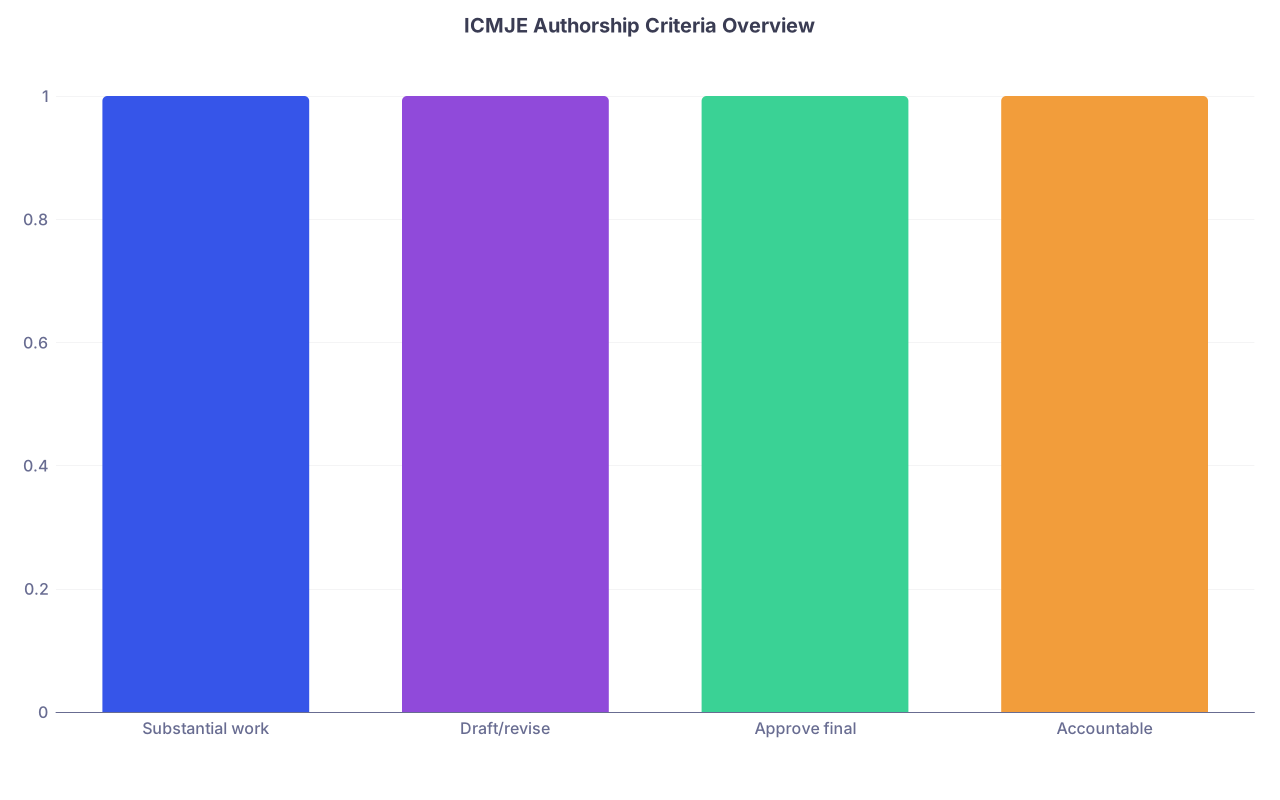
The dominant standard in medical research is the ICMJE (International Committee of Medical Journal Editors). For authorship, you’re supposed to meet all four:
- Substantial contributions to conception/design OR data acquisition OR analysis/interpretation
- Drafting the article or critically revising it for important intellectual content
- Final approval of the version to be published
- Agreement to be accountable for all aspects of the work
If you:
- Dropped a few numbers into a spreadsheet once, and
- Never saw a draft, and
- Had no role in analysis or interpretation
…then you’re very likely not an author under that standard. You’re an acknowledged contributor. At best.
So first conclusion: honestly assess—would a decent journal editor, if they saw a detailed breakdown, say “Yes, that’s authorship”? If your stomach answers “No” immediately, listen to that.
2. Understand Why This Is Actually a Big Deal
A lot of people will shrug and say, “Everyone does it. Take the line and move on.”
These people are part of the problem.
Here’s what you’re actually dealing with when your name is on a study you barely worked on:
You’re claiming intellectual ownership you didn’t earn.
Your CV will later imply you understand the methods, results, and implications. Program directors will assume you can talk about it in detail. You might not be able to.You’re accepting responsibility and accountability.
If the paper is later flagged for misconduct, fabricated data, or flawed analysis, your name is tied to it. You’re not a “minor” author in the eyes of the public.You’re setting your “normal.”
The first time feels weird. The third time feels routine. Ten years later you’re supervising students and normalizing the same garbage.You’re slowly training yourself to blur lines.
Blurry ethics in research bleed into documentation, billing, and patient care. I’ve seen it. The resident who shrugs at gift authorship often also shrugs at “copy-forward exam, it’s basically the same.”
So yes, this matters. Not in a vague “integrity” way, but in a very concrete “this might be on your fellowship PD’s desk while you’re sitting across from them” way.
3. Immediate Response: Before You Reply to That Email
You’re tempted to say nothing, list it on your CV, and enjoy the bump. Pause.
Before replying, do three things:
Skim the actual manuscript.
Get the draft or submitted version. If they haven’t sent it, ask:
“Could you share the latest version of the manuscript so I can review it?”
Read enough to know:- Do you understand the basic question?
- Do you agree with how your “role” is described in the acknowledgments/authorship contributions section (if they have one)?
- Is there anything that looks off, rushed, or sloppy?
Identify your real comfort level. Ask yourself:
- Could I defend being on this paper if an ethics committee asked?
- Could I discuss this study in an interview in a way that sounds honest?
- Do I feel like I’m lying if I call myself a co-author?
If your chest tightens reading those, you already know.
Check the authorship guidelines.
Many journals now require a contributor statement and follow ICMJE. A 30-second search:- Look up the journal’s “Instructions for Authors” page.
- Search for “authorship” or “ICMJE”.
- See if they require you to affirm your role.
If the journal explicitly follows ICMJE, and you know you did not meet criteria, you’re now staring at a simple problem: either you participate in bending the rules, or you speak up.
4. How to Respond If You Barely Did Anything
Here’s the part you’re probably afraid of: pushing back.
You do not need a dramatic moral speech. You need a short, calm, specific email. Something like:
“Thanks for sharing this and for including me. I went back and reviewed my involvement on this project and it looks like my contribution was limited to [e.g., collecting a small subset of data/attending early planning meetings]. Given the ICMJE authorship criteria and the fact that I haven’t been involved in drafting or revising the manuscript, I’m concerned that my current contribution may not rise to the level of authorship.
I want to be consistent with authorship guidelines, especially this early in my career. Would it be more appropriate to include me in the acknowledgments instead, or is there a way I can meaningfully contribute to the revision process so that my role aligns with the criteria?”
This does three useful things at once:
- Signals you actually know the rules.
- Shows you’re not attacking them—you’re offering two solutions.
- Gives them an out: either downgrade you to acknowledgment, or let you step up and actually meet criteria.
Most senior people, when approached like this, will be at least somewhat reasonable. Some will be annoyed. The ones who are furious are telling you who they are. Believe them.
5. The “Fix It” Option: Earn Your Authorship
If you want to keep the authorship—and there’s enough time—you can ask to actually do the work that qualifies you.
Here’s what you can offer that legitimately moves you toward ICMJE compliance:
Take responsibility for writing or revising a specific section:
Methods, Limitations, Discussion (future directions). Not “fixing commas.”Critically revise the manuscript:
That means not just editing grammar. It means challenging reasoning, tightening claims, improving interpretation, and backing arguments with proper citations.Help with data interpretation or additional analysis:
If you understand the statistics or clinical context, offer to review tables, clarify subgroup analyses, or interpret borderline findings.
But here’s the catch: this has to be real, not theater. Skimming the paper and suggesting “maybe add a sentence on limitations” doesn’t magically make you an author. You should be putting in solid, traceable work that any honest person could see and say “yes, they contributed intellectually.”

| Step | Description |
|---|---|
| Step 1 | Offered authorship |
| Step 2 | Accept and review manuscript |
| Step 3 | Ask to add real work |
| Step 4 | Request acknowledgment only |
| Step 5 | Approve final version |
| Step 6 | Do substantive revisions |
| Step 7 | Maintain clean CV |
| Step 8 | Did I meet ICMJE? |
| Step 9 | Time to contribute more? |
If they say, “No, it’s already submitted, can’t change anything” and you still haven’t met criteria? Then you should ask to be removed.
Yes, completely. Off the paper.
6. What If It’s Already Accepted or Published?
Now we’re in damage control.
You might discover you’ve been “gifted” onto a paper that’s already accepted, in proofs, or even fully published. It happens more than people admit. You didn’t see the final draft, you didn’t approve anything, and now you’re PubMed-able.
You still have options:
Document your concern in writing (email).
Example:“I just realized the paper has been accepted/published, and I never had the chance to review or approve the final version. Given my limited contribution (X), I’m worried my authorship might not align with ICMJE criteria. How do you think we should address this?”
This is partly self-protection. If something blows up later, there’s a paper trail that you raised concern.
If it’s in proofs stage, ask to be removed now.
Journals can still change author lists at this point. It’s awkward, but completely doable.If it’s fully published, consider a correction.
Most people won’t go this far because it’s socially painful. But if the paper is dodgy, or your involvement is almost zero and you’re uncomfortable, you can propose a “corrigendum” changing your status to acknowledgment. This will make you stand out—to the right people.
Realistically? Most trainees stop at the email, swallow the discomfort, and leave it. I won’t lie and say you’re obligated to publicly self-sabotage. But I will say: having some record that you were not happily complicit is smart.
7. Handling Power Dynamics: When the PI Is Intimidating
Here’s the real reason you’re hesitating: you’re an MS3, an intern, a PGY2, and the PI is a big name who writes your letters.
You’re thinking: “Do I really want to ‘educate’ Dr. Famous on authorship ethics?”
No, you don’t. That’s not your angle.
Your angle is protecting your future, not lecturing theirs.
Frame it like this:
- You blame guidelines, not them.
- You position it as your discomfort, not their wrongdoing.
- You show deference but stay firm.
For example:
“I genuinely appreciate you including me. I’m trying to be conservative with authorship early in my career because I know fellowship programs will ask about everything on my CV. Given that I only [describe minor contribution], I’m worried I may not be able to speak to this project at the level expected. Would it be possible to list me in the acknowledgments this time? I really value the opportunity and would love to be involved more deeply on a future project.”
You’re not accusing. You’re signaling standards. And you’re implicitly saying: “I actually care about doing this right.” Good mentors respect that. Bad ones show their colors.
If they push back hard—“Everyone does this, stop overthinking it”—remember: their normalization does not erase your risk.
8. What To Do With This on Your CV
Suppose you decide to stay on the paper after actually doing more work. Or you accept that, though borderline, your contribution plus final revision is enough, and you can live with it.
Fine. Then your next job is to make sure you can back it up.
Two rules:
Never list a paper you can’t talk about in detail.
Interviewers will sometimes open PubMed in front of you and ask, “So tell me about this one.” If all you can say is “I helped with data collection,” they’ll notice.Be honest about your actual role if asked.
If someone asks, “What was your contribution?” resist the instinct to puff it up. Say:- “I joined midstream; I helped with data collection and contributed to revising the Discussion section, especially around X and Y.”
- “I didn’t design the study but was involved with [specific parts] and helped with the final revisions before submission.”
They’re not expecting you to be the PI on every paper. They are expecting you to be straightforward.
If, deep down, you know your role was too thin to comfortably describe, you have your answer: it shouldn’t be on your CV at all.
| Situation | Best Move |
|---|---|
| Paper not submitted yet | Ask to add real work or be removed |
| Submitted, under review | Offer substantive revision or downgrade to acknowledgment |
| In proofs | Request removal from author list |
| Already published, minor concern | Document concern by email, consider leaving as is but be ready to explain |
| Already published, major concern | Ask PI about issuing a correction changing you to acknowledgment |
9. Preventing This From Happening Again
You can reduce how often you end up in this mess.
At the start of any project, do what almost nobody does: ask about authorship criteria and expectations.
Something like:
“For my own clarity, what would I need to do on this project to end up as an author versus just in the acknowledgments?”
You’ll get one of three responses:
- A clear, thoughtful answer referencing specific tasks and ICMJE-like standards. Green flag.
- A vague, hand-wavy “We’ll see at the end, but we’re generous.” Yellow flag.
- A dismissive “Don’t worry about it, everyone gets on the paper.” Red flag.
When you get a red flag, don’t kid yourself—you’re walking into a lab or team where authorship is treated like confetti. Either accept that risk knowingly, or find another project.
Also, track your contributions. Literally. A simple document in your notes:
- Dates worked
- Tasks done
- Files or sections you wrote
- Meetings you contributed to
That log is your memory when the paper resurfaces 18 months later and someone says, “We’re adding you as 7th author, congrats!”
10. The Long Game: Who You’re Becoming
This whole scenario isn’t just about this one paper. It’s about your professional identity.
You’re deciding:
- Whether you’re the kind of physician who quietly benefits from corners being cut.
- Whether your trainees will one day have to choose between pleasing you and being honest.
- Whether your CV is a story you can stand behind—or a list of half-truths you hope nobody probes.
I’ve sat in rooms where selection committees skim CVs and say things like, “They’ve got 12 papers as a med student? Sure. Let’s see if any of this is real.” Then they grill the person on one random paper. When the story falls apart, it’s game over. Not because they lacked publications—because they lacked integrity and self-awareness.
You don’t need an artificially inflated PubMed to match or get a good fellowship. You need a believable trajectory and a reputation for doing things the right way.
Open your email right now and reread the message that added you to that study. Then write one reply sentence that moves you toward either (a) doing real work to earn the authorship or (b) stepping back to an acknowledgment so your CV stays clean. Do not sit in the gray zone.


