
The biggest barrier between you and a med school educator job is not your CV. It is that you’re still thinking like a community program PD.
You already run a residency. You shepherd residents through ACGME requirements, handle difficult learners, negotiate with hospital leadership. And yet when you look at full‑time “Director of Undergraduate Medical Education” or “Assistant Dean for Clinical Education” postings, they feel like a different universe.
They’re not. But you do have to reframe who you are and how you talk about what you do.
This is for you if:
- You’re a program director (or APD) at a community hospital.
- You like teaching and curriculum work more than chasing RVUs.
- You’re eyeing a move into med school education—maybe at your affiliated school, maybe somewhere entirely new—and you have no idea how to make that jump without taking a massive pay cut or starting at the bottom.
Let’s walk through what actually works.
Step 1: Understand the Game You’re Trying to Enter
You already know GME. UME runs on similar logic with different jargon and different power centers.
Here’s the core shift:
In residency, your “unit” is the program.
In med school, your “unit” is the course, the clerkship, or the phase of the curriculum.
You need to start thinking and talking like someone who manages courses, competencies, and cohorts instead of “service and rotations.”
| Domain | GME (Residency PD) | UME (Med School Educator) |
|---|---|---|
| Primary Unit | Residency program | Course / Clerkship / Curriculum Phase |
| Main Framework | ACGME Milestones, NAS | LCME Standards, Entrustable Activities |
| Learner Focus | Specialty residents | Pre-clinical and clinical students |
| Outputs | Board-eligible grads, recruitment | Competent MD grads, Step, match data |
| Reporting To | DIO, GME office, Dept Chair | Dean’s office, Curriculum committees |
You do not need to be a basic scientist. You do not need a PhD.
But you do need to speak LCME and curriculum the way you currently speak ACGME and Milestones.
If you’re in this situation right now, here’s your first 30‑day task list:
- Download your affiliated med school’s curriculum map (or any mid‑tier school’s if you don’t have one).
- Find their LCME self‑study or accreditation summary if it’s public. Skim it.
- Learn these words and be able to use them in a sentence: “entrustable professional activities,” “programmatic assessment,” “spiral curriculum,” “competency‑based medical education,” “interprofessional education.”
No, you don’t need to become a jargon robot. But these phrases have to show up in your conversations and your CV or you’ll read like “good community PD who doesn’t quite get UME.”
Step 2: Translate Your PD Experience into Med School Language
Your experience is more transferable than you think. You just haven’t labeled it correctly.
Take a standard PD task and convert it.
Original:
“I redesigned our night float system and created new resident evaluations.”
Med school version:
“Led a structured redesign of the inpatient educational experience, aligning schedules, supervision, and assessment tools with competency‑based objectives and improving learner evaluations of teaching by 25%.”
Same work. Different framing.
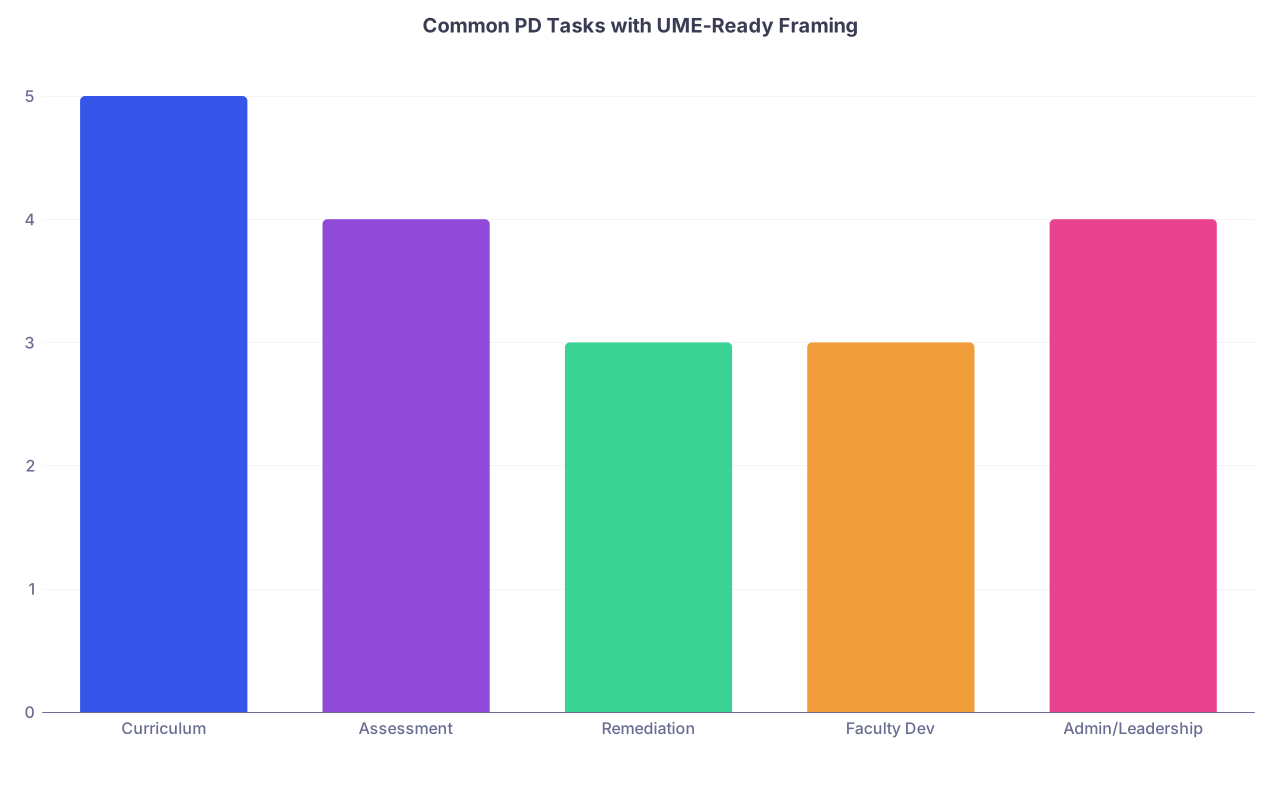
Here’s a quick translation guide you can apply to your own CV and cover letters.
| Category | Value |
|---|---|
| Curriculum | 5 |
| Assessment | 4 |
| Remediation | 3 |
| Faculty Dev | 3 |
| Admin/Leadership | 4 |
Think in these buckets:
Curriculum Design
- You’ve:
- Created new rotations, built schedules, integrated didactics, simulation, QI projects.
- Translate to:
- “Curriculum development”
- “Horizontal and vertical integration”
- “Mapping outcomes to competencies”
- Example line:
“Co‑designed and implemented a longitudinal QI curriculum across PGY levels, with resident‑led projects resulting in three institutional practice changes.”
- You’ve:
Assessment and Evaluation
- You’ve:
- Managed CCC, Milestones, clinical evaluations, rotation feedback, in‑training exam responses.
- Translate to:
- “Programmatic assessment”
- “Multi‑modal evaluation strategies”
- “Data‑driven learner feedback”
- Example:
“Implemented multi‑source assessment portfolio for residents, using performance data to guide individualized learning plans and promotion decisions.”
- You’ve:
Dealing with Struggling Learners
- You’ve:
- Set up remediation, handled professionalism issues, coordinated with GME and legal.
- Translate to:
- “Learner support and remediation”
- “Professionalism and fitness to practice”
- Example:
“Developed structured remediation plans with clear competencies and milestones, coordinating with institutional wellness and legal teams where indicated.”
- You’ve:
Faculty Development
- You’ve:
- Run teaching workshops, handled clinical preceptor feedback, onboarded new faculty.
- Translate to:
- “Faculty development in teaching and assessment”
- Example:
“Created a quarterly faculty development series on bedside teaching and feedback, with pre/post self‑ratings showing improved confidence across participants.”
- You’ve:
Leadership / Administration
- You’ve:
- Done budgets, recruitment, block schedules, hospital negotiations, ACGME site visits.
- Translate to:
- “Educational leadership”
- “Accreditation management”
- Example:
“Led successful 10‑year ACGME program review, including development of continuous quality improvement processes for educational outcomes.”
- You’ve:
Spend one evening with your current CV and literally rewrite every PD bullet to sound like you already work in UME. Because functionally, you do.
Step 3: Build Credibility in UME Before You Quit Your Job
Jumping cold from “community PD” to “Director of Clinical Skills Course” without visible UME work is tough. Not impossible, but you’re making it harder than it has to be.
The smarter play is to stack visible UME‑adjacent work while you’re still in your PD role.
Here’s what that looks like in real life.
If you’re at a community site with a med school affiliate
This is the most straightforward path. You should be doing some of these yesterday:
- Volunteer (aggressively) for UME roles at your site:
- Clerkship site director
- Longitudinal preceptor for 1st–2nd year students
- OSCE examiner
- Small‑group leader for pre‑clinical courses
- Ask to sit on:
- The school’s clinical education committee
- The clerkship directors’ meetings
- Any curriculum revision task force that involves your specialty
- Offer to:
- Host med student simulation sessions at your hospital
- Pilot new assessment tools with your students
- Run a faculty development session for community preceptors
You’re aiming for 2–3 concrete bullets that read like this on your CV:
- “Clinical site director for 3rd‑year internal medicine clerkship; responsible for local implementation of clerkship curriculum, student assessment, and faculty development.”
- “Member, Clinical Curriculum Committee, XYZ University School of Medicine, contributing to redesign of 3rd‑year clerkship structure and assessment.”
That’s enough to show you’re not just GME‑locked.
If you have no formal med school affiliation
More annoying, but still doable.
Your play here is regional and national involvement:
- Join your specialty’s education arm:
- SGIM, APDIM, APGO, STFM, etc.—they all have med student education committees.
- Present on educational topics at meetings:
- Curriculum redesign, assessment, remediation, interprofessional teaching.
- Submit education scholarship:
- Even small: MedEdPORTAL publications, teaching innovations, workshop proposals.
You want at least one line that sounds like:
- “Co‑developed and presented a national workshop on competency‑based assessment in clinical rotations for the Society of General Internal Medicine.”
Does everyone have this? No. But the ones who beat you out for the job will.
Step 4: Target the Right First Role (Don’t Aim at the Dean’s Office Yet)
This is where a lot of people get it wrong. You see “Associate Dean for Curriculum” and think, “That’s me.” It might be… later.
Your first serious step into med school education from a community PD chair is usually one of these:
| Role | Feasibility | Comment |
|---|---|---|
| Clerkship Director | High | Natural jump from PD |
| Assistant / Associate Clerkship Director | Very High | Great entry point |
| Director of Clinical Skills Course | Medium | Easier if you have pre‑clinical contact |
| Director of UME at a Regional Campus | Medium‑High | Ideal for community‑based PDs |
| Assistant Dean for Clinical Education | Medium | Requires prior UME leadership |
The clerkship route
This is the cleanest fit for most community PDs. You already:
- Manage clinical rotations
- Work with attendings and residents
- Know how to assess clinical performance
What you need to show you can do:
- Run student evaluations and grades fairly
- Align your clerkship to the overall curriculum
- Participate in LCME documentation and reviews
If you see postings for “Clerkship Director,” “Co‑Director,” or “Site Director,” strongly consider them as your ramp.
The regional campus / distributed sites route
Many med schools now have distributed or regional campuses in community hospitals. This is where a community PD can walk in with instant credibility.
The job titles here:
- Regional Campus Dean / Assistant Dean
- Director of Undergraduate Medical Education, [Hospital Name]
- Site Director for UME
Your pitch:
“I already run GME here. I can align UME and GME, manage faculty, ensure evaluation quality, and be your on‑the‑ground academic leader.”
You will need at least some prior explicit UME association (even informal) to be competitive, but not much.
Step 5: Fix Your CV, Cover Letter, and Interview Story
You’re not applying as “tired community PD who wants out.” You’re applying as “experienced educational leader with a strong GME foundation who’s ready to take on broader UME responsibilities.”
Those are not the same person.
Your CV
Two big moves:
- Create an “Educational Leadership” section high up:
- List PD, APD, clerkship work, course leadership, committees, major teaching awards.
- Create a “Medical Education Scholarship” section:
- MedEdPORTAL, conference workshops, curriculum projects, assessment tools.
If all your teaching stuff is buried under “Other Activities,” you look like a clinician who dabbles in teaching. Pull it forward.
Your cover letter
Stop writing, “I enjoy teaching residents and students.” Nobody cares.
You need three things:
- A clear identity sentence:
- “I am a community‑based program director who has spent the past 8 years leading internal medicine GME and building integrated UME experiences at a regional campus.”
- 2–3 specific examples of med school‑relevant work:
- “Over the past 3 years, I have served as site director for the 3rd‑year internal medicine clerkship, co‑chaired the clinical curriculum committee, and led a redesign of our assessment system to align with EPAs.”
- A forward‑looking statement that fits the job:
- “I’m particularly drawn to the opportunity to lead your clerkship through its next LCME cycle and to further integrate your clinical curriculum across sites.”
If your cover letter reads like you’re just trying to escape hospital admin hell, you’re dead in the water.
The interview
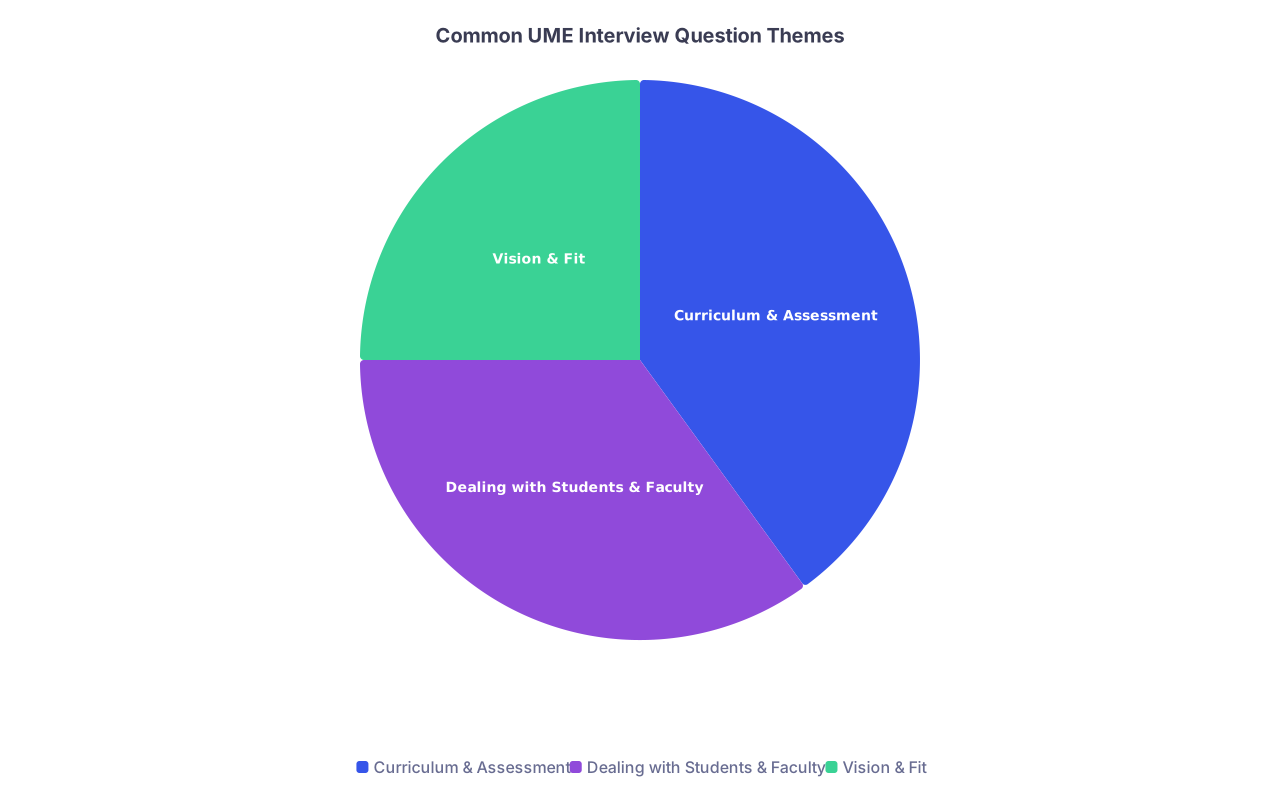
Expect questions in three predictable categories:
| Category | Value |
|---|---|
| Curriculum & Assessment | 40 |
| Dealing with Students & Faculty | 35 |
| Vision & Fit | 25 |
Curriculum and assessment:
- “Tell us about a curriculum you’ve developed.”
- “How do you approach grading and evaluation in clinical rotations?”
- “What’s your experience with LCME or accreditation processes?”
Dealing with people:
- “How do you handle a failing or unprofessional student?”
- “How do you manage inconsistent teaching quality across sites?”
- “Describe a conflict with a faculty member and how you resolved it.”
Vision and fit:
- “Where do you see UME heading in the next 5–10 years?”
- “How do you see the relationship between UME and GME?”
You should have at least:
- One polished curriculum story (what you built, how, what changed).
- One assessment story (how you improved or overhauled evaluation).
- One difficult learner story.
- One difficult faculty/administrator story.
And you should be able to talk fluently about:
- Competency‑based education
- EPAs
- Clinical skills assessment (OSCEs, direct observation)
- Integration of basic science and clinical medicine
If those phrases make you vaguely uncomfortable right now, spend two weekends reading a few MedEd articles and LCME documents. This isn’t rocket science; it’s vocabulary plus your existing experience.
Step 6: Deal with Money, Rank, and Politics Like a Grown‑Up
Here’s what no one says out loud: a lot of PDs hesitate because they’re afraid they’ll take a financial and status hit.
Let’s be honest about it.
Salary
In many systems:
- A full‑time clerkship director or assistant dean will make less clinical money but more academic money and have more predictable time.
- If you’re currently a PD with a big RVU load, you might break even or take a modest cut.
Do not guess. Ask.
Before you get too far:
- Ask trusted contacts about typical salary ranges for similar jobs at that school.
- Ask about protected time and actual clinical FTE.
- Ask how previous people in the role balanced education vs. clinical.
If they can’t give you straight answers or dance around protected time, that’s a warning.
Rank and promotion
If you’re moving to a med school‑owned faculty track, you may go in as:
- Clinical Associate Professor (if mid‑career with good CV)
- Assistant Professor (if earlier and little scholarship)
Don’t obsess over the title at the expense of the job content. But do:
- Ask how academic rank is decided.
- Ask what’s expected for promotion.
- Ask how education leadership is weighed vs. research.
If they still behave like “real faculty are the researchers, educators are service,” think hard about whether that’s a culture you want long‑term.
Politics
If the med school already uses your hospital for students, there are landmines:
- Existing clerkship leaders who feel threatened.
- Department chairs who don’t want to give up control or FTE.
- GME office who worries about you “abandoning” residency leadership.
Be explicit:
- Frame this as “building alignment between UME and GME,” not “escaping GME.”
- Talk to your DIO and department chair early, before rumors start.
- Have a transition plan for your PD role ready to discuss.
You want allies, not people quietly undercutting your candidacy with “We’re not sure how this will work logistically.”
Step 7: Play the Long Game (Even If This Move Takes 2–3 Years)
Some of you reading this are ready now. Your CV is stacked, you’re done with 2 a.m. angry phone calls about cross‑coverage, and you want out.
Others are 2–3 years away. That’s fine.
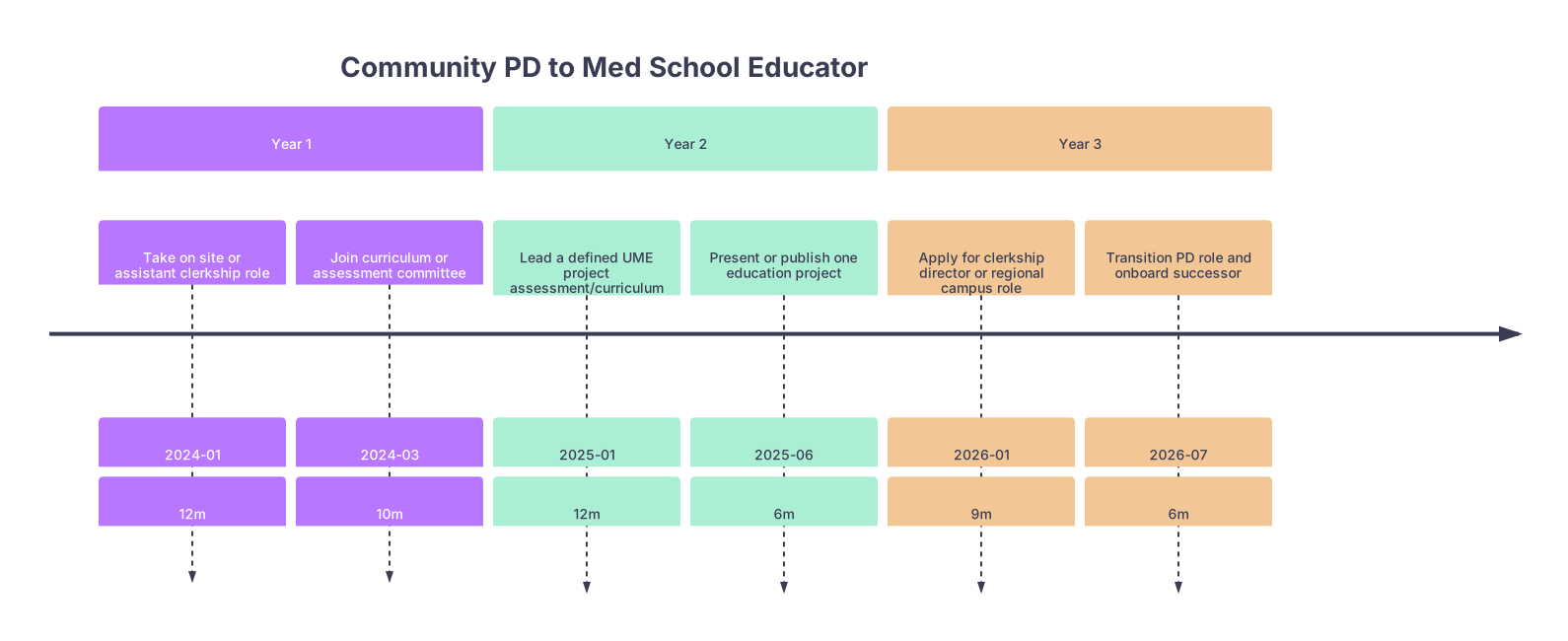
Here’s a simple, honest timeline:
| Period | Event |
|---|---|
| Year 1 - Take on site or assistant clerkship role | 2024-01 |
| Year 1 - Join curriculum or assessment committee | 2024-03 |
| Year 2 - Lead a defined UME project assessment/curriculum | 2025-01 |
| Year 2 - Present or publish one education project | 2025-06 |
| Year 3 - Apply for clerkship director or regional campus role | 2026-01 |
| Year 3 - Transition PD role and onboard successor | 2026-07 |
Year 1:
- Grab a concrete UME role (site director, assistant clerkship director).
- Get yourself onto at least one med school committee.
Year 2:
- Lead one clearly defined UME project:
- Clerkship evaluation overhaul
- OSCE station development
- New clinical skills small‑group series
- Turn that project into:
- A MedEdPORTAL submission, or
- A national workshop/poster.
Year 3:
- Start applying for proper UME leadership jobs.
- Hand off your PD role deliberately, instead of burning out and bolting.
You’re not starting over. You’re repositioning.